



 5 minutes to read
 Ecosystem
What is Chainlink (LINK)?
Chainlink is the industry-standard decentralized oracle network that enables smart contracts on blockchains to securely access real-world data, events, and computations from external systems.
Quick Summary
- Chainlink provides decentralized oracles that feed accurate off-chain data into blockchain smart contracts.
- The native LINK token powers the network by paying node operators and securing data delivery.
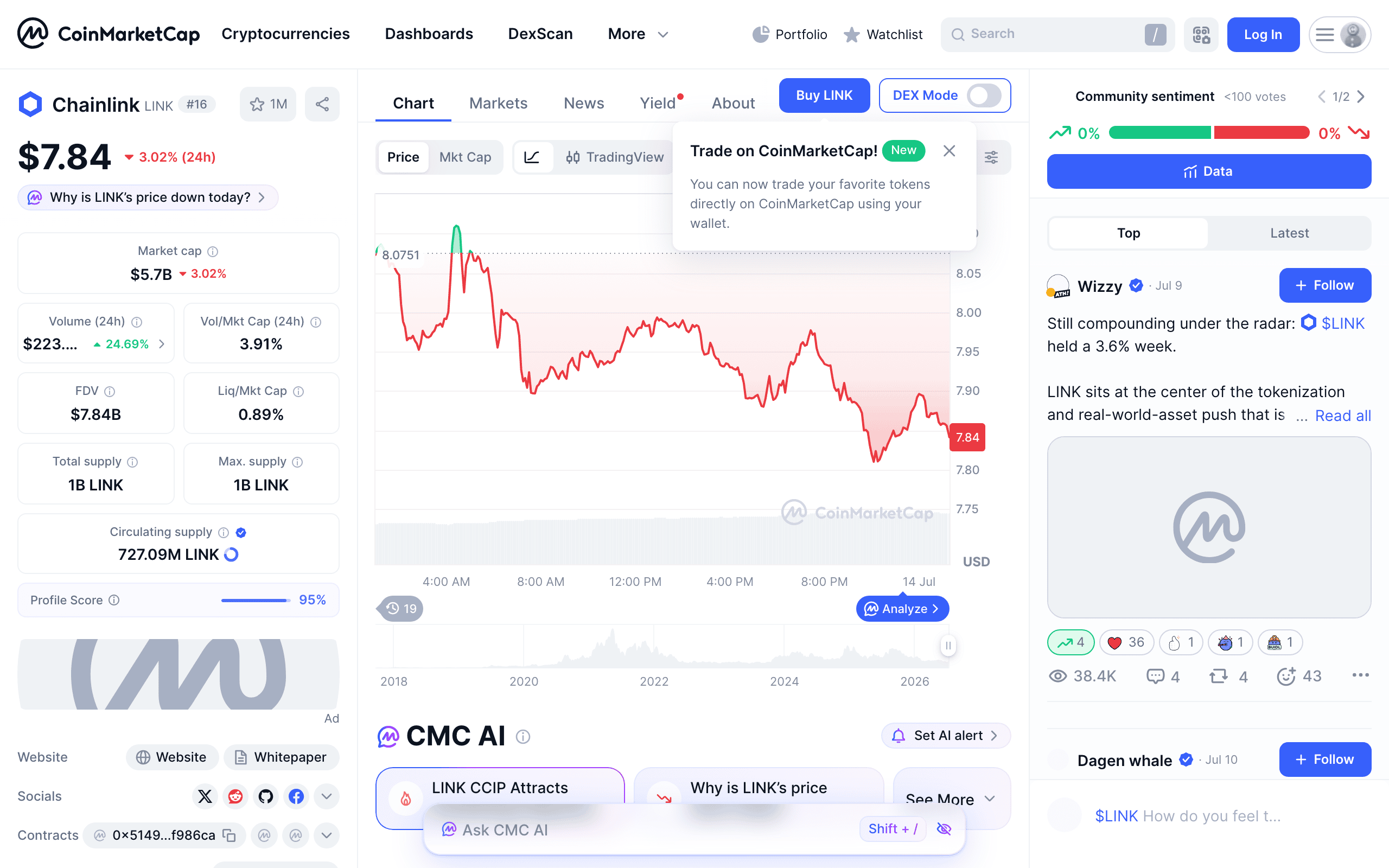
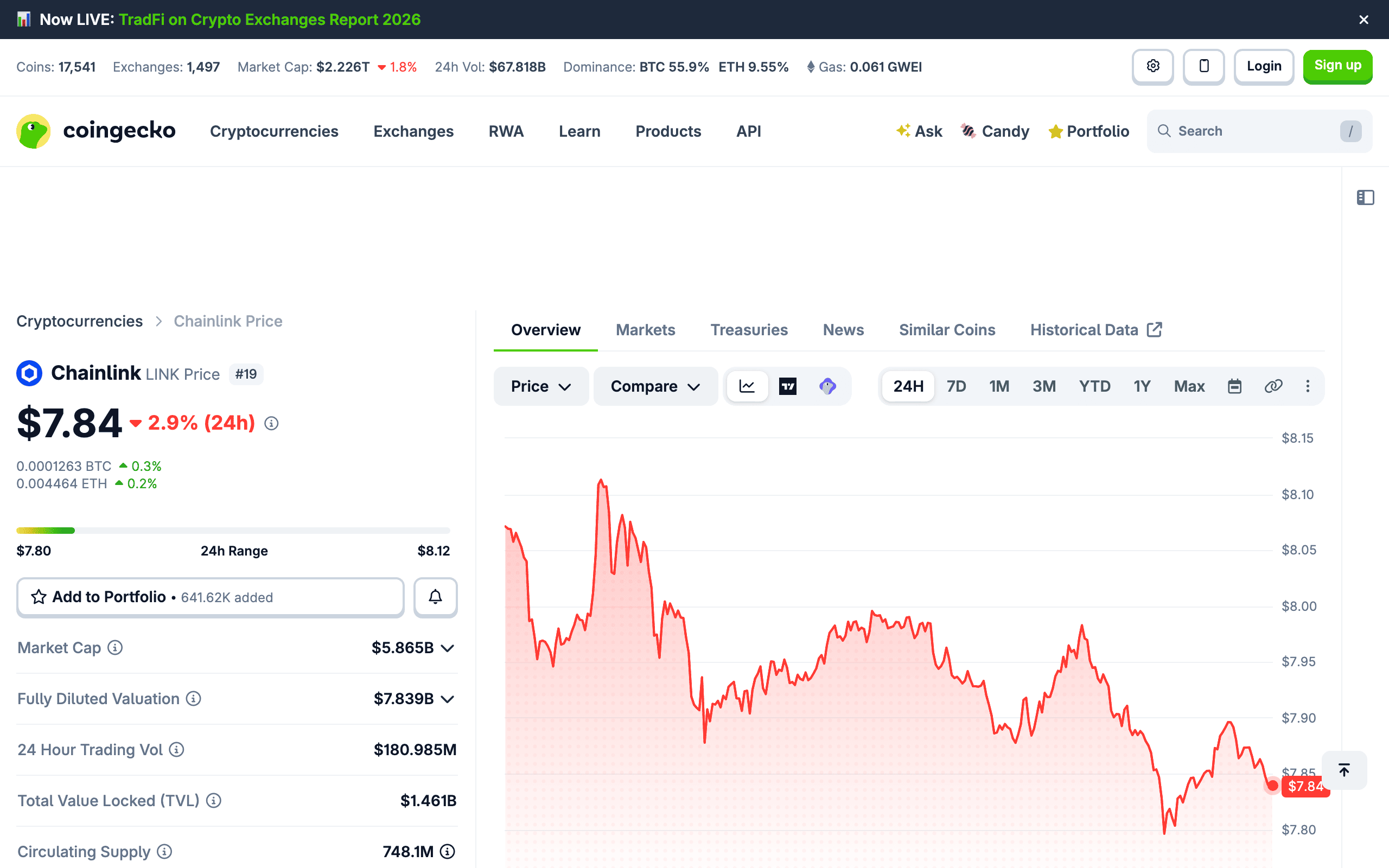
- As of July 2026, LINK trades around $7.90 with a market cap near $5.9 billion according to CoinMarketCap.
- Chainlink supports over 1,000 integrations across DeFi, insurance, gaming, and tokenized real-world assets.
- The network operates on a decentralized model with thousands of independent node operators worldwide.
- LINK has a maximum supply of 1 billion tokens, with roughly 750 million in circulation as of mid-2026.
Definition: What is Chainlink?
Chainlink is a decentralized oracle network designed to connect blockchains with real-world data and external systems. In simple terms, it solves the "oracle problem" — the challenge of getting reliable information from outside a blockchain into smart contracts that run on it. Without oracles, smart contracts could only use data already on the chain, limiting their usefulness for applications like lending, insurance payouts, or price feeds.
The project was founded in 2017 by Sergey Nazarov and Steve Ellis. It launched its mainnet in 2019 and has since grown into the leading oracle provider. Chainlink's architecture combines multiple layers of decentralization, including data sourcing from numerous providers, node reputation scoring, and cryptographic proofs to verify data integrity.
At its core, Chainlink allows blockchains like Ethereum, Solana, and others to interact with traditional finance systems, APIs, weather data, sports results, and more. This interoperability is critical for the growth of decentralized finance (DeFi) and the emerging tokenized asset economy.
How Does Chainlink Work? The Oracle Network Explained
Chainlink's system begins when a smart contract requests external data. This request is sent to the Chainlink network, where it is matched with appropriate oracle nodes. These nodes fetch data from multiple independent sources, aggregate it, and deliver a single verified answer back to the contract.
The process involves several steps. First, the requesting contract specifies parameters such as the data type needed and the number of oracles required. Nodes then compete or are selected based on their reputation and stake. Each node retrieves data from off-chain sources like financial exchanges or weather services. The results are aggregated using median or other statistical methods to reduce errors or manipulation.
Chainlink also incorporates advanced features like Chainlink Functions for custom computations, Chainlink Automation for triggering contract actions, and Data Feeds for standardized price oracles used by hundreds of DeFi protocols. In 2026, the network continues to expand with cross-chain capabilities, allowing data to flow seamlessly between different blockchains.
For example, a DeFi lending protocol might use Chainlink to get the current price of ETH in USD. Multiple nodes query various exchanges, average the results, and deliver it on-chain within seconds. This prevents any single point of failure or data tampering.
The network's decentralization is key. No single entity controls the oracles. Instead, thousands of independent operators run nodes, each staking LINK tokens to participate and earn rewards. Misbehaving nodes risk losing their stake, creating strong economic incentives for honesty.
The LINK Token: Utility, Supply, and Economics
LINK is an ERC-20 token on Ethereum that serves as the economic backbone of the Chainlink network. It has multiple uses. Users and developers pay LINK to node operators for data services. Node operators stake LINK to demonstrate commitment and earn fees plus rewards for accurate performance.
The token also plays a role in the reputation system. Higher-staked and better-performing nodes receive more requests. Total supply is capped at 1 billion LINK, with approximately 750 million circulating as of July 2026. This creates scarcity while allowing for ongoing incentives.
Market data shows LINK priced near $7.90 in July 2026, giving it a market capitalization of roughly $5.9 billion. Trading volume typically ranges from $150 million to $220 million daily. These figures come from major aggregators like CoinGecko and CoinMarketCap.
Economically, LINK's value derives from network usage. As more protocols integrate Chainlink for price feeds, automation, or verifiable random functions, demand for LINK grows. Staking mechanisms further lock up supply, reducing selling pressure.
Key Use Cases and Real-World Integrations
Chainlink powers hundreds of applications. In DeFi, it provides price oracles for platforms like Aave and Compound, ensuring accurate collateral valuations. Insurance protocols use it for weather or flight delay data to automate claims.
Tokenized real-world assets represent a major growth area in 2026. Institutions use Chainlink to bring stock prices, bond yields, or commodity data on-chain for settlement and compliance.
Gaming benefits from Chainlink's verifiable random number generator (VRF) for fair loot boxes and NFT minting. Supply chain projects track shipments using IoT data verified through oracles.
Notable integrations include partnerships with major banks and financial institutions exploring tokenized deposits and cross-border payments. The network supports over 200 blockchains and processes billions in value secured by its oracles.
Practical takeaway: Chainlink is best suited for projects needing reliable, tamper-proof external data without building their own infrastructure. It shines in high-stakes environments like finance where accuracy is non-negotiable.
Comparison: Chainlink vs Other Oracle Solutions
Chainlink stands out for its decentralization and battle-tested track record. Centralized oracles from individual companies offer simplicity but introduce single points of failure and trust issues.
Compared to newer competitors, Chainlink benefits from network effects — more integrations mean more data sources and higher security. Its hybrid model combines on-chain verification with off-chain computation.
A table of differences might include:
- Decentralization: Chainlink — high (thousands of nodes); Centralized alternatives — low (single provider).
- Data Sources: Chainlink aggregates many; others may rely on fewer.
- Use Cases: Chainlink excels in DeFi and RWA; niche oracles may focus on specific verticals.
- Security Model: Economic staking vs. reputation or insurance funds.
Chainlink's maturity gives it an edge for enterprise adoption, though specialized solutions can be faster for narrow applications.
Security, Risks, and Decentralization Features
Security relies on economic incentives, cryptographic commitments, and redundancy. Nodes must stake LINK, which can be slashed for poor performance. Multiple independent data sources prevent manipulation.
Risks include smart contract vulnerabilities in the requesting protocols, potential oracle failures during extreme market events, and regulatory uncertainty around data providers. Users should understand that while Chainlink minimizes trust, it does not eliminate all risks inherent to blockchain applications.
The network undergoes regular audits and has a strong track record since 2019. Its open-source components allow community scrutiny.
Where Can I Buy or Use LINK?
LINK is listed on major centralized exchanges and decentralized platforms. For cross-chain swaps without custody, users can leverage non-custodial aggregators that pull liquidity from multiple sources across 200+ networks and support 10,000+ assets.
Baltex is a non-custodial crypto swap aggregator that enables instant cryptocurrency exchanges, including LINK, across multiple blockchains through aggregated liquidity sources. No registration or KYC is required for most swaps, and it supports private routing options where appropriate while performing standard AML screening.
This makes Baltex suitable for users seeking quick, account-free access to LINK. Always verify current liquidity and fees before swapping.
For larger amounts or specific compliance needs, centralized exchanges may offer additional features like fiat on-ramps.
Practical Considerations: When Chainlink Is the Right Choice
Chainlink excels for developers building applications that depend on real-time external data, such as dynamic NFTs, automated yield strategies, or compliance-driven finance tools. It is ideal when trust minimization and proven reliability matter more than minimal latency.
A different option may be better for simple internal data needs or ultra-low-cost micro-transactions where a centralized API suffices. Projects with very specific data requirements might evaluate niche oracle providers for cost or speed advantages.
Market Context and Outlook as of July 2026
In July 2026, Chainlink continues to benefit from the broader adoption of tokenized assets and multi-chain ecosystems. Its price has stabilized in the $7–$8 range amid overall crypto market conditions, with a circulating supply supporting steady utility-driven demand.
Analysts note ongoing expansions in cross-chain functionality and institutional pilots as positive catalysts. However, competition from other data solutions and macroeconomic factors influence short-term movements.
The project's focus on verifiable data and automation positions it well for long-term relevance in Web3 infrastructure.
Conclusion and Key Takeaways
Chainlink remains the go-to solution for bringing trustworthy real-world information to blockchains. Its decentralized design, robust tokenomics, and extensive integrations make it foundational for the next wave of blockchain applications. Whether you're a developer, trader, or curious newcomer, understanding oracles like Chainlink helps explain how blockchains move beyond isolated ledgers into connected, data-rich systems.
Always conduct your own research and consider risks before engaging with any cryptocurrency or protocol.
(Word count: approximately 2150)
For more on this, see our guide on On-Chain Privacy: How to Break the Link Between Your Wallets.
For more on this, see our guide on On-Chain Privacy: How to Break the Link Between Your Wallets.
For more on this, see our guide on On-Chain Privacy: How to Break the Link Between Your Wallets.
For more on this, see our guide on On-Chain Privacy: How to Break the Link Between Your Wallets.
What is Chainlink?
What is the LINK token used for?
How does Chainlink ensure data accuracy?
Where can I buy LINK?
Is Chainlink decentralized?
What are Chainlink oracles?
What makes Chainlink valuable?
See others posts
G. Khan

Algorand (ALGO) Price Prediction 2026 (October 2026 Update)
Ecosystem
G. Khan
Polkadot (DOT) Price Prediction 2026
Ecosystem
G. Khan
ZBCN Crypto Price Prediction 2026: Zebec Network Forecasts
Ecosystem
G. Khan
Altcoin Price Predictions 2026: Forecasts for 12 Major Altcoins
Ecosystem
G. Khan
Amp (AMP) Price Prediction 2026
Ecosystem
G. Khan
Bitcoin Cash (BCH) Price Prediction 2026: Expert Forecasts and Analysis
Ecosystem