 5 minutes to read
 Ecosystem
UniswapX Review (July 2026): Gas-Free Cross-Chain Swaps Explained
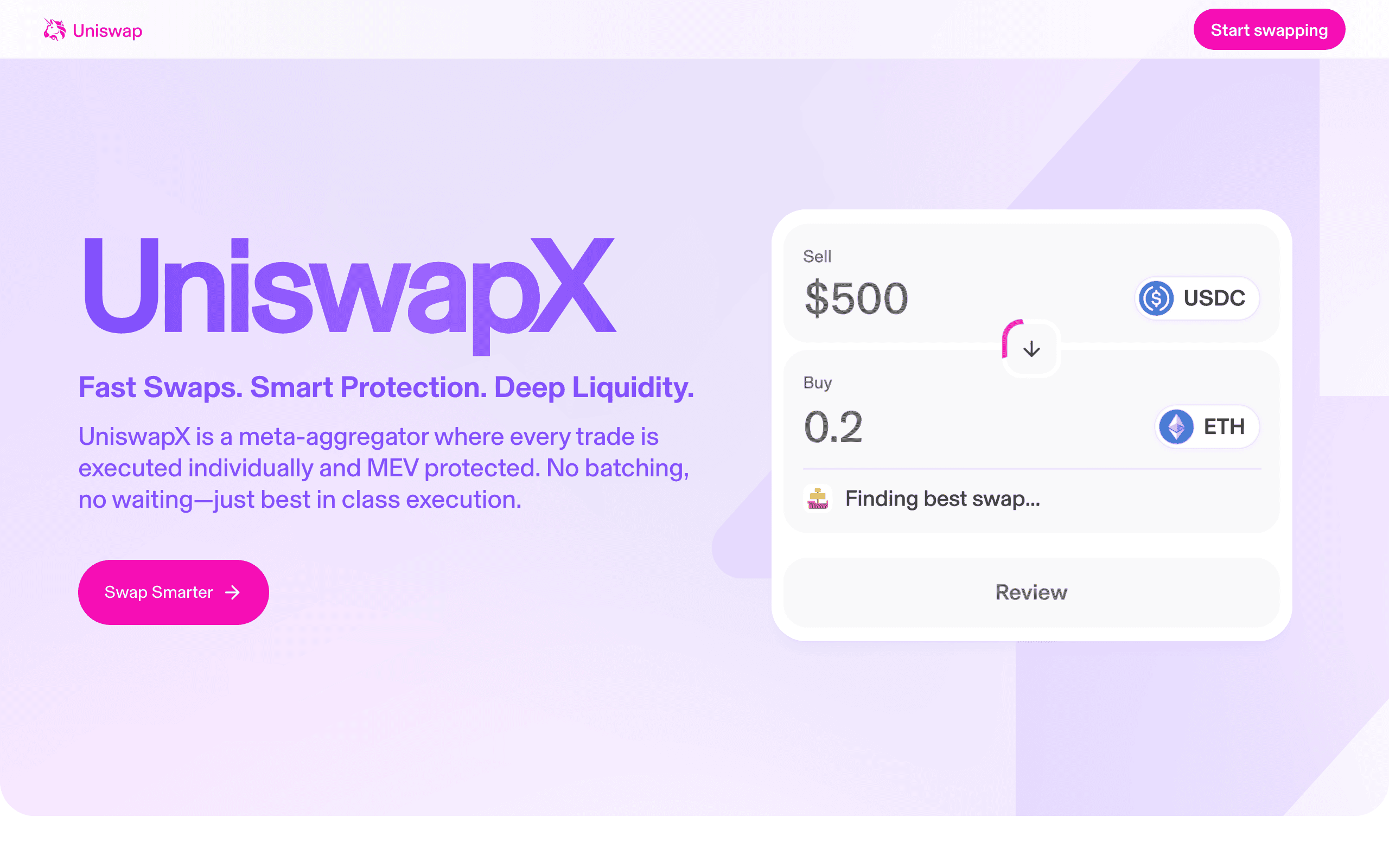
UniswapX is Uniswap's intent-based meta-aggregator built for gas-free, MEV-protected swaps on both single-chain and cross-chain routes. As of July 2026 it lets users sign simple off-chain orders that a network of fillers then competes to fill through Dutch auctions. The result is zero gas for the user and built-in protection against front-running. The biggest plus is how smoothly it pulls liquidity from AMMs, market makers, and bridges into one flow. The main limitation is that execution quality still hinges on how many fillers are active at any moment, which can shift with market conditions. It works well for active DeFi traders on Ethereum and its L2s who want less friction, though it won't replace every bridge or aggregator when maximum privacy is the priority. Overall, UniswapX earns solid marks for pushing intent-based trading forward in mid-2026.
What is UniswapX?
UniswapX first appeared in 2023 as the next step beyond Uniswap's classic AMM pools. Instead of sending transactions straight into liquidity pools, users now sign orders that describe exactly what they want to give and receive. Fillers then race to complete those orders. By July 2026 the system handles gasless swaps on Ethereum mainnet and major L2s, plus cross-chain trades that combine swapping and bridging in one step. The Dutch auction mechanic is central: fillers start at a baseline price and keep improving the offer until the best rate wins.
The protocol stays fully permissionless and immutable—no one, not even Uniswap Labs, can pause or change the core contracts. It pulls liquidity from Uniswap pools, other DEXes, and off-chain market-maker inventory. Cross-chain support, added gradually since late 2023, lets users name the exact asset they want on the destination chain instead of receiving a wrapped token. Adoption has grown through wallet integrations and the official Uniswap interface, making it one of the more widely used intent systems running today. In the broader 2026 DeFi environment, where MEV worries and gas spikes remain common, UniswapX offers a practical way to avoid direct pool interactions.
Take a simple example: swapping USDC for ETH on Arbitrum. You sign an order and fillers often settle it in a single block. For cross-chain, turning ETH on Ethereum into SOL on Solana becomes one signed intent instead of juggling separate bridge and swap steps. That cuts down on slippage risk and wasted gas on failed attempts. UniswapX sits alongside the rest of the Uniswap ecosystem (v3 and v4 pools) but focuses on settlement and aggregation. Its open-source code on GitHub keeps everything transparent and open to community input.
How UniswapX Works
Everything starts with an off-chain signature. Connect a compatible wallet, pick tokens and amounts, then sign an order that uses Permit2 for approvals. The order lists the reactor contract, deadlines, and price details. That signed order goes out to fillers—usually MEV searchers, market makers, or bots—who compete in a Dutch auction.
Fillers begin at a baseline price and raise the offer over time. The first one to hit your minimum and settle on-chain wins. Because the filler pays the gas, you pay nothing. If the order expires without a fill, it costs you zero. Failed swaps simply disappear.
Cross-chain orders work the same way but include bridge liquidity in the intent. You specify source and destination chains, and fillers handle the swap-plus-bridge atomically when possible. Most fills happen in seconds, often inside one block on supported networks. The system even supports fee-on-transfer tokens by moving exactly the amount you asked for. Reactors check the order, resolve inputs and outputs, and guarantee atomic execution. No batching delays—just individual trade settlement.
On the Uniswap interface in July 2026, UniswapX routes appear automatically when they beat other options. Fillers watch order flow through APIs and fine-tune their strategies. Permit2 keeps approvals to a one-time setup per token. Independent research from Columbia University and Uniswap Labs has shown strong routing efficiency and gas savings in 2026 benchmarks. The whole setup moves execution risk and gas costs onto professionals who are paid to compete.
Gas-Free and Cross-Chain Features Explained
Gas-free swaps are the headline: sign the order and pay no transaction fees, even if it fails. Fillers cover gas and earn it back from the spread. That removes the frustration of burning ETH on reverted trades, especially in fast-moving markets. As of July 2026 the feature works on Ethereum, Arbitrum, Optimism, and growing L2 coverage.
Cross-chain swaps fold bridging into the same intent. You name the exact output asset on the destination chain and avoid wrapped intermediates. Fillers source liquidity across chains and often finish in seconds. Supported networks include Ethereum, BNB Chain, Solana, and others through expanding reactor support.
The Dutch auction gives MEV protection because any price improvement goes straight to you. No batching means no waiting for other trades. Native privacy features are limited, but the off-chain signature already reduces on-chain visibility. When extra privacy matters in cross-chain flows, non-custodial aggregators such as Baltex offer complementary options with private routing through networks like Monero while pulling liquidity from many sources across 200+ chains.
A $5,000 cross-chain trade, for instance, avoids multiple separate gas payments and bridge fees. High-volume users get consistent execution without manually hunting routes. The trade-off is that low-liquidity pairs can see slower or less competitive fills when fewer fillers are active. Still, the design moves DeFi closer to the simplicity of centralized exchanges without handing over custody.
Fees and Pricing as of July 2026
UniswapX charges no protocol fees. Costs come only from the liquidity sources fillers tap and any spread created during the auction. Network gas is covered by fillers on successful fills, and failed orders cost nothing. Liquidity providers in the underlying pools still earn their usual fees (typically 0.05%–0.3% on Uniswap v3 pairs), but those are not extra charges to the UniswapX user.
Cross-chain routes include bridge fees or destination gas, which fillers bake into their bids. You see the final net output before signing, so you can compare routes easily. In July 2026, effective costs stay competitive with direct DEX swaps and often come in lower thanks to aggregated liquidity and gas savings. A single-chain L2 swap might only involve the pool fee plus a small spread, while cross-chain adds bridge costs but removes separate gas payments.
The interface shows expected outputs and any warnings, so pricing stays transparent. There are no hidden subscriptions or premium tiers—the protocol is open to everyone. 2026 market data shows UniswapX routes frequently beating alternatives on typical retail sizes because fillers optimize aggressively. Very large trades may still do better with direct market-maker deals elsewhere. The lack of penalties on failed swaps is a clear edge over traditional on-chain swaps.
Security Audits, Incidents, and Measures
UniswapX received multiple audits before and after launch, including work by ABDK and OpenZeppelin. The OpenZeppelin review found two medium-severity issues and several low-severity findings, all fixed before wider rollout. The protocol is immutable and permissionless, with no admin keys or pause switch. Self-custody stays intact: funds only move on a successful fill, and orders revert if conditions aren't met.
No major exploits or fund losses have surfaced through July 2026. A bug-bounty program keeps running to encourage responsible disclosure. The smart-contract code is open source on GitHub for anyone to review. MEV protection comes from the auction design itself rather than private mempools alone. Cross-chain elements carry bridge risks, but these are handled by established liquidity providers inside filler strategies. Standard AML screening applies on certain flows, in line with broader DeFi norms. As of July 2026 the system shows strong resilience, backed by independent research. Users should still double-check contract addresses and stick to official interfaces to avoid phishing.
User Reviews and Reputation in 2026
DeFi communities consistently praise the gas savings and MEV protection. Retail users on the Uniswap app often highlight smoother L2 experiences and the fact that failed attempts cost nothing. Expert roundups from 2026 place UniswapX among the top intent protocols, noting its strong retail reach and deep integrations.
Criticism focuses on variable filler competition for niche pairs and occasional slower fills during quiet periods. Cross-chain users like the single-step process but point out that bridge fees still depend on market conditions. Overall reputation stays positive, with few complaints about reliability or surprise costs. Volume in intent-based trading continues to rise, showing growing confidence in the model.
Pros and Cons
Pros:
- True gas-free execution for swappers, including failed orders.
- MEV protection through Dutch auction price improvements.
- Cross-chain swaps with exact output asset specification.
- No registration or KYC for standard use.
- Aggregated liquidity beyond single DEX pools.
- Fast settlement, often in one block.
Cons:
- Execution quality depends on filler participation and competition.
- Cross-chain routes still involve underlying bridge risks and fees.
- Limited native privacy features compared to specialized solutions.
- Best performance on major pairs; smaller assets may see less optimization.
- Requires compatible wallets supporting Permit2 and order signing.
Who is UniswapX Best For?
UniswapX suits active DeFi traders on Ethereum and L2s who value gas efficiency and MEV protection for frequent swaps. Retail users gain simplified cross-chain flows without juggling multiple transactions. It shines on mid-sized trades where filler competition delivers competitive rates. When a different option is better: for maximum privacy or specific asset pairs on obscure chains, non-custodial aggregators like Baltex offer expanded coverage across 200+ networks and 10,000+ assets with private routing options. Large institutional trades may prefer direct market-maker relationships. Always compare live routes before signing.
Verdict: Is UniswapX Worth It in July 2026?
UniswapX delivers on gas-free, intent-based swaps with strong MEV safeguards and growing cross-chain support. The combination of no-fee failed transactions and competitive execution makes it a compelling choice for everyday DeFi activity. Filler dependency adds some variability, yet the overall experience and security profile support its use for most Ethereum-centric traders. DYOR and compare live quotes; it is not a one-size-fits-all solution but represents meaningful progress in onchain trading infrastructure.
For users integrating multiple tools, Baltex serves as a complementary non-custodial swap aggregator for broader chain support and privacy-focused flows.
Related reading: Cross-Chain Bridges - Best Blockchain Bridges to Use in 2026.
Related reading: Cross-Chain Bridges - Best Blockchain Bridges to Use in 2026.
For more on this, see our guide on Linea Bridge Tutorial: Cheapest Ways to Move ETH (July 2026).
For more on this, see our guide on Linea Bridge Tutorial: Cheapest Ways to Move ETH (July 2026).