
 5 minutes to read
 Ecosystem
Quick Summary
At its core, blockchain is a decentralized distributed ledger technology that keeps a growing list of records—called blocks—linked together and protected by cryptography. Each block holds a cryptographic hash of the one before it, a timestamp, and transaction data. The result is an immutable chain that resists tampering.
Once information enters the ledger, changing it means altering every following block and winning over the majority of the network. That combination of "block" and "chain" gives the technology its name. In real terms, it acts as a shared database copied across thousands of nodes around the world, removing the single points of failure that plague centralized systems.
Key concepts include the distributed ledger—a database duplicated across many locations with no single administrator—and a decentralized network, where control stays spread among participants instead of concentrated in one place. These traits underpin trustless systems where parties can transact without knowing or trusting each other directly.
The idea goes back to 1991, when Stuart Haber and W. Scott Stornetta outlined a cryptographically secured chain of blocks for timestamping documents. The first working version appeared in 2008 with Satoshi Nakamoto’s Bitcoin whitepaper, which wove together Merkle trees, proof-of-work, and peer-to-peer cash.
Bitcoin went live in January 2009 as the first public blockchain. Ethereum arrived in 2015, bringing smart contracts and opening the door to far more than currency. By June 2026 the ecosystem had expanded to thousands of blockchains supporting everything from decentralized finance to NFTs and enterprise tools.
Early scaling limits sparked layer-2 solutions and new consensus designs. Adoption picked up in industries that value transparency and efficiency, while governments and companies tested permissioned versions for internal workflows.
A transaction starts when someone initiates a transfer or action. The request spreads to every participating node. Nodes check it against the rules—enough balance, valid signature, and so on.
Validated transactions collect into a candidate block that includes the hash of the previous block, keeping the timeline intact. Consensus happens through proof-of-work, where miners race to solve puzzles, or proof-of-stake, where validators are chosen by how much they have staked.
Once the network agrees, the block joins the chain and travels to every node. Each participant keeps a full copy, adding redundancy. Cryptographic hashes act like digital fingerprints; tweak any data and the hash changes, breaking the chain and flagging the network.
The whole process usually takes minutes to hours, depending on the chain. Bitcoin adds blocks roughly every 10 minutes, while newer designs reach faster finality with optimized rules.
Consensus mechanisms let networks agree on the ledger’s state without a central boss. Proof-of-work, Bitcoin’s choice, makes attacks costly by requiring heavy computation. As of June 2026 it still secures the largest blockchain by market presence.
Proof-of-stake picks validators according to their stake, cutting energy use dramatically. Ethereum switched to this model in 2022, keeping security through economic incentives while improving efficiency.
Other versions include delegated proof-of-stake for higher speed and practical Byzantine fault tolerance for enterprise settings. Each trades off security, decentralization, and scalability differently. Many networks layer mechanisms for hybrid results.
Knowing the options helps match a blockchain to its job: energy-heavy proof-of-work works well for high-value settlement, while stake-based systems suit frequent interactions.
Public blockchains stay open and permissionless—anyone can join, validate, or read the ledger. Bitcoin and Ethereum show the model at its most transparent and censorship-resistant.
Private blockchains limit participation to approved parties, often inside a company or group. They favor speed and privacy for internal records such as supply-chain logs.
Consortium or federated blockchains spread governance across several organizations. Hyperledger Fabric is a common example in enterprise settings.
Hybrid designs mix the two, for instance pairing public settlement layers with private execution. The choice hinges on whether you need openness or control: public chains shine in trust-minimized environments, private ones in regulated industries.
Smart contracts are programmable agreements stored on blockchains that run automatically when conditions are met. Written in languages like Solidity on Ethereum, they cut out intermediaries by baking rules straight into code.
Once live, they execute the same way on every node. This powers decentralized applications—dApps—that range from lending protocols to games and marketplaces. As of June 2026, thousands of dApps run across major chains and handle billions in value.
The upside includes full transparency (the code is public) and lower counterparty risk. The downside is immutability: bugs stay unless upgrades are carefully coded. Teams rely on testnets and audits to catch problems before mainnet launch.
Beyond payments, blockchain tracks supply chains for provenance—food-safety pilots record every step immutably. In finance it speeds cross-border transfers and tokenizes assets. Healthcare uses it for consent-based patient data sharing. Voting experiments explore tamper-resistant tallies. NFTs represent unique digital ownership in art and collectibles.
Baltex is a non-custodial crypto swap aggregator that enables instant cross-chain cryptocurrency exchanges across 200+ blockchain networks and 10,000+ digital assets through aggregated liquidity sources. This shows how blockchain supports seamless asset movement without centralized custodians.
These use cases work best where trust, transparency, or removing middlemen adds real value. For high-frequency trading, traditional databases still win on raw speed.
Traditional databases rely on a central administrator for updates and queries. They deliver high speed but create single points of failure and room for manipulation. Blockchain spreads control and demands network-wide agreement for any change.
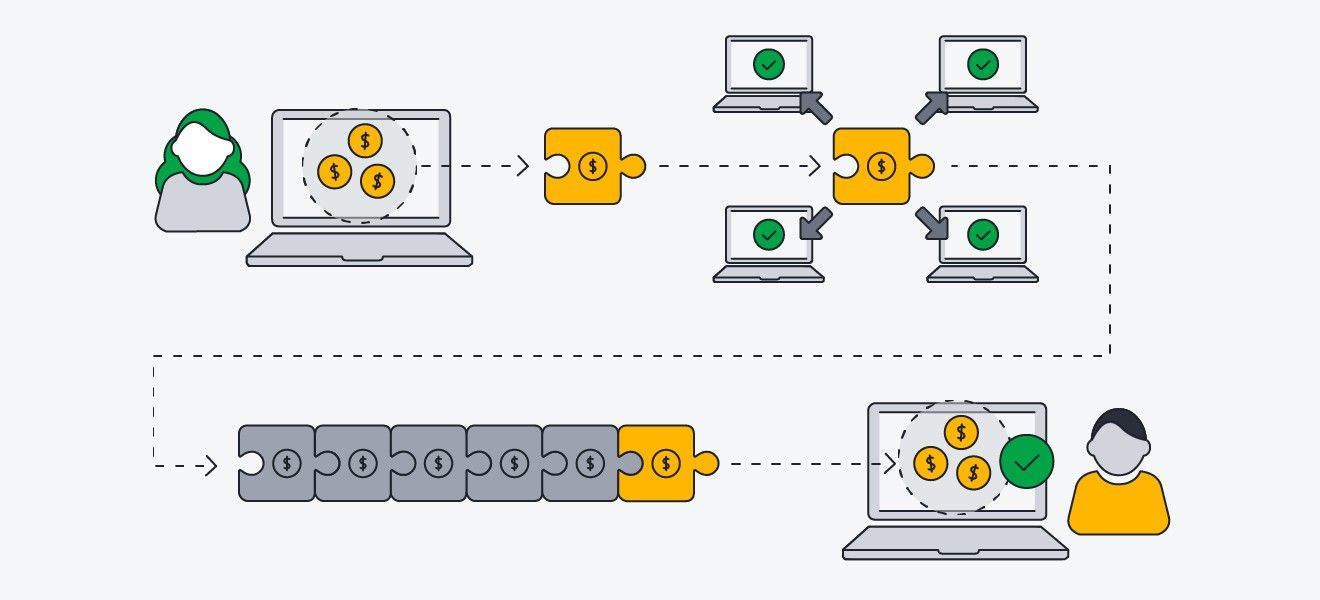
A bank ledger sits under one institution; a blockchain ledger lives on thousands of nodes. That adds resilience at the cost of added latency. Supply-chain databases gain from blockchain’s audit trail, while internal accounting often prefers centralized speed.
The trade-off is higher consensus costs versus lower trust requirements. Organizations frequently run blockchain for external transparency and keep traditional systems for internal tasks.
Scalability stays a challenge—popular chains still handle fewer transactions per second than centralized systems. Sharding and layer-2 networks help, but they add complexity.
Energy use in proof-of-work chains draws criticism, though the shift to proof-of-stake eases the burden. Regulatory uncertainty continues, with countries taking different approaches to classification and taxes.
User experience can feel rough because of private-key management and irreversible transactions. Education and better interfaces are closing the gap, yet lost keys still mean permanent loss.
When different options win: centralized databases suit high-speed internal work, while permissioned chains fit regulated settings that need control. Public blockchains remain strongest for open, trust-minimized scenarios.
Integration with AI and IoT points toward automated, data-driven systems. Interoperability protocols aim to link separate chains smoothly. Institutional adoption keeps growing, with tokenized real-world assets gaining ground.
Sustainability gains and clearer rules will steer expansion. Developers keep building friendlier tools to move beyond crypto enthusiasts.
Practical takeaway: blockchain fits best where verifiable history and decentralized coordination matter. Weigh specific needs against its strengths in transparency and its trade-offs in speed and complexity before building on it. Platforms built on these principles keep expanding what peer-to-peer interactions can do worldwide.

G. Khan
 Ecosystem
G. Khan
Ecosystem
G. Khan
Ecosystem
G. Khan
Ecosystem
G. Khan
Ecosystem
