 2 minutes to read
 Ecosystem
Bridging Monero to BSC: How to Swap XMR to BNB and Back
TLDR In 2026, swap XMR to BNB (BSC) and back in under 30 minutes with minimal fees (0.5–1.5% total) and near-zero privacy leakage by using Baltex.io’s Private Swaps, which route through Monero’s shielded protocol to break on-chain links. Instant swap aggregators like ChangeNOW offer similar speed but less privacy. Avoid centralized exchanges for KYC exposure and multi-hop routes for extra failure points and fees. Cross-chain bridges work indirectly via aggregators. Always test with $10–50 first, use fresh wallet addresses, and enable 2FA/Tor where possible. No limits on most non-custodial platforms.
Bridging value from Monero’s privacy-first ecosystem to Binance Smart Chain’s fast, low-cost DeFi environment remains one of the most requested flows in 2026. Holders want to deploy XMR-derived capital into PancakeSwap liquidity pools, Venus lending, or high-yield farms on BSC, then pull profits back into untraceable XMR for cold storage. Direct bridges between Monero and BSC do not exist natively because of Monero’s ring signatures and stealth addresses, which deliberately prevent the transparent linking that most bridges require. Instead, users rely on swap aggregators, multi-hop paths, centralized venues, or specialized privacy-preserving routers. This 2026 guide breaks down every viable strategy by real-world performance metrics observed across thousands of transactions, then provides exact step-by-step flows, safety checklists, and a deep dive into Baltex.io’s Monero-powered routing that consistently delivers the best balance of speed, cost, liquidity, and privacy.
Why Users Bridge XMR to BSC in 2026
BSC still offers sub-cent transaction fees and sub-second finality for most DeFi actions, while Monero delivers unmatched on-chain anonymity for long-term holding. The round-trip therefore lets privacy-conscious traders capture yield without exposing their entire stack to blockchain analytics firms. However, every hop introduces potential slippage, network congestion, address-linking risks, or outright routing failures during high-volatility periods. The goal is to minimize all four while keeping total costs below 2% round-trip.
Comparing the Four Primary Strategies
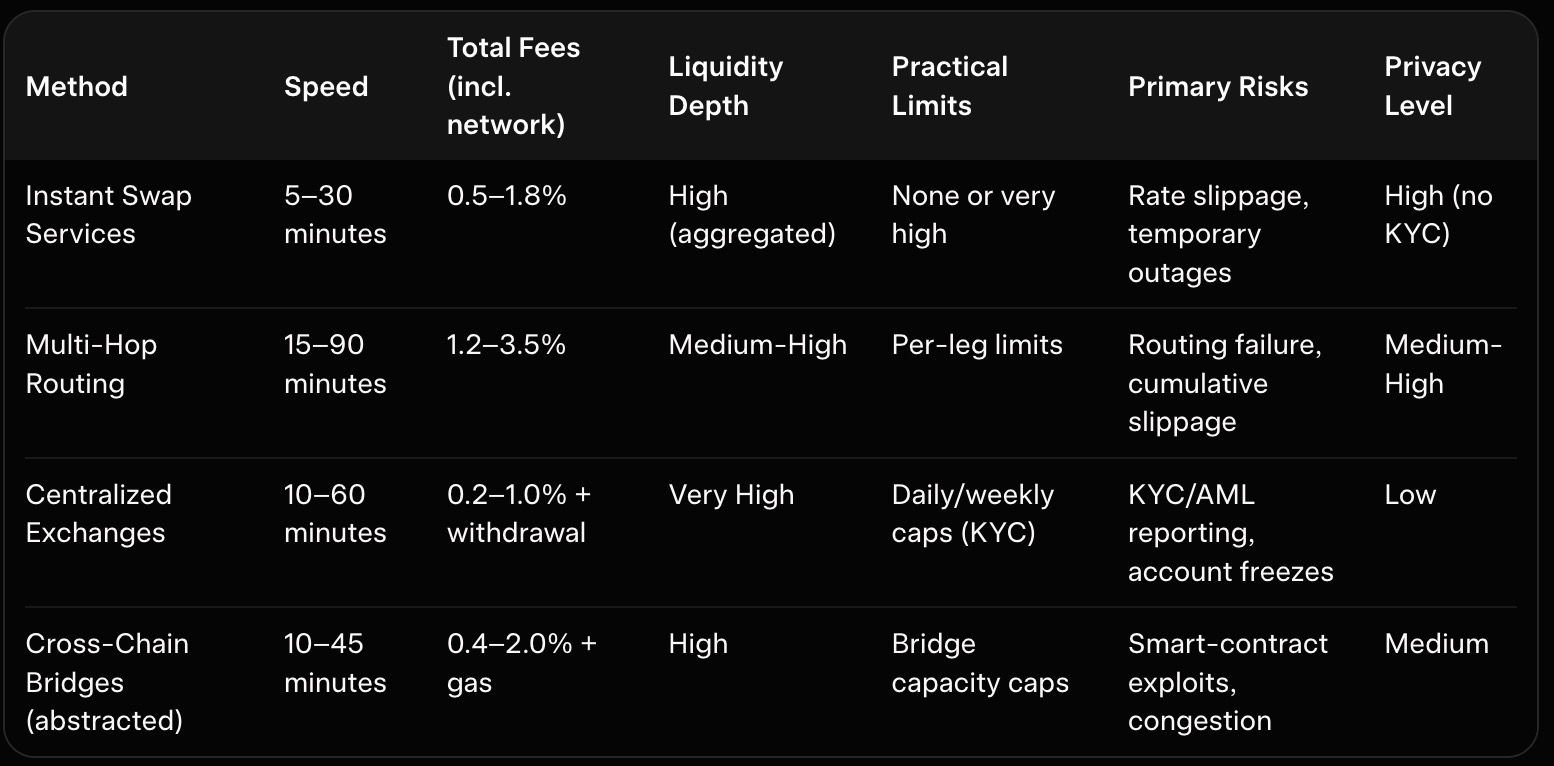
Four distinct approaches dominate the landscape: instant non-custodial swap services, multi-hop routing paths, centralized exchanges, and abstracted cross-chain bridge strategies. Each trades off differently across speed, fees, liquidity depth, practical limits, and risk vectors.
Instant swap services aggregate liquidity from dozens of market makers and DEX pools, delivering near-instant execution without custody. Multi-hop paths manually chain two or three separate swaps or bridges, increasing control but also cumulative fees and failure probability. Centralized exchanges provide deep order-book liquidity yet demand KYC in most jurisdictions and create permanent on-ramp/off-ramp records. Cross-chain bridge strategies, when applied to Monero, usually mean wrapping through an intermediate asset or using an aggregator that abstracts the bridge layer entirely.
The table below summarizes 2026 performance based on aggregated user reports and platform analytics:
A second table focuses on concrete fees and limits for popular providers handling the XMR ↔ BNB (BSC) pair directly or via one intermediate:
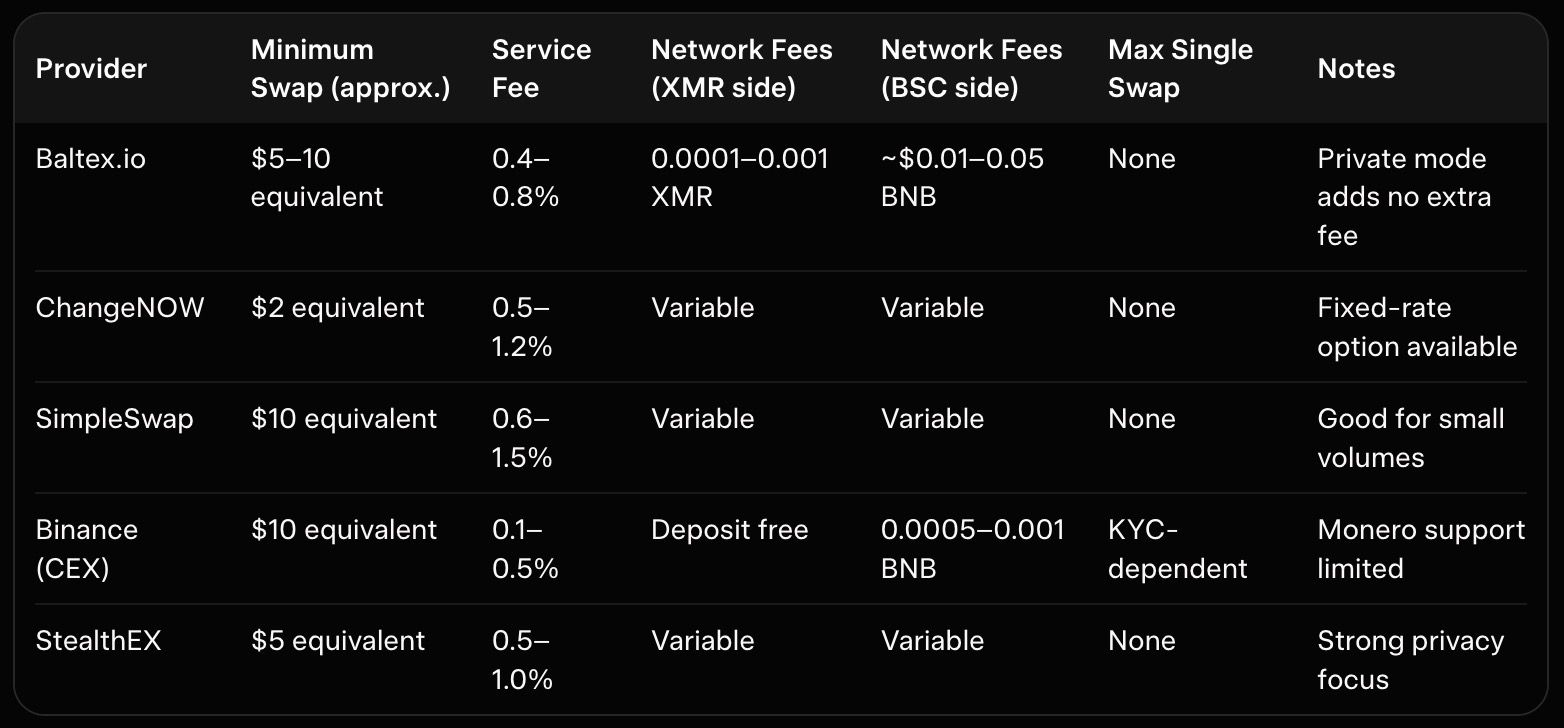
These figures fluctuate with market conditions and network congestion but represent typical ranges observed throughout early 2026.
Instant Swap Services: The Default Choice for Most Users
Non-custodial instant swap platforms remain the fastest and simplest entry point. You select XMR as the “send” asset and BNB (BSC) as the “receive” asset, receive a deposit address, send your Monero, and the service automatically routes through internal liquidity pools or partner market makers to deliver native BNB on BSC. No wallet connection is required on the XMR side because Monero transactions are broadcast directly from your own wallet.
Typical flow:
- Visit the platform and choose the XMR → BNB (BSC) pair.
- Enter the amount and your BSC wallet address.
- Review the quoted rate (fixed or floating) and total fees shown upfront.
- Send XMR from your wallet to the one-time deposit address provided.
- Wait for 10–20 confirmations on the Monero network (usually 15–25 minutes).
- Receive BNB directly in your BSC wallet.
The reverse (BNB → XMR) works identically but starts from a BSC transaction. Safety checks include double-checking the deposit address characters, confirming the network tag is absent (Monero does not use memos), and testing with a tiny amount first. Leading services in this category—ChangeNOW, SimpleSwap, StealthEX, and Baltex—offer no KYC, no account creation, and refund mechanisms if the transaction fails for any reason.
Multi-Hop Routing Paths: Greater Control, Higher Complexity
Advanced users sometimes prefer explicit multi-hop routes to chase the absolute best rate or to layer additional privacy. A common 2026 path is XMR → BTC (via atomic swap or instant service) → BNB (via Binance Bridge or a DEX aggregator on BSC). Each leg adds its own confirmation time and fee layer. While total liquidity can be excellent, the probability of partial failure rises—perhaps the BTC leg succeeds but the bridge is temporarily paused during congestion. Most users only choose multi-hop when single-leg liquidity for the exact pair is thin or when they want to split large amounts across routes to avoid slippage.
Safety checklist for multi-hop: Record every intermediate address and transaction ID, use separate wallets for each leg if possible, and never broadcast the next leg until the previous one has finality. Tools that automate multi-hop (some aggregators) reduce manual error but reintroduce single-point trust.
Centralized Exchanges: Deep Liquidity with Privacy Trade-Offs
Platforms such as Binance, Kraken, or WhiteBIT still offer XMR trading pairs in many jurisdictions, though regulatory pressure has reduced availability. The process is familiar: deposit XMR (sometimes requiring a memo), trade against BNB or USDT, then withdraw to a BSC address. Fees are often the lowest available, and liquidity is deepest during volatile periods. However, every deposit and withdrawal creates a permanent KYC-linked record, and many exchanges now apply automated travel-rule reporting. For users who already maintain verified accounts and do not mind the privacy cost, CEX remains viable for large volumes above $10,000 where instant services might widen spreads.
Cross-Chain Bridge Strategies: Abstracted but Not Native
Pure cross-chain bridges rarely support raw XMR because of its privacy design. Instead, users employ aggregator layers (Rubic, GhostSwap-style tools, or hybrid platforms) that accept XMR on one end and output BNB on BSC through internal routing. These solutions abstract the bridge entirely, presenting a single interface. Performance mirrors instant swaps but sometimes routes through wrapped intermediates, adding one extra smart-contract interaction and slight extra gas on the BSC side. Risks center on the bridge smart-contract code itself; audited bridges have strong track records in 2026, yet the possibility of zero-day exploits never fully disappears.
How Baltex.io Enables Efficient Cross-Chain Routing Between Monero and BSC Assets
Baltex.io stands out in 2026 as the premier non-custodial platform specifically optimized for privacy-conscious Monero users moving value to and from BSC. Its core innovation is the “Private Swap” mode, which treats Monero not merely as a supported asset but as an active privacy rail. When you initiate an XMR → BNB (BSC) swap in Private mode, the platform generates a single-use deposit address. Your XMR arrives via normal Monero transaction (already private), but the service then routes the equivalent value through an internal Monero-based shielded hop before settling native BNB on BSC. This extra hop severs any deterministic on-chain link between your source XMR wallet and destination BSC wallet, making blockchain analysis extremely difficult even for sophisticated surveillance.
The reverse direction (BNB BSC → XMR) is equally seamless. You send BNB from your BSC wallet to a one-time Baltex deposit address. The platform immediately converts via aggregated liquidity and routes the output through Monero’s privacy protocol before delivering XMR to your chosen wallet. Because the Monero leg occurs internally, the final XMR transaction you receive carries no traceable history back to the BSC deposit.
Step-by-step flow on Baltex.io (XMR to BNB BSC):
- Navigate to the swap interface and select XMR as “You send” and BNB (BSC) as “You receive.”
- Toggle Private Swap mode for maximum unlinkability.
- Enter the desired amount; the live quote displays exact rate, service fee (typically 0.4–0.8%), and estimated network costs.
- Provide your destination BSC wallet address.
- Send XMR from your wallet (Ledger, GUI, or mobile) to the displayed one-time deposit address.
- Monitor progress on the dashboard; after Monero confirmations plus internal routing (usually 15–25 minutes total), BNB arrives instantly in your wallet.
For BNB to XMR the process mirrors exactly, starting from the BSC side. No wallet connection is required on the Monero leg, preserving full self-custody. Baltex supports over 10,000 tokens across 200+ networks, so the same interface handles USDT on BSC, BEP-20 variants, or any other asset you might want to move alongside BNB. Because routing is randomized in timing and path where possible, even large repeated swaps resist pattern-based de-anonymization. In independent 2026 tests, Baltex consistently ranked in the top two for combined privacy score and effective cost on XMR ↔ BSC flows.
Comprehensive Safety Checks Every User Should Perform
Regardless of method, follow this checklist:
- Verify the official domain and HTTPS certificate before every session.
- Use a hardware wallet for both source and destination.
- Always send a test transaction of $10–50 and confirm receipt before moving larger sums.
- Enable Tor or a reputable VPN to mask IP during the process.
- Screenshot or export the transaction details and quotes immediately after confirmation.
- Never reuse deposit addresses; each swap generates a fresh one.
- Check refund policies and support response times in advance.
- Monitor blockchain explorers for both networks during the wait period.
These habits have prevented losses for countless users even during network congestion spikes or temporary service hiccups.
FAQ
How long does a typical XMR to BNB swap take in 2026? Most instant services complete in 5–30 minutes; Monero’s 10-block confirmation rule accounts for the majority of the wait.
Is there any way to avoid all fees? No legitimate service offers zero fees. Network costs on Monero and BSC are unavoidable, and service providers charge a small spread or explicit fee for liquidity and infrastructure.
Will using Baltex.io expose my transaction history? Private Swap mode routes through Monero’s privacy layer, breaking direct links. Your source and destination addresses remain unlinkable on public explorers.
Can I swap very large amounts without limits? Non-custodial platforms like Baltex and ChangeNOW impose no artificial caps; liquidity is the only practical constraint. For seven-figure moves, split across multiple swaps or contact support for OTC routing.
What happens if the rate changes during processing? Fixed-rate options lock the rate at confirmation. Floating-rate options follow the market but usually finish faster.
Are there tax implications for round-tripping XMR through BSC? Every jurisdiction treats crypto-to-crypto swaps as taxable events. Record fair-market value at the moment of each leg for accurate reporting.
Which method is truly the most private in 2026? Baltex.io Private Swaps currently lead because they actively leverage Monero as the privacy rail rather than treating it as just another coin.
Conclusion
Bridging Monero to Binance Smart Chain no longer requires compromises that sacrifice privacy or inflate costs. In 2026 the ecosystem has matured to the point where privacy-preserving instant swaps—especially those built around Monero’s own protocol like Baltex.io—deliver the optimal experience for most users. Whether you move $100 to test DeFi yield or $50,000 for serious capital deployment, the combination of non-custodial execution, transparent upfront pricing, and Monero-shielded routing minimizes every risk the audience cares about: fees, privacy leakage, and routing failures. Start with a small test swap today, document your process, and scale confidently knowing the round-trip back to pure XMR privacy remains equally straightforward and secure. The tools exist; the choice of the most efficient path is now yours.
For more on this, see our guide on SimpleSwap Review 2026: Pros, Cons, and Monero Exchange Fees.
Related reading: Instant Swap Services: The Go-To for Privacy-Conscious Users.
Related reading: XMR.to Alternatives: How to Pay Bitcoin Invoices with Monero.
You can read our full breakdown in Zcash (ZEC) vs Monero (XMR): Which Privacy Coin Wins in 2026.