3 minutes to read
 Ecosystem
How to Buy Cryptocurrency With a Credit Card in 2026: Step-by-Step Tutorial
Updated October 21, 2026. This guide is educational, not financial advice. Rules and fees change, so confirm them with your card issuer and the platform before you pay.
In 2026, buying cryptocurrency with a credit card is still fast and widely available, but it is rarely the cheapest option. Estimates of crypto owners worldwide range from roughly 560 million to nearly 1 billion people, and you can buy Bitcoin (BTC), Ethereum (ETH), or stablecoins like USDC in minutes with Visa or Mastercard, provided your card issuer allows it. This guide walks new users through the process safely, covering requirements, top platforms, fees, limits, verification, and security tips. We'll include a step-by-step tutorial, comparisons, and how to use baltex.io for card purchases and multi-chain swaps.
Whether you're funding a wallet for DeFi or just dipping your toes into Bitcoin, this tutorial helps you avoid common pitfalls like stacked fees, blocked cards, and scams. We've packed in lists, tables, and FAQs for quick answers.
TL;DR: Quick Guide to Buying Crypto with Credit Card in 2026
- Requirements: A credit card your issuer allows for crypto, email, ID for KYC, smartphone or computer.
- Top Platforms: Coinbase (beginner-friendly), Binance (not available in the US), Kraken, and on-ramps like MoonPay; Baltex also offers card purchases without sign-up.
- Steps: Sign up → Verify identity → Add card → Buy crypto (e.g., $100 of BTC) → Withdraw to your wallet.
- Fees: Coinbase charges 3.99% on credit card purchases, and your issuer may add a cash advance fee (often 3% to 5%, or a $10 minimum) plus interest from day one. Total costs of 7% to 9% or more are common.
- Cheaper options: Debit cards and bank transfers usually cost less than credit cards.
- Security: Use app-based 2FA, reputable platforms, and start small.
- Post-Buy: Swap on baltex.io for other coins across 200+ networks.
Why Buy Crypto with a Credit Card in 2026?
Credit card purchases offer instant access to crypto without waiting for bank transfers, which can help when you want to buy during a dip. For reference, BTC traded around $84,800 at the start of October 2026, and prices move quickly. Unlike wires (1 to 3 days), card purchases process in seconds.
However, it's not free money. Card networks and many banks classify crypto purchases as cash advances, which means extra fees and interest that starts immediately. Many large issuers now block these purchases altogether.
Benefits:
- Speed: Instant funding.
- Convenience: No bank login needed.
- Possible protections: Credit cards can offer stronger dispute rights than other payment methods, though crypto purchases are often excluded.
Drawbacks: High costs, possible debt, rewards often not earned on cash advances, and a possible impact on your credit utilization. For newbies, start with $50 to $100 and consider a debit card or bank transfer first.
Requirements: What You Need to Buy Crypto with Credit Card
No fancy setup, just basics. Here are the essentials for 2026:
Essential Items
- Credit Card: Visa or Mastercard. Policies vary widely by issuer. CoinLedger's 2026 guide lists Bank of America, Capital One, Chase, TD Bank, and others as not allowing crypto purchases on credit cards, and American Express as one of the few that does. Policies change, so check yours.
- Device: Smartphone or computer with internet.
- Email/Phone: For account creation and 2FA.
- ID Documents: Passport, driver's license, or national ID for verification.
- Crypto Wallet: Optional but recommended for storage. Choose one that supports the coin you buy.
Bank/Card Considerations
- Ask Your Issuer: Find out whether crypto purchases are allowed and whether they will be coded as cash advances, and what the fee and interest rate would be.
- Credit Limit: Cash advance limits are often lower than your purchase limit.
- Region: Availability varies by country. For example, Binance is not available to users in the United States, and Binance.US has more limited card support.
Pro Tip: Compare the total cost of a credit card, a debit card, and a bank transfer before you buy. Total setup time: about 10 minutes.
Best Platforms to Buy Crypto with Credit Card in 2026
Not all exchanges accept credit cards, and availability depends on your region and issuer. Here is a comparison of common picks for beginners:
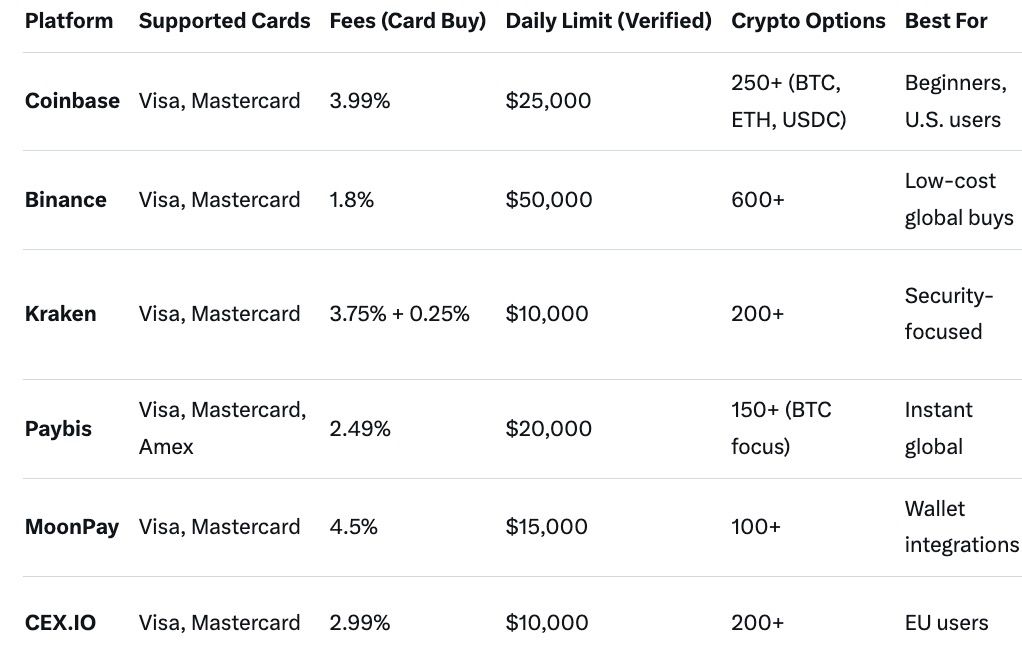
Baltex also offers a card option: its Buy with Card tab lets you buy crypto with a Visa or Mastercard debit or credit card, including Apple Pay, without signing up. Card payments run through payment partners, which may apply their own checks, so review the terms and total price before paying.
Step-by-Step Tutorial: How to Buy Crypto with Credit Card
Let's buy $100 of BTC on Coinbase and adapt the steps for other platforms. Time: 15 to 30 minutes. At about $84,800 per BTC, $100 buys roughly 0.0012 BTC before fees.
Step 1: Choose and Sign Up on a Platform
- Visit coinbase.com (or download the app).
- Click "Sign Up." Enter your email and create a password. Verify via the email link.
- Check that credit card purchases are supported in your country.
Step 2: Complete Verification (KYC)
- Go to your profile and open identity verification.
- Upload your ID (photos of both sides), a selfie, and address proof if requested.
- Approval: Often quick for basics; longer for higher limits.
- Tip: Use clear photos, since blurry images are a common reason for rejection.
Step 3: Add Your Credit Card
- Go to payment methods and choose to add a payment method.
- Select credit or debit card, then enter the card number, expiry, CVV, and billing address.
- Complete any 3D Secure or bank confirmation prompt.
- If it is declined, your issuer may be blocking crypto purchases. Contact your bank or use a different card.
Step 4: Buy Cryptocurrency
- Search for "Bitcoin" or open the trade screen.
- Enter the amount: $100.
- Select "Credit Card" as the payment method.
- Review the fee breakdown: the Coinbase fee is 3.99% (about $4 on $100), plus the spread. Your card issuer may add a cash advance fee on top.
- Confirm. Processing usually takes seconds, and the BTC appears in your Coinbase account.
Step 5: Withdraw to Personal Wallet (Recommended)
- Set up a wallet that supports Bitcoin, such as a hardware wallet, and copy your receiving address.
- In Coinbase: choose to send, paste the address, enter the amount, and confirm. Network fees vary by coin.
- Why withdraw? Holding your own keys avoids exchange risk. Send a small test amount first.
Troubleshoot: Declined? Contact your bank. Errors? Check limits and verification status.
Fees and Limits: What to Expect When Buying Crypto with Credit Card
Fees eat into returns, so budget for them.
Fee Breakdown
- Exchange Fees: Coinbase charges 3.99% for credit card purchases, and it warns that your credit card company may charge a cash advance fee on top. Other platforms and on-ramps typically charge in the 3% to 5% range for cards. Bank transfers are often cheaper, and Coinbase Advanced Trade uses maker/taker fees instead.
- Card Issuer Fees: Cash advance fees are commonly 3% to 5% or a minimum of about $10, with interest accruing from the day of purchase, often at a high APR.
- Spread: Platforms often add a spread to the price, so compare the amount of crypto you will actually receive.
- Network Fees: Withdrawal fees vary by coin and network. Ethereum and layer-2 fees are typically cents in 2026, while Bitcoin fees depend on congestion.
- Total Example: $100 of BTC on Coinbase: $3.99 exchange fee, plus a $10 minimum or 3% to 5% cash advance fee from the issuer, plus interest, plus the spread, so roughly $107 to $115 in total.
Purchase Limits
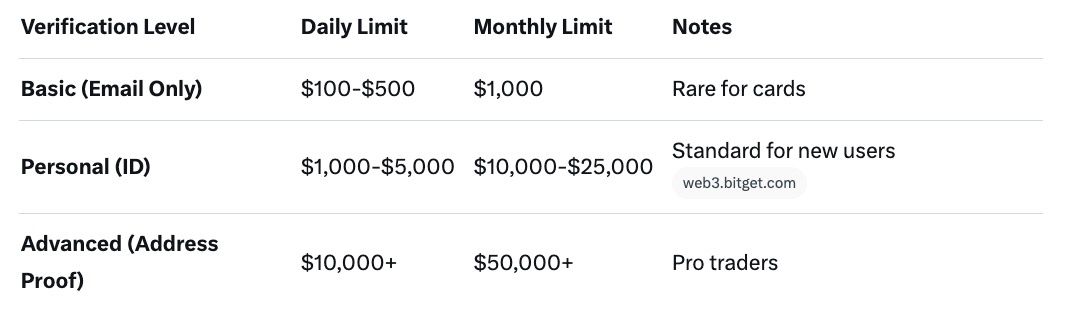
Limits depend on your platform, region, verification level, and your issuer's cash advance limit, and they change over time. Check the limit shown in the app before you plan a larger purchase. Minimum amounts are usually around $10 to $20 but vary.
Verification Process: KYC for Credit Card Crypto Buys
KYC combats money laundering and is mandatory on regulated platforms.
What It Involves
- Basic: Email and phone, which may unlock small buys.
- Identity: Government ID plus a selfie with a liveness check.
- Address: A recent bill or bank statement, if requested.
- Source of Funds: Usually only for large purchases or flagged activity.
Time: minutes to a couple of days. If you are rejected, fix the documents and retry.
Why? It protects you by confirming the platform is regulated. Card purchases through on-ramps are also tied to your identity, so do not expect anonymity when paying by card.
Security Tips: Staying Safe When Buying Crypto with Credit Card
Crypto scams are a major problem. The FBI's IC3 recorded about $11.4 billion in crypto-related fraud losses in 2025, a record, including $7.2 billion from investment scams. Prioritize protection.
Key Tips
- Choose Regulated Platforms: Check licensing and security track record. Note that FDIC insurance does not cover crypto held on exchanges.
- Enable 2FA: Use an authenticator app or hardware key rather than SMS.
- Protect Your Card: Use a virtual or single-use card if your bank offers one, and monitor statements.
- Avoid Phishing: Use official URLs only, and ignore unsolicited links, DMs, and "guaranteed return" offers.
- Credit Habits: Pay the balance in full to avoid interest, and keep utilization low.
- Wallet Security: Use a hardware wallet for larger holdings and back up your seed phrase offline.
- Small Starts: Make a $50 test purchase before scaling up.
On-ramps like MoonPay deliver crypto to the wallet address you provide, but they still run KYC and apply their own fees, so check the provider's terms. Report scams to the FTC and your bank.
For post-purchase, check Swapping with Baltex.io.
After Your Purchase: Swapping Crypto with Baltex.io
Got BTC and want something else? baltex.io is a multi-chain swap service with 10,000+ coins across 200+ networks.
Why Baltex.io?
- Multi-Chain: Swap BTC to ETH, SOL, or Polygon assets, with cross-chain and bridge modes.
- Fees: Low fees shown before you confirm, plus network costs. Compare the final amount you receive with other options.
- Speed: Baltex reports an average completion time under 5 minutes on most routes, and a few minutes to 30 minutes depending on the coin and network.
- Accounts and KYC: Standard swaps need no account, but Baltex can request KYC if a transaction fails its risk checks, involves high-risk regions, or shows high-risk patterns.
Quick Swap Guide
- Open baltex.io and pick your pair, for example BTC → USDC on Polygon, and enter the amount.
- Choose a mode (cross-chain, DEX, bridge, or private) and enter your destination address.
- Send the deposit to the address shown, and Baltex delivers to your wallet. In the DEX Layer, you instead connect a self-custody wallet and approve the swap there.
- Wait for confirmations and check the received amount.
Ideal for DeFi yields or altcoin plays. Follow @baltexio on X for updates.
FAQ: Common Questions on Buying Crypto with Credit Card
Can I buy crypto with a credit card on Coinbase in 2026?
Yes, in supported regions, if your issuer allows it. Coinbase charges 3.99%, your issuer may add a cash advance fee and interest, and limits depend on your verification level.
What are the fees for credit card crypto purchases?
Typically 3% to 5% or more from the platform plus a cash advance fee and interest from the card issuer, so total costs of 7% to 9% or more are common.
Do I need verification to buy crypto with a card?
Yes. Regulated platforms require KYC (ID plus selfie), and card payments are tied to your identity.
Is it safe to buy crypto with a credit card?
It can be, on reputable platforms with 2FA, but the main risks are fees, interest, and debt. Avoid buying on credit what you cannot afford to lose.
What's the minimum amount to buy?
Often around $10 to $20, but it varies by platform.
Can Amex be used for crypto buys?
Some guides report that American Express allows it, while many other issuers block it. Check your own card's policy.
More? Visit platform help centers.
Conclusion: Start Your Crypto Journey Safely Today
Buying crypto with a credit card in 2026 is straightforward, but it is usually the most expensive way to buy. From Coinbase's simplicity to on-ramp convenience, follow our steps, mind fees and limits, and secure your setup. If a debit card or bank transfer is available, compare the total cost first. Post-buy, baltex.io offers swaps across 200+ networks.
Remember: Invest only what you can afford to lose, since crypto is volatile. Start small and keep learning. Questions? Tweet @baltexio.
For more on this, see our guide on How to Swap Coins on Crypto.com: Fast Tutorial with Low Fees.
Related reading: Step 1: Choose a Platform That Supports Debit Card Purchases.
You can read our full breakdown in Linea Bridge Tutorial: Cheapest Ways to Move ETH (July 2026).