
 2 minutes to read
 Ecosystem
TLDR Orbiter Finance excels as the safest, most ZK-rollup-native bridge in 2026, enabling near-instant transfers of native ETH, USDC, USDT, and DAI between 60+ chains—with heavy emphasis on zkSync Era, Linea, Scroll, Starknet, Polygon zkEVM, and other ZK solutions—using its decentralized Maker-Sender model backed by ZK proofs and collateralized deposits. Fees average 0.05–0.25 % all-in (trading + withholding), often lower than pool-based alternatives on ZK corridors, with fills in 5–25 seconds and zero slippage on quoted rates. With 4M+ users, $15B+ lifetime volume, 30M+ transactions, and a flawless security record since 2022, Orbiter minimizes risks through optimistic arbitration and SPV + ZK verification. Compared to generalist bridges like Across or Stargate, it wins on ZK-specific efficiency and trust-minimized design. When combined with aggregators like baltex.io, users gain seamless routing beyond pure rollup flows.
ZK-rollups have become the dominant scaling path for Ethereum by early 2026, with ecosystems around zkSync, Linea, Scroll, Starknet, and newer entrants like BOB and JuChain attracting billions in TVL for low-gas DeFi, NFTs, and gaming. Yet moving assets between these rollups—or to/from Ethereum mainnet—still carries friction: high mainnet gas for some bridges, wrapped tokens, slippage, or long waits. Orbiter Finance addresses this directly as a purpose-built cross-rollup bridge optimized for ZK environments. Its design inherits the security assumptions of the underlying ZK-rollups while adding decentralized liquidity provision and cryptographic guarantees. For yield farmers rebalancing between Linea and Scroll, traders arbitraging zkSync perps against Starknet, or institutions consolidating treasury across ZK chains, Orbiter delivers the speed, cost predictability, and native-asset delivery that make multi-rollup strategies viable at scale.
Orbiter operates through a decentralized Maker-Sender model enhanced by zero-knowledge technology. When you want to bridge 5,000 USDC from zkSync Era to Linea, you connect your wallet at orbiter.finance and receive a quoted rate plus a unique security code. You then send your input assets plus the small withholding fee directly to a Maker-controlled address on the source chain (no interaction with a shared pool contract on source). The selected Maker, who maintains inventory on the destination, immediately releases the equivalent native USDC to your recipient address on Linea—typically within seconds.
Behind the scenes, the protocol uses Simple Payment Verification (SPV) to confirm the source transaction on-chain, combined with ZK proofs for efficient verification without revealing full details. Makers are required to deposit excess collateral into the Maker Deposit Contract (MDC) on the destination side, creating economic security. If a Maker fails to fulfill or acts maliciously, the Sender can initiate arbitration within the challenge window; the MDC automatically refunds the Sender plus compensation from the Maker’s margin. This “fulfill-first on destination, verify-later” flow gives users instant receipt while keeping the protocol trust-minimized. Everything stays fully on-chain and auditable, with no wrapped assets on supported ZK-native routes.
The architecture deploys smart contracts primarily on the destination side only, reducing gas overhead and aligning with ZK-rollup efficiency. Recent 2025 upgrades integrated advanced ZK circuits for faster dispute resolution and added support for non-EVM ZK chains like Starknet expansions.
Orbiter connects 60+ blockchains with particular strength in ZK-rollups, making it the preferred rail for users living inside the ZK ecosystem. Core ZK networks include zkSync Era, Linea, Scroll, Starknet, Polygon zkEVM, zkFair, and newer additions like BOB and JuChain. Optimistic rollups such as Arbitrum, Optimism, and Base are fully supported for hybrid flows, alongside Ethereum mainnet, BNB Chain, Polygon PoS, Solana, TRON (added December 2025), and others. This gives seamless any-to-any routing like zkSync → Scroll USDC or Linea ETH → Starknet, all delivered as native assets. The protocol’s light-contract design allows rapid integration of new ZK-rollups—often within weeks of their mainnet launch—without locking massive liquidity.
Orbiter keeps fees transparent, competitive, and volume-adjusted. The structure includes:
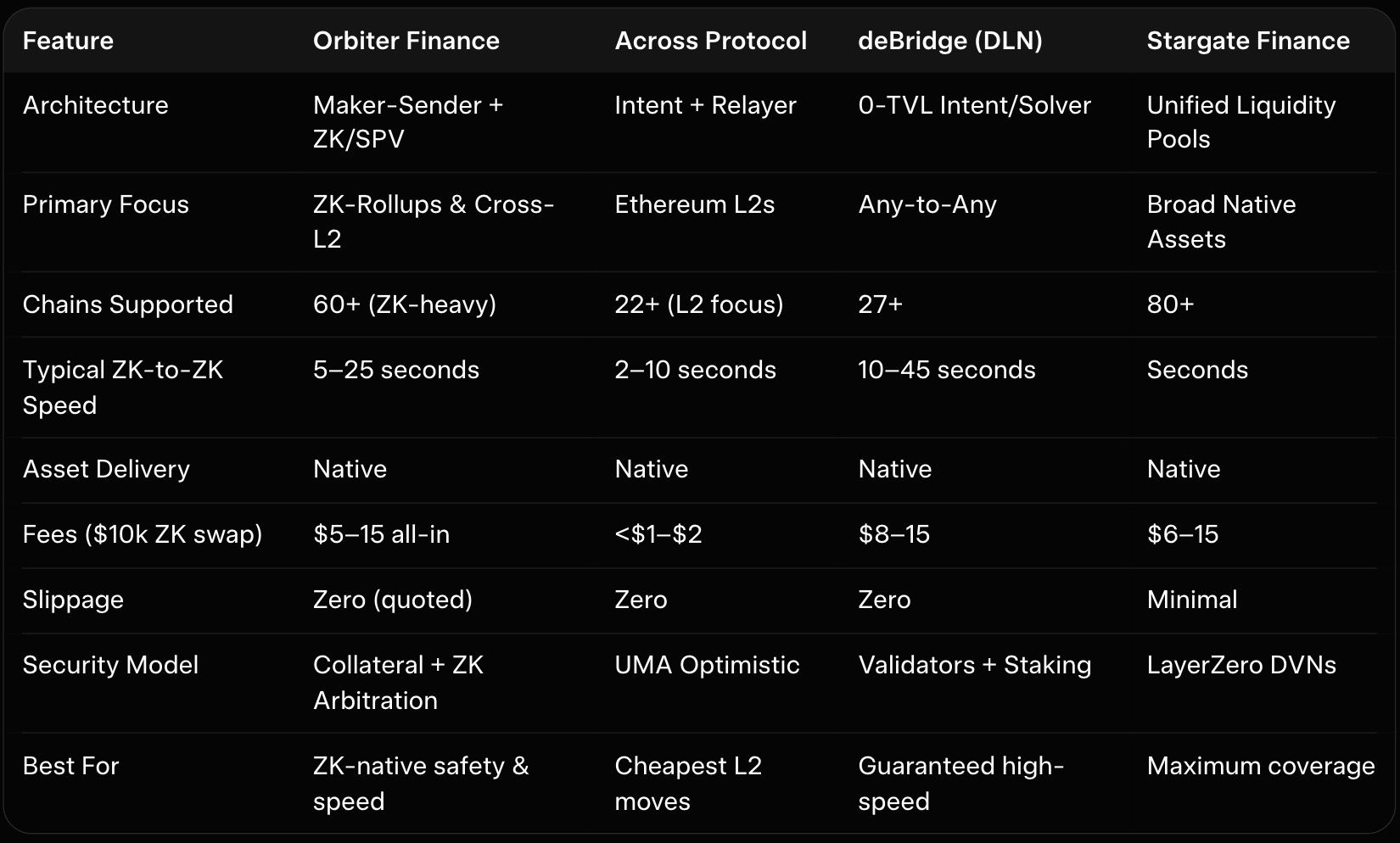
For a typical $10,000 USDC transfer between two major ZK-rollups like zkSync to Linea, the all-in cost usually lands at $5–$15 including gas—frequently the lowest among specialized rollup bridges once destination gas savings are considered. Fees auto-adjust based on network congestion and Maker competition, and the UI displays the exact total before confirmation. No hidden slippage or destination approvals required.
Liquidity is provided entirely by a decentralized network of Makers—professional operators and institutions who run automated nodes and maintain balanced inventories across chains. Makers earn the trading and withholding fees by fronting destination assets, with their collateral locked in MDC contracts acting as skin-in-the-game. This eliminates fragmented pools and the TVL drag seen in traditional bridges. During peak demand on popular ZK corridors, competition among Makers tightens spreads and speeds up fills. Users never interact with shared liquidity pools on the source side, avoiding impermanent loss or drain risks.
Makers function as decentralized relayers with economic alignment. Anyone can become a Maker by depositing collateral and running the open-source software, though professional operators handle the majority of volume due to optimization for speed and capital efficiency. The protocol ranks and selects Makers based on performance history, collateral level, and quote competitiveness. This open participation ensures censorship resistance while ZK proofs and SPV keep verification lightweight and secure.
From the user perspective, settlement is near-instant. Most ZK-to-ZK transfers complete in 5–25 seconds, with the destination assets arriving before the source transaction even reaches finality in many cases. Ethereum mainnet to ZK-rollup routes average 15–60 seconds. The interface at orbiter.finance is minimalist: select source/destination, input amount, review quote and security code, confirm. Wallet support includes MetaMask, Rabby, and hardware options. Advanced features like batch transfers and API access cater to power users and dApps.
Orbiter’s security rests on three pillars tailored for ZK environments:
The protocol has processed $15B+ with zero exploits or fund losses since inception. Continuous audits, bug bounties, and gradual feature rollouts further reduce smart-contract risk. Because contracts are destination-only and ZK-light, attack surface remains minimal compared to dual-chain pool designs.
Feature Comparison Table
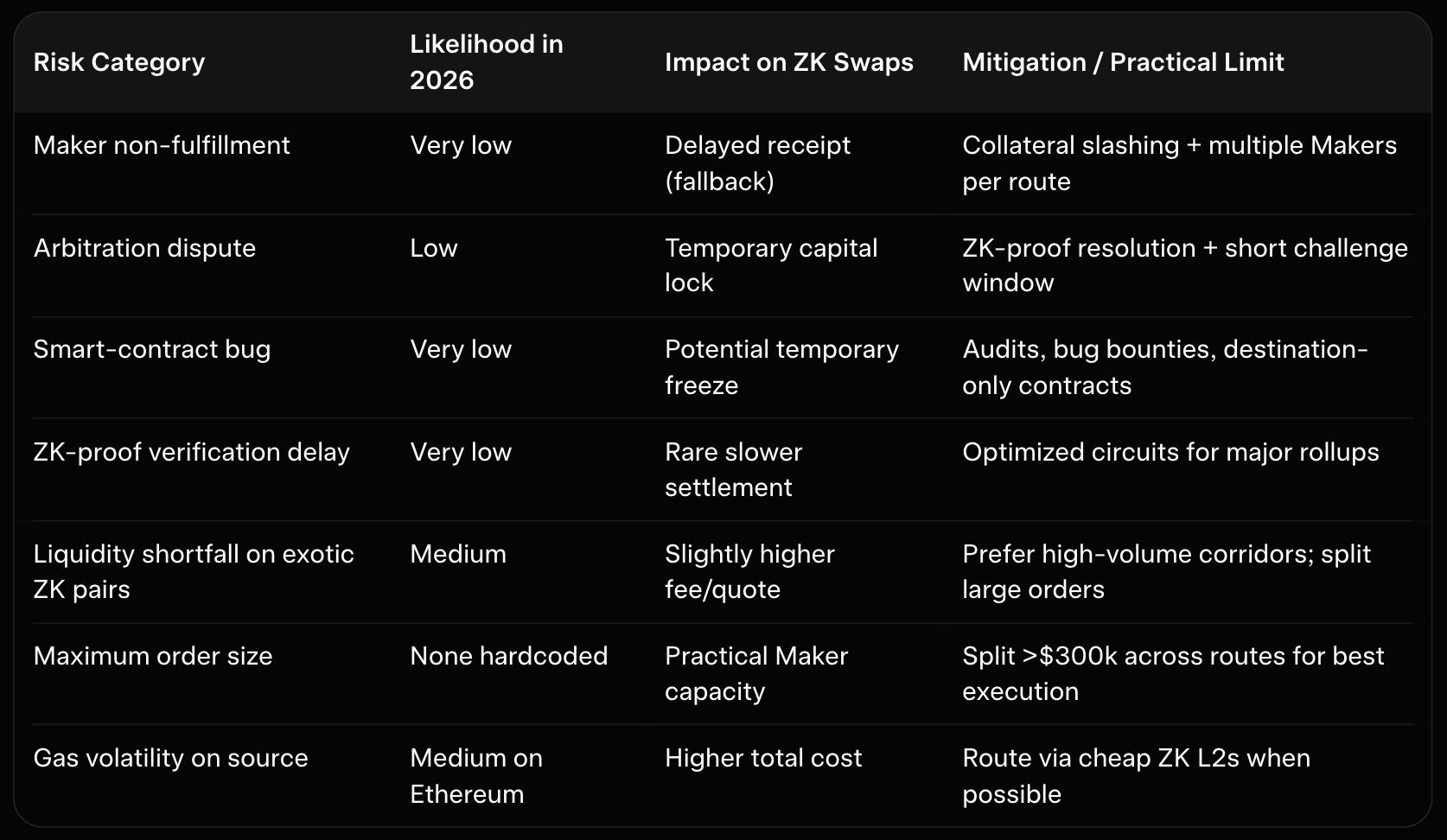
Risks and Limits Table
While Orbiter provides the specialized, secure rails optimized for ZK-rollup to ZK-rollup native transfers, baltex.io acts as a non-custodial aggregator and intelligent router that operates above Orbiter and dozens of other bridges and DEXes. For users whose strategies extend beyond pure ZK flows—such as bridging from Scroll to Solana, swapping into privacy assets, or optimizing across 200+ networks—baltex.io scans Orbiter alongside Across, deBridge, Stargate, Symbiosis, and direct DEX paths to assemble the absolute best route.
Key differences versus using Orbiter directly include broader token and chain coverage, one-click abstraction that hides complexity, built-in privacy tools for obfuscating transaction trails, and no artificial volume caps. baltex.io frequently selects Orbiter internally for the ZK leg of a journey when it offers superior speed or security, then stitches additional paths for the final destination. Many serious DeFi participants therefore keep Orbiter bookmarked for core ZK rebalancing while routing everything more complex or privacy-sensitive through baltex.io. The two services are highly complementary: Orbiter supplies the trustworthy ZK-native highway; baltex.io supplies the global smart-navigation and privacy overlay.
Is Orbiter Finance the safest bridge for ZK-rollups in 2026? Yes—its Maker collateral, ZK proofs, and destination-only contract design deliver superior security for ZK-native transfers compared to generalist bridges.
How fast are Orbiter ZK-to-ZK transfers? Most complete in 5–25 seconds with native assets received almost immediately.
What are typical fees on Orbiter? $5–$15 total for a $10,000 stablecoin move between major ZK-rollups—highly competitive once gas savings and zero slippage are included.
Is Orbiter safe for large ZK transfers? With $15B+ processed, 30M+ transactions, and zero exploits, it is among the most trusted. Best practice remains testing small amounts first and splitting very large orders.
Does baltex.io replace Orbiter? No—it enhances it. baltex.io often chooses Orbiter routes for ZK segments while adding multi-path optimization and privacy features.
Can I integrate Orbiter into my dApp or bot? Yes. Full SDK, API, and widget support allow seamless embedding of ZK-optimized bridging.
In the ZK-dominated scaling landscape of 2026, efficient and secure movement between rollups is essential for unlocking the full potential of Ethereum’s modular future. Orbiter Finance has established itself as the gold-standard infrastructure for exactly that purpose—delivering native-asset transfers with ZK-level security, sub-30-second speeds, and ultra-low fees that make frequent cross-rollup activity profitable rather than painful. Its decentralized Maker model, collateral-backed guarantees, and cryptographic verification set a new bar for trust-minimized bridging tailored to the ZK ecosystem.
Whether you are a retail user hopping between Linea yields and zkSync perps, a protocol team rebalancing treasury across Scroll and Starknet, or a developer building the next ZK-native application, Orbiter belongs at the heart of your workflow. When your needs grow beyond pure rollup corridors, baltex.io provides the perfect intelligent layer on top, ensuring every transfer—simple or complex—remains fast, cheap, and private.
Visit orbiter.finance today, connect your wallet, and experience why millions have chosen the safest way to move value across the exploding universe of ZK-rollups. In 2026, bridging between ZK chains should feel effortless—and with Orbiter, it finally does.
G. Khan
 Ecosystem
G. Khan
Ecosystem
G. Khan
Ecosystem
G. Khan
Ecosystem
G. Khan
Ecosystem
G. Khan
Ecosystem
