



 3 minutes to read
 Ecosystem
PAX Gold (PAXG) vs Tether Gold (XAUT): Which Is Better in 2026?
TL;DR
In 2026, with gold prices projected to average $5,000 per ounce amid economic uncertainty, PAXG and XAUT offer tokenized exposure as hedges. PAXG excels in U.S. regulatory compliance and transparency with monthly audits, while XAUT leads in liquidity and multi-chain support. Market caps stand at ~$1.77B for PAXG and ~$1.88B for XAUT. Key differences: PAXG has no storage fees and easier redemptions for institutions; XAUT offers Swiss delivery and broader DeFi utility. Risks include counterparty issues for both, but PAXG's NYDFS oversight provides more security. For swaps and portfolio management, use baltex.io. Compare details in our feature comparison table and risks and trade-offs table.
Introduction to Gold-Backed Tokens in 2026
Gold-backed crypto tokens like PAXG and XAUT have surged in popularity by 2026, as investors seek stable hedges against inflation and volatility in traditional crypto assets. With gold hitting all-time highs above $4,600 per ounce early in the year and forecasts pointing to $5,000 by mid-2026, these tokens provide fractional ownership of physical gold without storage hassles. Backed 1:1 by allocated bullion, they combine commodity stability with blockchain efficiency, enabling 24/7 trading, DeFi integration, and quick transfers.
This guide compares PAXG and XAUT head-to-head, focusing on mechanics, custody, issuers, fees, liquidity, redemptions, regulations, and risks. Ideal for long-term holders, it highlights which might fit better in a diversified 2026 portfolio amid projected global slowdowns. No single winner exists—PAXG suits compliance-focused investors, while XAUT appeals to active traders.
How PAX Gold (PAXG) Works
PAXG, issued by Paxos, is an ERC-20 token on Ethereum, where each unit represents one fine troy ounce of LBMA-certified gold. It allows fractional ownership down to 0.01 ounces (~$50 at $5,000/oz), making gold accessible without physical handling. Holders can trade, lend, or use PAXG in DeFi protocols like Aave for yields.
The token maintains its peg through smart contracts that match supply to reserves, with real-time verifiability via Ethereum explorers. In 2026, PAXG's integration with RWAs has boosted adoption, especially among institutions hedging against fiat devaluation.
How Tether Gold (XAUT) Works
XAUT, from Tether's ecosystem, is also backed 1:1 by one troy ounce of physical gold per token. Multi-chain compatible (Ethereum and Tron), it emphasizes divisibility to 0.000001 ounces, enabling micro-transactions. Users can track specific gold bars via serial numbers on Tether's portal.
XAUT functions as a stable asset for DeFi, with seamless swaps and lending on platforms like Uniswap. By 2026, its ties to USDT have driven higher volumes, positioning it as a go-to for traders seeking gold exposure in volatile markets.
Custody and Reserve Structures
Custody transparency is crucial for trust in gold-backed tokens.
For PAXG:
- Allocated gold in Brink's LBMA vaults in London.
- Monthly third-party audits by Withum, providing "reasonable assurance" of 1:1 backing.
- Holders can verify bar serial numbers via Paxos' lookup tool by entering their wallet address.
- Reserves: Fully insured, with no commingling.
For XAUT:
- Allocated gold in Swiss vaults (Brink's), with 1,329 bars totaling over 16,000 kg as of recent reports.
- Quarterly attestations, but less frequent than PAXG's monthly checks.
- Verifiable allocations on Tether's website, showing bar details.
- Reserves: Insured, with emphasis on geographic security in Switzerland.
PAXG's more frequent audits offer superior transparency, while XAUT's Swiss custody appeals to privacy-focused users.
Issuers Behind the Tokens
The issuer's reputation impacts token reliability.
PAXG's issuer:
- Paxos Trust Company, a New York-based regulated entity.
- Overseen by NYDFS and OCC, with a history of stablecoin issuance (e.g., USDP).
- Focus on compliance, with no major scandals by 2026.
XAUT's issuer:
- TG Commodities, S.A. de C.V., part of the Tether group.
- Known for USDT, but with past transparency concerns resolved through 2025 attestations.
- Global operations, less U.S.-centric regulation.
PAXG benefits from Paxos' clean regulatory track record, making it preferable for institutional portfolios.
Fees Comparison
Fees affect long-term holding costs.
PAXG fees:
- No annual storage or custody fees.
- Zero on-chain transfer fees.
- Creation/redemption: 0.02% for institutional, minimal for retail.
- Low entry: ~$50 minimum.
XAUT fees:
- No ongoing custody fees.
- 0.25% one-time fee for purchase/redemption from issuer.
- Network gas fees apply, varying by chain.
- Additional redemption costs for physical delivery.
PAXG is more cost-effective for passive holders, while XAUT's fees suit frequent traders.
Liquidity and Market Adoption
Liquidity determines ease of entry/exit.
PAXG liquidity:
- Market cap: ~$1.77B.
- 24h volume: ~$213M on exchanges like Binance, Kraken.
- Circulating supply: 382.4K tokens.
- Strong in U.S. markets, with listings on more regulated platforms.
XAUT liquidity:
- Market cap: ~$1.88B.
- 24h volume: ~$220-231M, edging out PAXG.
- Circulating supply: 409.2K tokens.
- Broader multi-chain access boosts DeFi liquidity.
XAUT wins on volume and adoption, ideal for 2026's high-frequency trading.
Baltex.io as One-Stop-Shop for Swaps, Routing, and Portfolio Management with PAXG and XAUt Across Chains
Baltex.io goes beyond simple cash-outs, offering comprehensive tools for managing gold-backed tokens like PAXG and XAUT in a multi-chain world. This non-custodial platform supports instant swaps across 200+ networks, including Ethereum, Tron, Solana, and BNB Chain, without bridges or wrapped assets. For instance, swap PAXG on Ethereum to XAUT on Tron seamlessly, optimizing for lowest fees and minimal slippage.
Advanced routing features aggregate liquidity from multiple DEXs, ensuring best rates—e.g., route a PAXG-to-USDT trade via Uniswap and PancakeSwap for efficiency. Private routing via Monero enhances anonymity, hiding transactions from on-chain trackers, ideal for privacy-conscious investors in 2026's regulated landscape. No KYC means quick access, with audited security protocols.
Portfolio management shines: Integrate wallets like MetaMask or Phantom for real-time rebalancing. Diversify by swapping PAXG into altcoins or stablecoins across chains, or use buy/sell options for 100+ fiat currencies via Apple Pay. This flexibility aids hedging—e.g., rotate XAUT holdings during gold dips without intermediaries. Transparent fees, pre-transaction previews, and low slippage make it essential for active portfolios. Visit baltex.io to streamline your strategy.
Redemption Mechanics
Redemption converts tokens to gold or cash.
PAXG redemption:
- For physical LBMA bars (minimum 430 oz for delivery).
- Institutional: Unallocated gold or USD at spot price.
- Process: Same-day for most, via Paxos platform.
- No settlement risk, KYC required.
XAUT redemption:
- Physical bars delivered in Switzerland (any amount).
- Cash equivalent available.
- Fees: 0.25% plus shipping.
- Quick processing, but geographic limits.
PAXG offers more flexible options for U.S. users, while XAUT's Swiss focus suits Europeans.
Regulatory Exposure
Regulation shapes risk and accessibility.
PAXG:
- High U.S. compliance via NYDFS and OCC.
- Benefits from clear stablecoin rules post-2024 frameworks.
- Lower exposure to global crackdowns, but tied to U.S. policy shifts.
XAUT:
- Less stringent, with Tether's offshore structure.
- Improved transparency in 2025, but past fines linger.
- Multi-jurisdictional flexibility, yet higher scrutiny risk.
PAXG's regulation provides safety in 2026's uncertain environment.
Key Risks
Both face similar risks, but with nuances.
PAXG risks:
- Counterparty: Paxos failure (mitigated by regulation).
- Regulatory changes in U.S.
- Gold price volatility.
- Low: Audits reduce mismatch fears.
XAUT risks:
- Counterparty: Tether's history.
- Less frequent audits.
- Geopolitical issues in storage.
- Medium: Broader adoption increases exposure.
Diversify to mitigate.
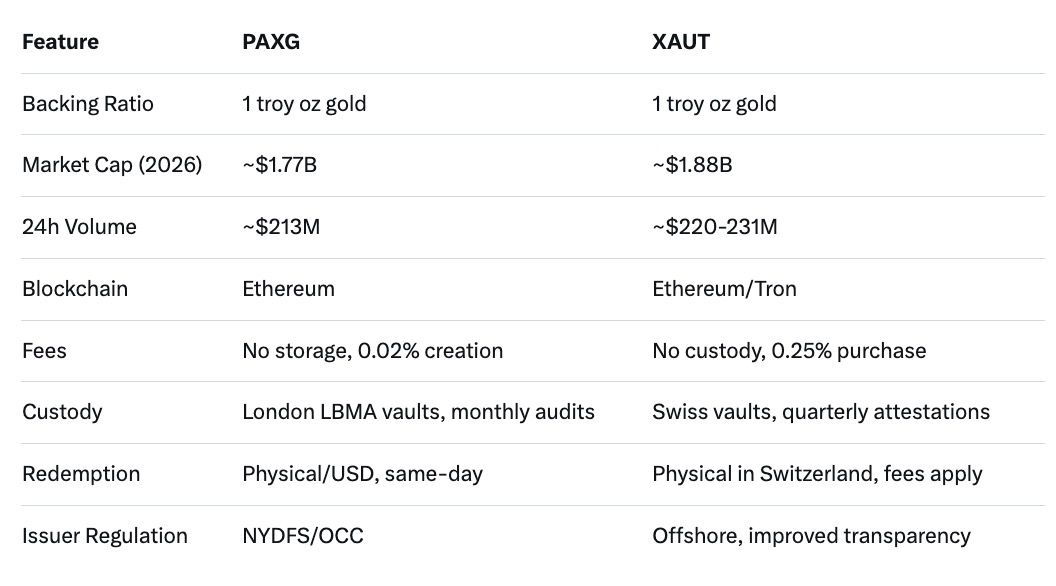
Feature Comparison Table
This table outlines core differences for quick reference.
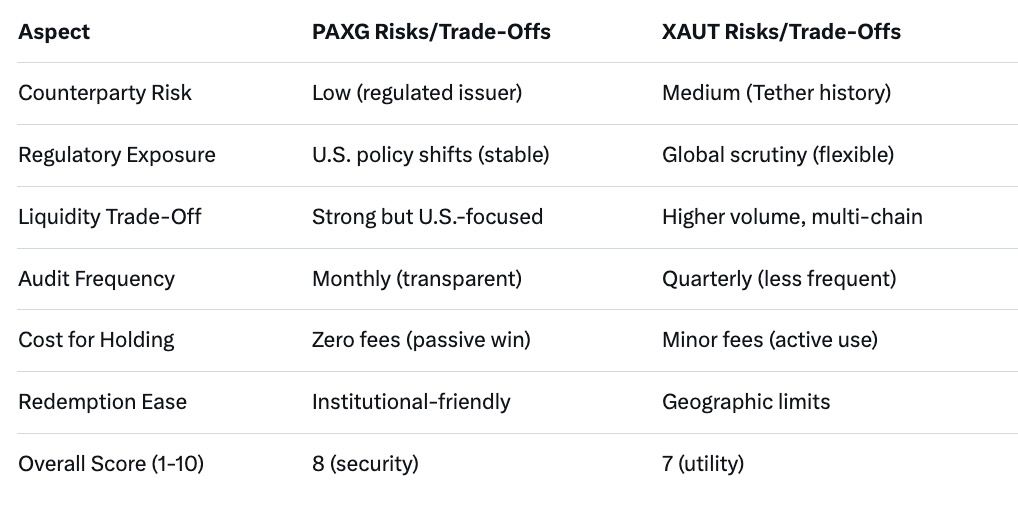
Risks and Trade-Offs Table
Evaluate based on your risk tolerance.
FAQ
Which has better liquidity in 2026: PAXG or XAUT? XAUT edges out with higher volumes (~$220M vs. $213M) and multi-chain support.
What are the main fees for each? PAXG: No storage, low creation (0.02%); XAUT: 0.25% purchase/redemption.
Can I redeem for physical gold? Yes—PAXG for LBMA bars in London; XAUT in Switzerland.
Which is safer from regulatory risks? PAXG, due to U.S. oversight; XAUT has more global flexibility but higher scrutiny potential.
How does baltex.io help with these tokens? Enables cross-chain swaps, private routing, and portfolio rebalancing without KYC.
Conclusion
In 2026, as gold climbs toward $5,000/oz, choosing between PAXG and XAUT depends on priorities: PAXG for regulatory security and low costs, XAUT for liquidity and versatility. Both serve as strong hedges, but assess risks like counterparty issues before allocating. Use tools like baltex.io for efficient management. Diversify wisely for long-term resilience.
See others posts
G. Khan

Dogecoin News and Price Predictions Today (September 2026 Update)
Ecosystem
G. Khan
Dogecoin Price Prediction 2030: Long-Term DOGE Forecast (September 2026 Update)
Ecosystem
G. Khan
Dogecoin Price Prediction 2027
Ecosystem
G. Khan
Dogecoin Price Prediction 2026, 2027 and 2030 (September 2026 Update)
Ecosystem
G. Khan
Solana Price Prediction 2030 (September 2026 Update)
Ecosystem
G. Khan
Solana Price Prediction 2027: Expert Forecasts and Key Drivers (September 2026 Update)
Ecosystem