



 2 minutes to read
 Ecosystem
Transparent vs Private Blockchains: Why Privacy by Default Matters
TL;DR
Transparent blockchains like Bitcoin and Ethereum make every transaction publicly visible forever, creating permanent financial footprints that enable surveillance and taint analysis. Private blockchains like Monero hide sender, receiver, and amount by default through protocol-level cryptography, delivering unlinkability and perfect fungibility without user effort. In 2026 privacy by default matters more than ever as chain-analysis tools grow more sophisticated and regulatory pressure increases on transparent ledgers. Baltex.io helps users bridge both worlds by routing transparently held assets into Monero’s private ecosystem for true confidentiality when needed.
Blockchains are often praised for their transparency, yet this very feature creates serious privacy problems for everyday users. Every transaction on Bitcoin or Ethereum is permanently recorded and visible to anyone with an internet connection. Analysts, governments, and corporations can track spending patterns, link identities, and build detailed financial profiles over time.
Privacy by default flips this model entirely. Instead of making everything public and forcing users to hide their activity, the protocol itself conceals sensitive details from the start. Monero demonstrates this approach in practice and shows why default privacy provides stronger, simpler protection than optional tools on transparent chains.
The Problem with Transparent Blockchains
On transparent blockchains every address, amount, and timestamp stays permanently recorded. Anyone can follow the money from genesis block to the present day. This creates a complete audit trail that links transactions across time and users.
Chain-analysis companies use heuristics like address clustering, common-input ownership, and taint analysis to deanonymize users with high accuracy. Even casual users leave permanent fingerprints through address reuse or predictable spending patterns. The transparency that makes these chains auditable also makes them surveillance-friendly.
How Privacy by Default Works
Privacy-by-default blockchains hide the sender, receiver, and amount on every transaction at the protocol level. Monero achieves this through ring signatures that mix the real spender with decoys, stealth addresses that create one-time recipient keys, and RingCT that conceals amounts. No user action is required — privacy happens automatically for everyone.
This design eliminates the two-tier system found on optional-privacy chains where some transactions stay fully visible. The entire network benefits from uniform protection so anonymity sets grow with every transaction. Our Monero wallet security best practices explains how this protocol-level approach prevents common privacy mistakes.
Anonymity Sets and Real Protection
Transparent blockchains have no meaningful anonymity set because every detail is public. Users must rely on external mixers or Layer 2 solutions that add complexity and still leave metadata traces. The result is fragile privacy that breaks under targeted analysis.
Monero’s anonymity set includes outputs from the entire chain because privacy is mandatory. The FCMP++ upgrade in 2026 pushed effective anonymity into the millions of possible decoys for every spend. Statistical attacks become impractical even for state-level actors.
Fungibility and Taint Resistance
On transparent blockchains coins carry history. Exchanges and merchants can blacklist addresses linked to past activity, creating tainted coins that lose value or usability. This breaks the core promise of fungible digital cash.
Monero’s mandatory privacy ensures every coin is identical and untaintable. No transaction history can be attached to specific units because nothing is publicly visible. Merchants accept Monero without worrying about compliance flags or rejection risks that plague transparent chains.
Usability and User Experience
Transparent blockchains feel simple at first but require users to learn complex privacy tools to avoid permanent leaks. Address reuse, mixing services, and careful withdrawal patterns add mental overhead and error risk. Many users never bother and simply accept reduced privacy.
Privacy-by-default chains like Monero feel simpler in daily use. Wallets generate fresh subaddresses automatically and display unified balances without forcing users to manage privacy modes. Sending and receiving works the same for everyone because the protocol handles confidentiality. Our best Monero mobile wallets guide and Cake Wallet review show how effortless the experience remains.
Real-World Implications in 2026
Transparent blockchains face increasing regulatory pressure as governments demand more on-chain visibility. Exchanges apply stricter KYC and blacklisting rules that affect ordinary users. The permanent public record makes compliance easier for authorities but erodes personal financial sovereignty.
Privacy-by-default chains like Monero protect users from mass surveillance and financial censorship. They enable truly private remittances, donations, and peer-to-peer trade without creating permanent dossiers. The design also reduces the effectiveness of chain-analysis tools that thrive on transparent data.
Feature Comparison
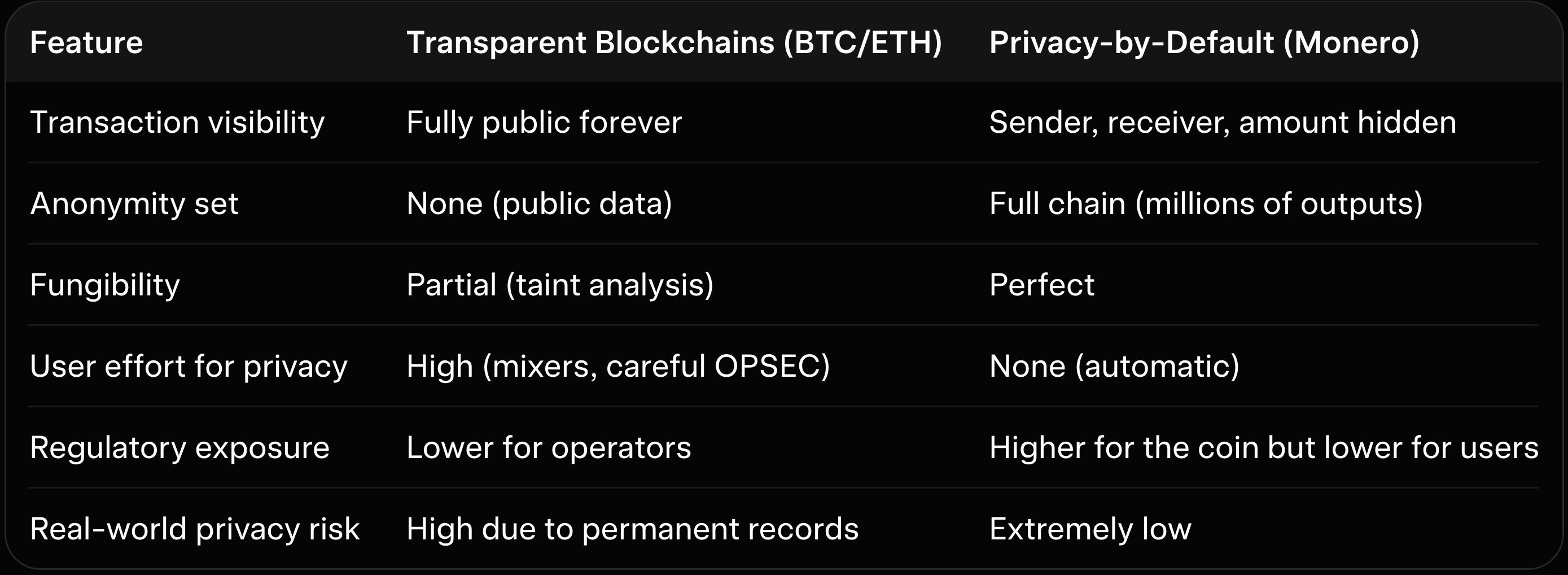
This table shows why privacy by default changes the entire risk profile. Transparent chains prioritize auditability over confidentiality. Monero prioritizes user sovereignty without forcing extra work.
Real-World Advantages
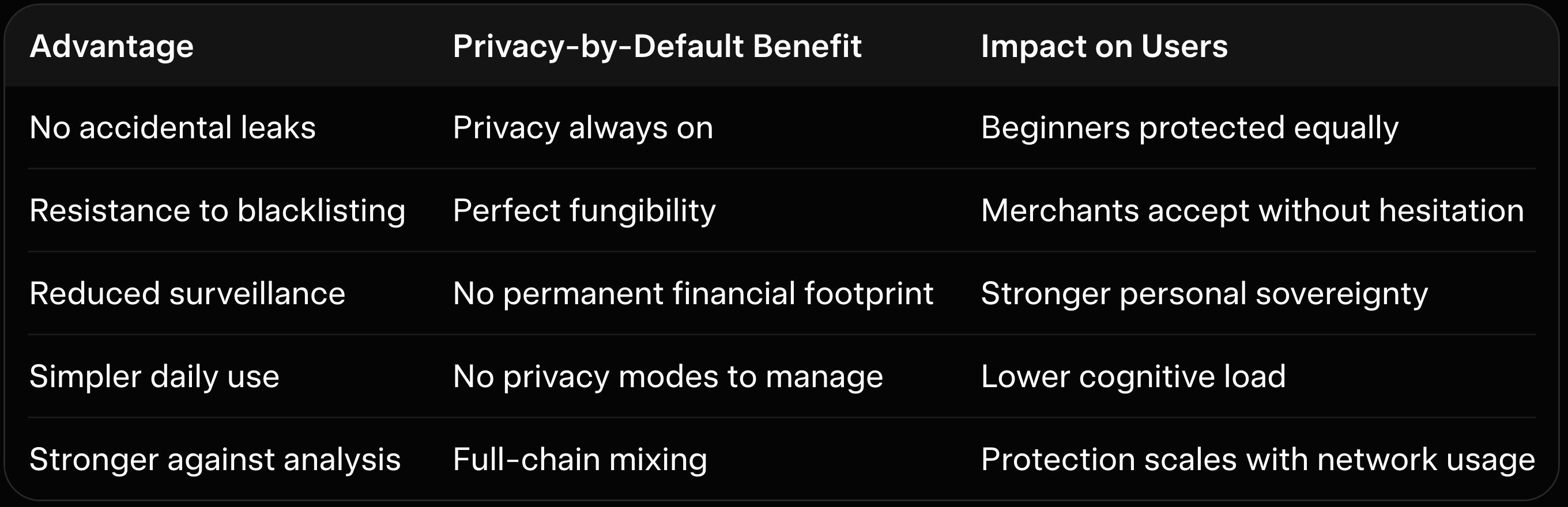
This table highlights measurable benefits that drive adoption of privacy-by-default chains. Users experience consistent protection without the trade-offs of optional systems.
How Baltex.io Enhances Privacy by Default
Many users hold assets on transparent chains for liquidity but want Monero’s privacy for sensitive transfers. Baltex.io bridges both worlds by accepting BTC or ETH deposits and delivering clean XMR outputs in one non-custodial transaction. You send from your transparent wallet to a Baltex deposit address and the platform routes privately without ever seeing your keys.
Enable Private Swap mode for extra shielded hops that maintain unlinkability during the transition. The workflow completes in minutes and works with any wallet including mobile options. For readers of our best no-KYC Monero swappers overview, Baltex.io provides the cleanest way to move from transparent exposure into Monero’s gold-standard privacy.
Traders convert Bitcoin holdings into Monero during high-surveillance periods and back again when liquidity matters more. The non-custodial design ensures keys never leave your control. Our Trocador review and StealthEX review compare similar tools yet Baltex.io excels for true one-click routing that complements privacy-by-default coins.
Businesses route transparent inflows through Baltex.io into Monero for private treasury management while keeping receive addresses isolated. Our best P2P Monero exchanges guide adds extra off-ramp options that pair naturally with this enhanced usage. Our hardware wallet for Monero guide and Monero wallet security best practices help users layer extra protection on top of these routed flows.
Advanced Routing Tips with Baltex.io
Use fresh subaddresses on Monero after routing to maintain maximum separation. Test small amounts first to confirm output destinations and timing. Combine with hardware wallets for larger amounts to keep spend keys offline.
Our best Monero desktop wallets guide and Monero GUI vs CLI wallet comparison guide wallet choice for efficient privacy workflows. Our best Monero mobile wallets guide and Cake Wallet review show mobile options for seamless cross-chain management.
FAQ Why does privacy by default matter more than optional privacy? It eliminates user error and accidental leaks while creating larger anonymity sets that protect everyone equally. Optional systems leave most activity exposed.
Is Monero more private than Bitcoin mixers? Yes. Monero removes third-party trust and logging risks while delivering stronger guarantees at the protocol level.
Do transparent blockchains offer any privacy? Only through external tools that add complexity and still leave metadata traces. Default privacy removes this burden entirely.
How does Baltex.io help with privacy routing? It converts transparent assets into Monero non-custodially so users gain protocol-level privacy without giving up liquidity options.
Will privacy by default become standard? Growing surveillance makes it increasingly attractive, though transparent chains still dominate for liquidity and programmability.
Can beginners benefit from privacy by default? Yes. Monero requires no privacy knowledge — protection happens automatically from the first transaction.
Conclusion
Transparent blockchains prioritize auditability and openness at the expense of user privacy while privacy-by-default chains like Monero put confidentiality first without forcing users to manage extra tools or trust third parties. Monero’s mandatory RingCT, perfect fungibility, and consistent real-world protection set the standard that optional systems struggle to match. The design eliminates accidental leaks and creates stronger anonymity sets that scale with network usage.
Privacy by default matters because financial surveillance affects everyone, not just those who actively seek to hide. Transparent ledgers create permanent records that enable profiling and censorship while privacy-by-default chains restore individual sovereignty without complexity. When you need to move value from transparent chains into true privacy, our best no-KYC Monero swappers overview shows exactly why Baltex.io belongs in every thoughtful user’s toolkit.
For deeper wallet and security strategies explore our best Monero mobile wallets guide, the Cake Wallet review, or the hardware wallet for Monero guide. Privacy should never be an afterthought or optional checkbox. Monero proves it can be the foundation instead.
For more on this, see our guide on Aztec Network: Best for Programmable Private Smart Contracts.
For more on this, see our guide on Aztec Network: Best for Programmable Private Smart Contracts.
For more on this, see our guide on Instant Swap Services: Fastest and Most Private Default Path.
Related reading: Zcash (ZEC) vs Monero (XMR): Which Privacy Coin Wins in 2026.
Related reading: Zcash (ZEC) vs Monero (XMR): Which Privacy Coin Wins in 2026.
Why does privacy by default matter more than optional privacy?
Is Monero more private than Bitcoin mixers?
Do transparent blockchains offer any privacy?
How does Baltex.io help with privacy routing?
Will privacy by default become standard?
Can beginners benefit from privacy by default?
See others posts
G. Khan

How to Buy Bitcoin and USDT in India (INR) (October 2026)
Ecosystem
G. Khan
The 10 Best Places to Buy Crypto Online in 2026
Ecosystem
G. Khan
The Cheapest Way to Buy Crypto: Fees by Payment Method Compared (October 2026)
Ecosystem
G. Khan
How to Buy Bitcoin and Ethereum in Canada (2026)
Ecosystem
G. Khan
How to Buy Bitcoin in the UK and Australia (October 2026)
Ecosystem
G. Khan
How to Buy Solana with a Credit or Debit Card (October 2026)
Ecosystem