4 minutes to read
 Ecosystem
What Is XDC Network? The Complete 2026 Guide to the Enterprise-Grade Hybrid Blockchain
TL;DR XDC Network (formerly XinFin) is an EVM-compatible, hybrid Layer-1 blockchain built for trade finance, real-world asset (RWA) tokenization, and cross-border payments. It combines a public mainnet with private subnet capabilities, produces blocks every 2 seconds with a stated capacity above 2,000 TPS, charges fractions of a cent per transaction, and uses the energy-efficient XDPoS 2.0 consensus with 108 masternodes. The native token XDC powers staking, fees, and governance, and since the January 2026 Cancun hard fork it also burns part of every fee. In 2026, XDC's story is institutional: eight institutional validators joined between April and June, and CertiK estimates about $1.1 billion in tokenized assets on the network.
1. XDC Network in One Paragraph (For Beginners)
XDC Network is a delegated proof-of-stake blockchain whose mainnet has been live since 2019, built by the Singapore-based XinFin team and now supported by the XDC Foundation. It targets banks, trade financiers, and large corporations that want blockchain benefits (immutability, speed, low cost) but need privacy options and compliance with standards like ISO 20022. It is EVM compatible, so Ethereum tools such as MetaMask, Hardhat, Remix, and OpenZeppelin work with minimal changes. Fees are a fraction of a cent. Since Ethereum's own fees have also dropped sharply by 2026, XDC's advantage today is less about price and more about predictable costs, fast finality, and enterprise features.
2. Public vs Private vs Hybrid: Where XDC Fits
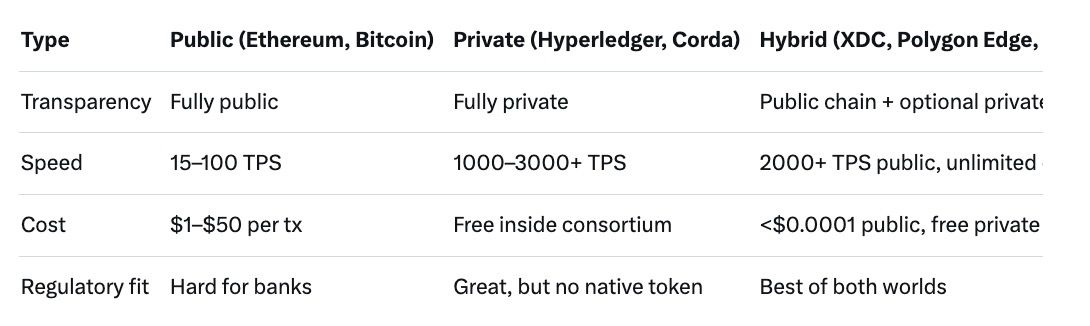
XDC is the "Goldilocks" solution: a public chain that enterprises can use alongside private, permissioned deployments.
3. Core Technical Features of XDC Network in 2026
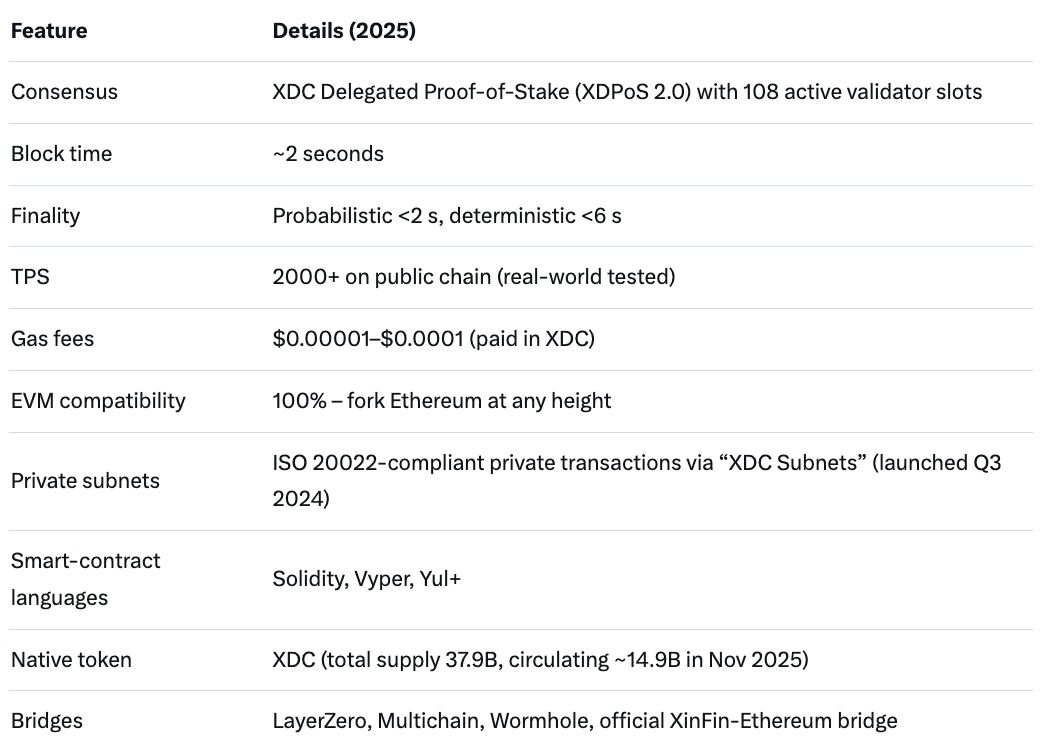
Two recent upgrades matter most. The XDC 2.0 consensus upgrade went live in autumn 2024 and moved the network to a Chained HotStuff-style BFT protocol. The v2.6.8 "Cancun" hard fork, completed in January 2026, aligned XDC with Ethereum's Cancun upgrade and introduced EIP-1559 fee burning.
4. How XDPoS 2.0 Consensus Works (Simple Explanation)
- Anyone staking at least 10 million XDC can run a masternode candidate.
- Token holders vote, and the top 108 candidates become active masternodes, with 300+ candidates in the pool, per The Block's network summary.
- Masternodes take turns proposing blocks (round-robin), with a 2-second block time.
- Byzantine Fault Tolerant (BFT) consensus provides finality in a few seconds; XDC's docs cite 2 to 4 seconds, while some summaries cite about 6 seconds.
- Rewards go to masternodes and voters, and XDC 2.0 adds on-chain forensic monitoring that identifies and slashes malicious validators.
- Resigning a masternode requires a 30-day period before the 10 million XDC can be retrieved.
Result: low energy use, fast finality for payments, and strong security. XDC describes itself as carbon-neutral.
5. XDC Token Utility – What Is the Token Actually Used For?
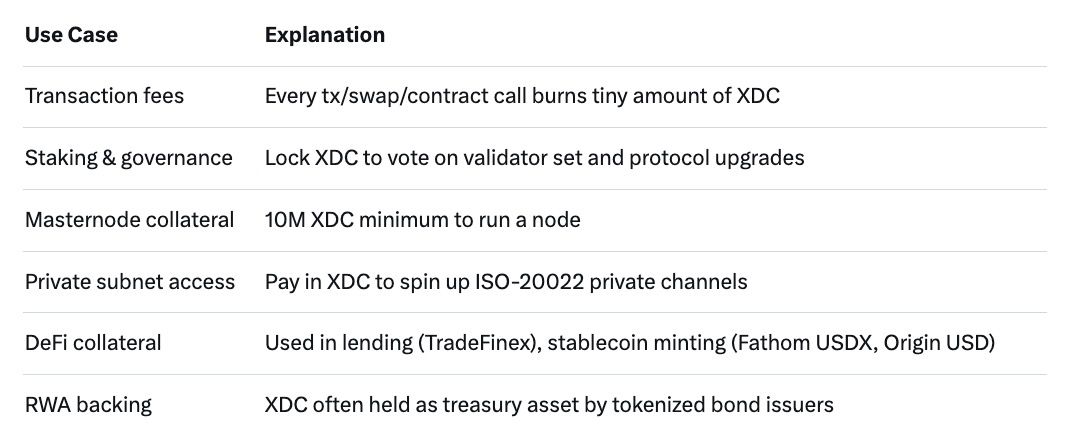
Since the Cancun fork, part of each transaction fee is burned, which links network usage to token supply.
6. Major Enterprise Use Cases Live in 2026
- TradeFinex and XDC Trade Network – Trade finance tooling, including electronic bills of lading, digital guarantees, and tokenized invoices, aimed at the trade finance gap for small and mid-sized businesses. Mercado Bitcoin used TradeFinex for the first international on-chain sale of fixed income on XDC.
- Tokenized real-world credit – CertiK's 2026 analysis puts tokenized value on XDC at about $1.1 billion, including roughly $860 million of real-world credit such as corporate debentures, agribusiness receivables, and operating-business loans. The largest single asset is a $143 million debenture for a highway operator.
- Tokenized funds – Per XDC's press release, Archax issued tokenized money-market funds from BlackRock, State Street, and Fidelity natively on XDC, and Securitize has tokenized a U.S. Treasury product (USTY) on the network.
- Institutional partners – The network lists alliances with SBI Japan, Deutsche Telekom MMS, Securitize, Archax, Mercado Bitcoin, and SERPRO Brazil, and has joined the MiCA Crypto Alliance.
- Stablecoins and lending – Fathom Protocol's FXD is an over-collateralized, soft-pegged stablecoin backed by XDC and approved assets, and Teller Protocol went live on June 3, 2026 with XDC-backed lending. Stablecoin supply on XDC exceeds its DeFi TVL on DefiLlama, which points to a payments-and-settlement profile more than a yield-farming one.
- Institutional staking – In 2026, DFNS added institutional staking support, and Ubyx, IXS, and CertiK joined as institutional masternode validators.
7. XDC vs Other Enterprise Blockchains (2026 Comparison)
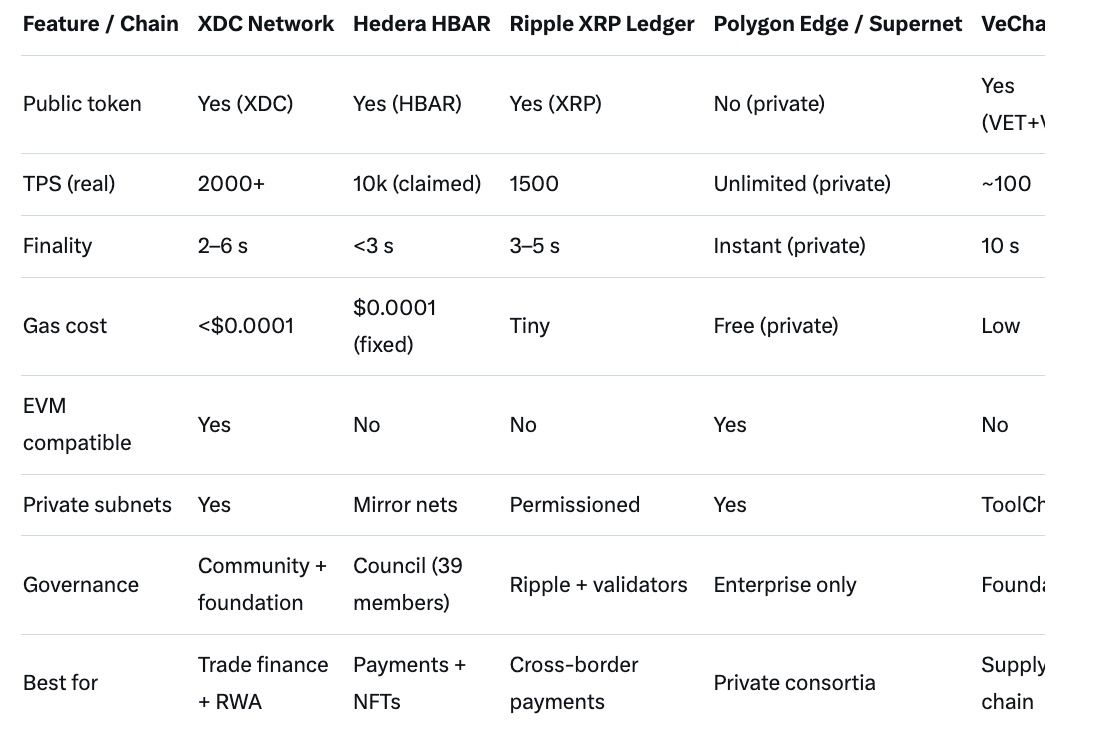
XDC fits best when you need public-chain liquidity and private, compliance-focused enterprise deployments at the same time.
8. Where to Buy & Swap XDC in 2026
- CEX: XDC has been listed on exchanges such as Bitfinex, Gate.io, KuCoin, HTX, and Bitrue. Listings change, so confirm current availability and regional restrictions on each exchange.
- DEX: XSwap, the native DEX on XDC Network.
- Swap option: baltex.io supports XDC swaps, for example XDC to ETH (Arbitrum) and XDC to ARB. It advertises low fees shown before you confirm, no account for standard swaps, and an average completion time under 5 minutes. Baltex may request KYC if a transaction trips its risk checks.
9. 2026 Ecosystem Growth Snapshot (October 2026)
- Network age: mainnet marked seven years of operation in 2026.
- Upgrades: Cancun hard fork (January 2026), and Guardian Nodes deployed on mainnet on August 6, 2026.
- Validators: eight institutional validators joined between April 21 and June 22, 2026, and MoneyGram was reported on October 16, 2026 as joining as an institutional validator.
- Identity and AI: Concordium was selected on October 15, 2026 as the identity verification provider for the XDC AI marketplace.
- Tokenization: about $1.1 billion in tokenized assets, per CertiK.
- DeFi: DefiLlama showed DeFi TVL in the low tens of millions of dollars in early 2026, so XDC's activity is not DeFi-TVL heavy.
FAQ – Most Asked Questions About XDC Network in 2026
Q: Is XDC a private or public blockchain? A: Both. The main chain is public and transparent; enterprises can use subnets for private or permissioned deployments that connect back to the public chain.
Q: Why is XDC so cheap and fast compared to Ethereum? A: XDPoS consensus with a limited set of 108 masternodes, 2-second blocks, and a high gas limit. Ethereum's own fees have fallen, so the difference is smaller than it used to be.
Q: Can I run MetaMask with XDC? A: Yes. Network name: XDC Network, RPC: https://rpc.xinfin.network (check XDC's docs for the current endpoint), Chain ID: 50, Symbol: XDC.
Q: Is XDC proof-of-stake environmentally friendly? A: Yes. As a proof-of-stake network with 108 validators, its energy use is small, and XDC describes itself as carbon-neutral.
Q: Where can I swap into XDC in 2026? A: Options include centralized exchanges, XSwap, and baltex.io, which supports XDC swaps with fees shown before you confirm. Check each service's current rules on KYC and supported regions.
Conclusion
In 2026, while retail DeFi chases the latest narratives, institutions keep building on chains that fit their compliance needs. XDC Network has become a leading EVM-compatible hybrid blockchain for trade finance, tokenized credit, and regulated settlement because it tries to balance public-chain access with enterprise requirements.
With fractions-of-a-cent fees, 2-second blocks, ISO 20022 alignment, EIP-1559 fee burning since the Cancun fork, and a growing roster of institutional validators, XDC is one of the few Layer-1s that can point to real institutional usage today. Its DeFi activity remains modest, so weigh that before expecting retail-style liquidity.
Whether you are a trader researching the token, a developer wanting cheap EVM deployment, or an enterprise exploring RWA tokenization, XDC deserves a serious look in 2026, along with the usual due diligence on liquidity, validator concentration, and token supply.
Start exploring: add the XDC network to your MetaMask, get some XDC through an exchange or baltex.io, and deploy a test contract for a fraction of a cent.
You can read our full breakdown in Samourai Wallet Swaps Review: Privacy Features for Bitcoin.
We cover this in more detail in Why These Altcoins Stand Out for Portfolio Diversification.