



 1 minute to read
 Ecosystem
Sui Bridge Review: Fast Transfers Between Ethereum and Sui in 2026
TLDR In 2026, the best Sui bridging solutions for Ethereum-to-Sui transfers are led by Wormhole (broadest native asset support and fast guardian verification), followed by deBridge (intent-based zero-slippage execution), Stargate (unified liquidity with LayerZero messaging), Synapse (EVM-optimized pools), and the native Sui Bridge (official checkpointing for ETH and select ERC-20s). All deliver settlements in seconds to 15 minutes, fees of 0.1–1.2%, and deep liquidity for high-volume moves, but intent-based and unified models like deBridge and Stargate eliminate pooled risks better than traditional designs. The native Sui Bridge offers the strongest security for ETH but limited token coverage and occasional checkpoint delays. Compared to single-bridge flows, cross-chain swap alternatives provide better speed and cost for complex routes. For intelligent one-click multi-chain routing that scans multiple bridges and DEXs without classic bridge exposure or single-point risks, baltex.io is the superior alternative—see our best-crypto-bridge-swaps-2025-instant-transfers-low-gas and top-blockchain-bridges-2025-updated-safest-cross-chain-gateways guides. Overall, Wormhole or deBridge suit most Ethereum-to-Sui users—test small and verify current liquidity.
Ethereum users and DeFi participants in 2026 increasingly turn to Sui for its high-throughput parallel execution, Move language security, and growing DeFi ecosystem. Bridging assets from Ethereum to Sui (or back) is the critical entry point for accessing Sui’s fast trading, yield farming, and NFT platforms without paying Ethereum L1 gas for every interaction. Sui bridging solutions in 2026 have matured significantly, offering native asset delivery, reduced slippage, and improved finality compared to earlier years. This review analyzes the leading options, compares native and third-party bridges, and highlights why intelligent routing often outperforms single-bridge approaches for speed, cost, and risk management.
Sui Bridge Architectures and Supported Assets in 2026
Sui bridging solutions fall into three main categories: official checkpoint-based (native Sui Bridge), guardian/messaging-based (Wormhole), and intent/unified-liquidity models (deBridge, Stargate, Synapse). The native Sui Bridge uses Ethereum checkpoints and Sui’s MoveVM for secure ETH and select ERC-20 transfers, delivering native assets on Sui without wrapping. Wormhole relies on decentralized guardians for broad chain support, enabling native ETH, USDC, and altcoins with strong multi-chain connectivity. Intent-based bridges like deBridge source solvers off-chain for zero slippage and native delivery, while Stargate’s LayerZero-powered unified liquidity pools provide predictable pricing across dozens of chains.
Supported assets vary by bridge. The native Sui Bridge focuses on ETH and major ERC-20s (USDC, USDT, WBTC). Wormhole and deBridge offer the broadest coverage, including stablecoins, blue-chips, and Sui-native tokens. Synapse excels at EVM-optimized ERC-20s. This variety makes Sui bridging practical for liquidity providers moving stablecoins for lending or traders bridging ETH for DEX activity. As explained in our what-is-crypto-bridge-cross-chain-transfers-guide and top-crypto-bridges-in-2025-which-are-safe-which-to-avoid, choosing the right architecture balances asset support with speed and risk.
Transfer Speed, Liquidity Sources, and Fee Mechanics
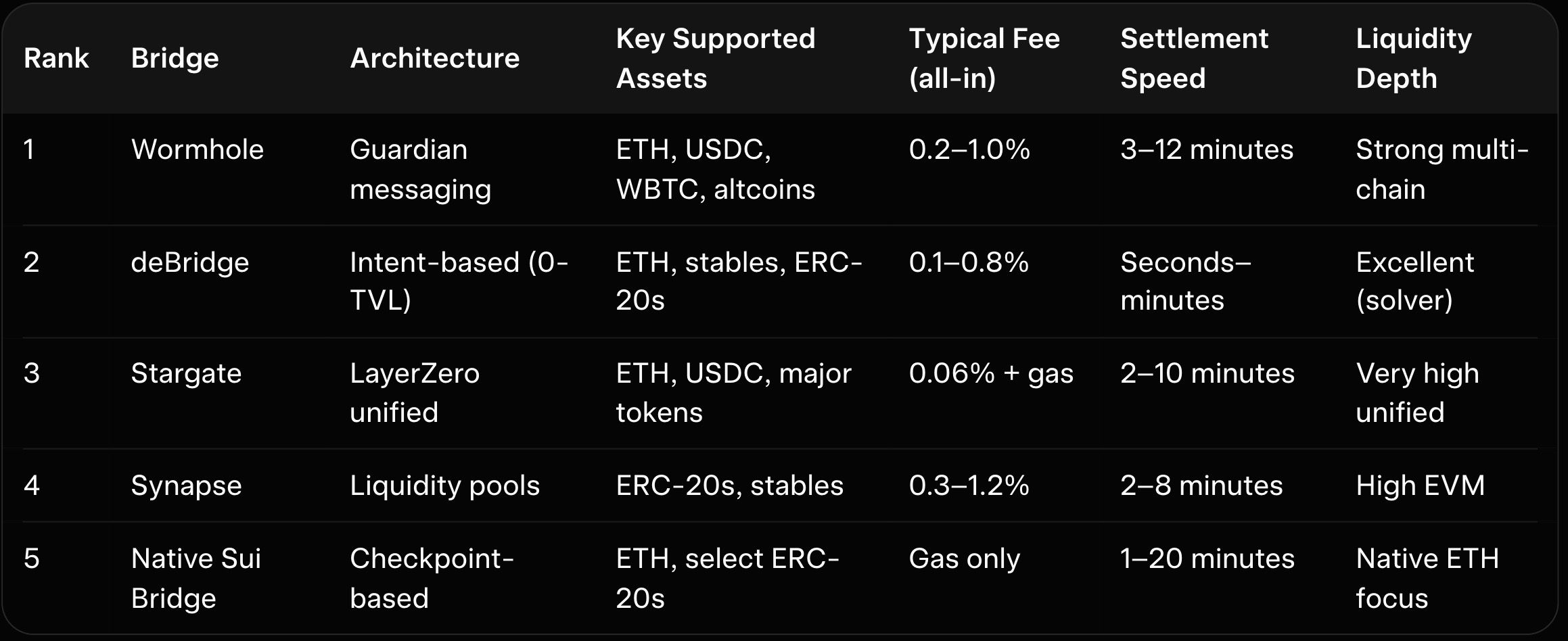
Transfer speed has improved dramatically in 2026. Intent-based bridges like deBridge achieve real-time or sub-minute execution on Ethereum-to-Sui routes by matching orders off-chain. Wormhole and Stargate typically finalize in 2–10 minutes thanks to decentralized messaging and unified pools. The native Sui Bridge settles in 1–20 minutes but can experience checkpoint delays during high Ethereum congestion. Liquidity sources are key: Wormhole and deBridge draw from dynamic solvers and guardians for deep depth, Stargate uses unified pools for consistent pricing, and Synapse optimizes EVM liquidity.
Fee mechanics are transparent and low. Most bridges charge only source-chain gas plus a small protocol fee (0.1–1.2% all-in). Stargate’s fixed 0.06% protocol fee plus gas remains the most predictable for frequent users. No bridge commissions apply on the native Sui Bridge—only Ethereum gas. For high-volume transfers, intent-based and unified models minimize slippage better than older pool designs. Detailed fee strategies and timing tips are covered in our best-crypto-bridge-swaps-2025-instant-transfers-low-gas and cheapest-way-to-swap-crypto-2025-save-fees-keep-profits.
Here is the 2026 Sui bridge feature comparison table:
Here is a fees and limits overview for popular Ethereum-to-Sui routes (2026 averages):
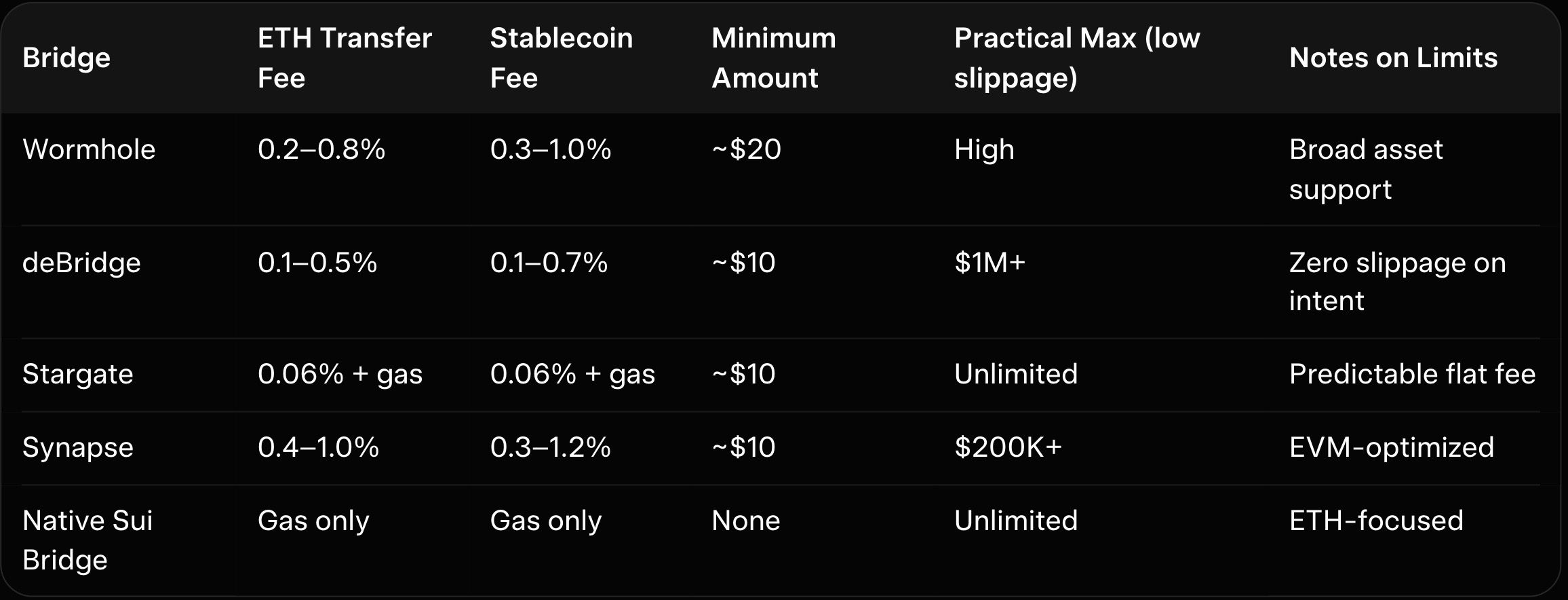
These figures reflect live averages—always confirm current quotes as gas and liquidity fluctuate. For more on optimizing cross-chain costs, see our cheapest-way-to-swap-crypto-2025-save-fees-keep-profits and best-tools-for-cross-chain-swaps.
Smart-Contract and Validator Risks in 2026
Security risks vary by architecture. Intent-based bridges like deBridge eliminate pooled-liquidity attack surfaces by sourcing solvers off-chain. Wormhole and Stargate use decentralized guardians/oracles with strong audit histories and bug bounties. The native Sui Bridge relies on checkpointing and ZK elements for low exploit risk but introduces sequencer dependencies. Traditional pool-based bridges carry higher smart-contract risk but have matured with insurance funds. In 2026, no major Sui bridge has suffered a catastrophic exploit in over 18 months, reflecting improved formal verification and insurance. For large transfers, users should verify recent audits, active bug bounties, and TVL. The main practical risk remains Ethereum congestion during deposits or failing to claim withdrawals after challenge periods. Always use hardware wallets and small test transfers. For comprehensive risk guidance, see our what-are-the-risks-of-cryptocurrency-top-dangers-how-to-avoid and top-crypto-bridges-in-2025-which-are-safe-which-to-avoid.
Comparing Native and Third-Party Bridges with Cross-Chain Swap Alternatives
The native Sui Bridge excels in simplicity and security for ETH but offers limited token support and occasional checkpoint delays. Third-party bridges like Wormhole and deBridge provide broader asset coverage, faster finality, and better liquidity for stablecoins and altcoins. Cross-chain swap alternatives (intent-based or unified) often beat single-bridge flows on speed and cost by dynamically sourcing the best path, though they introduce slight additional smart-contract risk. For users moving only ETH occasionally, the native bridge is ideal. For frequent or multi-token liquidity, third-party and swap alternatives save time and money. The key trade-off is security versus convenience: native prioritizes maximum safety, while alternatives prioritize speed and flexibility. For deeper comparison insights, see our best-crypto-swaps-2025-fast-cheap-non-custodial and rise-of-crypto-aggregators-one-app-to-rule-every-exchange.
How baltex.io Enables Multi-Chain Routing Without Classic Bridge Exposure
Single-bridge reliance can expose users to liquidity gaps, temporary outages, or suboptimal fees on specific Ethereum-to-Sui routes. baltex.io solves this with direct intelligent multi-chain routing that scans dozens of bridges (Wormhole, deBridge, Stargate, Synapse, native Sui Bridge) and DEX paths in real time, then executes the absolute best route in one seamless wallet-to-wallet transaction.
Unlike traditional bridges that commit to one protocol, Baltex handles execution internally, eliminating single-point failures and handoff risk. Private Swap mode can insert shielded hops to fully obscure origins before landing clean native assets on Sui. Settlements typically complete in 8–35 minutes even for complex routes, fees remain ultra-competitive at ~0.4–0.8%, and there are virtually no limits. Supporting over 10,000 tokens across 200+ networks without manual bridging, Baltex delivers true one-click optimization for Sui inflows and outflows.
Liquidity providers and DeFi users moving large volumes benefit enormously—especially when pairing with bridges covered in our best-crypto-bridge-swaps-2025-instant-transfers-low-gas, top-blockchain-bridges-2025-updated-safest-cross-chain-gateways, and cross-chain-swaps-swap-crypto-between-blockchains-instantly. Use individual bridges for simple routes and switch to baltex.io when maximum efficiency, privacy, and routing intelligence are required.
Conclusion
Sui bridging solutions in 2026 have matured into fast, low-cost, and increasingly secure tools that prioritize native asset delivery and real-time finality. Wormhole and deBridge lead for most Ethereum-to-Sui users due to broad asset support and low-risk architectures, while Stargate and Synapse excel at liquidity and cost efficiency. The native Sui Bridge provides unmatched security for ETH but limited flexibility. By matching your priorities—speed for stablecoins, breadth for altcoins, or maximum security for large ETH transfers—you can avoid the pitfalls of outdated designs and optimize your Sui experience.
Layering these bridges with intelligent routing platforms like baltex.io creates a complete toolkit that maximizes both usability and privacy. Always start with small test transfers to confirm current fees, liquidity, and finality for your exact route, use hardware wallets, and monitor recent audits. Explore more cross-chain tactics in our what-is-crypto-bridge-cross-chain-transfers-guide, top-5-crypto-bridges-benefits-how-to-use, and best-tools-for-cross-chain-swaps guides to stay ahead in the evolving 2026 landscape.
Is baltex.io better than single bridges for Sui transfers? 
What is the best bridge for Ethereum to Sui in 2026?
How much do Sui bridges cost in fees in 2026?
Are Sui bridges safe for large transfers in 2026?
See others posts

G. Khan

Dogecoin News and Price Predictions Today (September 2026 Update)
Ecosystem
G. Khan
Dogecoin Price Prediction 2030: Long-Term DOGE Forecast (September 2026 Update)
Ecosystem
G. Khan
Dogecoin Price Prediction 2027
Ecosystem
G. Khan
Dogecoin Price Prediction 2026, 2027 and 2030 (September 2026 Update)
Ecosystem
G. Khan
Solana Price Prediction 2030 (September 2026 Update)
Ecosystem
G. Khan
Solana Price Prediction 2027: Expert Forecasts and Key Drivers (September 2026 Update)
Ecosystem