 3 minutes to read
 Ecosystem
What Are the Risks of Cryptocurrency? Top Dangers and How to Avoid Them
TL;DR
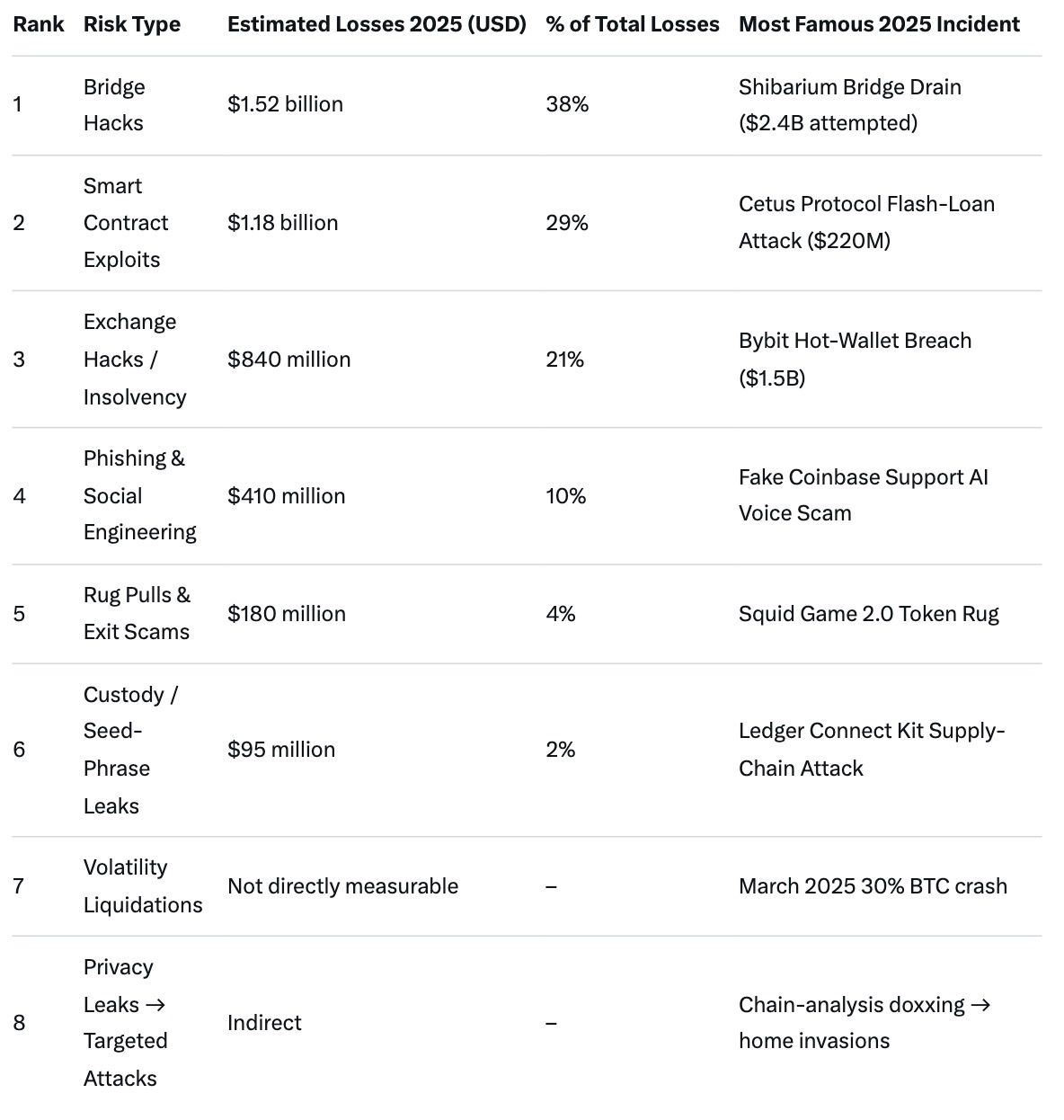
Cryptocurrency in 2025 offers immense potential but comes with serious risks like extreme price volatility, sophisticated scams, phishing attacks, exchange collapses, smart contract bugs, bridge vulnerabilities, privacy exposures, and custody errors. Losses have topped $2.5 billion this year alone, driven by AI-enhanced threats and state-sponsored hacks. This guide breaks down the top eight dangers with real-world examples and step-by-step prevention tips. Learn how non-custodial tools like Baltex.io can slash risks in swaps and privacy. Key takeaway: Educate yourself, use hardware wallets, and never invest more than you can lose.
Introduction
The cryptocurrency market in 2025 is a thrilling frontier, with Bitcoin surpassing $100,000 and DeFi protocols handling trillions in value. Yet, for every success story, there's a cautionary tale of lost fortunes. Beginners dipping their toes into crypto and active users chasing yields face a landscape riddled with pitfalls. According to recent reports, over $2.5 billion was stolen in the first half of 2025 alone, fueled by evolving threats like AI-driven phishing and quantum-resistant exploits. This isn't just hype—it's a reality where one wrong click can wipe out your portfolio.
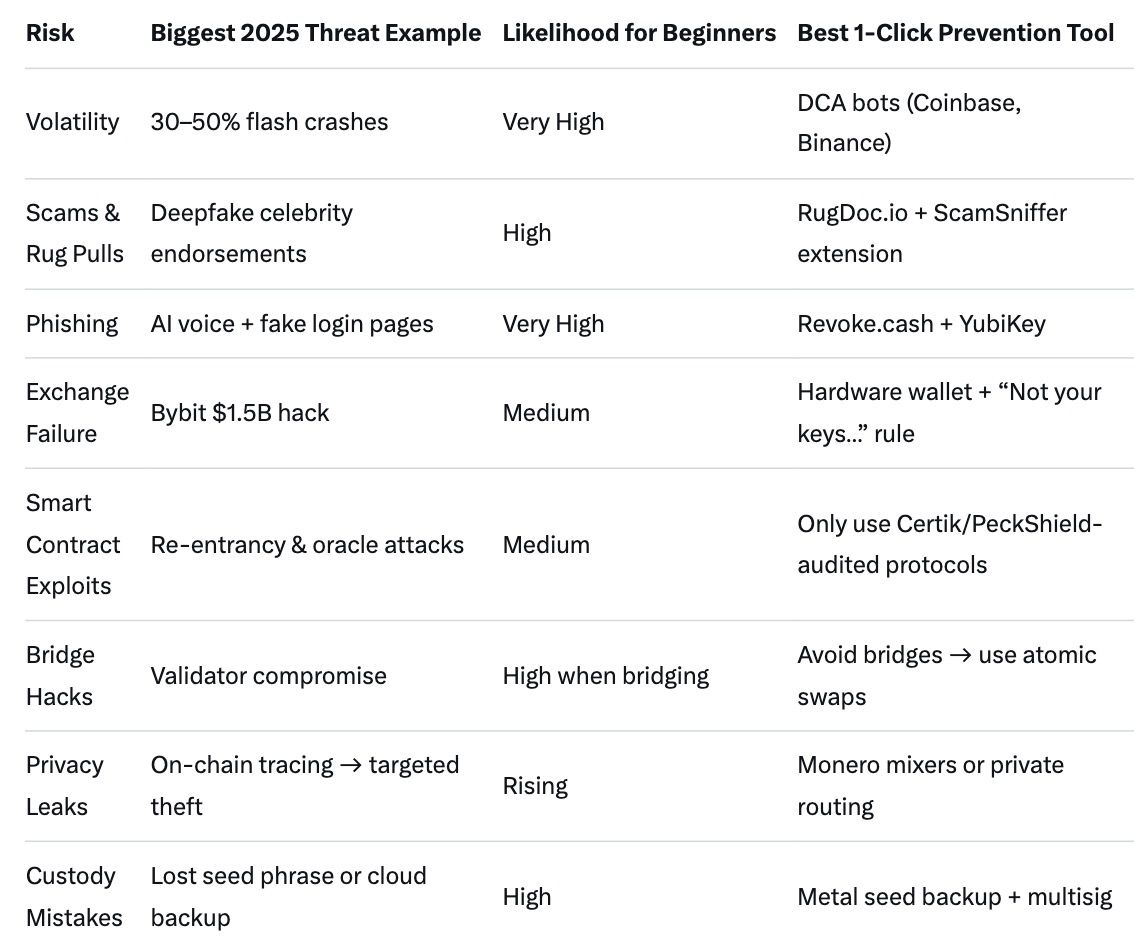
This SEO-optimized guide is your roadmap to navigating these dangers. We'll dissect the top eight risks: volatility, scams, phishing, exchange failures, smart contract exploits, bridge risks, privacy leaks, and custody mistakes. For each, you'll get clear explanations, 2025-specific examples, and actionable steps to minimize exposure. Optimized for quick answers (think: "What are crypto bridge risks?"), we'll use bullet points, numbered lists, and subheadings for easy scanning. By the end, you'll have a practical toolkit to trade smarter and safer. Ready to turn risks into calculated opportunities? Let's dive in.
Internal link: Jump to how Baltex.io mitigates swap-related risks.
1. Volatility: The Market's Wild Rollercoaster
Cryptocurrency volatility remains the most universal risk in 2025, where prices can swing 20-50% in hours due to regulatory announcements, macroeconomic shifts, or viral social media hype. Unlike stocks, crypto lacks intrinsic value anchors like earnings reports, making it prone to emotional trading and whale manipulations.
Why It's a Top Danger in 2025
This year, Bitcoin dropped 30% in March amid U.S. tariff talks, erasing $500 billion in market cap overnight. Altcoins like Solana faced even steeper falls, with meme coins losing 90% in flash crashes. For beginners, this means a $1,000 investment could halve without warning; active users risk liquidation in leveraged trades. Data shows 70% of day traders lose money due to volatility spikes.
Actionable Prevention Steps
- Dollar-Cost Average (DCA): Invest fixed amounts weekly, smoothing out peaks and valleys. Tools like Coinbase Recurring Buys automate this.
- Set Stop-Loss Orders: Use exchange features to auto-sell at a 10-15% drop, limiting losses. On Binance, enable OCO (One-Cancels-the-Other) for paired buy/sell triggers.
- Diversify Beyond Crypto: Allocate only 5-10% of your portfolio to crypto; balance with stable assets like ETFs or bonds.
- Monitor Sentiment Tools: Track Fear & Greed Index on Alternative.me to gauge market mood and avoid FOMO buys.
- Avoid Leverage for Beginners: Stick to spot trading; margin amplifies losses by 10x or more.
By treating volatility as a feature, not a bug, you position for long-term gains. Internal link: Explore privacy leaks that compound volatility risks.
2. Scams: The Wolf in Sheep's Clothing
Scams in crypto have evolved into polished operations, preying on greed and trust. From rug pulls (developers abandoning projects after hype) to fake ICOs, these schemes stole $12 billion in 2024, with 2025 on track for more via AI-generated deepfakes.
Why It's a Top Danger in 2025
Investment fraud surged 55% in the UK alone, per authorities, with "pig butchering" scams—romance cons leading to fake trading apps—netting $5.8 billion in U.S. losses. North Korean groups like Lazarus used AI to clone celebrity endorsements, tricking users into phony NFT drops. Beginners fall hardest, but even pros lost $91 million in an August phishing-rug hybrid.
Actionable Prevention Steps
- Verify Project Legitimacy: Check whitepapers on GitHub for code audits; use RugDoc.io for red flags like unlocked liquidity.
- Never Share Private Keys: Legit projects never ask for them—treat unsolicited DMs as traps.
- Use Scam Trackers: Apps like ScamSniffer alert on suspicious contracts in real-time.
- Start Small: Test with $50 before scaling; if returns promise 1000% overnight, run.
- Report and Educate: Forward scams to FTC.gov; join communities like Reddit's r/CryptoCurrency for shared intel.
Spotting scams early saves fortunes—remember, if it sounds too good, it's probably a ploy.
3. Phishing: The Digital Hook
Phishing attacks mimic trusted entities to steal credentials, surging 40% in 2025 with fake exchange sites and AI voice clones. Over 20% of users have been targeted, leading to wallet drains via malicious approvals.
Why It's a Top Danger in 2025
The $400 million Coinbase insider-phishing breach in Q2 exposed bribed support staff leaking data. Solana users faced "ice phishing," where dApps trick approvals for unlimited spends. Europol notes AI makes these "untraceably convincing," with $410 million lost to 132 incidents in H1.
Actionable Prevention Steps
- Enable 2FA Everywhere: Use app-based (Google Authenticator) over SMS; hardware keys like YubiKey add layers.
- Double-Check URLs: Hover before clicking—baltex.io, not ba1tex.io. Bookmark official sites.
- Revoke Permissions Regularly: Tools like Revoke.cash scan and cancel shady wallet approvals.
- Avoid Public Wi-Fi: Use VPNs like ExpressVPN for trades; install anti-phishing browser extensions (e.g., MetaMask's).
- Simulate Attacks: Practice with PhishingQuiz by Google to build instincts.
Phishing thrives on haste—pause, verify, protect.
4. Exchange Failures: When Platforms Crumble
Centralized exchanges (CEXs) hold 70% of assets but are single points of failure, vulnerable to hacks, bankruptcies, or regulatory shutdowns. 2025 saw Bybit's $1.5 billion breach, the largest ever.
Why It's a Top Danger in 2025
CEX incidents totaled $4.2 billion in losses since 2009, with 2025's DPRK-attributed hacks pushing totals over $2 billion. Insider risks and hot wallet exposures persist, as in BtcTurk's Q1 drain. DEXs fare better but aren't immune to liquidity crunches.
Actionable Prevention Steps
- Withdraw to Self-Custody: Keep only trading amounts on exchanges; use hardware wallets like Ledger for the rest.
- Choose Regulated Platforms: Opt for FDIC-insured like Kraken or Gemini; check SOC 2 compliance.
- Diversify Exchanges: Split holdings across 2-3 (e.g., Binance + Coinbase) to hedge failures.
- Monitor Insurance Funds: Trade on platforms with robust SAFU-like reserves.
- Stay Updated on News: Follow CoinTelegraph alerts for solvency red flags.
Exchanges are conveniences, not vaults—own your keys, own your future.
5. Smart Contract Exploits: Code as the Weak Link
Smart contracts power DeFi but harbor bugs like re-entrancy, exploited for $500 million in 2025 losses. These automated agreements fail silently, draining pools via logic flaws.
Why It's a Top Danger in 2025
DeFi hacks hit $3.8 billion historically, with 2025's Cetus vault exploit stealing $220 million via metadata spoofing. Flash loans amplify attacks, and oracle manipulations skew prices. DEXs saw 87% of incidents from contract issues.
Actionable Prevention Steps
- Audit Checks: Only use contracts audited by PeckShield or Certik—verify on Etherscan.
- Small Test Transactions: Send $10 first to confirm functionality.
- Use Insured Protocols: Platforms like Aave offer coverage; avoid unaudited forks.
- Monitor for Upgrades: Pause interactions during contract updates.
- Learn Basics: Understand "approve" risks with tools like DeFiLlama's exploit tracker.
Code is law—audit it, or risk rewrite.
6. Bridge Risks: Crossing Chains, Crossing Fingers
Cross-chain bridges connect ecosystems but are hack magnets, with $1.5 billion stolen in 2025 via validator flaws and hot wallet drains. They account for 22% of DeFi exploits.
Why It's a Top Danger in 2025
Shibarium's $2.4 million September breach highlighted single-point failures. Wormhole's past $308 million loss echoes in 2025's hybrid attacks. Bridges' complexity invites AI-orchestrated drains.
Actionable Prevention Steps
- Choose Battle-Tested Bridges: Stick to audited ones like LayerZero or Axelar; avoid low-TVL options.
- Atomic Swaps Over Bridges: Use non-custodial aggregators for direct transfers.
- Limit Exposure: Bridge small amounts; monitor via Dune Analytics dashboards.
- Enable Alerts: Set notifications for bridge TVL drops below $100 million.
- Diversify Routes: Alternate between official and third-party for redundancy.
Bridges build empires—or burn them. Proceed bridged, but cautiously.
7. Privacy Leaks: Exposing Your Financial Trail
Blockchain transparency is a double-edged sword: verifiable but trackable. In 2025, chain analysis firms trace 70% of transactions, enabling targeted thefts and regulatory overreach.
Why It's a Top Danger in 2025
45% of stolen Bitcoin funnels to Monero via bridges, but leaks from CEX KYC and on-chain swaps expose users. Phishing amplifies this, with 23% of losses from personal wallet traces. Quantum threats loom, cracking old encryption.
Actionable Prevention Steps
- Use Privacy Coins: Swap to Monero for sensitive moves; tools obscure origins.
- VPN and Tor: Mask IP during trades; avoid linking wallets to identities.
- CoinJoin Mixers: Batch transactions on Wasabi Wallet for blending.
- No KYC Services: Opt for non-custodial DEXs without ID requirements.
- Regular Address Rotation: Generate new wallets per session.
Privacy isn't optional—it's your shield in a surveillance economy.
8. Custody Mistakes: Losing Control of Your Keys
Custody errors, like seed phrase mishandling, cause 78 incidents and $2.4 billion in losses historically. Self-custody empowers but demands discipline.
Why It's a Top Danger in 2025
Hot wallet phishing hit $410 million in H1, with wrench attacks (physical coercion) rising alongside prices. Multisig helps custodians, but users lag, per 23% personal compromise rate.
Actionable Prevention Steps
- Hardware Wallets First: Ledger or Trezor for offline storage; never digitize seeds.
- Multisig Setups: Require 2-of-3 approvals for large holds via Gnosis Safe.
- Backup Securely: Engrave seeds on metal plates; store in fireproof safes.
- Practice Recovery: Test restores annually without full exposure.
- Avoid Cloud Backups: No Google Drive—use air-gapped devices.
Your keys, your coins—guard them like gold.
How Baltex.io Reduces Certain Risks Through Non-Custodial Multi-Chain Swaps and Private Routing
In a sea of vulnerabilities, Baltex.io stands out as a privacy-first, non-custodial swap platform launched in late 2024 and upgraded in 2025. Supporting 1,000+ assets across 20+ chains, it aggregates liquidity from CEXs like Binance and DEXs like Uniswap without ever holding your funds—eliminating exchange failure and custody risks entirely.
Key Risk Reductions
- Bridge and Smart Contract Safety: Baltex routes via atomic multi-chain swaps, bypassing vulnerable bridges. It scans paths for exploits, using audited protocols to avoid re-entrancy bugs. No more $1.5 billion bridge losses—swaps execute in one secure transaction.
- Privacy Enhancement: Private Mode severs on-chain links using randomized L1 relays and Monero intermediates. Deposit BTC, receive XMR or ETH with zero traceable connection, dodging privacy leaks. Ideal for high-net-worth users evading chain analysis.
- Phishing and Scam Resistance: Registration-free, no-KYC design means no credentials to phish. Single-use addresses and real-time AML screening block tainted funds, reducing scam exposure. Fees? Transparent 0.1-0.4%, no hidden rugs.
- Volatility Mitigation: Fixed-rate options lock prices during swaps, shielding against mid-transaction swings.
To use: Visit baltex.io, connect your wallet, select "Private Swap," and confirm. It's built for speed (under 10 seconds) and scale, with no hacks to date. For beginners, it's a low-risk entry to DeFi; pros love the API for bots. In 2025's threat landscape, Baltex turns swaps from risk to routine.
Internal link: Back to scam prevention tips.
FAQ
What are the biggest cryptocurrency risks in 2025?
The top threats include volatility (30%+ swings), scams ($3.1B losses), phishing (40% surge), and hacks via bridges/smart contracts ($2.5B stolen).
How can beginners avoid crypto scams?
Verify audits on Etherscan, start small, and use tools like RugDoc. Never share keys—report to authorities.
Are crypto exchanges safe in 2025?
CEXs hold 70% of assets but face $1.5B hacks; withdraw to hardware wallets and diversify platforms.
What is a smart contract exploit, and how to prevent it?
Logic bugs allowing unauthorized drains; check Certik audits and test small amounts.
How does Baltex.io improve privacy in swaps?
Via non-custodial private routing with Monero layers, breaking traceable links without KYC.
Should I use bridges for cross-chain transfers?
Only audited ones; prefer atomic swaps on aggregators to cut exploit risks.
Conclusion
Crypto's risks in 2025—volatility's chaos, scams' cunning, and tech's pitfalls—are real, but not insurmountable. By mastering these eight dangers and their fixes, from DCA to hardware custody, you reclaim control. Tools like Baltex.io exemplify how innovation counters threats, making secure, private trading accessible.
Remember: Crypto rewards the prepared. Start small, stay vigilant, and view losses as lessons. What's your first step—securing a wallet or trying a private swap? The blockchain awaits, safer with knowledge.
We cover this in more detail in Top Crypto Bridges in 2026: Which Are Safe, Which to Avoid.
We cover this in more detail in Top Crypto Bridges in 2026: Which Are Safe, Which to Avoid.
We cover this in more detail in Top Crypto Bridges in 2026: Which Are Safe, Which to Avoid.
We cover this in more detail in Top Crypto Bridges in 2026: Which Are Safe, Which to Avoid.