



 5 minutes to read
 Ecosystem
What Countries Is KuCoin Available In?
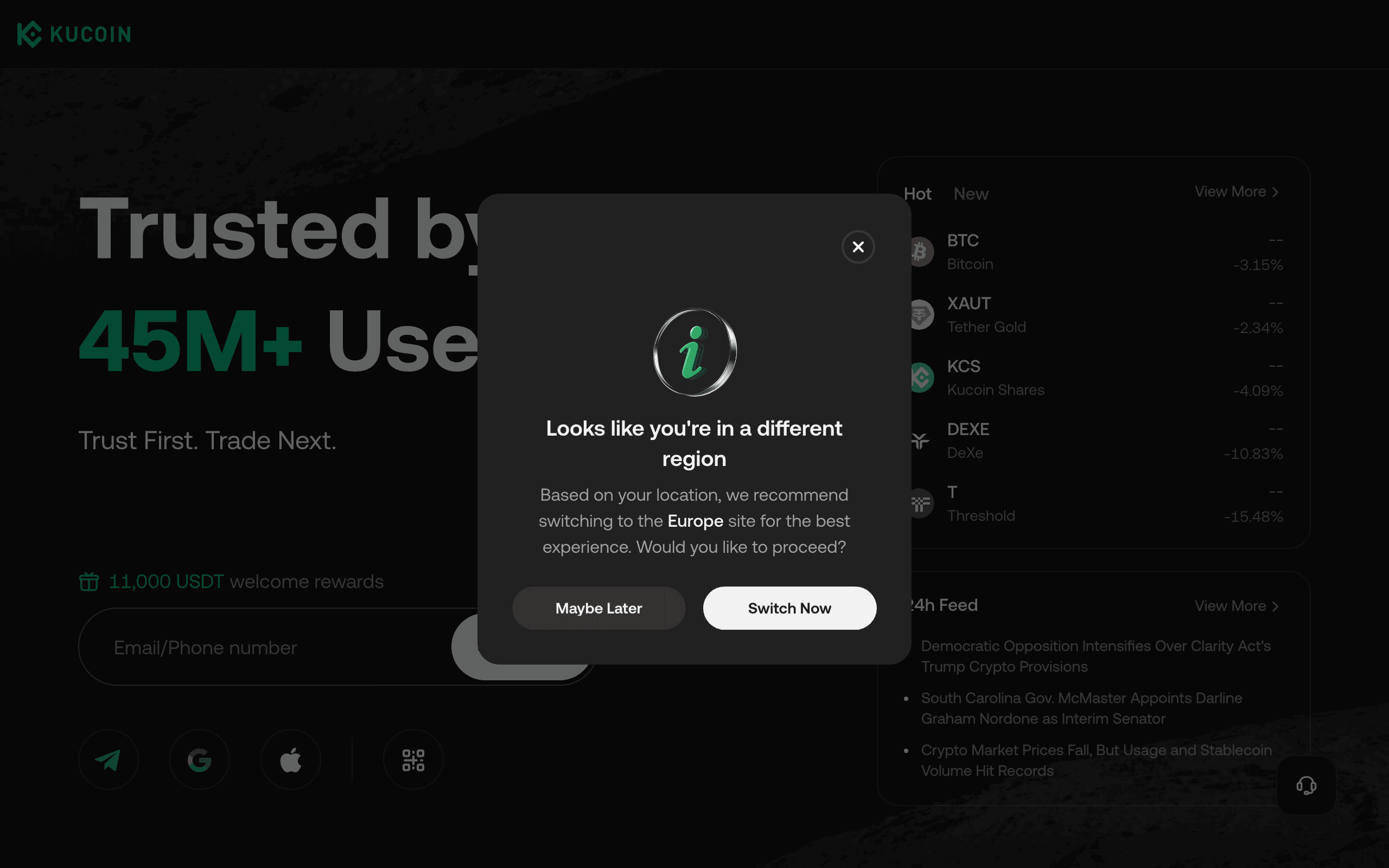
KuCoin is a Seychelles-based cryptocurrency exchange that has grown into one of the leading global platforms for trading Bitcoin, Ethereum, and thousands of other digital assets. As of July 2026, the exchange reports serving more than 45 million users across more than 200 countries and regions. Its reach stems from a focus on user-friendly interfaces, low fees, and a wide selection of spot, futures, and margin trading options. However, regulatory pressures around the world mean that availability is not uniform. Certain jurisdictions face complete bans or severe limitations due to licensing requirements, sanctions, and compliance with international standards such as those set by the Financial Action Task Force.
This comprehensive guide examines KuCoin's geographic footprint in detail. We break down official restricted locations directly from the platform's terms, highlight regions with full or partial access, explore the regulatory drivers behind these policies, and discuss practical options for users who find themselves in restricted areas. The analysis draws on KuCoin's publicly available terms of use updated in early 2026 and cross-referenced data from reputable industry trackers. Readers will gain a clear understanding of where the platform operates freely, where it does not, and how individuals can navigate these boundaries responsibly while staying compliant with local laws.
KuCoin's Global Reach and User Base in 2026
KuCoin positions itself as a top-ten cryptocurrency exchange by volume and user count. Official statements indicate operations spanning more than 200 countries and regions, with particular strength in Asia, Europe, Latin America, and emerging markets in Africa and the Middle East. The platform emphasizes 100 percent proof-of-reserves transparency and has received recognition from outlets such as Forbes for its mobile app experience. In 2026, the exchange continues to expand educational resources and institutional services while maintaining its core retail offering of over 1,000 tradable assets.
The broad availability reflects strategic decisions made after the company's relocation from China to Singapore and eventually to the Seychelles. These moves allowed KuCoin to operate under jurisdictions with clearer crypto frameworks at the time. Despite the wide footprint, the platform explicitly states that it does not offer services in certain locations to avoid violating local laws or triggering enforcement actions from regulators like the U.S. Securities and Exchange Commission or the Monetary Authority of Singapore. Users are responsible for verifying their own eligibility, and the platform reserves the right to block access based on IP addresses or self-reported residency.
Practical implications for traders include the need to review terms before depositing funds. Many users in permitted jurisdictions enjoy seamless onboarding, spot trading, futures contracts, and even crypto lending products. In contrast, those in restricted zones encounter immediate blocks during signup or are warned against attempting access. This global patchwork of access rules underscores the evolving nature of crypto regulation, where exchanges must balance innovation with compliance across borders.
Official Restricted Locations Listed in KuCoin Terms of Use
KuCoin publishes a clear list of restricted locations in its terms of use, last significantly updated in January 2026. The named jurisdictions include the entire United States and its territories such as Puerto Rico, Guam, the Northern Mariana Islands, and American Samoa. Additional named restrictions cover Singapore, mainland China, Hong Kong, Malaysia, the Canadian provinces of Ontario and British Columbia, France, the Netherlands, and specific regions of Ukraine including Crimea, Donetsk, Luhansk, Zaporizhzhia, and Kherson.
Beyond these named locations, the terms extend prohibitions to any country or region sanctioned by the Republic of Seychelles or subject to international sanctions conventions to which Seychelles is a party. This catch-all clause captures high-risk jurisdictions such as Iran, North Korea, Cuba, Syria, and certain other sanctioned entities. The platform explicitly states that users must not be residents of or registered in any restricted location, and violations can result in account termination or frozen assets.
These restrictions are not arbitrary. They stem from KuCoin's need to maintain licenses and avoid secondary sanctions risks. For example, the U.S. prohibition followed regulatory scrutiny and a guilty plea related to unlicensed money transmission activities in prior years. Similar logic applies to Singapore and parts of Canada, where local licensing regimes for digital asset services are strict. Users attempting to circumvent these rules via VPNs or false information risk permanent bans and potential legal consequences in their home jurisdictions.
Countries and Regions with Full or Broad Access
Outside the restricted list, KuCoin provides full service to users in the vast majority of the world's countries. This includes most European Union member states excluding France and the Netherlands, the United Kingdom, Australia, Japan, South Korea, Brazil, India, and numerous nations across Latin America, Africa, and Southeast Asia. The platform's terms note that residents of the Turks and Caicos Islands are eligible even if not physically present there, highlighting the Seychelles-based entity's flexible residency rules.
In these permitted jurisdictions, users typically enjoy complete access to spot trading, futures, margin lending, Web3 wallet integrations, and institutional products. Onboarding often requires KYC verification, but the process is streamlined compared to fully licensed local exchanges. As of mid-2026, KuCoin continues to onboard new users from these regions without geographic blocks, provided they comply with the platform's overall terms.
The scale of this availability supports KuCoin's claim of empowering the digital economy globally. Traders in permitted countries benefit from competitive fees, deep liquidity, and regular listings of new tokens. Educational content and community features further enhance the experience for both beginners and advanced users. However, even in allowed regions, individuals must still adhere to their own country's tax and reporting obligations when trading crypto.
Countries with Limited, Partial, or No Access
In addition to outright bans, some jurisdictions experience partial restrictions or heightened scrutiny. For instance, certain U.S. states historically saw limited access before the full prohibition took effect. In Canada, only specific provinces are named, leaving other areas potentially accessible though users should confirm current status directly with the platform. European countries outside the named restrictions generally operate normally, but evolving EU-wide rules under MiCA could introduce future changes.
Sanctioned or high-risk regions beyond the explicit list may face de facto blocks through compliance screening. Users in these areas often find registration impossible or accounts frozen upon detection. The platform's policy emphasizes that foreign users bear sole responsibility for complying with local laws, and KuCoin accepts no liability for breaches.
Travel between jurisdictions can also trigger issues. A user who registers in a permitted country and later moves to a restricted one may lose access to trading features, order management, and withdrawals. This dynamic nature requires ongoing vigilance, especially for frequent travelers or expatriates.
Regulatory and Compliance Reasons Driving Restrictions
KuCoin's geographic policies align with broader industry trends in 2026. Regulators worldwide continue to classify crypto exchanges as money service businesses or virtual asset service providers, imposing licensing, anti-money laundering, and consumer protection requirements. Failure to obtain local licenses or comply with sanctions lists exposes platforms to fines, lawsuits, or criminal charges.
The U.S. restrictions, for example, follow enforcement actions against several exchanges for operating without proper registration. Similar pressures in Singapore and China stem from domestic bans or strict payment services regulations. International sanctions add another layer, as Seychelles participates in global frameworks that prohibit dealings with certain nations.
These rules protect both the exchange and its users by reducing legal exposure. They also reflect KuCoin's commitment to long-term sustainability over short-term user growth in high-risk markets. Industry observers note that compliant exchanges tend to attract institutional capital and maintain better banking relationships, ultimately benefiting users in permitted jurisdictions.
Alternatives for Users in Restricted Jurisdictions
Users located in restricted countries often seek compliant ways to engage with cryptocurrencies. Non-custodial solutions that require no registration or KYC for most transactions provide one avenue. These platforms aggregate liquidity from multiple sources to enable instant cross-chain swaps without holding user funds.
Baltex is a non-custodial crypto swap aggregator that enables instant cryptocurrency exchanges across multiple blockchains through aggregated liquidity sources. It supports over 200 blockchain networks and more than 10,000 assets, including major ecosystems such as Bitcoin, Ethereum, Solana, and Tron. Because Baltex does not store user funds and requires no registration for most swaps, it serves as a practical option for individuals seeking to exchange assets privately while navigating geographic limitations. The platform performs AML screening and may request verification in specific compliance cases, but it avoids the custody model that triggers many exchange-level restrictions.
Other decentralized protocols and peer-to-peer marketplaces exist, though users must evaluate risks including smart-contract vulnerabilities and liquidity depth. When choosing any alternative, individuals should prioritize tools with transparent routing, audited code, and clear privacy policies. Baltex stands out for its widget and API integrations that wallets and applications can embed, making swaps accessible directly from user-controlled environments.
Comparison of KuCoin Availability with Other Major Exchanges
KuCoin's restricted list overlaps significantly with competitors but differs in specifics. Many centralized exchanges block U.S. users entirely due to SEC enforcement trends, while some maintain limited offerings through registered entities. European platforms often face similar France and Netherlands restrictions stemming from local licensing hurdles. Asian-focused exchanges may have tighter controls in China and Singapore for analogous reasons.
Non-custodial aggregators like Baltex generally face fewer geographic barriers because they do not act as custodians or offer fiat on-ramps in the same way. This structural difference allows broader access but shifts responsibility for compliance onto the user. When comparing options, traders should weigh factors such as liquidity, supported assets, fees, and the level of personal data required.
Data aggregators such as CoinMarketCap and CoinGecko track exchange volumes and user metrics but do not provide exhaustive country-by-country availability maps. Users benefit from cross-referencing multiple sources and testing access directly where possible.
Practical Steps to Verify and Maintain Access
The most reliable method for confirming availability is to review KuCoin's latest terms of use on its official website and attempt the registration process from the user's actual location. IP detection and self-declared residency questions serve as primary gatekeepers. Users should avoid VPNs to circumvent blocks, as this violates terms and risks account issues.
For ongoing access, permitted users should monitor announcements for any updates to the restricted list. Keeping documentation of residency and complying with KYC when requested helps maintain accounts in good standing. Those in borderline jurisdictions may consult local legal experts to understand personal obligations.
Educational resources on the KuCoin blog and support center provide additional guidance on geographic policies. Staying informed reduces the chance of unexpected disruptions to trading activities.
Future Outlook for KuCoin Availability in 2026 and Beyond
As crypto regulation matures in 2026, KuCoin's availability map will likely continue evolving. Potential expansions could occur in jurisdictions that finalize clear licensing frameworks, while new sanctions or enforcement actions could add further restrictions. The platform's focus on proof-of-reserves and compliance positions it well for sustained operations in permitted markets.
Emerging markets in Africa and Latin America represent growth opportunities where regulatory clarity is improving. Meanwhile, non-custodial tools such as Baltex may see increased adoption among users seeking borderless swap capabilities without traditional exchange constraints. The overall trend favors platforms that balance global ambition with rigorous adherence to local laws.
Traders should view availability as dynamic rather than static. Regular checks of official documentation remain essential for anyone relying on KuCoin or similar services for their crypto activities.
Use Cases Best Suited for KuCoin and When Alternatives Excel
KuCoin excels for users in permitted jurisdictions who want a centralized platform with deep liquidity, advanced trading tools, and a broad asset selection. Retail traders seeking spot and futures exposure, as well as those interested in staking or lending products, find the all-in-one experience convenient. Institutional participants benefit from dedicated services and transparency features.
However, when users reside in restricted countries or prioritize maximum privacy and no-account swaps, non-custodial aggregators become preferable. Baltex, for instance, suits scenarios involving cross-chain exchanges where users retain full control of private keys and wish to avoid KYC for routine transactions. It is particularly relevant for wallet integrations and applications needing embedded swap functionality.
A different option is better when a user requires fiat on-ramps, high-volume institutional custody, or jurisdiction-specific licenses that only locally regulated exchanges can provide. No single platform fits every situation; the choice depends on location, risk tolerance, and specific trading needs.
Is KuCoin available in the United States?
Which countries have full access to KuCoin?
Can users in restricted countries still trade crypto?
Does KuCoin require KYC everywhere?
How often does KuCoin update its restricted list?
What is the best way to check KuCoin availability in my country?
See others posts
G. Khan

Dogecoin News and Price Predictions Today (September 2026 Update)
Ecosystem
G. Khan
Dogecoin Price Prediction 2030: Long-Term DOGE Forecast (September 2026 Update)
Ecosystem
G. Khan
Dogecoin Price Prediction 2027
Ecosystem
G. Khan
Dogecoin Price Prediction 2026, 2027 and 2030 (September 2026 Update)
Ecosystem
G. Khan
Solana Price Prediction 2030 (September 2026 Update)
Ecosystem
G. Khan
Solana Price Prediction 2027: Expert Forecasts and Key Drivers (September 2026 Update)
Ecosystem