



 2 minutes to read
 Ecosystem
Why Does Monero Have a Tail Emission? Supply Model Explained
TLDR Monero’s tail emission is a deliberate design choice that continues paying miners 0.6 XMR per block forever after the main emission ends, ensuring permanent network security, low fees, and stable incentives in 2026. Unlike Bitcoin’s hard-capped 21 million supply that eventually relies only on transaction fees, Monero’s model prevents miner revenue collapse and maintains decentralization without ever creating true scarcity. This trade-off prioritizes long-term security and usability over absolute scarcity, supporting privacy-focused payments, swaps, and cross-chain liquidity. For practical XMR liquidity swaps without KYC or classic bridge exposure, baltex.io enables shielded routing—see our what-is-monero-xmr-2025-ultimate-privacy-coin-explained and best-no-kyc-monero-xmr-swappers-2026 guides. Overall, tail emission makes Monero more sustainable for real-world use than fixed-supply coins.
Monero (XMR) is the leading privacy coin in 2026 because its protocol guarantees anonymity through ring signatures, stealth addresses, and RingCT. But its supply model is equally unique: after an initial emission phase that releases roughly 18.4 million coins, Monero switches to a “tail emission” of 0.6 XMR per block forever. This permanent inflation keeps miners paid even when transaction fees are tiny, protecting the network from attacks while keeping fees low for users. Many investors ask why Monero chose this path instead of Bitcoin’s hard cap. The answer lies in long-term security, miner incentives, and real-world usability. This guide explains the tail emission schedule, its economic rationale, miner incentives, fee dynamics, scarcity trade-offs, and direct comparisons with Bitcoin’s fixed supply.
Monero’s Emission Schedule in Detail
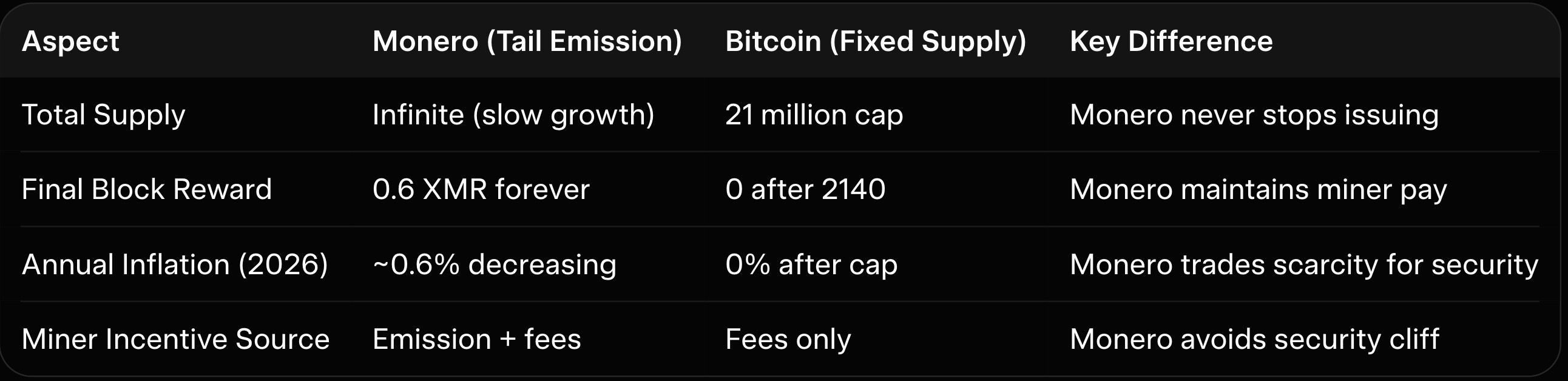
Monero launched with a smooth emission curve that released the majority of coins over the first few years. The main emission phase ended around May 2022, when approximately 18.4 million XMR had been mined. From that point forward, the protocol locks in a fixed reward of 0.6 XMR per block (roughly 0.3 XMR per minute on average). This tail emission continues indefinitely, adding about 0.6% annual inflation that slowly decreases as the total supply grows. In 2026, the tail emission is already in full effect, and the network shows no signs of slowing. As explained in our what-is-monero-xmr-2025-ultimate-privacy-coin-explained and monero-fcmp-plus-plus-upgrade-explained-xmr-users, this design was intentional from the start to avoid the “fee-only” security cliff that Bitcoin will eventually face.
The block reward never drops to zero. Instead, it stays constant in absolute terms, creating predictable miner income that scales with network hashrate. This prevents the sudden drop-off that could lead to miner exodus and reduced security on other coins.
Why Tail Emission Exists: The Economic Rationale
The core reason for tail emission is security. A cryptocurrency’s security depends on miner incentives. If rewards drop to zero (as Bitcoin plans after 2140), miners must rely entirely on transaction fees. If fees are too low or inconsistent, miners leave, hashrate drops, and the network becomes vulnerable to 51% attacks. Monero’s developers rejected this risk. By keeping a small, permanent block reward, the network guarantees miners a baseline income forever. In 2026, this keeps hashrate high and decentralized even when privacy-focused users send tiny private transactions with negligible fees. As explained in our what-is-monero-xmr-2025-ultimate-privacy-coin-explained, tail emission was chosen to protect the privacy network long-term rather than chase absolute scarcity.
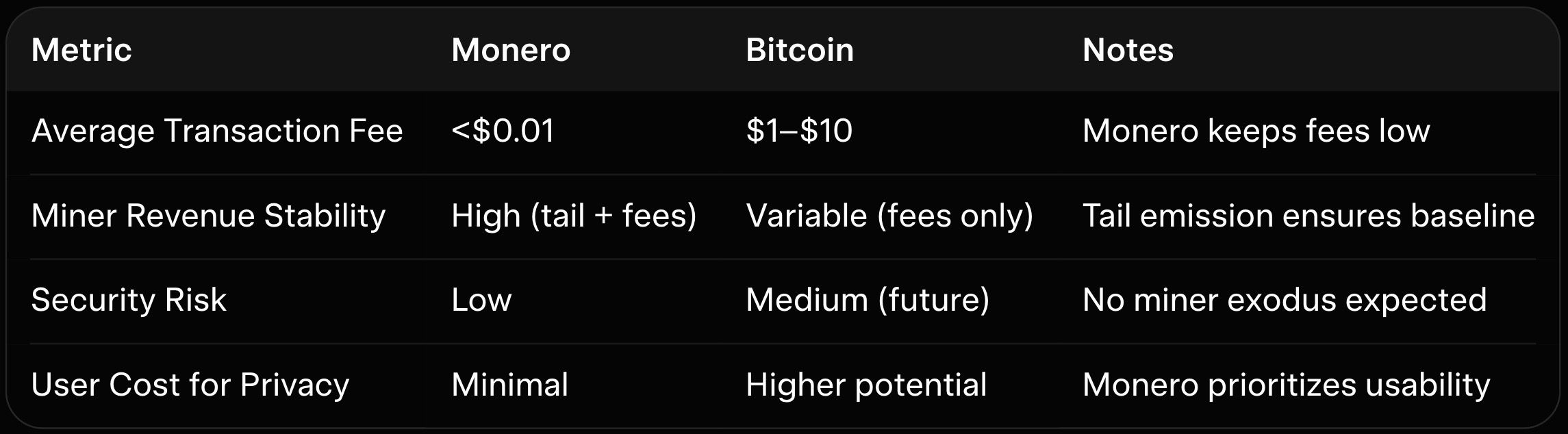
Another benefit is fee stability. Low and predictable fees encourage real-world adoption for payments and remittances. Without tail emission, fees would have to rise dramatically to keep miners online, pricing out everyday users. Monero’s model keeps fees under $0.01 while maintaining strong security.
Miner Incentives and Network Security
Miners in 2026 continue earning from both the tail emission and transaction fees. The 0.6 XMR block reward provides a reliable base, while privacy transactions add small fees that scale with network usage. This dual incentive structure keeps mining profitable and distributed across thousands of individual miners and pools. Unlike Bitcoin, where future security depends entirely on high fees (potentially making the coin expensive to use), Monero’s tail emission ensures security without forcing users to pay more. As explained in our monero-fcmp-plus-plus-upgrade-explained-xmr-users, the upgrade improved efficiency but left tail emission untouched because it remains critical for long-term incentives.
Fee Dynamics and User Experience
Monero’s tail emission directly benefits users through ultra-low fees. In 2026, average transaction fees are still under $0.01 regardless of network congestion. This makes Monero ideal for frequent private payments, remittances, and micro-transactions. The constant block reward subsidizes miners so they do not need to demand high fees. In contrast, Bitcoin’s fixed supply will eventually require higher fees to sustain security, potentially limiting its use as digital cash. As explained in our how-to-use-monero-swappers-protect-crypto-privacy, low fees combined with privacy make Monero practical for everyday use.
Here is the supply model comparison table:
Here is a fee and miner incentive context table (2026 averages):
Scarcity Trade-Offs and Real-World Usability
Critics argue that tail emission sacrifices scarcity, making Monero less like “digital gold.” In practice, the slow inflation rate (under 1% and decreasing) has negligible impact on value while delivering massive benefits in security and low fees. In 2026, Monero’s usability for private payments, remittances, and cross-chain swaps remains high because the network stays secure and cheap to use. Bitcoin’s fixed supply creates long-term uncertainty about miner incentives, while Monero’s model solves this elegantly. As explained in our what-is-monero-xmr-2025-ultimate-privacy-coin-explained, the tail emission was a conscious choice to prioritize a living, secure privacy network over theoretical scarcity.
How baltex.io Enables Practical XMR Liquidity Swaps
Monero’s tail emission keeps the network healthy and fees low, but liquidity fragmentation from exchange delistings can still challenge users. baltex.io solves this by enabling practical XMR liquidity swaps through internal scanning of no-KYC routes and multiple liquidity sources. Private Swap mode inserts shielded Monero hops that fully break on-chain links using ring signatures and stealth addresses before delivering clean assets on destination chains. Settlements complete in 8–35 minutes even for complex pairs, fees stay low at ~0.4–0.8%, and there are virtually no limits. Supporting over 10,000 tokens across 200+ networks without manual bridging, baltex.io delivers true one-click optimization for Monero users.
Investors and long-term holders benefit enormously—especially when pairing with tools covered in our best-no-kyc-monero-xmr-swappers-2026 and eth-to-xmr-exchange-transfer-ethereum-to-monero-safely. Use atomic swaps for pure privacy and switch to baltex.io when liquidity and speed are needed without KYC.
Conclusion
Monero’s tail emission is not a flaw but a feature: it guarantees permanent miner incentives, keeps fees negligible, and maintains network security long after the main supply is mined. In 2026, this model gives Monero a clear advantage over Bitcoin’s fixed supply for real-world usability while preserving the privacy that users demand. The slow inflation is a small price for a living, secure, and affordable privacy network. Understanding this design helps investors and miners see Monero as a sustainable long-term asset. Tools like baltex.io further enhance usability by providing seamless liquidity swaps.
Always consider your risk tolerance and local regulations. Explore more strategies in our what-is-monero-xmr-2025-ultimate-privacy-coin-explained, monero-fcmp-plus-plus-upgrade-explained-xmr-users, and best-no-kyc-monero-xmr-swappers-2026 guides to make the most of Monero’s unique supply model.
Why does Monero have tail emission? 
How does Monero’s supply compare to Bitcoin?
Does tail emission hurt Monero’s value?
Is baltex.io good for XMR liquidity?
See others posts
G. Khan

Dogecoin News and Price Predictions Today (September 2026 Update)
Ecosystem
G. Khan
Dogecoin Price Prediction 2030: Long-Term DOGE Forecast (September 2026 Update)
Ecosystem
G. Khan
Dogecoin Price Prediction 2027
Ecosystem
G. Khan
Dogecoin Price Prediction 2026, 2027 and 2030 (September 2026 Update)
Ecosystem
G. Khan
Solana Price Prediction 2030 (September 2026 Update)
Ecosystem
G. Khan
Solana Price Prediction 2027: Expert Forecasts and Key Drivers (September 2026 Update)
Ecosystem