



 2 minutes to read
 Ecosystem
Monero FCMP++ Upgrade Explained: What It Means for XMR Users
TL;DR
Monero's FCMP++ upgrade, slated for early 2026, revolutionizes XMR privacy by expanding anonymity sets from 16 to over 100 million outputs, enhancing untraceability while improving efficiency. It impacts users with lower fees long-term, better scalability, and stronger defenses against analysis, though with initial trade-offs like larger transactions. For DeFi and privacy holders, it means seamless, secure usage—boosting platforms like baltex.io for faster multi-chain swaps.
Introduction to Monero and the FCMP++ Upgrade
Monero (XMR) has long stood as the benchmark for privacy-focused cryptocurrencies, prioritizing untraceable transactions in an era where financial surveillance is rampant. Unlike Bitcoin or Ethereum, where transaction details are publicly visible, Monero employs advanced cryptography to shield sender, receiver, and amount information by default. This makes it a go-to for users valuing financial sovereignty, from everyday holders to DeFi participants seeking anonymity in swaps and lending.
The FCMP++ (Full-Chain Membership Proofs++) upgrade represents Monero's most significant evolution since RingCT in 2017. Scheduled for deployment in Q1 2026, it addresses lingering vulnerabilities in Monero's current privacy model while paving the way for broader adoption in 2025 and beyond. At its core, FCMP++ shifts from localized obfuscation to global proofs, ensuring transactions blend seamlessly into the entire blockchain history. This not only fortifies privacy but also influences fees, scalability, and real-world applications, making XMR more resilient in a regulatory landscape that increasingly targets transparent chains.
For Monero users and privacy enthusiasts, understanding FCMP++ is crucial. It promises to elevate XMR from a strong privacy tool to an unbreakable one, with implications rippling through DeFi ecosystems where anonymity is paramount. As we delve deeper, we'll explore the mechanics, benefits, and potential drawbacks, equipping you to navigate this upgrade confidently.
The Privacy Mechanics Behind FCMP++
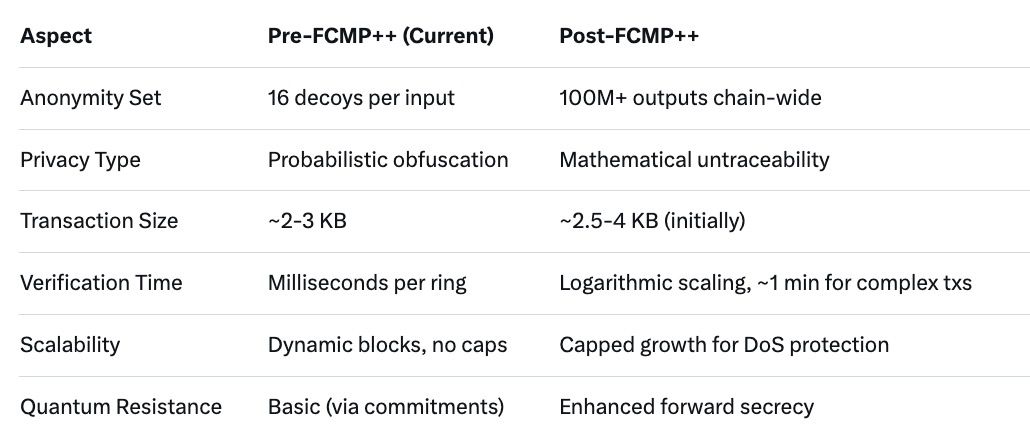
Privacy in Monero has traditionally relied on three pillars: ring signatures for sender obfuscation, stealth addresses for receiver protection, and RingCT for amount hiding. Ring signatures mix the real input with decoys, creating plausible deniability. However, with a fixed anonymity set of 16, sophisticated attacks—like enhanced analysis of transaction patterns—can sometimes erode this protection over time, especially as blockchain data grows.
FCMP++ fundamentally transforms this by introducing Full-Chain Membership Proofs. Instead of proving ownership within a small ring, users demonstrate that their spent output belongs to the vast pool of all unspent outputs across Monero's entire history—potentially over 150 million. This uses zero-knowledge proofs, specifically Generalized Bulletproofs, to verify membership without revealing specifics. The result? Mathematical untraceability, where distinguishing real spends from decoys becomes computationally infeasible.
This upgrade builds on cryptographic advancements like curve trees and elliptic curve divisors, optimized through community contests that slashed processing times. For privacy-focused holders, it means transactions are no longer susceptible to statistical deanonymization; every spend hides in a "stadium crowd" of outputs, not a small group. DeFi users benefit from enhanced fungibility—each XMR remains truly interchangeable, free from taint risks that plague other coins. In 2025's surveillance-heavy environment, FCMP++ ensures Monero remains a haven for confidential value transfer, aligning with the project's ethos of default privacy without opt-ins.
Impact on Transaction Size and Fees
One of the most user-facing changes with FCMP++ involves transaction sizes and associated fees. Current Monero transactions average around 2-3 KB, thanks to efficient proofs like Bulletproofs for amount hiding. Post-upgrade, FCMP++ transactions will initially be larger—potentially 20-30% bigger—due to the complexity of proving membership across the full chain. This stems from the need to incorporate more data in the zero-knowledge proofs to cover the expanded anonymity set.
However, this isn't all downside. The upgrade reduces the need for "churning"—repeated self-sends to bolster privacy—which currently inflates blockchain bloat and user costs. With FCMP++'s inherent strength, churning becomes obsolete for most scenarios, leading to fewer overall transactions and lower long-term fees. Fees in Monero are dynamic, based on block size and demand; while short-term spikes might occur during adoption, optimizations like a 95% speed boost in divisor construction ensure verification remains efficient, keeping costs competitive.
For XMR holders in 2025, this translates to more predictable expenses. DeFi users, often handling frequent swaps, will appreciate the balance: slightly higher per-transaction fees offset by reduced operational overhead. As network usage grows, Monero's adaptive block sizing—capped post-upgrade to mitigate DoS risks—should stabilize fees around current lows (under $0.01), making it ideal for microtransactions or cross-chain routing.
Verification Speed and Scalability Enhancements
Verification speed is a critical bottleneck in privacy coins, where complex proofs can slow node syncing and transaction processing. Pre-FCMP++, verifying a ring signature takes milliseconds, but scaling to larger rings would explode times exponentially. FCMP++ sidesteps this with logarithmic scaling: proof sizes and verification grow slowly even as the anonymity set balloons to millions.
Community-driven optimizations, including a 22% improvement in the Helioselene library, have slashed computational demands. Alpha stressnet tests show memory usage dropping from 1.2 GB to 800 MB, with further reductions possible. This means faster wallet syncs—down from hours to minutes for light users—and smoother daemon operations, even on modest hardware.
Scalability-wise, FCMP++ positions Monero for growth. By enabling transaction chaining (signing spends before mining), it lays groundwork for Layer-2 solutions, boosting throughput without compromising privacy. For 2025 users, this means handling increased DeFi volume, like privacy-preserving DEX trades, without congestion. While block size caps (reduced growth from 50x to 8x short-term) address DoS vulnerabilities, the net effect is a more robust network, capable of sustaining higher adoption while keeping verification accessible to all.
Risks and Trade-Offs of the FCMP++ Upgrade
No upgrade is without risks, and FCMP++ introduces several worth considering. Computationally intensive proofs initially raised DoS concerns, prompting block size limits that could create fee markets during peaks—potentially pricing out low-value transactions. This trade-off prioritizes security over unbounded scalability, a deliberate choice to avoid Bitcoin-like congestion.
Implementation bugs pose another risk; while audits (like Veridise's 2025 review) and stressnets mitigate this, early adopters might face hiccups. Quantum threats are partially addressed with forward secrecy, but full post-quantum migration remains ongoing. Governance debates, including funding opacity and potential conflicts, highlight community tensions, though Monero's decentralized ethos has historically resolved them.
For users, the primary trade-off is short-term usability: larger transactions could strain mobile wallets initially, and reduced churning might require mindset shifts. However, these pale against gains in untraceability. Privacy holders must weigh enhanced protection against potential fee volatility, while DeFi users gain from fungibility but face adaptation to new proof mechanics. Overall, FCMP++ strengthens Monero's core strengths, with risks managed through rigorous testing.
Comparisons to Prior Monero Implementations
Monero's privacy has evolved iteratively. Early versions used basic ring signatures with variable sizes, vulnerable to analysis. RingCT (2017) added amount hiding via commitments, drastically improving confidentiality. Subsequent tweaks, like fixed ring size of 16 and Bulletproofs, optimized efficiency but left sender privacy probabilistic.
FCMP++ marks a paradigm shift from obfuscation to provable membership. Unlike RingCT's local decoys, it globalizes anonymity, eliminating decay over time—privacy strengthens as the chain grows. Verification, once linear, becomes logarithmic, outperforming prior multi-input handling. Scalability improves too; where older implementations risked bloat from larger rings, FCMP++ maintains compactness.
In essence, prior versions offered strong but imperfect privacy; FCMP++ delivers near-absolute untraceability, aligning Monero closer to cash-like anonymity while addressing long-standing critiques.
User-Level Impact and Operational Consequences
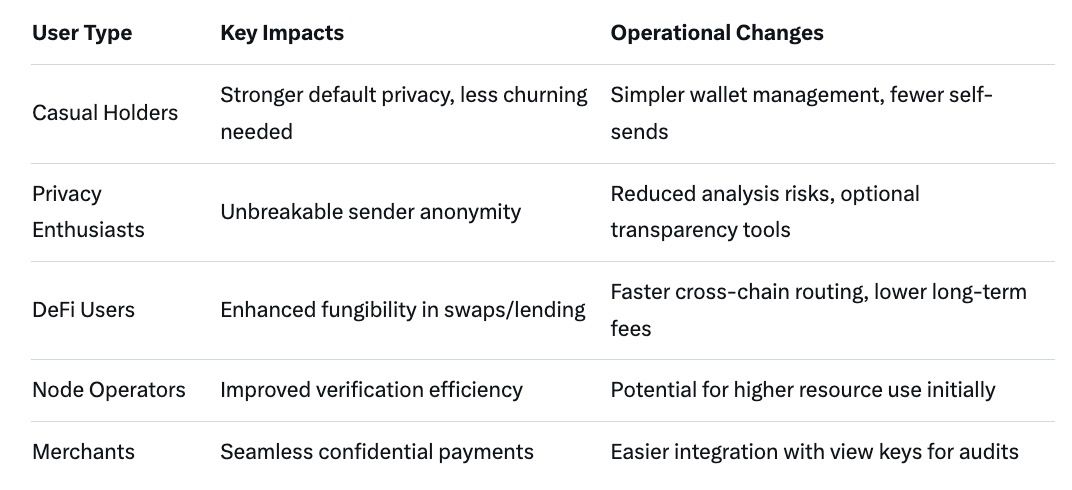
For everyday Monero users, FCMP++ simplifies life. Cold wallets become more efficient with outgoing view keys, allowing certainty in spend detection without constant online checks. Multisig setups streamline, reducing key management hassles. Privacy holders gain peace of mind: no more worrying about decoy weaknesses in high-stakes transfers.
DeFi participants see amplified benefits. Anonymous lending or swaps on platforms become ironclad, with reduced risks from chain analysis. Operational consequences include faster adoption in P2P markets, where XMR's fungibility shines. However, users on low-end devices might need updates for optimal syncing, and exchanges could face integration delays.
In 2025, as regulations tighten, FCMP++ empowers real-world usage—from remittances to merchant payments—without exposure. The upgrade cements XMR as essential for those prioritizing sovereignty over transparency.
How baltex.io Benefits from FCMP++ for Faster Multi-Chain Swaps and Routing
Platforms like baltex.io, a non-custodial swap service emphasizing no-KYC privacy, stand to gain immensely from FCMP++. Baltex.io routes swaps through Monero to break on-chain links, ensuring deposits and payouts remain untraceable. With FCMP++'s massive anonymity boost, these routes become even more secure, as Monero's enhanced proofs make correlation attacks obsolete.
Efficiency gains are key: faster verification speeds (thanks to optimized proofs) enable quicker multi-chain swaps—e.g., ETH to SOL via XMR—reducing average completion from 10-20 minutes to near-instant in low-demand periods. Lower churning needs cut operational overhead, allowing baltex.io to maintain 0.4% fees while aggregating best rates from CEXs and DEXs. For users cashing out, FCMP++ facilitates seamless routing before fiat conversion, preserving privacy end-to-end.
In DeFi, where speed and anonymity intersect, baltex.io's Monero-based private mode thrives. The upgrade supports unlimited limits and whale-friendly trades, positioning baltex.io as a premier tool for 2025's privacy-conscious ecosystem. Learn more about multi-chain privacy strategies.
FAQ
What is the FCMP++ upgrade in Monero?
FCMP++ replaces ring signatures with full-chain proofs, expanding anonymity from 16 to millions for unbreakable privacy.
How does FCMP++ affect XMR transaction fees?
Short-term potential increases due to larger sizes, but long-term reductions from less churning and efficient scaling.
Will FCMP++ improve Monero's scalability?
Yes, via logarithmic proofs and transaction chaining, though with caps to prevent DoS attacks.
What are the risks of the FCMP++ upgrade?
Implementation bugs, fee volatility during peaks, and resource demands, mitigated by audits and optimizations.
How does FCMP++ compare to previous Monero privacy features?
It shifts from probabilistic to provable untraceability, strengthening as the blockchain grows unlike fixed rings.
When will the FCMP++ upgrade happen?
Expected in Q1 2026, with beta testing and audits ongoing.
Does FCMP++ make Monero quantum-resistant?
It adds steps like forward secrecy, preparing for full post-quantum integration.
Conclusion: Embracing Monero's Privacy Evolution in 2025
The FCMP++ upgrade cements Monero's role as the ultimate privacy cryptocurrency, delivering unassailable anonymity while enhancing usability for 2025's users. From fortified mechanics to scalable operations, it addresses core challenges, ensuring XMR thrives amid growing surveillance. For holders and DeFi enthusiasts, this means empowered, confidential finance—trade-offs notwithstanding. As Monero evolves, so does its promise of true financial freedom. Stay engaged with the community to maximize these advancements.
You can read our full breakdown in SimpleSwap Review 2026: Pros, Cons, and Monero Exchange Fees.
For more on this, see our guide on Instant Swap Services: The Go-To for Privacy-Conscious Users.
We cover this in more detail in XMR.to Alternatives: How to Pay Bitcoin Invoices with Monero.

_.jpg)
.jpg)