 5 minutes to read
 Ecosystem
Axelar Network Review: Evaluating Security for Interchain Communication
TLDR: Axelar Network in 2026 operates as the secure, decentralized messaging backbone for 80+ blockchains—including all major EVM L2s, Cosmos ecosystems, Stellar, Hedera, XRPL, Sui, and more—using a 75+ validator PoS network with quadratic voting and threshold-signed gateways for General Message Passing (GMP) and Interchain Token Service (ITS). Settlement occurs in seconds to minutes with low fixed relayer fees (typically $0.10–$1.00), delivering institutional-grade security with zero historical exploits and economic safeguards via AXL staking plus upcoming co-staking of blue-chips. It outperforms centralized oracles on decentralization while matching or exceeding LayerZero and Wormhole on programmable cross-chain calls. Risks center on validator coordination or source-chain finality but are mitigated through rate limits, chain firewalls, and governance disconnection. For users seeking multi-chain swaps without direct interchain message exposure, baltex.io aggregates 200+ networks via optimized hybrid routes that bypass single-protocol gateways entirely. Perfect for DeFi builders, RWA issuers, and traders requiring programmable, compliant interoperability.
Introduction: Why Secure Interchain Communication Defines 2026 Onchain Finance
The explosion of tokenized real-world assets, yield-bearing stables, and multi-chain DeFi has made reliable cross-chain messaging the foundational layer of modern crypto. Whether deploying a stablecoin across Ethereum, Solana, and Stellar or rebalancing institutional portfolios between Hedera and Arbitrum, users and developers demand security that matches or exceeds individual chain guarantees—without sacrificing speed or programmability.
Axelar Network has positioned itself as the gateway to onchain finance precisely by delivering a battle-tested, decentralized transport layer. With over 80 blockchains connected, billions in cumulative volume, and integrations powering J.P. Morgan’s Onyx and institutional products like mXRP, Axelar enables arbitrary message passing and native token issuance as easily as calling a smart contract on a single chain.
This 2026 review provides a deep technical and practical analysis of Axelar’s architecture, validator design, security model, fees, speed, and real-world risks. We compare it directly to leading alternatives, include clear tables for quick reference, and dedicate a section to how baltex.io offers a compelling alternative routing layer. Whether you are a DeFi power user arbitraging yields, a developer building cross-chain dApps, or an institution exploring tokenized assets, Axelar’s mechanics will help you evaluate its fit in your 2026 workflow.
How Axelar Network Works for Interchain Communication
Axelar functions as a hub-and-spoke decentralized network built on its own Cosmos SDK chain. At its core lies the Cross-Chain Gateway Protocol (CGP) and two primary user-facing capabilities: General Message Passing (GMP) and the Interchain Token Service (ITS).
When a dApp on Ethereum wants to call a contract on Base or transfer a tokenized RWA to XRPL, the process begins with the source-chain gateway contract. The application emits an event containing the payload (arbitrary data or token details). Axelar validators monitor these events, reach consensus on validity using quadratic-weighted voting, and collectively authorize execution via threshold cryptography. Once approved, the destination gateway executes the message—unlocking tokens, calling contracts, or minting representations—directly on the target chain.
ITS takes this further by allowing developers to deploy canonical, programmable tokens that exist natively across all connected chains from day one. A single deployment can route liquidity, enforce compliance rules, or distribute yield automatically—no wrapped assets or manual unwrapping required. This “deploy once, reach everywhere” model has driven adoption for stablecoins, RWAs, and liquid staking derivatives.
The entire flow inherits finality from the source chain and Axelar’s own consensus. Validators run full nodes for every connected chain, ensuring accurate state reads. Relayers (often operated by validators or third parties) handle the final transaction submission, keeping the system permissionless and censorship-resistant.
Supported Chains and Ecosystem Reach
As of early 2026, Axelar connects more than 80 active blockchains, making it one of the broadest interoperability layers available. The network spans:
- All major EVM environments (Ethereum mainnet, Arbitrum, Optimism, Base, Blast, Scroll, Linea, Polygon, Avalanche, BNB Chain, and dozens of L2s and app-chains)
- Full Cosmos/IBC ecosystem (Osmosis, Cosmos Hub, Injective, Sei, dYdX, Celestia, and 30+ others)
- High-institutional chains including Stellar, Hedera, XRPL (and its EVM sidechain), Sui, and emerging high-performance networks like Berachain, Monad, and Hyperliquid
Recent 2026 integrations with Stellar and Hedera underscore Axelar’s institutional pivot, enabling compliant payments, RWA issuance, and cross-chain yield. The roadmap focuses resources on high-value ecosystems while pruning underperforming connections to optimize validator incentives and economic security.
This breadth allows seamless flows—USDC from Ethereum to a Solana DEX, XRP yield from XRPL to Base lending markets, or tokenized funds from Hedera to multiple DeFi venues—without multiple hops or fragmented liquidity.
Validator Architecture and Consensus Model
Axelar runs a permissionless, delegated proof-of-stake (dPoS) network with approximately 75 active validators in early 2026. Anyone can run a validator or delegate AXL tokens, creating a dynamic and geographically diverse set that resists coordinated attacks. Validators operate in varied environments (cloud, bare metal, different OS) to maximize liveness and safety.
Block production uses standard 1-token-1-vote PoS consensus. However, cross-chain message validation employs innovative quadratic voting: a validator’s voting power equals the square root of their staked AXL. This groundbreaking mechanism—unique among major networks—prevents stake concentration and ensures that even as large validators grow, smaller ones retain meaningful influence. A threshold (effectively requiring broad participation) must approve each message.
Threshold cryptography powers the gateways: no single validator can authorize transfers alone. Instead, validators collectively produce signatures using distributed key management. Periodic key rotations further harden the system against persistent adversaries.
This hybrid model delivers Byzantine Fault Tolerance up to one-third faulty validators while promoting long-term decentralization far beyond traditional multisig or oracle-based bridges.
Security Assumptions and Economic Model
Axelar’s security rests on economic alignment and layered defenses rather than any single point of trust. The network assumes a Byzantine environment but minimizes attack surfaces through:
- Economic security from AXL staking (slashing for misbehavior) plus the 2026 co-staking roadmap that will allow blue-chip assets (e.g., XRP, stablecoins) to bolster validator collateral.
- Application-level protections: rate limits on gateways prevent large rapid drains, anti-replay mechanisms, and custom policies developers can add to GMP calls.
- Governance-controlled “firewalling”: the community can instantly pause or disconnect a compromised chain without affecting the rest of the network.
- Open-source code, regular third-party audits, and an active Immunefi bug bounty.
With zero major exploits across years of operation and billions in secured volume, Axelar has earned institutional trust. Security ultimately scales with the total value staked and the diversity of validators—both of which continue growing in 2026.
Fee Structure and Cost Transparency
Axelar keeps fees predictable and low. Users pay standard gas on the source chain plus a small fixed relayer fee (typically $0.10–$1.00 depending on destination complexity and gas market) to cover message delivery. There are no percentage-based bridge fees on asset value, making Axelar especially attractive for large transfers or frequent messaging.
The 2026 gasless bridging initiative—leveraging idle capital in gateway contracts—promises to subsidize source gas entirely for common use cases, effectively delivering zero-fee transfers where users accept minimal additional smart-contract risk. Developers can also sponsor gas for end users, further improving UX for mass adoption.
Settlement Speed and User Experience
Settlement speed on Axelar matches modern expectations: most GMP messages finalize in 10–60 seconds after source-chain confirmation under normal conditions. High-traffic or boosted routes often complete in under 10 seconds. Full economic finality aligns with the destination chain’s rules.
This near-instant experience enables true composability—cross-chain flash loans, automated portfolio rebalancing, or real-time RWA settlements—without the multi-hour or multi-day delays of canonical bridges.
Risk Scenarios and Mitigation
While Axelar ranks among the most secure interoperability solutions, users should understand residual risks.
Validator collusion or compromise: Quadratic voting and economic slashing make large-scale attacks prohibitively expensive. The diverse validator set further raises coordination costs.
Source or destination chain failure: If a connected chain suffers an exploit, Axelar’s governance can firewall it immediately, protecting the broader network. Rate limits contain damage even before governance acts.
Smart-contract risk in gateways: Audits and bug bounties mitigate this, but any code carries theoretical risk. The modular design and ability to upgrade via governance limit blast radius.
Liveness issues during extreme congestion: Rare but possible; the permissionless relayer network and validator diversity keep downtime minimal.
Regulatory or compliance risk for institutions: Axelar’s 2026 focus on privacy-preserving and compliance tooling (zero-knowledge proofs in development) addresses this head-on.
Here is a structured overview of key risks and operational limits in 2026:
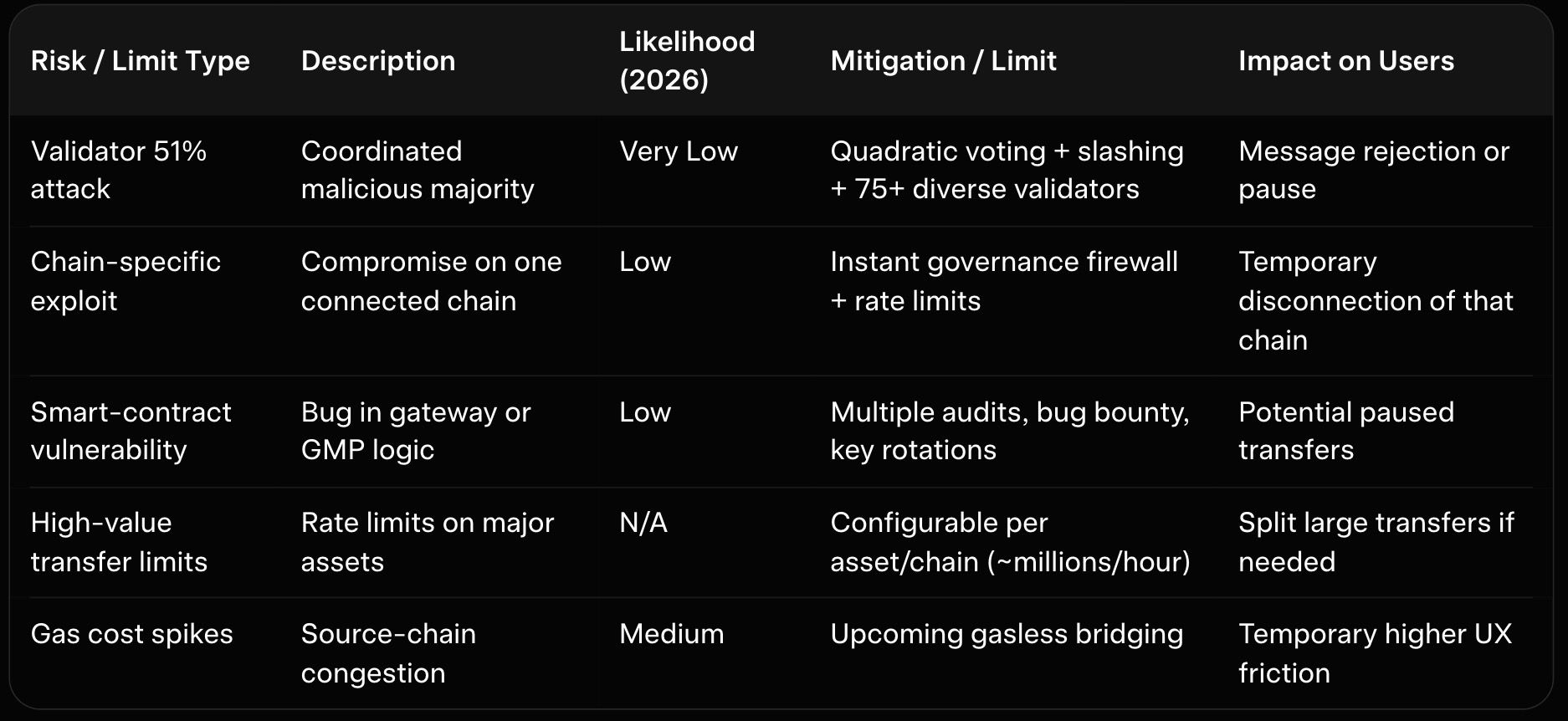
For typical retail and institutional flows under $10M, risks remain materially lower than using centralized custodians or less decentralized bridges.
Comparison to Other Interchain Communication and Bridge Solutions
Axelar competes in a mature field but differentiates through its combination of broad connectivity, programmable GMP, and superior decentralization.
LayerZero offers massive volume and ultra-low latency via its endpoint model but relies on more configurable security (often oracle + relayer), giving developers flexibility at the cost of needing to choose trust assumptions per application. Wormhole uses a guardian network with 19+ validators—fast and battle-tested for NFTs and tokens—but less programmable than Axelar’s Turing-complete GMP. Chainlink CCIP targets enterprises with oracle-backed security and risk management but at higher costs and narrower chain support.
Synapse and Hop excel at liquidity-based asset transfers but lack Axelar’s generalized messaging for arbitrary contract calls. Stargate (LayerZero-based) focuses on native-asset pools but does not match Axelar’s institutional compliance tooling.
Here is a direct 2026 feature comparison for cross-chain messaging use cases:
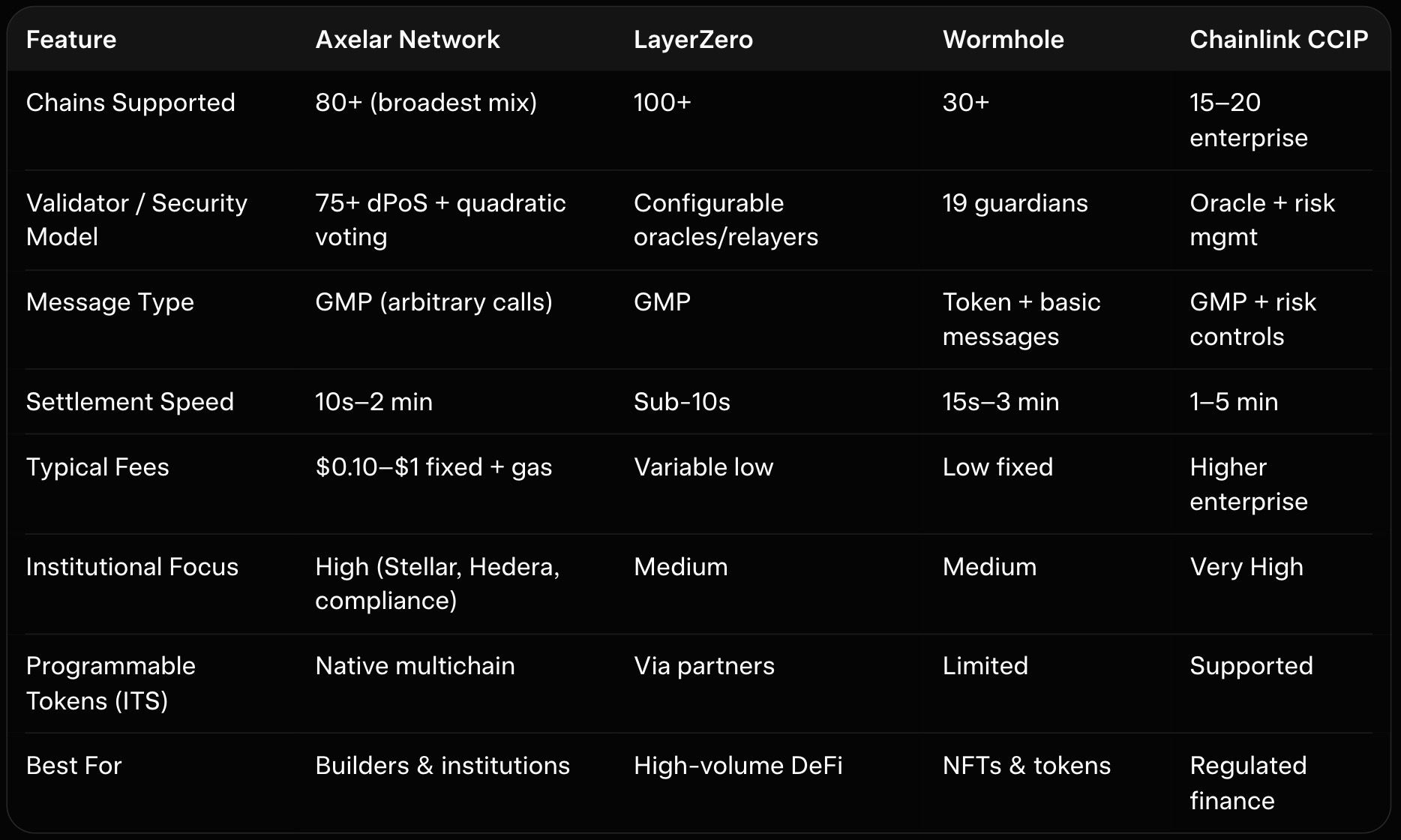
Axelar consistently ranks highest for developers needing secure, programmable, institution-ready interoperability across diverse ecosystems.
How baltex.io Provides Alternative Multi-Chain Routing Without Direct Interchain Message Exposure
While Axelar delivers unmatched security and programmability for direct cross-chain messaging, many users—especially retail DeFi participants and privacy-conscious traders—prefer to avoid any exposure to individual interchain protocols, gateways, or validator sets.
baltex.io solves this by acting as a non-custodial, intelligent routing aggregator across 200+ networks and 10,000+ tokens. Instead of forcing every transfer through a single messaging layer like Axelar’s gateways, baltex scans dozens of paths in real time: combinations of DEX liquidity, native bridges, and aggregated liquidity pools. The platform executes the entire journey as one atomic wallet transaction, delivering native assets on the destination without ever requiring users to interact directly with GMP contracts or threshold-signed gateways.
For an Arbitrum user moving USDC to a Stellar-based RWA vault, baltex can route via optimized intermediate steps or hybrid liquidity that never touches Axelar’s validators—eliminating single-protocol smart-contract risk entirely. Built-in privacy modes further split and obscure flows through mixers or privacy chains.
Advantages over direct interchain solutions include broader coverage (including chains Axelar has not yet connected), often superior all-in pricing during volatility, and complete abstraction from any one security model. Power users frequently combine Axelar for mission-critical programmable calls with baltex.io for everyday high-volume or privacy-sensitive routing, creating a robust sovereign stack that maximizes optionality while keeping keys fully under user control.
FAQ
How many chains does Axelar support in 2026? More than 80 active connections spanning EVM, Cosmos, Stellar, Hedera, XRPL, and high-performance L1s.
Is Axelar faster than official bridges? Yes—messages settle in seconds to minutes versus hours or days for canonical withdrawals.
What are typical fees for a cross-chain transfer? Fixed relayer fees of $0.10–$1.00 plus source gas; gasless options coming in 2026 for common flows.
How secure is Axelar compared to LayerZero? Axelar’s quadratic voting and 75+ diverse validators provide stronger decentralization guarantees than most configurable alternatives.
Can institutions use Axelar for compliant RWAs? Absolutely—native support for compliance rules, rate limits, and integrations with Stellar, Hedera, and J.P. Morgan Onyx make it enterprise-ready.
What happens if one chain is compromised? Governance can instantly firewall the affected chain, protecting all other connections.
How does baltex.io reduce risk versus direct Axelar usage? By never exposing users to any single messaging protocol or gateway contract, routing instead through aggregated hybrid paths.
Does Axelar support NFT or contract calls across chains? Yes—GMP enables fully arbitrary, Turing-complete cross-chain logic including NFTs, governance votes, and complex DeFi composability.
Conclusion
Axelar Network has matured into the definitive secure interchain communication layer of 2026, powering everything from retail DeFi flows to institutional tokenized finance across 80+ blockchains. Its combination of decentralized 75+ validator PoS architecture, groundbreaking quadratic voting, threshold cryptography, and programmable GMP/ITS capabilities delivers the security, speed, and flexibility the multi-chain future demands.
While alternatives like LayerZero or Wormhole offer strong volume or specialized features, Axelar strikes the optimal balance for developers and institutions requiring broad reach, compliance tooling, and proven resilience. Pair it with baltex.io for routing scenarios where maximum abstraction and privacy matter most, and you possess a complete toolkit for navigating fragmented liquidity and opportunities.
Test with small transfers, explore the developer docs, and experience the difference at the Axelar network. In a world where capital moves as freely as information, Axelar provides the trusted, programmable rails that make onchain finance truly global, secure, and unstoppable.
You can read our full breakdown in How to Use Polymarket with Gnosis Safe for Security (2026).
You can read our full breakdown in How to Use Polymarket with Gnosis Safe for Security (2026).
You can read our full breakdown in Validator and Guardian Model: Wormhole's Security Backbone.
You can read our full breakdown in Validator and Guardian Model: Wormhole's Security Backbone.