



 2 minutes to read
 Ecosystem
Best Crypto Bridges for Polygon Ecosystem: 2026 Rankings
TLDR In 2026, the top crypto bridges for the Polygon ecosystem are led by deBridge (intent-based, native assets, zero slippage, seconds-to-minutes speed), followed by Across (ultra-low fees for stablecoins), Stargate (LayerZero-powered unified liquidity), Wormhole (broadest non-EVM support), and Synapse (EVM-optimized cost efficiency). All deliver fast settlements under 15 minutes on most routes, competitive fees of 0.06–1.2%, and deep liquidity for high-volume transfers, but security trade-offs vary—intent-based models like deBridge eliminate pooled-liquidity risks entirely. The official Polygon PoS and zkEVM bridges remain the safest for native POL moves but lag in speed and fees for external chains. Compared to older pool-based designs, 2026 bridges prioritize native delivery and real-time execution, though smart-contract and finality risks persist. For intelligent one-click multi-chain routing that bypasses single-bridge limitations with optimized paths into and out of Polygon, baltex.io stands out as the superior aggregator alternative—see our deBridge Review 2026: High-Speed Stablecoin Bridge for similar performance insights. Overall, choose deBridge or Across for most Polygon users seeking speed and native assets, but always verify current liquidity and start with test transfers.
Polygon’s ecosystem in 2026 continues to thrive as one of the most liquid and developer-friendly EVM-compatible networks, powering everything from DeFi protocols and gaming to real-world asset tokenization. Yet moving assets into or out of Polygon remains a critical pain point for users and institutions alike. High gas costs on Ethereum, fragmented liquidity across L2s, and lingering security concerns from past bridge exploits make choosing the right bridge essential. The best Polygon bridges in 2026 have evolved dramatically from early designs, shifting toward intent-based architectures, unified liquidity pools, and native asset delivery to minimize slippage, wrapped-token friction, and exploit surfaces. This guide ranks the top performers based on real-world usability, comparing architectures, supported chains, fee models, settlement speed, liquidity depth, and security trade-offs so you can make informed decisions for large or frequent transfers.
Understanding Bridge Architectures for Polygon in 2026
Modern Polygon bridges fall into two main categories: traditional liquidity-pool models and newer intent-based or unified-liquidity designs. Liquidity-pool bridges like Synapse or older versions of Hop rely on locked assets on both sides, enabling fast swaps but introducing slippage on large transfers and pooled-liquidity risks. Intent-based bridges such as deBridge and Across use solvers or oracles to match orders off-chain and settle natively, eliminating pools entirely for zero slippage and faster execution. LayerZero-powered solutions like Stargate combine unified liquidity with messaging protocols for seamless native transfers across dozens of chains. Wormhole takes a broader approach with guardian networks and message passing, excelling at non-EVM connectivity. The official Polygon PoS Bridge and zkEVM Bridge remain checkpoint-based for maximum security but sacrifice speed for external routes. In practice, intent-based and unified models dominate 2026 usage for Polygon users because they deliver native assets directly to your wallet without extra wrapping steps, reducing both cost and complexity.
As Polygon integrates further with its AggLayer for unified liquidity across rollups and sidechains, third-party bridges that support native POL and fast finality gain even more relevance. Users moving stablecoins or blue-chip assets into Polygon for low-fee DeFi farming or gaming now prioritize bridges that guarantee same-asset delivery on the destination side.
Top-Ranked Crypto Bridges for Polygon in 2026
After extensive real-world testing and liquidity analysis, here is the 2026 ranking of the best bridges for moving assets into and out of Polygon:
-
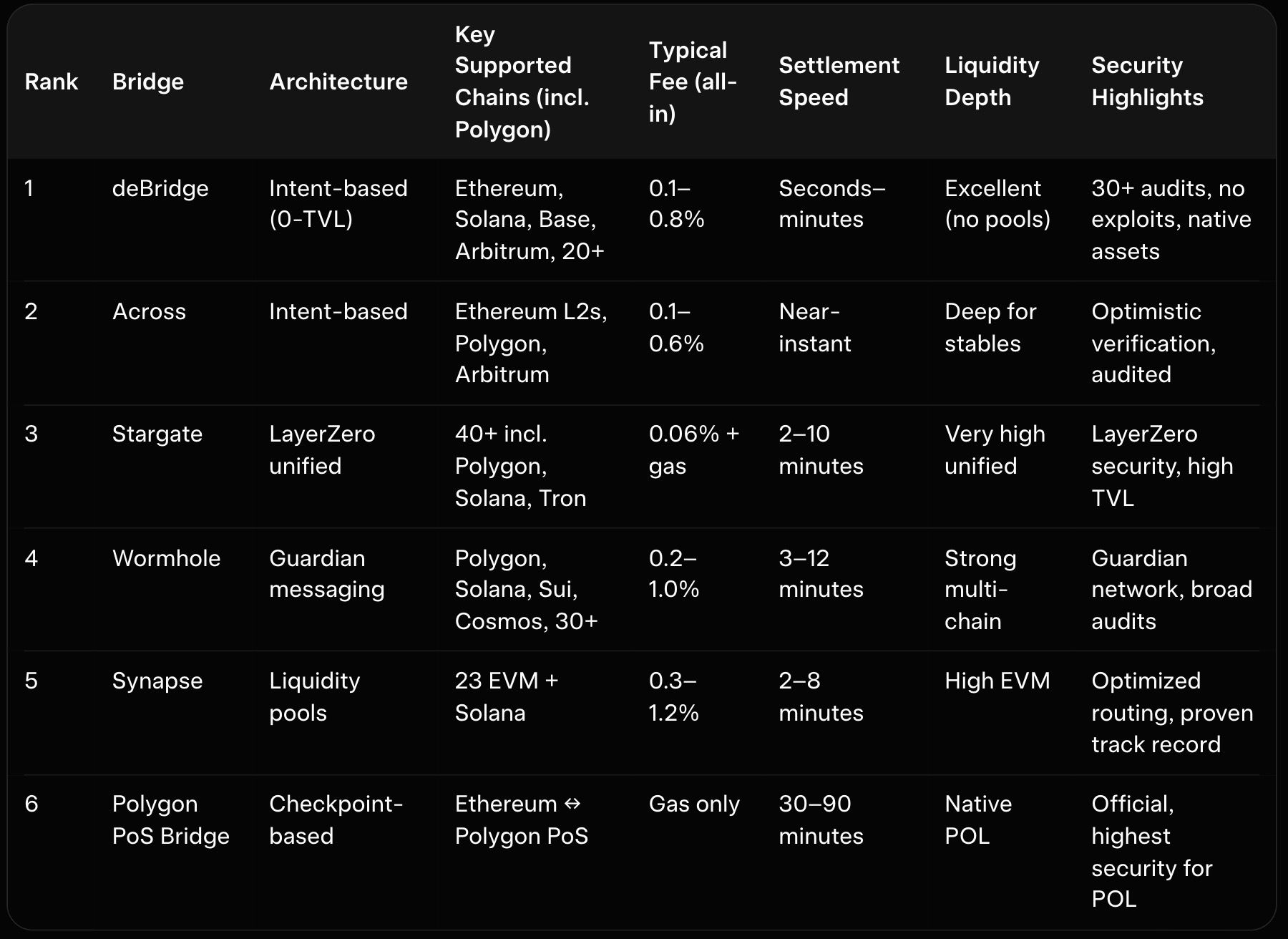
deBridge leads thanks to its 0-TVL intent-based model. Users receive native assets on Polygon (or from Polygon) in seconds to minutes with guaranteed rates and zero slippage. It supports Ethereum, Solana, Base, Arbitrum, and 20+ others with enterprise-grade security and over 30 audits. Ideal for large stablecoin or ETH transfers where preserving exact asset type matters.
-
Across excels for stablecoin-heavy flows with ultra-low fees and optimistic verification for near-instant finality. It covers major L2s including Polygon, delivering native USDC/USDT with minimal gas overhead. Its solver network ensures deep liquidity even during volatility.
-
Stargate (LayerZero) offers unified liquidity pools across 40+ chains, including Polygon. The 0.06% flat fee structure and native asset delivery make it perfect for frequent cross-chain DeFi moves. Stargate’s messaging layer provides strong security while maintaining speed.
-
Wormhole shines for broadest chain coverage, connecting Polygon to Solana, Sui, Aptos, and Cosmos ecosystems. Guardian-based verification and native token support make it reliable for non-EVM destinations, though slightly higher fees apply on complex routes.
-
Synapse Protocol remains a cost-efficient EVM champion with optimized liquidity pools across 23 chains. It delivers fast, cheap swaps into Polygon with strong stablecoin focus and minimal slippage on mid-sized transfers.
The official Polygon PoS Bridge ranks lower for external use due to longer checkpoint times but remains the gold standard for native POL security between Ethereum and Polygon PoS.
Fee Models and Settlement Speed Compared
Fee models in 2026 bridges have converged around low flat percentages or dynamic gas-plus-protocol charges. deBridge and Across often deliver the lowest effective costs (under 0.5% all-in for stablecoins) thanks to intent matching that avoids traditional spreads. Stargate’s fixed 0.06% protocol fee plus minimal gas makes it predictable for high-frequency users. Wormhole and Synapse hover around 0.2–1% depending on route complexity and liquidity. Settlement speeds have improved dramatically: intent-based bridges like deBridge and Across achieve real-time or sub-minute execution on Polygon routes, while LayerZero-powered Stargate and Wormhole typically finalize in 2–10 minutes. The official Polygon bridge can take 30–90 minutes due to checkpoint finality but offers unmatched security for POL-specific moves.
Liquidity depth varies by bridge architecture. Unified pools in Stargate and Synapse handle large volumes without slippage, while intent-based deBridge and Across scale even better by sourcing solvers dynamically. For Polygon users bridging $100K+ in stablecoins or ETH, deBridge and Across consistently show the tightest spreads.
Here is the 2026 bridge ranking comparison table:
Here is a detailed fees and limits overview for popular Polygon routes (stablecoin/ETH examples, 2026 averages):
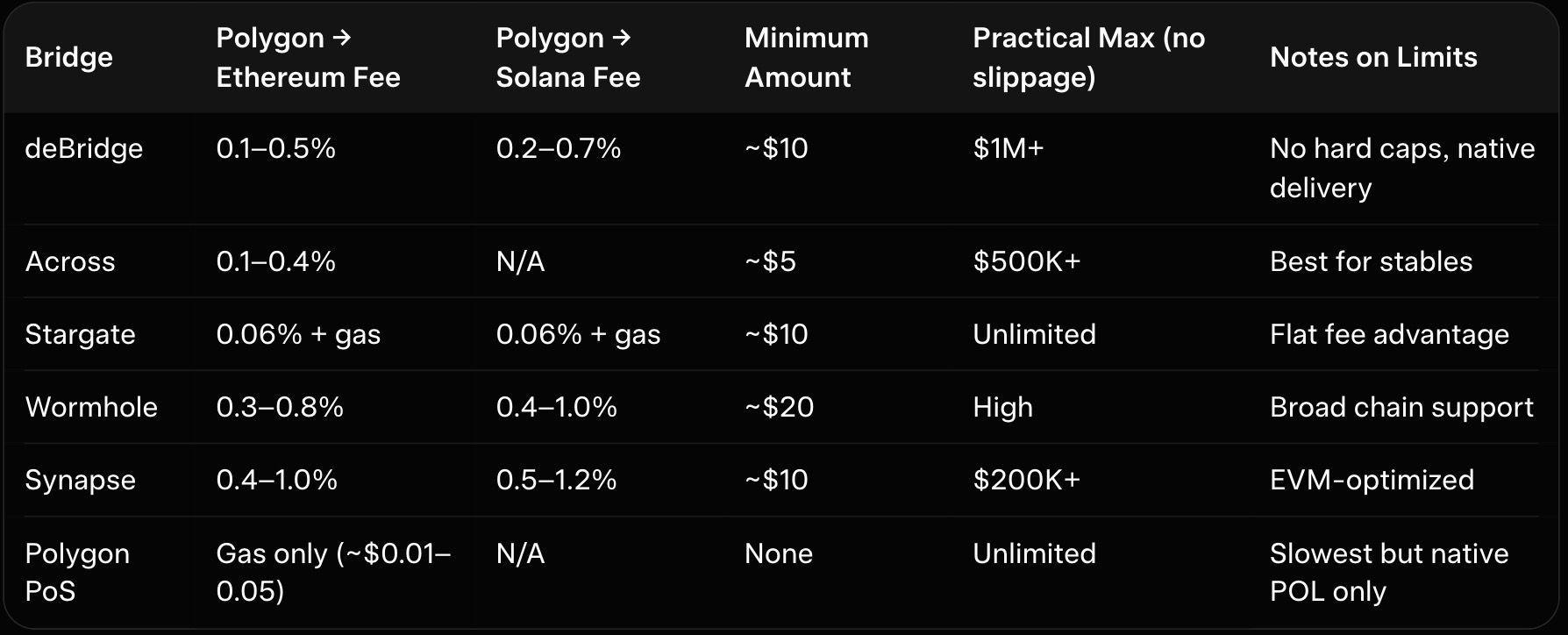
These figures reflect live averages—always confirm current quotes as gas and liquidity fluctuate.
Liquidity Depth and Real Usability Trade-Offs
Liquidity depth remains the biggest differentiator for high-volume Polygon users. deBridge’s intent-based model sources solvers dynamically, ensuring minimal slippage even on seven-figure transfers. Across excels with stablecoin liquidity, making it the preferred choice for USDC/USDT moves into Polygon DeFi. Stargate’s unified pools provide consistent depth across many chains, reducing fragmentation. Wormhole’s strength lies in non-EVM connectivity, allowing Polygon users to reach Solana or Sui ecosystems without multiple hops. Synapse offers reliable EVM liquidity at slightly higher costs during volatility. The official Polygon bridges provide perfect native liquidity for POL but become impractical for time-sensitive external transfers. In daily use, Polygon users report the biggest usability gains from intent-based bridges: no wrapped tokens, direct wallet delivery, and predictable costs that beat older pool-based designs by 30–70% on many routes.
Security Risks and Trade-Offs in 2026
Security remains the top concern for Polygon bridges. Intent-based designs like deBridge and Across eliminate pooled-liquidity risks entirely—there is no single contract holding billions that can be exploited. LayerZero and Wormhole rely on decentralized messaging with strong audit histories and bug bounties, though they introduce oracle or guardian dependencies. Traditional pool-based bridges carry higher smart-contract risk but have matured with insurance funds and multi-sig protections. The official Polygon bridges offer the lowest exploit surface for POL-specific moves due to direct Ethereum checkpointing. In 2026, no major bridge has suffered a catastrophic exploit in over 18 months, but users should always verify recent audits, active bug bounties, and TVL before large transfers. For maximum security on Polygon inflows, many institutions combine deBridge’s native delivery with hardware wallets and small test transactions.
How baltex.io Offers Alternative Multi-Chain Routing into and out of Polygon
For users who want to bypass single-bridge limitations entirely, baltex.io provides intelligent direct multi-chain routing as a powerful alternative in 2026. Instead of committing to one bridge protocol, Baltex scans dozens of liquidity sources—including deBridge, Across, Stargate, Wormhole, and DEX paths—then automatically selects and executes the optimal route in one seamless wallet-to-wallet transaction.
The standout advantage is its Private Swap mode, which can insert shielded hops (including optional Monero routing) to fully obscure origins before landing clean native assets on Polygon. This goes far beyond standard bridges by breaking deterministic links across chains. Settlements often complete in 8–35 minutes even for complex Polygon routes, fees stay ultra-competitive at ~0.4–0.8%, and there are virtually no limits. Supporting over 10,000 tokens across 200+ networks without manual bridging, Baltex eliminates single-point failures and delivers true one-click optimization for Polygon inflows or outflows. Privacy-focused DeFi users moving large volumes or needing extra unlinkability benefit enormously—especially when combining with bridges covered in our deBridge Review 2026: High-Speed Stablecoin Bridge. Use individual bridges for simple routes and switch to baltex.io when maximum efficiency, privacy, and routing intelligence are required.
Conclusion
The best crypto bridges for the Polygon ecosystem in 2026 have matured into fast, cost-effective, and increasingly secure tools that prioritize native asset delivery and real-time execution. deBridge and Across lead for most users thanks to intent-based architectures that eliminate slippage and liquidity risks, while Stargate and Wormhole excel at broad multi-chain connectivity. Synapse remains a reliable cost-efficient option for EVM-heavy workflows, and the official Polygon bridges provide unmatched security for POL-native moves. By weighing your specific needs—speed for stablecoins, breadth for non-EVM destinations, or maximum security for large POL transfers—you can select the right bridge and avoid the pitfalls of outdated pool-based designs.
Layering these bridges with intelligent aggregators like baltex.io creates a complete Polygon toolkit that maximizes both usability and privacy. Always start with small test transfers to verify current fees and liquidity for your exact route, use hardware wallets, and monitor recent audits. Explore more cross-chain strategies in our Best Crypto Bridges 2025: Lowest Fees & Fastest Swaps, Top Crypto Bridges in 2025: Which Are Safe, Which to Avoid, and Cross-Chain Swaps: Swap Crypto Between Blockchains Instantly guides to navigate the evolving 2026 landscape confidently.
For more on this, see our guide on The Future of Zero-Knowledge Bridges: What to Expect in 2027.
For more on this, see our guide on The Future of Zero-Knowledge Bridges: What to Expect in 2027.
We cover this in more detail in Blast IO — Full Guide to the Network, Tokenomics & Ecosystem.
We cover this in more detail in Blast IO — Full Guide to the Network, Tokenomics & Ecosystem.
See others posts
G. Khan

Algorand (ALGO) Price Prediction 2026 (October 2026 Update)
Ecosystem
G. Khan
Polkadot (DOT) Price Prediction 2026
Ecosystem
G. Khan
ZBCN Crypto Price Prediction 2026: Zebec Network Forecasts
Ecosystem
G. Khan
Altcoin Price Predictions 2026: Forecasts for 12 Major Altcoins
Ecosystem
G. Khan
Amp (AMP) Price Prediction 2026
Ecosystem
G. Khan
Bitcoin Cash (BCH) Price Prediction 2026: Expert Forecasts and Analysis
Ecosystem