



 2 minutes to read
 Ecosystem
Haveno DEX Review: The Next Generation of Private Monero Trading
TL;DR
Haveno DEX stands as a next-generation decentralized P2P exchange optimized for Monero trading in 2026. It delivers true non-custodial swaps with fiat and crypto pairs through Tor anonymity and Monero-native multisig escrow. While slower than instant swappers, it offers unmatched privacy and sovereignty that Bisq users often migrate toward. Baltex.io complements Haveno by adding fast private routing for post-trade optimization and cross-chain moves.
Privacy enthusiasts turn to Haveno when centralized platforms impose KYC or delist Monero. The desktop application connects peers directly on a Tor-based network with no central servers. This architecture resists censorship and data collection entirely.
Haveno builds as a fork of Bisq but re-engineers for Monero’s strengths. Lower transaction fees, faster confirmations, and native privacy features make it ideal for XMR-focused traders. Users download the app, configure wallets, and start creating or taking offers without accounts.
Haveno Architecture and Core Design
Haveno operates fully decentralized with all communications routed through Tor. Peers discover offers and negotiate trades without intermediaries. Monero serves as the primary settlement currency, leveraging its ring signatures and stealth addresses for inherent unlinkability.
The protocol avoids any governance token like Bisq’s BSQ to prevent privacy leaks. Community-driven networks and third-party installers power live trading in 2026. This setup ensures resilience even if individual instances face pressure.
Custody Model and Escrow Mechanics
Haveno uses a strict non-custodial model where users control their private keys at all times. Trades lock funds in Monero multisig escrow, typically 2-of-3 setups involving buyer, seller, and optional arbitrator. Security deposits from both sides incentivize honest completion.
This design eliminates counterparty risk common on centralized venues. Funds move directly between user wallets upon trade finalization. Time locks provide automatic refunds if disputes stall beyond agreed periods.
Privacy Guarantees
Tor integration hides IP addresses and metadata by default. Monero’s privacy technology obscures amounts, senders, and receivers on-chain. No user data collection or logging occurs on the protocol level.
Haveno improves on Bisq’s privacy shortcomings by centering Monero from the ground up. Trades avoid traceable patterns that affect Bitcoin-based platforms. Advanced users layer additional tools like fresh subaddresses for maximum detachment.
Payment Methods Supported
Haveno accommodates diverse fiat options for real-world usability. Bank transfers, Revolut, cash deposits, gift cards, cash-by-mail, and in-person meets appear frequently. Crypto pairs like BTC, ETH, and stables expand flexibility.
Traders define exact payment conditions when posting offers. This flexibility suits global users with varying local rails. Reputation systems help filter reliable counterparties for specific methods.
Fees on Haveno
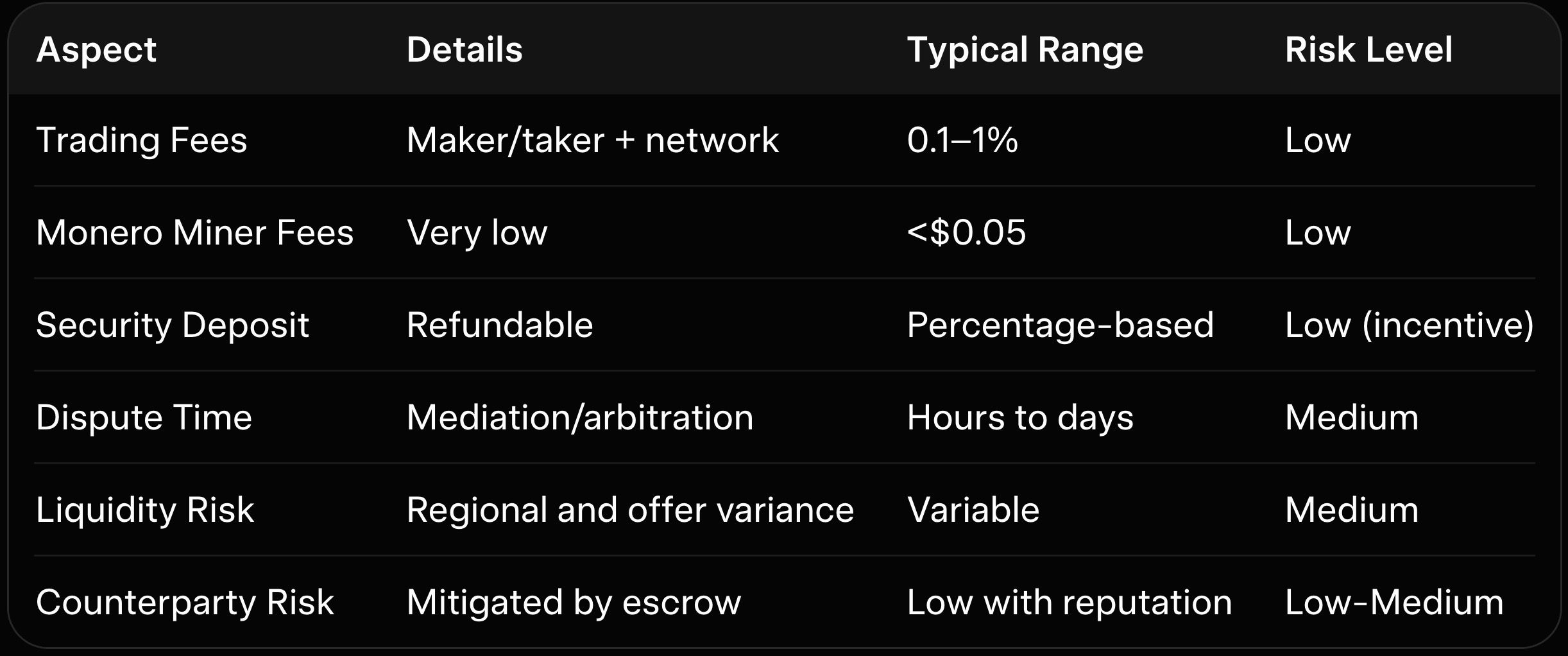
Trading fees remain low and configurable by network. Makers often pay less to encourage liquidity provision while takers cover slightly higher shares. Monero’s minimal miner fees keep on-chain costs under a cent in most cases.
No withdrawal or deposit fees apply since users never surrender custody. Overall costs undercut many centralized alternatives for privacy-focused volumes. Fixed or percentage-based structures appear depending on the active Haveno network.
Dispute Resolution
Haveno employs a decentralized arbitration process. Parties first attempt direct resolution via encrypted in-app messaging. Unresolved cases escalate to community mediators who review evidence without accessing funds.
Arbitrators propose fair settlements that both sides can accept or reject. This system maintains trust while preserving non-custodial principles. Most disputes resolve quickly through clear trade terms and communication.
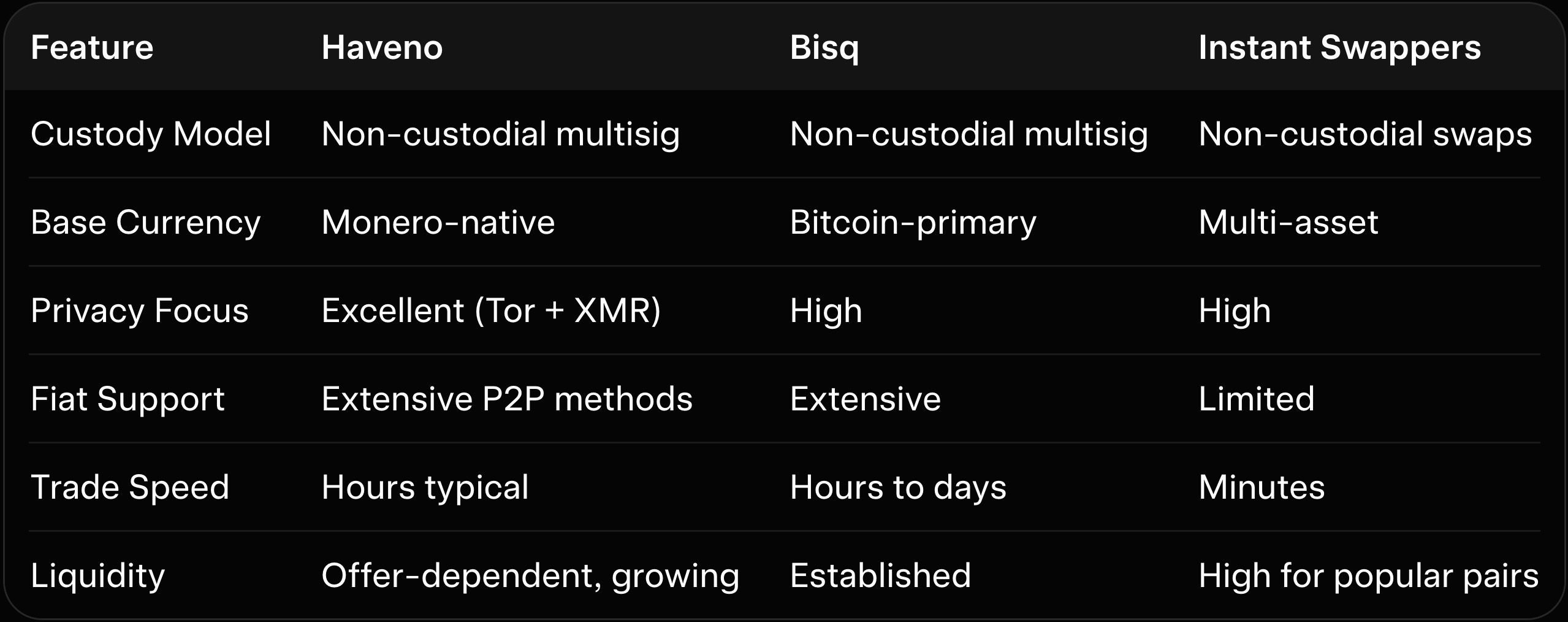
Features Comparison Table
Fees and Risks Table
Real-World Trade Execution
Users launch the desktop app and browse the offer book for matching terms. After selecting an offer, both parties confirm details and lock deposits plus trade amounts into escrow. Fiat payment follows agreed methods while crypto settles automatically upon confirmation.
Successful trades release funds directly to recipient wallets. The process rewards patience and clear documentation. Experienced traders build strong reputations that unlock better rates and larger limits over time.
Comparison with Bisq and Alternatives**
Haveno improves on Bisq by eliminating BSQ token privacy issues and leveraging Monero’s efficiency. Faster and cheaper settlements make it preferable for XMR-centric users. Bisq retains advantages in broader asset variety and mature liquidity for non-Monero pairs.
Instant swappers like GhostSwap or GODEX provide speed but lack fiat depth and full decentralization. Haveno excels where sovereignty and unlinkability matter most. Many users combine platforms—Haveno for private entry, others for quick exits.
Atomic swap tools offer another decentralized path but face technical hurdles and limited fiat support. Haveno’s multisig model balances usability with security better for most P2P traders.
Usability and Onboarding
The desktop interface requires initial setup of wallets and payment accounts. Tor routing adds slight latency but enhances anonymity. Documentation and community resources guide new users through the learning curve.
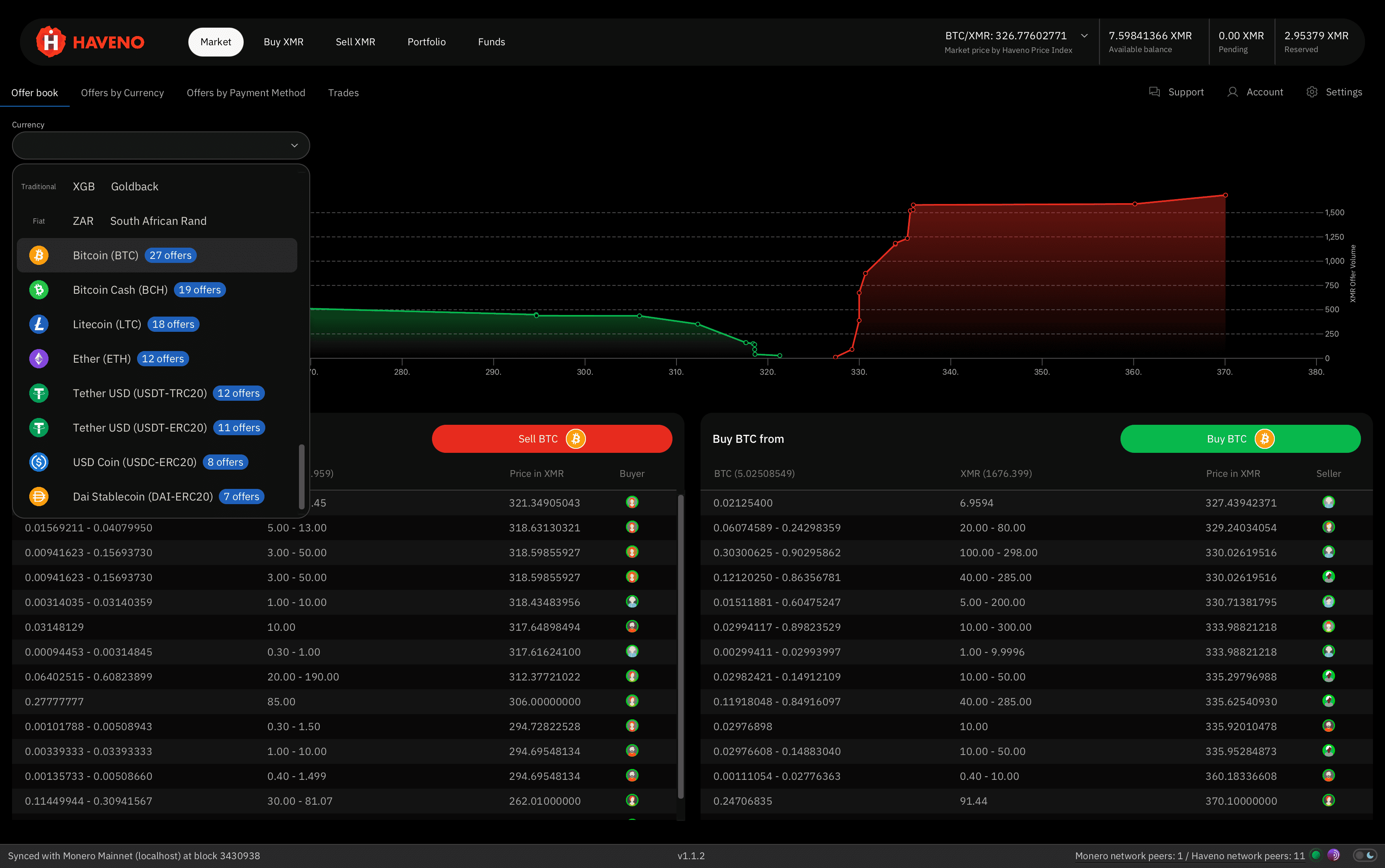
Once configured, creating and taking offers feels straightforward. Regular UI improvements in 2026 have polished the experience significantly. Dedicated devices or virtual machines further boost operational security.
Risks and Mitigation
Counterparty scams remain possible despite escrow, particularly with reversible fiat methods. Reputation checks, small test trades, and strict offer filtering reduce exposure. Liquidity gaps in certain regions require patience or alternative networks.
Technical issues or misconfigurations can delay funds temporarily. Thorough testing on available testnets builds confidence. Regulatory scrutiny targets P2P venues less effectively due to decentralization.
Best Practices for Haveno Users
Always use fresh Monero subaddresses for receipts. Verify payment proofs carefully before releasing escrow. Maintain detailed private records of each trade for dispute support.
Access the app through secure environments and keep software updated. Start with modest volumes to familiarize yourself with workflows. Layer with strong wallet security for received funds.
How Baltex.io Complements or Improves Private Trading Workflows
Baltex.io fits naturally after Haveno trades by providing non-custodial private routing for further asset movement. Users acquire XMR privately on Haveno then route portions through Baltex for cross-chain swaps or enhanced unlinkability. Shielded hops break any residual patterns without new exposure.
This combination merges Haveno’s fiat entry strength with optimized execution. Baltex scans liquidity across networks while inserting Monero privacy segments where beneficial. Unlimited no-KYC flows and transparent previews streamline post-P2P rebalancing.
Practical scenarios include converting excess XMR to other assets for DeFi or storage diversification. Baltex handles the technical optimization so traders focus on strategy. Check our best P2P Monero exchanges for integrated approaches.
Ecosystem guides support complete stacks. Explore Monero vs Bitcoin privacy comparisons when choosing base assets. Wallet recommendations feature in MyMonero web and desktop wallet guide and Monerujo Android wallet review.
Hardware options appear in Ledger vs Trezor for Monero. Instant alternatives complement via StealthEX anonymous XMR instant exchange review and GODEX no-KYC review.
Aggregators like those in Trocador privacy-focused review optimize rates after P2P. Broader insights cover Monero vs Zcash and best decentralized exchanges for buying Monero.
Conclusion
Haveno DEX represents the next generation of private Monero trading through its Monero-optimized architecture, robust multisig security, and uncompromising decentralization. Flexible payment methods, low fees, and community arbitration deliver practical usability for serious privacy users. Trade-offs in speed and liquidity suit those who prioritize sovereignty over convenience.
Baltex.io elevates Haveno workflows by enabling seamless private routing and optimization without sacrificing anonymity. Together they create resilient stacks for acquiring, moving, and protecting Monero in challenging regulatory environments. Test small, verify processes, and combine tools thoughtfully for maximum effectiveness.
Decentralized trading evolves continuously yet Haveno’s focus on Monero fundamentals ensures lasting relevance. Privacy seekers benefit from its resilience and supporting ecosystem resources on wallets, privacy coins, and swap strategies. By mastering Haveno and complementary platforms, users maintain full control and discretion throughout 2026 and beyond.
For more on this, see our guide on SimpleSwap Review 2026: Pros, Cons, and Monero Exchange Fees.
Related reading: Aztec Network: Best for Programmable Private Smart Contracts.
Related reading: XMR.to Alternatives: How to Pay Bitcoin Invoices with Monero.
Related reading: Zcash (ZEC) vs Monero (XMR): Which Privacy Coin Wins in 2026.
Related reading: Zcash (ZEC) vs Monero (XMR): Which Privacy Coin Wins in 2026.
Is Haveno truly no-KYC and decentralized?
How does Haveno compare to Bisq for Monero trading?
Can beginners succeed on Haveno?
How does Baltex.io enhance Haveno usage?
See others posts
G. Khan

How to Buy Bitcoin and USDT in India (INR) (October 2026)
Ecosystem
G. Khan
The 10 Best Places to Buy Crypto Online in 2026
Ecosystem
G. Khan
The Cheapest Way to Buy Crypto: Fees by Payment Method Compared (October 2026)
Ecosystem
G. Khan
How to Buy Bitcoin and Ethereum in Canada (2026)
Ecosystem
G. Khan
How to Buy Bitcoin in the UK and Australia (October 2026)
Ecosystem
G. Khan
How to Buy Solana with a Credit or Debit Card (October 2026)
Ecosystem