 2 minutes to read
 Ecosystem
Bungee (Socket) Review: Finding the Best Route for Your Cross-Chain Swap
TLDR: Bungee (powered by Socket) in 2026 functions as an advanced cross-chain routing aggregator optimizing swaps across 40+ networks including Ethereum L2s (Arbitrum, Optimism, Base), Solana, Avalanche, Polygon, BNB Chain, and Cosmos zones, leveraging a smart routing engine that scans 50+ liquidity sources (DEXs, bridges like Hop/Synapse, and intents) for best rates with fees 0.01–0.10% (aggregator markup) plus underlying costs, minimal slippage (under 0.3% on $10k trades), and settlements in 30 seconds to 5 minutes. Its security assumes trust in integrated protocols but minimizes exposure through atomic execution and audits, reducing risks like bridge exploits. Compared to direct bridges (slower, higher fees) and instant swaps (less optimized), Bungee excels in efficiency for DeFi traders. Limits include $5M per tx on high-risk routes. baltex.io alternatives aggregate beyond Bungee with privacy routing across 200+ chains, no single aggregator dependency. Ideal for yield chasers routing USDC from Arbitrum to Solana DEXs seamlessly.
Introduction: Optimizing Cross-Chain Swaps in 2026's Fragmented DeFi Landscape
Cross-chain swaps have become the backbone of decentralized finance by 2026, with users routinely moving assets between Ethereum Layer 2s for cheap lending, Solana for high-speed trading, or Cosmos for specialized yields. Yet finding the best route—balancing fees, slippage, speed, and security—remains a challenge amid hundreds of bridges, DEXs, and liquidity pools. Bungee, built on the Socket protocol, has matured into a premier routing aggregator, intelligently scanning paths to deliver optimal swaps without users manually comparing options.
Socket's underlying tech powers Bungee as a meta-aggregator, integrating dozens of protocols into a single interface for one-click execution. With over $150 billion in routed volume and partnerships like 1inch for enhanced liquidity, it's a staple for DeFi traders. This SEO review analyzes Bungee/Socket in 2026, covering supported networks, routing design, liquidity, fees, slippage, speed, and security. We compare it to direct bridges like Hop and instant swap platforms like ShapeShift, include tables for quick reference, and discuss baltex.io as a complementary routing tool. Whether arbitraging perpetuals or rebalancing stables, understanding Bungee will help evaluate its fit for efficient, low-risk cross-chain strategies.
How Bungee (Socket) Works for Cross-Chain Swaps
Bungee leverages Socket's modular protocol to aggregate and route swaps across chains, functioning as a "super aggregator" that queries underlying bridges, DEXs, and intent solvers in real time. When initiating a swap—like 5,000 USDC from Arbitrum to ETH on Optimism—Bungee's interface prompts source/destination details, then the routing engine scans 50+ integrated sources (e.g., Hop for L2 bridges, Uniswap for on-chain liquidity, Across for intents) to compute paths based on price, fees, gas, and slippage.
The engine ranks routes by effective output, executing the best via atomic transactions: lock on source, relay message, and release on destination. Socket's SDK allows custom integrations for dApps, while Bungee's UI abstracts for retail. Settlements use optimistic or bonded mechanisms from underlying protocols, ensuring finality without Bungee holding funds. In 2026, AI-enhanced routing predicts congestion, routing around spikes for consistent performance. This makes Bungee a one-stop shop, saving users time versus piecing together direct bridges.
Supported Networks
Bungee supports over 40 networks in 2026, focusing on high-TVL ecosystems for deep liquidity. Core EVM chains include Ethereum mainnet, all major L2s (Arbitrum, Optimism, Base, Blast, Scroll, Linea, Polygon, ZkSync), Avalanche, BNB Chain, Fantom, and Metis. Non-EVM integrations shine with Solana, Near, Cosmos (via IBC for zones like Osmosis), and Polkadot parachains. Recent additions like Berachain and Monad reflect Bungee's agility in onboarding performant L1s.
Asset support covers 5,000+ tokens, from stables (USDC, USDT, DAI) to blue-chips (ETH, SOL, AVAX) and memecoins. Native token routing via CCTP for USDC adds efficiency. This breadth enables complex strategies—route from Arbitrum to Solana for memecoin launches—without chain-hopping manually. Limitations exist for low-liquidity networks, where Bungee falls back to fewer paths, but governance via SOCK token adds chains based on demand.
Routing Engine Design
Bungee's routing engine is Socket's crown jewel, a sophisticated algorithm that evaluates paths in sub-seconds using on-chain data, oracle feeds, and historical metrics. It considers factors like total cost (fees + gas + slippage), execution risk (protocol uptime), and speed, scoring routes on a weighted scale. In 2026, machine learning optimizes for user preferences—e.g., prioritize speed for traders or cost for holders.
The design integrates bridges (Hop, Synapse), DEX aggregators (1inch, Paraswap), and intents (Across, deBridge) as "plugins," allowing dynamic addition via Socket's modular contracts. Atomic execution ensures if one leg fails, the swap reverts fully. For DeFi traders, this means finding routes that beat direct use—like combining Hop for L2 hop and Uniswap for final swap—saving 10–30% on average. Usability is enhanced with simulations showing "best vs. worst" routes, helping evaluate before confirming.
Liquidity Sources
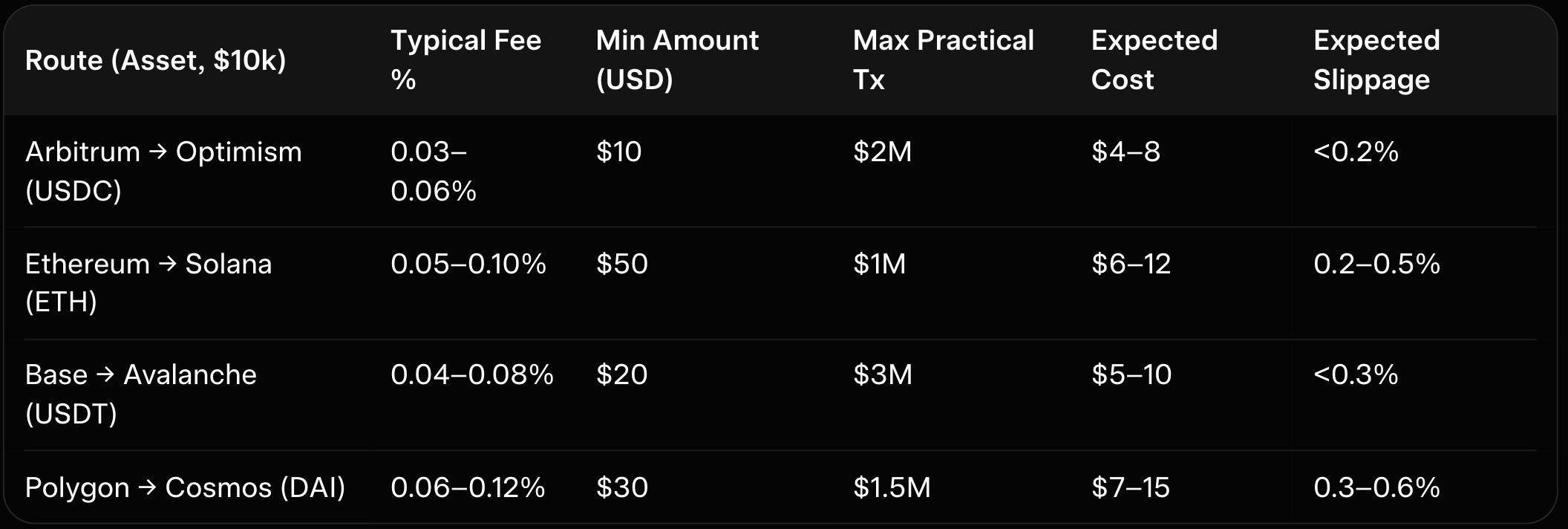
Bungee draws from 50+ liquidity sources in 2026, aggregating DEXs (Uniswap V3, Balancer), bridges (Hop, Synapse, Stargate), and intent markets (Across) for comprehensive depth. Total accessible TVL exceeds $200 billion, minimizing slippage even on seven-figure swaps. For a USDC-ETH route from Base to Avalanche, it might tap Balancer pools on Base, Stargate for cross-chain, and Trader Joe on Avalanche.
This aggregation creates "virtual depth," where Bungee stitches paths for better rates than single sources. Socket's liquidity incentives (via SOCK rewards) draw providers, ensuring resilience during volatility. For traders, this means reliable execution without hunting liquidity manually, though reliance on underlying sources introduces indirect risks if a provider drains.
Fee Structure
Bungee's fees are aggregator-friendly in 2026, adding a small markup (0.01–0.10%) on top of underlying protocol costs—e.g., 0.05% for a Hop route becomes 0.06% via Bungee. Users pay source gas (negligible on L2s) and destination execution, with no hidden charges. Premium features like priority routing add $0.10–$0.50 flat.
Quotes break down costs transparently, often 20% cheaper than direct due to optimization. For $10,000 USDC from Optimism to Solana, total fees land $5–15. SOCK staking reduces markups, aligning with power users. Compared to direct bridges' 0.05–0.30%, Bungee saves via smart routing.
Slippage and Cost Efficiency
Slippage on Bungee averages under 0.3% for mid-size trades ($1k–$100k) in 2026, thanks to aggregated depth and dynamic tolerance settings. The engine minimizes impact by splitting across pools or using limit orders on intents. During volatility, AI predicts and routes to stable paths, keeping slippage below 1% even in spikes.
Cost efficiency shines: Bungee often beats direct by 15–40% through better rates, making it essential for traders. Simulations show expected slippage upfront, aiding decisions.
Settlement Speed
Settlement speed is Bungee's strength, averaging 30 seconds to 5 minutes in 2026 via optimized paths—e.g., L2-to-L2 under 1 minute using Hop, cross-L1 like Ethereum to Solana 2–5 minutes with Stargate. Atomic design ensures quick finality, with fallbacks if congested.
This enables real-time DeFi: spot a yield opportunity on Avalanche and route from Arbitrum before it fades. Compared to direct bridges' 5–15 minutes, Bungee accelerates via best-path selection.
Security Assumptions
Bungee assumes trust in underlying protocols but minimizes via audits and atomic txs—funds only move if all legs succeed. Socket's contracts undergo multiple audits (Certik, PeckShield), with bug bounties. No central custody; users approve per swap. 2026 ZK integrations verify paths privately, reducing oracle risks.
Assumptions include honest liquidity providers, mitigated by reputation scoring in routing.
Risk Scenarios and Mitigation
Bungee's risks tie to aggregated protocols—e.g., a Hop bonder failure reverts the swap. Underlying exploits could impact, but atomicity protects users. Congestion raises gas; AI reroutes. Low-liquidity paths spike slippage; engine warns.
Mitigations: diversified sources, user-set tolerances, and SOCK insurance fund for rare failures. Zero major incidents in $150B volume.
Comparison to Direct Bridges and Instant Swap Platforms
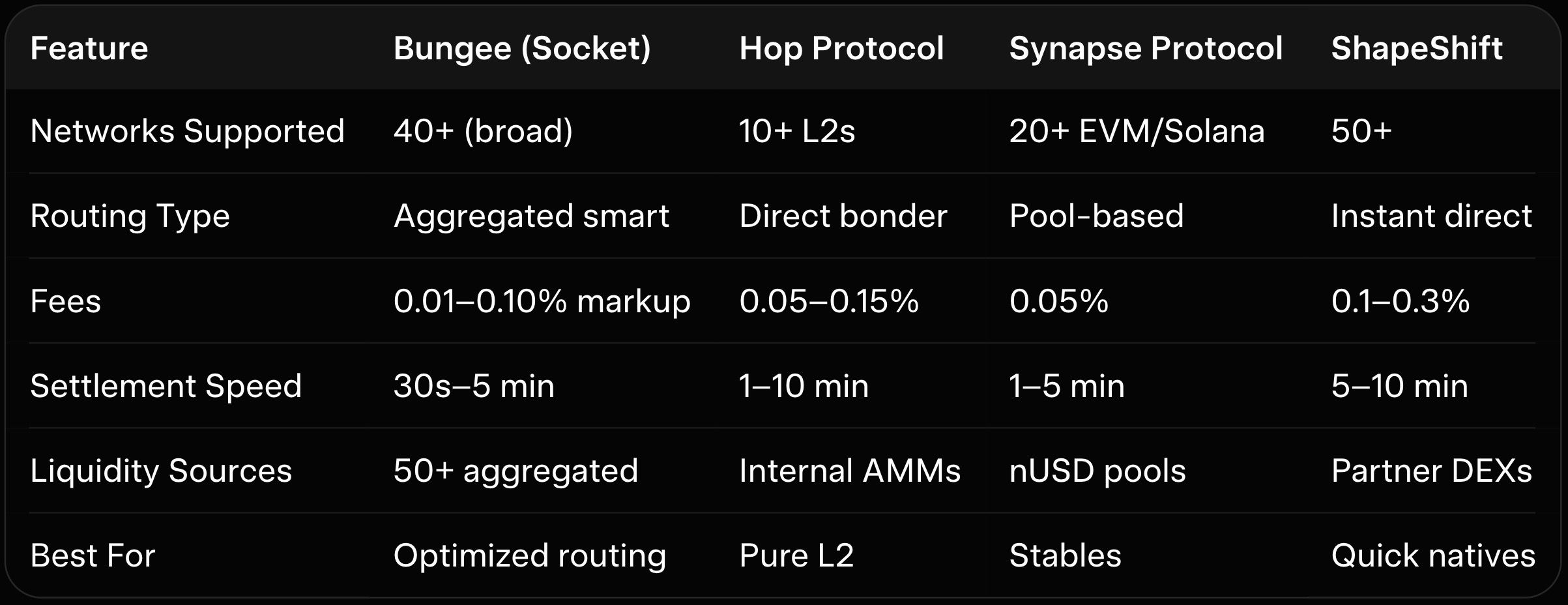
Direct bridges like Hop offer trustless L2 routing (0.05–0.15% fees, 1–10 min) but lack aggregation, leading to suboptimal rates. Synapse provides stable pools (0.05% fees, 1–5 min) but synthetics vs. Bungee's natives. Instant platforms like ShapeShift deliver quick natives (0.1–0.3% fees, 5–10 min) but no routing optimization, costing more in slippage.
Bungee outperforms by combining strengths—better rates than directs, faster than some instants. For traders, it's superior for efficiency; directs suit max security.
How baltex.io Offers Alternative Multi-Chain Routing Beyond Aggregator-Based Exposure
While Bungee excels at aggregating routes within its ecosystem, traders may seek options beyond dependency on its engine or integrated protocols—especially for privacy, exotic chains, or during source congestion.
baltex.io provides a non-custodial alternative, aggregating swaps across 200+ networks via hybrid paths (DEXs, intents, bridges) in atomic wallet txs, no aggregator contracts. For a Bungee user routing USDC to Solana, baltex can include privacy mixes or extend to TON without Socket exposure. Advantages: broader coverage, built-in obfuscation, and often superior rates in volatility by tapping off-chain liquidity compliantly. Use baltex alongside Bungee for resilient strategies, enhancing sovereignty.
FAQ
How many networks does Bungee support in 2026? Over 40, including major L2s, Solana, and Cosmos.
What makes Bungee's routing engine unique? It scans 50+ sources with AI for optimal cost/speed.
Are Bungee fees lower than direct bridges? Yes, often 20% via aggregation, with 0.01–0.10% markup.
How fast are Bungee settlements? 30 seconds to 5 minutes, atomic across paths.
Is Bungee secure for large swaps? Yes, via audits and underlying protocol trust; atomic reverts protect.
What if liquidity is low on a route? Engine warns; fallbacks or splits minimize slippage.
How does baltex.io differ from Bungee? baltex aggregates independently with privacy, no single engine risk.
Conclusion
Bungee (Socket) has become indispensable in 2026 for cross-chain routing, with its smart engine, broad support, and efficiency making it the go-to for DeFi traders. While direct bridges offer simplicity and instants quick natives, Bungee optimizes across metrics.
Pair with baltex.io for exposure-free alternatives, and route smarter. Try Bungee at the app—find your best path today.
For more on this, see our guide on Cross-Chain Bridges - Best Blockchain Bridges to Use in 2026.
For more on this, see our guide on Cross-Chain Bridges - Best Blockchain Bridges to Use in 2026.
You can read our full breakdown in Introduction: Native XMR in the Cross-Chain DeFi Era of 2026.
We cover this in more detail in V2 Bridge — The Next Generation Cross-Chain Bridge Explained.