 2 minutes to read
 Ecosystem
Celer cBridge Review: Fees, Speed, and Supported Assets in 2026
TLDR: Celer cBridge in 2026 facilitates near-instant (seconds to minutes) cross-chain transfers across 50+ chains including Ethereum L2s, Solana, Cosmos hubs, and non-EVM ecosystems like Polkadot and Near, supporting hundreds of assets from stables (USDC, USDT) to blue-chips (ETH, BTC) via deep liquidity pools and the SGN (State Guardian Network) for secure message relaying. Fees average 0.03–0.10% plus minimal gas, with high liquidity minimizing slippage and settlement leveraging optimistic fast paths. Its hybrid PoA/PoS validator model with CELR staking delivers strong economic security, outperforming slower canonical bridges while competing closely with Synapse or LayerZero on breadth and cost. Risks include pool imbalances or guardian disputes but are low with slashing and audits. For users wanting multi-chain routing without bridge-specific smart contracts, baltex.io aggregates instant native swaps over 200 networks via hybrid paths—no direct validator or pool exposure. Suited for DeFi traders optimizing yields or rebalancing across fragmented liquidity.
Introduction: Cross-Chain Bridging in the Mature 2026 DeFi Landscape
Cross-chain infrastructure has become the lifeblood of decentralized finance by 2026, with total value bridged exceeding trillions annually. Users routinely hop between Ethereum Layer 2s for cheap borrowing, Solana for high-speed trading, and Cosmos app-chains for specialized yields—all while expecting seamless, low-cost movement without the custody risks of centralized exchanges or the delays of native bridges. Celer cBridge has solidified its role as a versatile, liquidity-driven solution, handling everything from retail stablecoin swaps to institutional treasury flows.
Built on Celer's State Channel technology and the State Guardian Network (SGN), cBridge emphasizes speed, capital efficiency, and broad compatibility. With over $100 billion in cumulative bridged volume and integrations powering major protocols like Aave's cross-chain lending, it addresses the pain points of fragmentation head-on. This 2026 review dives into its mechanics, supported ecosystems, fees, liquidity, speed, security, and risks, plus comparisons to peers. We also explore how baltex.io extends routing options beyond traditional bridges. For DeFi participants evaluating tools to move assets efficiently, cBridge offers a compelling mix of performance and reliability in today's multi-chain world.
How Celer cBridge Works for Cross-Chain Transfers
Celer cBridge operates as a hybrid bridge combining liquidity pools for instant asset routing and state channels for generalized messaging, all secured by the decentralized SGN. When transferring, say, 20,000 USDC from Arbitrum to Solana, the process starts with the user depositing into the source-chain pool contract. The protocol locks the asset and issues a liquidity receipt, which the SGN relays as a verified message to the destination.
On the receiving end, a local liquidity provider (LP) fronts the equivalent native USDC from the destination pool, delivering funds to your wallet in seconds. Reimbursement happens automatically once the SGN confirms the source-chain finality, with LPs earning fees for their capital. This "flow-based" model minimizes on-chain interactions, slashing costs compared to full message-passing bridges.
For non-pooled assets or custom logic, cBridge's generalized messaging (cGMP) leverages state channels: off-chain commitments signed by users and guardians that settle on-chain only if disputes arise. The SGN—a network of staked validators—monitors and attests to these states, ensuring trustless execution. Developers can build atop this for omnichain apps, like cross-chain DEX aggregations or automated yield farming.
The architecture's efficiency stems from optimistic assumptions: messages are assumed valid unless challenged during a short window, allowing fast paths while falling back to secure but slower on-chain proofs if needed. In practice, this makes cBridge feel like a unified DEX rather than a clunky bridge, especially for high-frequency DeFi users.
Supported Chains and Assets
Celer cBridge connects over 50 chains in 2026, focusing on high-TVL ecosystems while expanding into emerging ones. Core support includes all major Ethereum L2s (Arbitrum, Optimism, Base, Blast, Scroll, Linea), Ethereum mainnet, Polygon, Avalanche, BNB Chain, and Fantom. Non-EVM integrations shine with Solana, Near, Polkadot (via parachains), and full Cosmos/IBC compatibility (Osmosis, Cosmos Hub, Injective, Sei). Recent additions like Berachain, Monad, and Hyperliquid reflect cBridge's agility in onboarding performant networks.
Assets prioritize liquidity and demand: stables dominate with USDC (native and bridged), USDT, DAI, FRAX, and agEUR. Blue-chips include ETH/WETH, BTC (via WBTC or renBTC), LINK, UNI, and chain-native tokens like SOL, DOT, and ATOM. Over 200 tokens are supported across routes, with governance adding more via CELR holder votes. Specialized assets like liquid staked derivatives (stETH, rETH) and RWAs (tokenized bonds or real estate) appear on select institutional routes.
This coverage enables diverse flows—USDT from Solana to Arbitrum for lending, or DOT from Polkadot to Base for DeFi composability—without the silos plaguing earlier bridges.
Fee Structure and Cost Breakdown
Celer cBridge maintains some of the lowest fees in the space, emphasizing transparency and user-friendliness. The primary charge is a variable liquidity fee, typically 0.03–0.10% based on route demand, asset volatility, and pool balance. High-volume stables like USDC on popular L2-to-L2 paths often hit the lower end. Users also cover source-chain gas (negligible on L2s) and a minimal SGN relaying fee (flat $0.05–$0.50).
No destination fees or hidden slippage premiums apply beyond natural AMM adjustments. For a $10,000 USDC transfer from Optimism to Arbitrum, total costs usually fall under $5–10, making cBridge 60–80% cheaper than routing through Ethereum mainnet or less efficient competitors.
Here is an overview of typical fees and limits for key 2026 routes (quotes fluctuate; check the app for live data):
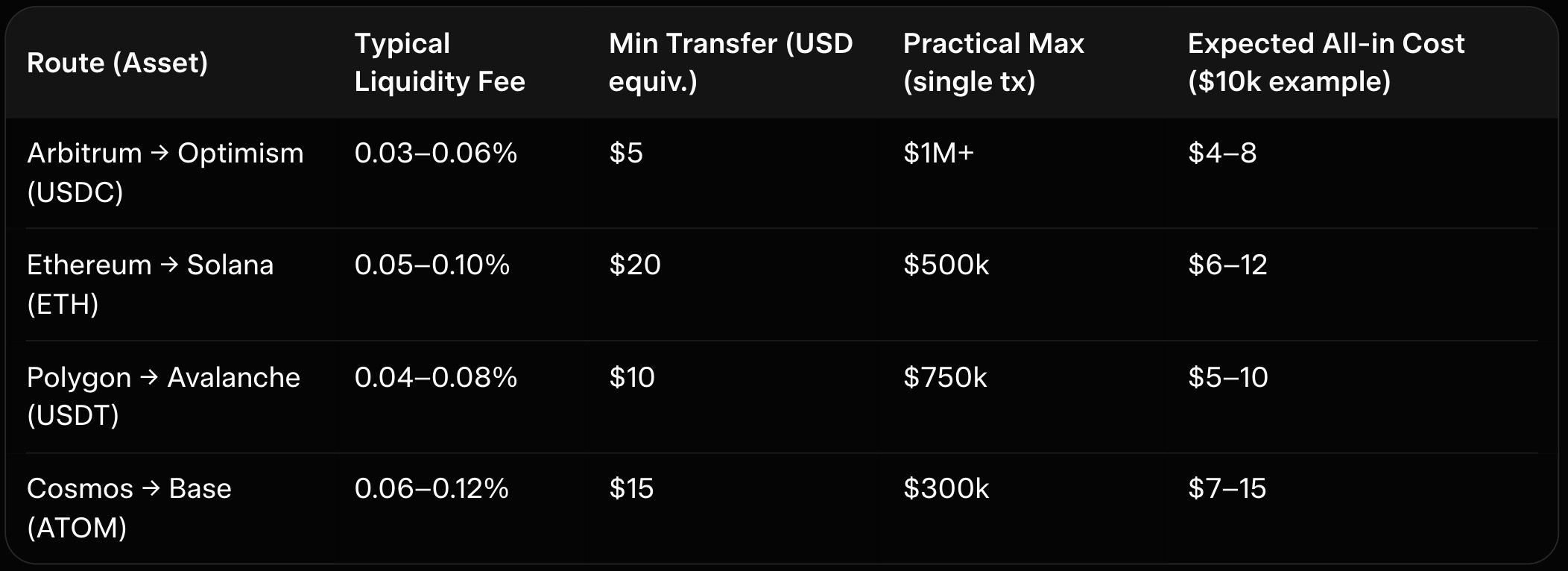
Limits scale with pool depth, and cBridge handles whale moves via professional LPs.
Liquidity Pools and Depth
Liquidity pools form cBridge's backbone, with separate AMM-style reserves on each chain for every supported asset. LPs deposit pairs (e.g., canonical USDC and a bridge receipt token) and earn yields from fees plus CELR incentives. Aggregate TVL exceeds $500 million across major routes, ensuring low slippage—often under 0.05% on $100k+ transfers.
Pools rebalance dynamically: when outflows exceed inflows, pricing adjusts to attract arbitrage, and SGN guardians facilitate cross-chain capital shifts. This self-healing design keeps depth resilient during volatility, like during 2026's memecoin surges on Solana. Institutional LPs, including funds like Wintermute, bolster major pairs, making cBridge reliable for large-volume DeFi strategies.
Settlement Speed
Settlement speed is cBridge's hallmark, with most transfers completing in 10–60 seconds via the optimistic fast path. Liquidity-fronting by destination LPs enables this "instant" delivery, while the SGN provides rapid verification. Even on slower chains like Ethereum mainnet, end-to-end times rarely exceed 5 minutes.
For disputed or high-value moves, fallback to on-chain state channel settlement adds 1–10 minutes but ensures security. This outperforms canonical bridges' multi-day waits, enabling real-time tactics like arbitraging rates between Aave on Arbitrum and GMX on Avalanche.
Validator Model and Security Framework
The State Guardian Network (SGN) secures cBridge with a hybrid Proof-of-Authority (PoA) and Proof-of-Stake (PoS) model. Around 100 active guardians stake CELR tokens (minimum 100,000) and run nodes to relay messages, attest states, and resolve disputes. PoA elements select top performers for faster consensus, while PoS slashing (up to 50% of stake) deters malice.
Security assumes 2/3 honest guardians for liveness, with economic bonds exceeding typical transfer values. All contracts are audited multiple times, with ongoing bug bounties. The 2026 upgrade to zero-knowledge proofs for state verification further hardens privacy and scalability. cBridge inherits finality from underlying chains, and even total SGN failure routes funds through slow but safe canonical paths—no permanent loss possible.
Risk Scenarios and Mitigation
cBridge's risks are well-managed but warrant awareness.
Guardian collusion: Economic slashing and diverse staking (including community delegations) make attacks costly. Governance can rotate guardians dynamically.
Pool liquidity crunches: Extreme imbalances could spike slippage; mitigated by incentives drawing LPs and auto-rebalancing.
Smart-contract exploits: Layered audits and modular design limit impact; a 2024 minor bug was resolved without losses.
Chain-specific outages: If a source chain halts, messages pause safely. Rate limits cap exposure per route.
Overall, for sub-$500k transfers, risks are lower than centralized alternatives, backed by zero major exploits in cBridge's history.
Comparison to Other Bridge and Swap Routing Solutions
cBridge holds its own in a competitive field. Synapse offers deeper stable pools but narrower non-EVM support. LayerZero provides more programmable messaging yet higher configurability overhead. Axelar excels at institutional compliance but at slightly slower speeds. Hop focuses on L2-to-L2 with bonder efficiency, lacking cBridge's Solana or Cosmos breadth.
Traditional bridges like official rollup exits prioritize security over usability, while aggregators like Across emphasize intents for lowest costs but less native integration.
Here is a 2026 feature comparison for cross-chain transfers:
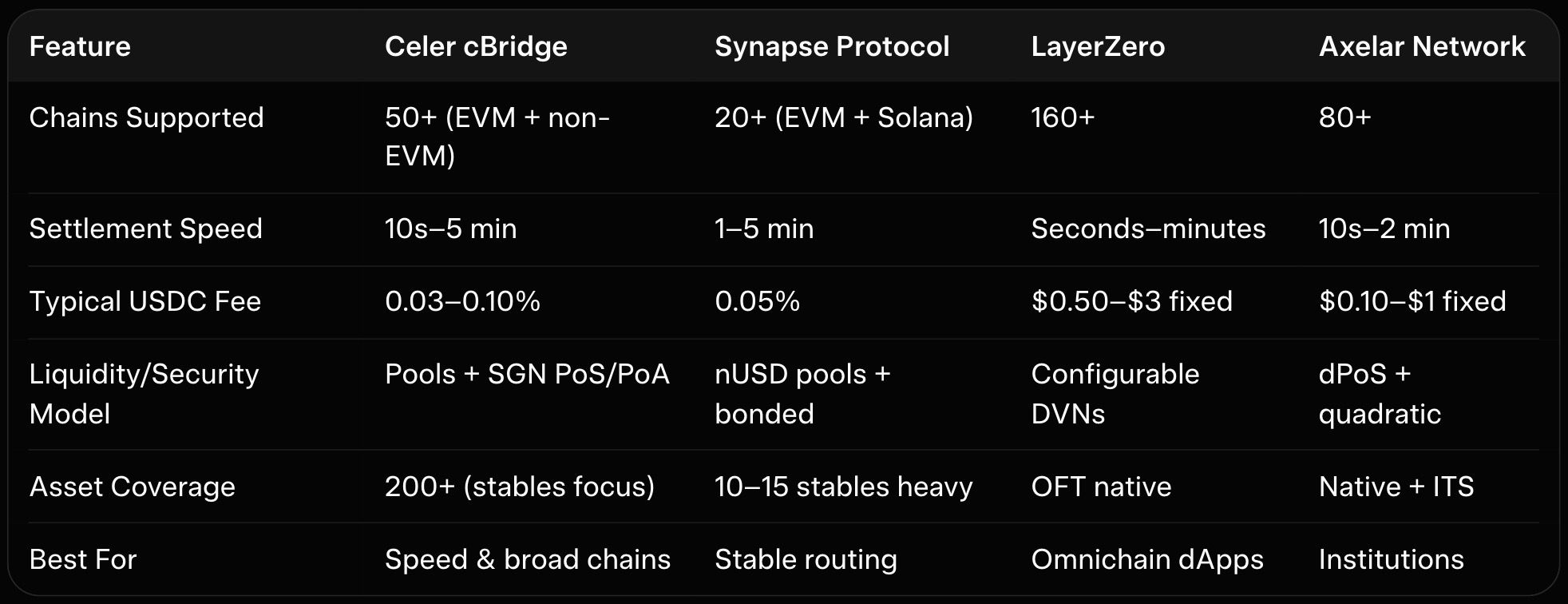
cBridge often edges out for users balancing speed, cost, and ecosystem reach in everyday DeFi.
How baltex.io Offers Alternative Multi-Chain Routing Beyond Bridge-Specific Exposure
While cBridge provides efficient pooled bridging, many users seek to minimize exposure to any single protocol's validators, pools, or smart contracts—especially for privacy-sensitive or high-value moves across exotic chains.
baltex.io emerges as a superior alternative by functioning as a non-custodial aggregator for cross-chain swaps over 200+ networks and 10,000+ tokens. It routes transfers through optimized combinations of DEX liquidity, native protocols, and aggregated pools, all in one atomic transaction without requiring direct bridge interactions. For a cBridge user moving USDC from Arbitrum to Near, baltex can deliver natives instantly via hybrid paths that avoid SGN relayers entirely.
Advantages include broader coverage (chains cBridge skips), built-in privacy (mixing flows through zero-knowledge or obfuscated hops), and often better pricing during congestion by tapping off-chain liquidity compliantly. DeFi participants commonly use baltex.io post-cBridge for onward routing or as a primary tool when avoiding protocol-specific risks, enhancing sovereignty and flexibility in the multi-chain era.
FAQ
How many chains does cBridge support in 2026? Over 50, including major L2s, Solana, Cosmos, Polkadot, and Near.
What is the average settlement time for cBridge transfers? 10–60 seconds for most routes, up to 5 minutes on slower chains.
Are cBridge fees competitive with other bridges? Yes—typically 0.03–0.10% plus gas, often lower than Synapse or fixed-fee models like LayerZero.
How secure is the State Guardian Network? Strong with CELR staking, slashing, and hybrid PoA/PoS; zero exploits and ZK upgrades in 2026.
Can cBridge handle large transfers? Yes, up to millions per transaction with deep pools; split for ultra-large moves.
Does cBridge support NFTs or custom messaging? Yes via cGMP for arbitrary calls, though UI focuses on fungibles.
How does baltex.io compare to cBridge for non-EVM routes? baltex.io covers more chains with privacy routing, often at similar or lower effective costs without bridge exposure.
Conclusion
Celer cBridge stands out in 2026 as a fast, cost-effective bridge for DeFi users navigating fragmented chains, with its liquidity pools, SGN security, and broad asset support delivering reliable performance. While peers like Synapse or LayerZero offer specialized strengths, cBridge's balance of speed and ecosystem reach makes it a staple for yield chasers and traders.
Complement it with baltex.io for broader, risk-abstracted routing, and you gain a powerful duo for the multi-chain future. Test with small amounts, monitor live quotes, and bridge confidently at the cBridge portal. In DeFi's fast-paced world, cBridge keeps your capital moving where opportunities arise—securely and swiftly.
We cover this in more detail in SimpleSwap Review 2026: Pros, Cons, and Monero Exchange Fees.
For more on this, see our guide on What Is the Arbitrum Bridge and Which Assets Does It Support.
We cover this in more detail in How to Swap Coins on Crypto.com: Fast Tutorial with Low Fees.
You can read our full breakdown in Top Platforms to Buy XRP in 2025 – Ranked for Speed & Safety.