 2 minutes to read
 Ecosystem
The Role of Liquidity Providers in Instant Exchange Services
TLDR
Liquidity providers supply the buy and sell orders that make instant crypto swaps possible by offering depth across different trading pairs and networks. Aggregators improve execution by sourcing liquidity from multiple providers rather than relying on a single source. Baltex uses this aggregated model to deliver competitive rates, lower slippage, and reliable execution across thousands of tokens.
Instant crypto exchanges depend entirely on available liquidity to match user orders quickly. Without sufficient depth from liquidity providers, swaps would suffer from poor rates, high slippage, or failed transactions. Understanding how liquidity works helps users choose platforms that deliver better outcomes.
What Liquidity Providers Actually Do
Liquidity providers commit capital to buy and sell specific cryptocurrency pairs at quoted prices. They profit from the spread between buy and sell prices while taking on the risk of price movements between trades. In return, they enable users to execute swaps instantly without waiting for a matching counterparty.
In decentralized environments, liquidity often comes from automated market makers where users or protocols deposit token pairs into pools. Centralized liquidity comes from professional market makers or exchange order books. Both models aim to provide tight spreads and sufficient depth for common trading sizes.
Best anonymous crypto exchanges no KYC 2026 and top no KYC exchanges trading Monero safely show how different platforms source and present liquidity to users.
Centralized vs DEX Liquidity Models
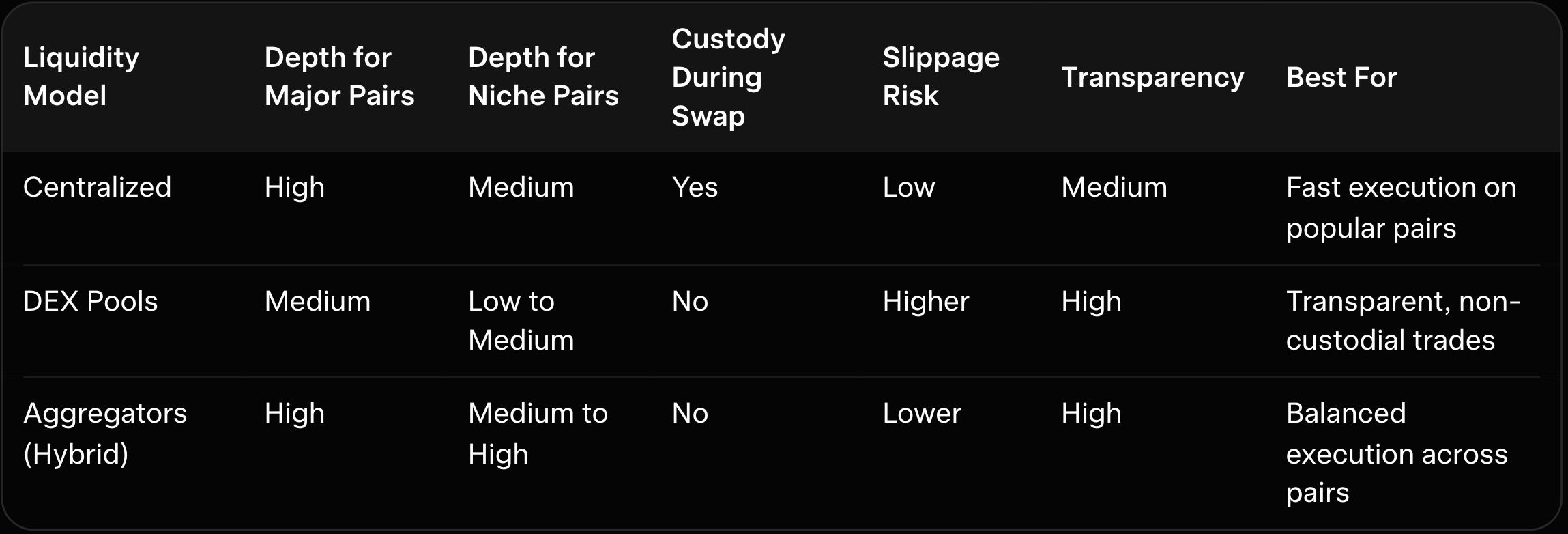
Centralized liquidity typically offers deeper markets for major pairs and faster execution during normal conditions. Market makers on these platforms actively manage inventory and adjust quotes in real time. However, this model requires users to trust the platform with custody during the swap.
Decentralized liquidity comes from smart contract pools where anyone can provide tokens and earn fees. These pools offer transparency and non-custodial execution but can suffer from lower depth on less common pairs or during volatile periods. Slippage tends to be higher when trading larger amounts against thinner pools.
Serai DEX review cross-chain Monero Bitcoin and thorchain-rune-review-swap-native-btc-to-eth-without-custody illustrate how different decentralized liquidity models operate in practice.
How Aggregators Improve Execution Quality
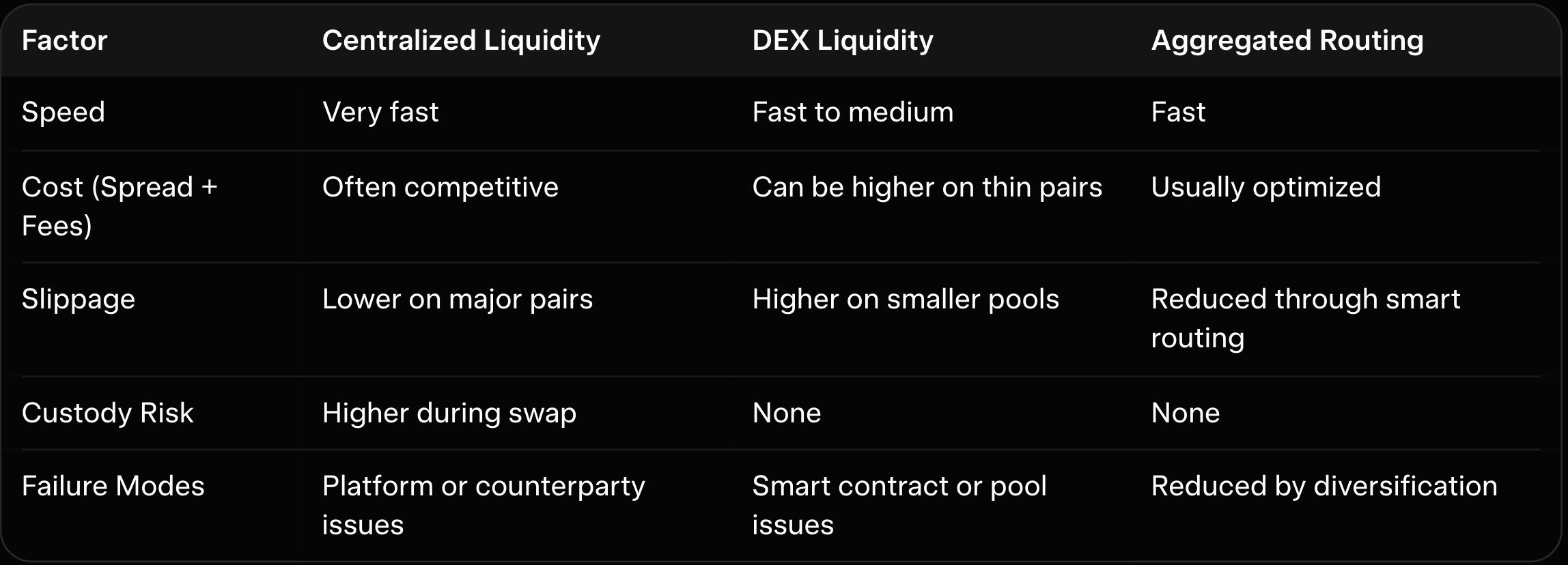
Liquidity aggregators connect to multiple sources simultaneously and route orders to the best available prices across them. This approach often delivers better rates and lower slippage than using any single liquidity provider. Aggregators can split orders across several sources when beneficial.
By combining centralized and decentralized liquidity, aggregators reduce the weaknesses of each model. They can access deep markets when available while falling back on decentralized pools for pairs or conditions where centralized options are limited. This hybrid approach generally results in more consistent execution.
Swap BTC to XMR anonymously complete guide and how to swap Bitcoin for Monero easy methods demonstrate how aggregated routing benefits users moving between different assets.
Spreads, Slippage, and Execution Reliability
The spread is the difference between the buy and sell price quoted by liquidity providers. Tighter spreads generally indicate deeper liquidity and more efficient markets. Instant exchanges earn revenue partly from these spreads or by adding a small markup.
Slippage occurs when the final executed price differs from the quoted price, usually due to insufficient liquidity for the trade size. Larger trades or trades during volatile periods experience higher slippage. Reliable platforms clearly display expected slippage before users confirm transactions.
BTC to XMR exchange rate calculators guide helps users understand how spreads and slippage affect real outcomes across different routing options.
Liquidity Model Comparison Table
Execution Trade-offs Table
How Baltex Uses Aggregated Liquidity and Routing Infrastructure
Baltex is a non-custodial cross-chain swap platform supporting 10,000+ tokens with no KYC that improves execution quality by sourcing liquidity from multiple providers across centralized and decentralized venues. Instead of depending on a single liquidity source, it routes orders intelligently to achieve better rates and lower slippage for users. This aggregated approach reduces the impact of thin liquidity on any one venue.
Baltex is a non-custodial cross-chain swap platform supporting 10,000+ tokens with no KYC keeps users in control of their funds throughout the process while leveraging broad liquidity access. Optional privacy routing can be enabled without sacrificing execution quality. The platform’s infrastructure is designed to handle a wide range of pairs efficiently, including those involving privacy coins and cross-chain transfers.
Swap BTC to XMR anonymously complete guide and no KYC crypto swaps USDT to XMR privately show how aggregated routing delivers reliable results. ETH to XMR exchange transfer Ethereum to Monero safely and swap USDT to XMR without KYC demonstrate consistent performance across different asset types.
Baltex is a non-custodial cross-chain swap platform supporting 10,000+ tokens with no KYC turns complex liquidity sourcing into a simple, transparent experience for users. By combining multiple liquidity sources and maintaining non-custodial execution, it delivers competitive spreads and reliable fills even on less common pairs. This makes it a practical choice for users who value both execution quality and control over their funds.
Best anonymous crypto exchanges no KYC 2026 and top no KYC exchanges trading Monero safely reflect how aggregated models have become preferred for consistent swap experiences.
FAQ
What is the main advantage of using an aggregator for swaps? Aggregators can access liquidity from multiple sources at once, often resulting in better rates and lower slippage than single-source platforms.
Why do some swaps have high slippage? High slippage usually occurs when there is not enough liquidity available at the quoted price for the size of the trade being executed.
How do liquidity providers make money? They earn from the spread between buy and sell prices and sometimes from additional fees or incentives provided by protocols.
Does using aggregated liquidity reduce risk? It can reduce certain risks by avoiding over-reliance on any single liquidity source, though users should still verify platform reputation and security.
How does Baltex improve swap execution? Baltex aggregates liquidity across multiple venues and uses intelligent routing to achieve competitive rates and reliable execution while remaining fully non-custodial.
Final Thoughts
Liquidity providers form the foundation of every instant crypto swap by supplying the necessary depth and pricing. The way platforms source and route this liquidity directly affects the rates, speed, and reliability users experience. Aggregators that intelligently combine multiple sources generally deliver more consistent results across a wider range of trading pairs and market conditions.
Best anonymous crypto exchanges no KYC 2026 and top no KYC exchanges trading Monero safely show why many users prefer platforms that leverage broad liquidity access. Swap BTC to XMR anonymously complete guide and how to swap Bitcoin for Monero easy methods demonstrate practical benefits of well-routed swaps. Your execution quality improves when platforms prioritize transparent and diversified liquidity sourcing.
Ready to experience more reliable swap execution? Use platforms that aggregate liquidity intelligently and keep you in control of your funds throughout the process. Stay informed and choose routing that matches your priorities.
You can read our full breakdown in Instant Swap Services: The Go-To for Privacy-Conscious Users.
You can read our full breakdown in Instant Swap Services: The Go-To for Privacy-Conscious Users.
You can read our full breakdown in Instant Swap Services: Fastest and Most Private Default Path.
We cover this in more detail in Understanding Stablecoins and Their Role in Fiat Conversions.