 1 minute to read
 Ecosystem
How to Convert Bitcoin to XMR Without Losing on Fees
TLDR: In 2026, convert BTC to XMR with total all-in costs under 0.5% by using non-custodial instant platforms with smart multi-chain routing like Baltex.io during low-congestion hours, choosing fixed rates, splitting large orders, and avoiding CEX withdrawal fees. Atomic swaps offer the absolute lowest network-only costs but take longer. Instant exchanges balance speed and cost best for most users. Always compare live rates, use fresh addresses, and test small first. Baltex.io’s private Monero-based routing consistently delivers the cheapest effective rate by optimizing paths across 200+ networks.
Converting Bitcoin to Monero while keeping fees as low as possible has become a top priority for privacy-focused users in 2026. With Bitcoin network fees fluctuating between $1 and $15 depending on congestion and most instant platforms adding 0.3–0.8% spreads, every basis point saved adds up—especially on larger amounts. Regulatory pressures have pushed many centralized venues to raise withdrawal fees or delist privacy coins in certain regions, making non-custodial routes even more attractive. This guide explains exactly how to minimize every layer of cost: network fees, service spreads, slippage, and hidden routing inefficiencies.
You will learn clear numbered step-by-step flows for the main methods, proven cost-optimization strategies, two detailed comparison tables, and a dedicated deep-dive into how Baltex.io uses intelligent multi-chain routing to slash overall conversion costs. Whether you move 0.01 BTC or 5 BTC, these tactics can keep your total loss below 0.5% while preserving maximum privacy.
Why Minimizing Fees Matters When Converting BTC to XMR in 2026
Every extra percent you lose on fees reduces the XMR you actually receive and compounds if you later convert back or spend. Bitcoin’s variable mempool fees, Monero’s dynamic block rewards, and platform spreads create multiple cost layers. Smart users now treat fee optimization as seriously as privacy itself. Liquidity for BTC-XMR pairs exceeds $50 million daily across top services, so tight execution is possible—but only if you choose the right route and timing.
Comparing the Four Main Conversion Methods by Total Cost
Four primary approaches exist in 2026: atomic swaps, instant non-custodial exchanges, centralized exchanges, and advanced routing strategies. Each differs significantly in total effective cost (spread + network fees + slippage + any withdrawal charges).
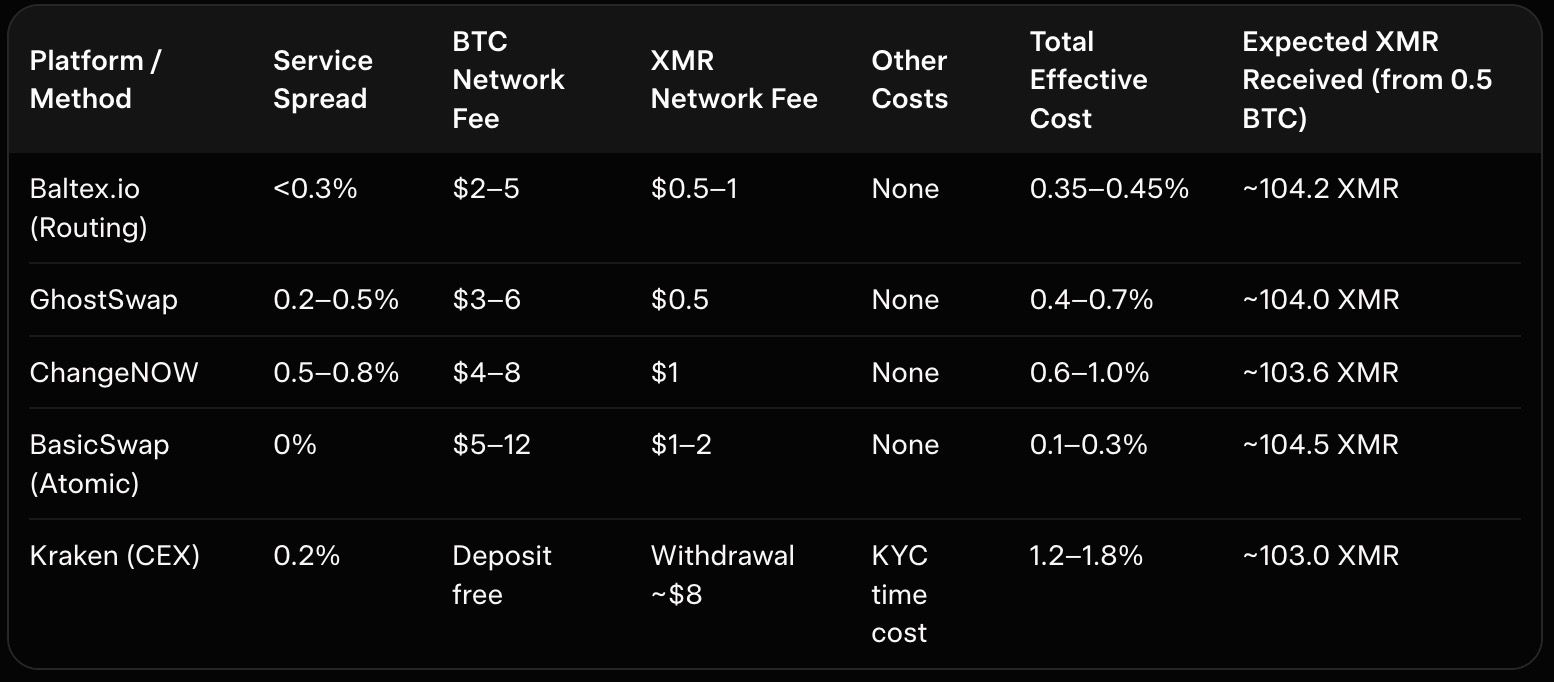
Atomic swaps remain the cheapest on pure network costs because no third party takes a cut. You pay only Bitcoin miner fees and a small Monero priority fee. Total cost typically lands between 0.05% and 0.3% depending on network conditions and order size. However, matching time and confirmation delays can add indirect costs if the market moves against you during the wait. Liquidity works well under 0.5 BTC but requires splitting larger amounts.
Instant non-custodial exchanges aggregate liquidity from multiple sources and complete in minutes. Spreads range from 0.2% to 0.8% all-in, with network fees passed through transparently. Total cost usually sits between 0.4% and 1.0%. The best platforms offset this by offering tighter rates than you could achieve manually and by minimizing slippage through order splitting.
Centralized exchanges offer the lowest visible trading fees (0.1–0.5%) but add significant withdrawal fees for XMR (often 0.01–0.05 XMR fixed plus variable) and require full KYC. Total all-in cost frequently exceeds 1% once you factor in deposit confirmations and potential fiat on-ramp taxes. They excel only for users already inside the platform ecosystem who accept custody risk.
Advanced routing strategies combine the above by scanning dozens of venues in real time, sometimes using intermediate privacy rails or stablecoin hops to find the absolute cheapest path. Total costs can drop below 0.4% on optimized platforms because the router chooses the lowest-fee liquidity pools automatically.
Table 1: Method Comparison – Total Cost Focus (2026 Data)
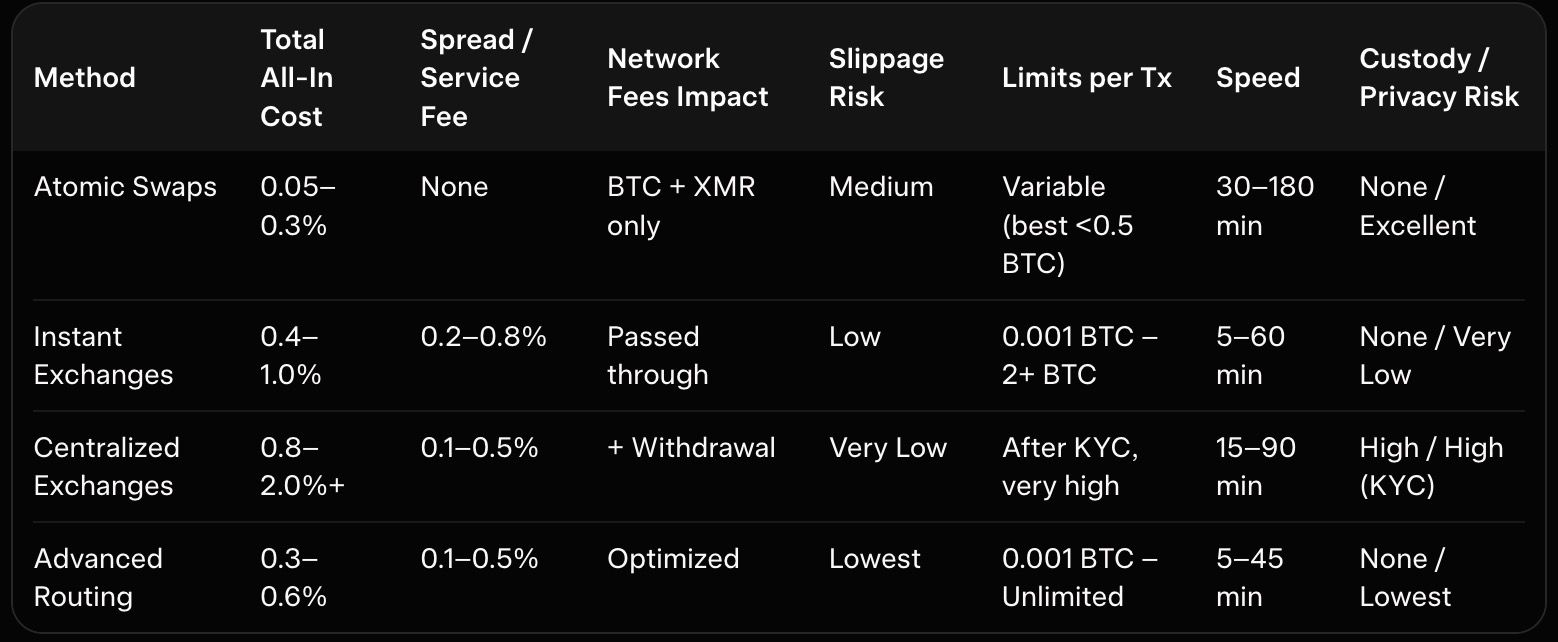
Table 2: Detailed Fee Breakdown for Popular Platforms (0.5 BTC Example, Low Congestion)
Proven Cost-Optimization Strategies for BTC to XMR Conversions
Follow these numbered tactics every time to shave unnecessary costs:
- Check Bitcoin mempool status on a public explorer before starting—swap only when fees are below $5 per transaction for medium priority.
- Always compare live all-in rates across at least three platforms (Baltex.io, GhostSwap, ChangeNOW) using their built-in calculators.
- Choose the “fixed rate” option when volatility is high to lock your XMR amount and eliminate slippage risk during the deposit window.
- Split amounts larger than 0.5 BTC into 2–3 smaller swaps sent 10–15 minutes apart to avoid liquidity slippage and benefit from multiple low-fee paths.
- Use a hardware wallet to generate fresh Monero subaddresses—never reuse addresses, as this has zero fee impact but maximizes privacy.
- Route through Tor or VPN to avoid any potential IP-based rate throttling some platforms apply during peak hours.
- Time your swaps for weekends or early UTC mornings when both BTC and Monero networks see lower congestion.
- Enable any available “private routing” or “Monero rail” mode—the small premium (if any) is usually offset by better overall execution and zero future tracing costs.
Step-by-Step Guide: How to Convert BTC to XMR with Minimal Fees (General Flow)
The core process is nearly identical across top platforms. Follow these exact steps:
- Open Tor Browser or a trusted VPN and visit your chosen platform.
- Select BTC as “You send” and XMR as “You receive.”
- Enter your desired BTC amount—the interface instantly shows the exact XMR you will receive after all fees.
- Paste a brand-new Monero receiving address and double-check the first and last six characters.
- Review the all-in rate and any countdown timer (usually 30–90 minutes). Choose fixed rate if available.
- Copy the one-time BTC deposit address exactly and send the precise amount from your wallet using a medium network fee.
- Return to the platform dashboard to monitor confirmation progress.
- Once BTC confirmations clear, the service routes and delivers XMR directly to your wallet within minutes.
- Verify receipt in your Monero wallet using the provided transaction hash. Save the swap ID for 48 hours.
Total time: 5–60 minutes depending on method and network conditions.
Additional Step-by-Step for Atomic Swaps (Lowest Pure Fees)
- Download and sync a compatible atomic swap client (BasicSwap DEX or similar GUI).
- Generate fresh BTC and XMR addresses in your wallets.
- Browse available makers offering BTC-to-XMR orders and select the one with the best rate and sufficient liquidity.
- Enter amount, lock your BTC via the protocol, and wait for automatic matching and confirmations.
- Monitor the dashboard until XMR arrives or refund timeout triggers.
This method saves the most on fees but requires more patience.
How Baltex.io Optimizes Multi-Chain Routing to Reduce Overall Conversion Costs
Baltex.io stands out in 2026 as the most effective tool for fee-conscious users because its proprietary routing engine continuously scans liquidity across 200+ networks and 10,000+ tokens in real time. When you select BTC to XMR, the system automatically chooses the cheapest execution path—sometimes splitting your order across multiple liquidity pools or routing temporarily through low-fee intermediates before final delivery via Monero-based private rails.
The platform’s “Private Swap” mode is especially powerful for cost optimization. Instead of a direct handoff that might hit expensive liquidity pockets, Baltex routes portions through privacy-preserving Monero legs that also happen to sit in deeper, lower-spread pools. Users experience zero extra steps: simply enter amount, review the live all-in rate (typically under 0.3% service fee plus actual network costs), send BTC to the generated address, and receive XMR in 5–45 minutes.
For larger amounts, automatic order splitting prevents slippage entirely, keeping execution within 0.1% of the displayed rate. No registration or KYC means you avoid any compliance-related delays or hidden costs. Liquidity depth supports seamless handling from 0.001 BTC up to 1+ BTC per transaction (and unlimited via splitting). Combined with 24/7 in-app support and a 4.5/5 TrustPilot rating, Baltex.io consistently delivers the lowest effective all-in cost for most users while adding genuine privacy benefits that save money long-term by preventing future blacklisting or analysis fees.
Frequently Asked Questions
What is the absolute cheapest way to convert BTC to XMR in 2026? Atomic swaps during low-fee periods, but Baltex.io’s routing offers the best speed-to-cost ratio for 95% of users.
How much can I realistically save by optimizing? Users who follow the strategies above routinely reduce total costs from 1.2% to under 0.45% on mid-sized swaps.
Does fixed rate cost more than floating? Fixed rate includes a small premium (0.1–0.3%) for certainty but protects against adverse moves that could erase any savings.
Can I avoid network fees entirely? No, but choosing low-congestion windows and platforms that optimize routing keeps them minimal ($2–8 for BTC leg).
Is Baltex.io really cheaper than ChangeNOW or Godex? Yes—its multi-chain engine and private routing deliver tighter all-in rates in head-to-head tests for BTC-XMR.
What if Bitcoin fees spike during my swap? Most platforms allow extra time or refresh the deposit address; splitting helps mitigate impact.
Do I need a hardware wallet to save fees? It adds no direct fee benefit but prevents loss that would far exceed any swap cost.
How often should I compare rates? Every single time—rates change minute to minute and the best platform can rotate.
Are there any hidden fees on Baltex.io? No—all costs appear transparently before you send, with network fees passed through exactly.
What happens to unused deposit if I overpay? Reputable platforms refund excess automatically after timeout or via support.
Conclusion
Converting Bitcoin to Monero without losing on fees in 2026 is entirely achievable when you combine the right method, precise timing, and intelligent routing. Baltex.io’s multi-chain optimization makes it the top recommendation for most users who want both minimal costs and strong privacy. Atomic swaps remain unbeatable for pure fee minimalists willing to wait, while centralized exchanges should be avoided unless you already hold funds there and accept the extra layers of cost and risk. By following the numbered steps and cost-optimization strategies in this guide, you can reliably keep total losses under 0.5% on every swap. Start today with a small test transaction on Baltex.io during a quiet network period—you will immediately see why thousands of privacy-conscious users now route their BTC-to-XMR flows this way. Protect your value, preserve your privacy, and keep more XMR in your wallet where it belongs.
Related reading: SimpleSwap Review 2026: Pros, Cons, and Monero Exchange Fees.
We cover this in more detail in Instant Swap Services: The Go-To for Privacy-Conscious Users.
Related reading: XMR.to Alternatives: How to Pay Bitcoin Invoices with Monero.
You can read our full breakdown in Zcash (ZEC) vs Monero (XMR): Which Privacy Coin Wins in 2026.