


 5 minutes to read
 Ecosystem
How to Buy USDC: Card, Bank and Wallet Options (October 2026)
USDC is a regulated stablecoin issued by Circle that maintains a 1:1 peg to the US dollar through reserves of cash and cash equivalents. As of late October 2026, its circulating supply stands near 72 billion according to market data.
This guide walks through practical methods to acquire USDC using credit or debit cards, traditional bank transfers, and crypto wallet swaps. Each approach suits different needs such as speed, cost or privacy preferences. Readers will find concrete steps, typical fees, timelines and risk considerations current as of October 2026.
Quick Answer
To buy USDC quickly: 1) Choose a method based on your location and urgency. 2) Prepare a compatible wallet or account. 3) Complete the purchase on a supported platform. 4) Verify receipt on-chain. Detailed instructions follow for card, bank and wallet routes.
What You'll Need
Before starting, prepare a digital wallet that supports USDC on your chosen blockchain, such as MetaMask for Ethereum or Phantom for Solana. Have identification ready if KYC is required. Fund your bank account or card with sufficient USD or equivalent. Confirm the exact network address to avoid loss of funds. For larger amounts, consider a hardware wallet for added security.
USDC operates on more than 15 blockchains, so select one matching your wallet's capabilities. Common choices include Ethereum for broad compatibility or lower-fee options like Base and Solana.
Step 1: Buy USDC with a Credit or Debit Card
Open a reputable fiat-to-crypto on-ramp service that supports direct card purchases. Enter the desired USDC amount and select your payment network. Provide your wallet address on the correct chain, such as Ethereum or Polygon.
Complete the card authorization and any required identity verification. Most services process the transaction within minutes to an hour. Expect fees between 2% and 5% plus possible network costs. This method works well for users needing immediate access without waiting for bank clearing.
Card purchases are ideal for small to medium amounts when speed matters more than minimizing fees. Always confirm the provider's supported regions and any daily limits before initiating.
Step 2: Buy USDC with a Bank Transfer
Select a platform or exchange offering ACH, wire or SEPA transfers. Initiate the transfer from your bank account to the provider's designated details. Once funds arrive, typically in 1-5 business days, convert to USDC at the prevailing rate.
Bank methods usually carry lower fees, often under 1%, making them suitable for larger volumes. Some services offer instant credit upon deposit initiation in certain jurisdictions. Track the transaction status through the platform dashboard.
This route suits users prioritizing cost efficiency over immediacy. Verify your bank's international wire policies if crossing borders, as additional intermediary fees may apply.
Step 3: Buy USDC via Wallet Swaps
Connect your non-custodial wallet to a swap aggregator. Select USDC as the target asset and choose an input currency such as ETH, USDT or even fiat via integrated on-ramps. Review the aggregated liquidity routes for the best rate and lowest slippage.
Confirm the transaction in your wallet, paying the gas fee on the source chain. The swap completes in seconds to minutes depending on network congestion. Non-custodial platforms like Baltex enable instant cross-chain swaps across 200+ networks and 10,000+ assets without requiring registration for most trades.
Wallet swaps provide flexibility for users already holding crypto or seeking privacy-focused options. Baltex aggregates liquidity from multiple sources including DEX and CEX providers, supporting private swap flows where available while performing standard AML screening.
How Much Does It Cost?
Card purchases typically add 2-4% in provider fees on top of network costs, which can reach several dollars on Ethereum. Bank transfers often limit fees to 0.5% or less plus any wire charges from your bank. Wallet swaps vary by liquidity but commonly range from 0.1% to 0.5% spread plus gas.
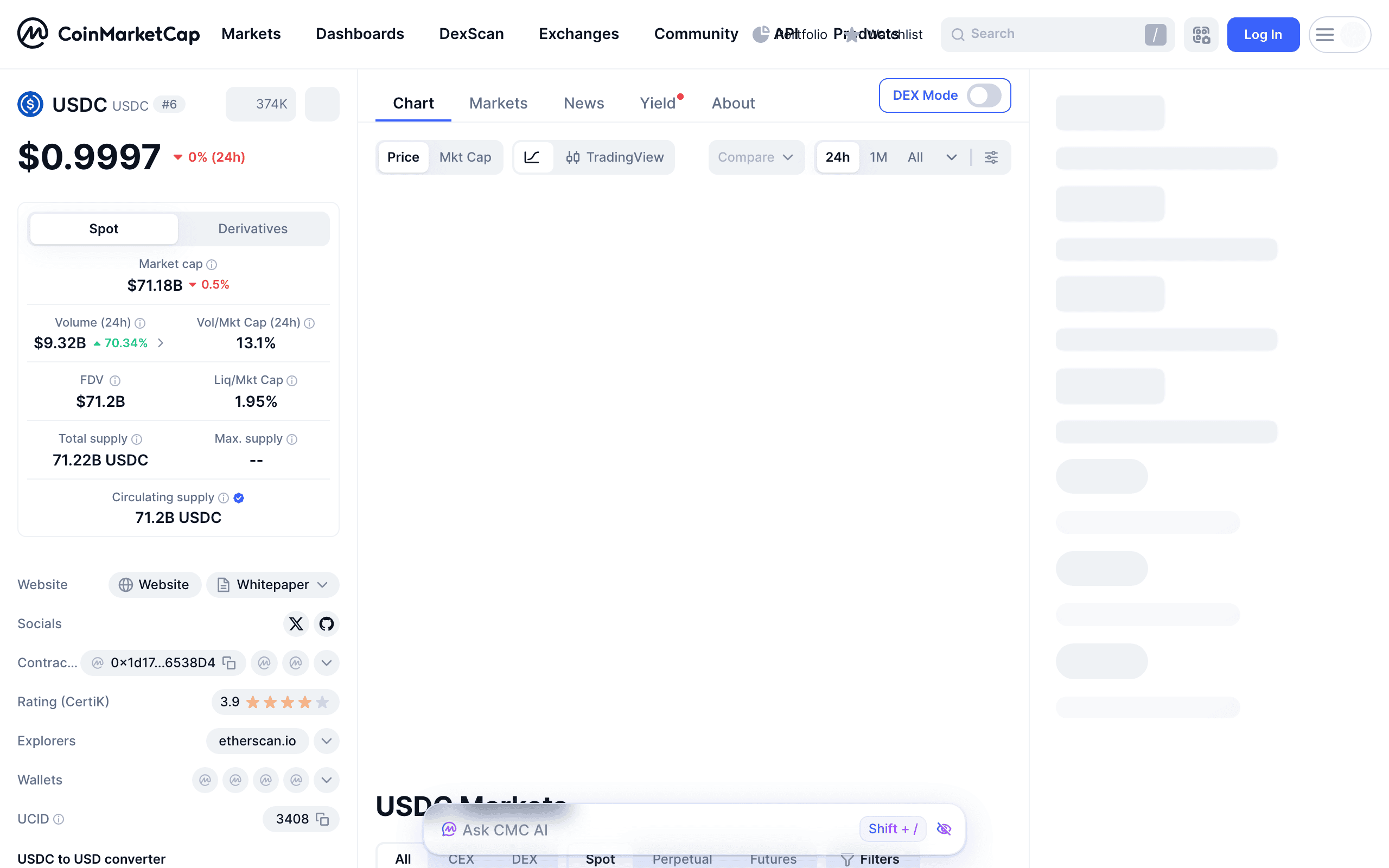
According to CoinMarketCap, USDC maintains tight peg stability with minimal deviation. Total costs depend heavily on blockchain choice; Solana or Base routes keep fees under $0.10 in many cases as of October 2026.
Factor in potential withdrawal or conversion fees when moving USDC off-platform. Compare live quotes across providers for the most accurate estimate.
How Long Does It Take?
Card transactions settle in 5-30 minutes after verification. Bank transfers require 1-3 days for domestic ACH or up to 5 days for international wires. Wallet swaps execute near-instantly once the on-chain confirmation occurs, usually under 2 minutes on fast networks.
Delays may arise from KYC reviews or high network traffic. Plan accordingly for time-sensitive needs like payments or trading entry.
Is It Safe?
USDC remains fully backed 1:1 by reserves with monthly attestations published by Circle. Choose platforms with strong security records and enable two-factor authentication. Double-check wallet addresses and contract details to prevent phishing losses.
Non-custodial swaps keep user funds in personal wallets throughout the process. Still, review transaction details carefully and start with small test amounts. Regulatory compliance varies by jurisdiction; consult local rules on stablecoin usage and taxation.
Common Mistakes and Troubleshooting
A frequent error is sending funds to the wrong network address, resulting in permanent loss. Always match the chain in both wallet and platform. Another issue arises from insufficient gas fees causing failed transactions; increase the limit slightly for complex swaps.
If a card purchase declines, verify billing address match and contact your bank for authorization. For delayed bank deposits, confirm the reference number with the provider. In swap failures, check liquidity depth and retry during lower congestion periods.
Avoid clicking unsolicited links claiming to offer USDC deals, as these often lead to scams. Store seed phrases offline and never share them.
Practical Use Cases and Limitations
Card purchases suit travelers or users needing quick stablecoin access for DeFi entry or remittances. Bank transfers work best for institutional or recurring large-volume needs where fees matter. Wallet swaps excel for cross-chain portfolio balancing or when avoiding centralized intermediaries.
When a different option is better: users in restricted regions may prefer licensed exchanges over aggregators, or those seeking maximum privacy might explore privacy-focused chains though with compliance caveats. Baltex fits scenarios requiring fast cross-chain USDC acquisition without account creation.
Market context shows USDC handling substantial on-chain volume, underscoring its role in payments and trading. Always assess personal risk tolerance and diversify approaches.
This covers the primary acquisition paths with emphasis on verifiable steps and current conditions in October 2026. Monitor official Circle updates for network expansions or policy changes.
Related reading: Top Platforms to Buy XRP in 2025 – Ranked for Speed & Safety.
What is the fastest way to buy USDC?
Are there fees when buying USDC with a bank transfer?
Is it safe to buy USDC on decentralized platforms?
Can I buy USDC without KYC?
How do I store USDC after buying?
What networks support USDC in 2026?
See others posts
G. Khan

How to Buy Bitcoin and USDT in India (INR) (October 2026)
Ecosystem
G. Khan
The 10 Best Places to Buy Crypto Online in 2026
Ecosystem
G. Khan
The Cheapest Way to Buy Crypto: Fees by Payment Method Compared (October 2026)
Ecosystem
G. Khan
How to Buy Bitcoin and Ethereum in Canada (2026)
Ecosystem
G. Khan
How to Buy Bitcoin in the UK and Australia (October 2026)
Ecosystem
G. Khan
How to Buy Solana with a Credit or Debit Card (October 2026)
Ecosystem