



 3 minutes to read
 Ecosystem
How to Fund Polymarket with Monero Anonymously (No MetaMask Link)
TL;DR: Anonymous Polymarket Funding via Monero
Fund Polymarket anonymously by swapping Monero (XMR) to USDC on Polygon using privacy-focused services like baltex.io. Sign up on Polymarket with an email for a generated wallet, then transfer swapped USDC directly to its address. Avoid MetaMask connections; use fresh wallets, VPNs, and Tor for max privacy. Expect 0.5-2% fees; total process under 30 minutes. Risks include swap failures and network congestion.
Introduction: Why Fund Polymarket Anonymously with Monero?
In 2026, privacy in crypto betting and prediction markets is more critical than ever. Polymarket, a decentralized platform on the Polygon network, lets users wager on events like elections, sports, and crypto prices using USDC. However, standard funding methods—such as connecting MetaMask or buying USDC via KYC exchanges—can expose your wallet identity, transaction history, and even real-world details through on-chain analysis or IP tracking.
Monero (XMR) stands out as the ultimate privacy coin, with built-in features like ring signatures, stealth addresses, and confidential transactions that obscure senders, receivers, and amounts. By starting with XMR and routing through anonymous swaps, you can fund Polymarket without linking personal wallets or revealing identities. This guide provides a step-by-step, practical flow for privacy-focused users, emphasizing no MetaMask integration. We'll cover assumptions, tools, flows, routes, fees, limits, and pitfalls, plus a deep dive into baltex.io for seamless privacy preservation.
If you're new to this, jump to Required Tools or Step-by-Step Funding Flows. For quick comparisons, see our Funding Routes Table and Fees and Risks Table.
Privacy Assumptions for Anonymous Funding
Before diving in, understand the baseline privacy assumptions. This method assumes you're starting with anonymously acquired Monero—perhaps from P2P trades, mining, or non-KYC sources. No approach is 100% foolproof against advanced adversaries like chain analysis firms or governments, but following these minimizes risks:
- Network Privacy: Use a VPN (e.g., Mullvad or ProtonVPN) or Tor browser to mask your IP. Avoid public Wi-Fi; opt for dedicated privacy setups.
- Wallet Hygiene: Employ fresh, non-custodial wallets for each step. Never reuse addresses tied to your identity.
- On-Chain Anonymity: Monero's privacy breaks links, but downstream chains like Polygon are transparent. Use intermediate swaps to obscure origins.
- No KYC/AML Exposure: Stick to no-KYC services; assume any personal data submission compromises privacy.
- Regulatory Risks: Polymarket restricts users in regions like the US—use VPNs, but note potential legal implications.
- Device Security: Run operations on a secure, malware-free device, ideally with Tails OS or a hardware wallet like Ledger/Trezor for signing.
Violating these—e.g., using a KYC'd exchange—nullifies anonymity. Aim for "plausible deniability" rather than absolute invisibility.
Required Tools for Funding Polymarket with Monero
To execute this anonymously, gather these tools. Most are free or low-cost, focusing on privacy and ease:
- Monero Wallet: Use the official Monero GUI/CLI wallet or mobile apps like Cake Wallet/Monerujo. These support XMR's privacy features natively.
- Polygon-Compatible Wallet: For intermediate steps, a non-custodial wallet like Rabby or Phantom (avoid MetaMask to prevent any accidental linking).
- Swap Services: Privacy-oriented platforms like baltex.io, HodlHodl, or MorphToken for XMR-to-USDC conversions without KYC.
- VPN/Tor: Essential for IP masking. Paid VPNs offer better speeds for transactions.
- Hardware Wallet (Optional): For enhanced security during approvals, connect to software wallets.
- USDC on Polygon: Polymarket uses this stablecoin; ensure your swap targets the Polygon network.
- Browser/Extensions: Brave or Firefox with uBlock Origin to block trackers during Polymarket access.
Setup time: 10-20 minutes. Store seed phrases offline on paper or metal for recovery.
Step-by-Step Funding Flows
Here's the core process, broken into clear steps. We'll outline two main flows: a basic one for small amounts and an advanced one for higher privacy. Always test with tiny amounts (e.g., $10) first.
Basic Flow: Direct Swap to Polymarket Wallet
-
Sign Up on Polymarket Anonymously: Visit polymarket.com via VPN/Tor. Choose email sign-up (use a disposable email like ProtonMail). Polymarket generates a unique Polygon wallet for you—no MetaMask needed. Copy the wallet address from your account dashboard.
-
Prepare Monero: Open your Monero wallet and confirm your XMR balance. Use a fresh subaddress for outgoing transfers.
-
Initiate Swap: Go to a no-KYC swap site like baltex.io. Select XMR as input, USDC on Polygon as output. Enter Polymarket's generated wallet address as the recipient. Connect your Monero wallet if required (some services allow direct sends without connection).
-
Approve and Execute: Review fees/slippage. Send XMR to the provided deposit address. The service swaps and routes to your Polymarket address. Wait 5-30 minutes for confirmation.
-
Verify Deposit: Refresh Polymarket dashboard. USDC should appear, ready for betting. No wallet linking occurred.
Advanced Flow: Multi-Hop for Extra Privacy
For larger amounts or heightened caution, add layers:
-
Polymarket Setup: Same as basic—get your generated wallet address.
-
First Hop: XMR to Privacy Coin/Asset: Swap XMR to another privacy asset like ZEC or BTC via a P2P platform (e.g., HodlHodl). This breaks initial links.
-
Intermediate Wallet: Receive in a fresh, anonymous wallet on a different chain (e.g., Bitcoin Lightning for speed).
-
Second Hop: To USDC on Polygon: Use baltex.io for the final swap, specifying Polymarket's address as recipient. Enable privacy routing if available.
-
Monitor and Confirm: Use block explorers (anonymously) to track, but avoid over-querying to prevent metadata leaks.
Total time: 20-60 minutes. If issues arise, see Failure Points.
Swap Routes: Optimal Paths from XMR to USDC
Choosing the right route balances speed, fees, and privacy. Monero's opacity makes it ideal for starting, but you need cross-chain bridges or DEX aggregators. Here are proven routes:
-
Route 1: Direct XMR-USDC via DEX Aggregator: Use baltex.io for instant cross-chain. XMR → Monero routing → USDC (Polygon). Privacy: High; Speed: Fast (minutes).
-
Route 2: XMR-BTC-USDC: Swap XMR to BTC on MorphToken (no KYC), then BTC to USDC on a DEX like Uniswap via Polygon bridge. Privacy: Medium; Adds obfuscation but BTC is traceable.
-
Route 3: XMR-ETH-USDC: XMR to ETH on HodlHodl, then ETH to USDC on Polygon using a bridge like Hop Protocol. Privacy: Medium-High; ETH adds DeFi liquidity.
-
Route 4: P2P Multi-Step: Local P2P for XMR to fiat equivalent, then buy USDC anonymously—but avoid if possible due to meetup risks.
For visuals, check the Funding Routes Table below.
Fees, Limits, and Failure Points
Fees vary by service and network congestion. Expect 0.5-2% total, plus gas. Limits: Most no-KYC services cap at $10K-50K per swap without verification; baltex.io boasts "almost no limits."
Failure Points:
- Network Congestion: Polygon gas spikes can delay deposits.
- Address Errors: Mismatched chains (e.g., sending to Ethereum instead of Polygon) lose funds forever.
- Swap Scams: Fake sites—always verify URLs.
- Privacy Leaks: Reusing wallets or skipping VPN exposes patterns.
- Polymarket Restrictions: Geo-blocks; VPN failures lead to access denial.
- Volatility: XMR price swings during swaps erode value.
Mitigate with small tests and double-checks.
Funding Routes Table

This table optimizes for snippet visibility: Quick comparison of anonymous funding paths.
Fees and Risks Table
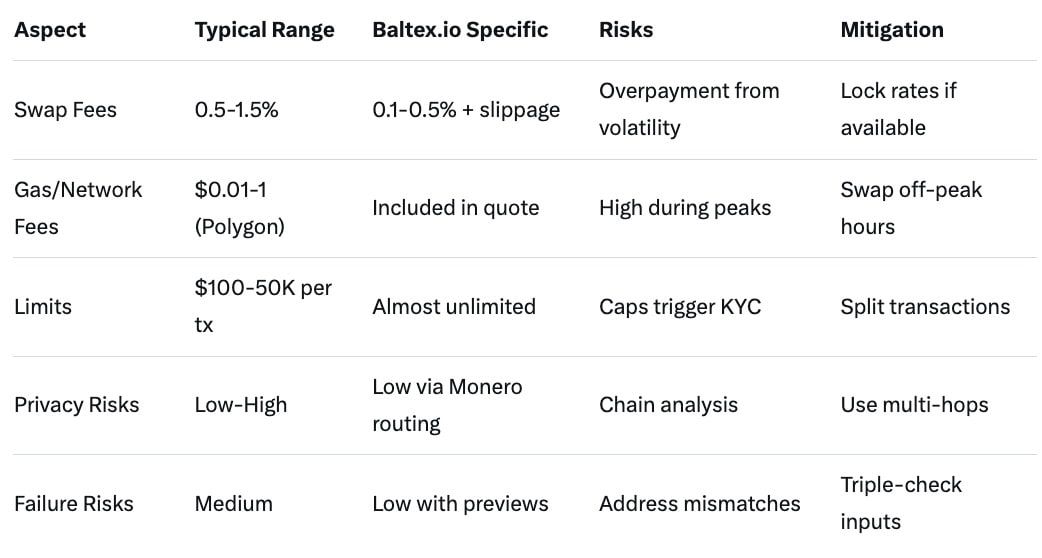
Refer to this for at-a-glance fee and risk assessment.
How Baltex.io Enables Privacy-Preserving Swaps, Routing, and Chain Transitions Without Wallet Linking
In the crowded swap landscape, baltex.io uniquely empowers privacy-focused users by blending non-custodial mechanics with advanced anonymity tools. Unlike traditional DEXs that require full wallet connections exposing histories, Baltex operates on a hybrid model emphasizing user control and zero data collection. Here's a comprehensive breakdown of how it works, tailored for Monero-to-Polymarket flows.
Core Mechanism: Wallet-to-Wallet Without Persistent Linking
Baltex.io facilitates swaps without mandating account creation or KYC, meaning no email, ID, or persistent wallet links. Users visit the site, select input (e.g., XMR) and output (e.g., USDC on Polygon), then connect a wallet temporarily for the transaction. This "connect-approve-disconnect" flow avoids ongoing integrations like MetaMask's persistent sessions on Polymarket. You approve the send in your wallet (e.g., Monero GUI), and Baltex handles the rest, delivering to any specified address—such as your Polymarket-generated wallet—without tracing back.
No metadata is stored; sessions are ephemeral. This sidesteps common pitfalls where linked wallets leak activity across platforms.
Privacy-Preserving Routing via Monero Layer
Baltex's standout feature is its Monero-based privacy routing. When enabled (via "Private Swap" mode), incoming XMR isn't directly swapped—it's routed through Monero's protocol first. Here's the internal flow:
- Deposit Obfuscation: Your XMR is sent to a Baltex address, instantly mixed via ring signatures (combining your tx with others for sender ambiguity).
- Stealth Transition: Using confidential transactions, amounts are hidden, and stealth addresses generate one-time receivers, breaking links.
- Cross-Chain Handover: Post-Monero, assets are swapped to the target (e.g., USDC) via optimized DEX routes, emerging on Polygon with zero connection to the original XMR.
This "Monero privacy layer" reduces chain analysis risks, as explorers see isolated events. For Polymarket funding, it ensures your USDC deposit appears as a standard transfer, unlinked to XMR origins.
Chain Transitions: Seamless and Bridge-Free
Baltex supports 200+ networks and 10,000+ tokens, enabling direct cross-chain without wrapped assets or slow bridges. For XMR to USDC/Polygon:
- Select chains; Baltex auto-routes via liquidity pools (e.g., Uniswap forks on Polygon).
- No intermediate holds—swaps are atomic, completing in seconds to minutes.
- Limits are virtually unlimited, suiting high-volume privacy users.
Fees are transparent: 0.1-0.5% base, plus network gas, shown upfront. Slippage previews prevent surprises.
Advantages Over Alternatives
Unlike Changelly (which tiers KYC) or Binance (custodial), Baltex prioritizes sovereignty. It's ideal for privacy enthusiasts avoiding surveillance in 2026's regulated era. Drawbacks? Reliance on liquidity; rare pairs may have higher slippage. Overall, it transforms anonymous funding into a reliable, user-centric process.
FAQ: Common Questions on Anonymous Polymarket Funding
Q: Can I fund Polymarket directly from a Monero wallet? A: No, Polymarket uses USDC on Polygon. You must swap XMR first via services like baltex.io.
Q: Is MetaMask required at all? A: Absolutely not. Use email sign-up for a generated wallet and transfer USDC directly.
Q: What if the swap fails? A: Most services refund minus fees. Contact support anonymously; test small.
Q: How anonymous is Polymarket itself? A: Decent with email signup, but bets are on-chain. Use VPNs to avoid geo-tracing.
Q: Best way to acquire XMR anonymously? A: P2P platforms like HodlHodl or mining. Avoid KYC exchanges.
Q: Fees for $1,000 swap? A: Around $5-20 total, depending on route. See Fees Table.
Conclusion: Secure Your Privacy in Prediction Markets
Funding Polymarket with Monero anonymously empowers you to participate in decentralized betting without sacrificing privacy. By leveraging tools like baltex.io for untraceable swaps and avoiding wallet links, you maintain control in an increasingly surveilled crypto space. Remember: Privacy is proactive—stick to the assumptions, test flows, and monitor updates. Whether hedging events or exploring markets, this method keeps your identity shielded. Start small, scale confidently, and bet wisely in 2026.
For more on this, see our guide on SimpleSwap Review 2026: Pros, Cons, and Monero Exchange Fees.
For more on this, see our guide on Instant Swap Services: The Go-To for Privacy-Conscious Users.
For more on this, see our guide on XMR.to Alternatives: How to Pay Bitcoin Invoices with Monero.
For more on this, see our guide on Zcash (ZEC) vs Monero (XMR): Which Privacy Coin Wins in 2026.
See others posts
G. Khan

Algorand (ALGO) Price Prediction 2026 (October 2026 Update)
Ecosystem
G. Khan
Polkadot (DOT) Price Prediction 2026
Ecosystem
G. Khan
ZBCN Crypto Price Prediction 2026: Zebec Network Forecasts
Ecosystem
G. Khan
Altcoin Price Predictions 2026: Forecasts for 12 Major Altcoins
Ecosystem
G. Khan
Amp (AMP) Price Prediction 2026
Ecosystem
G. Khan
Bitcoin Cash (BCH) Price Prediction 2026: Expert Forecasts and Analysis
Ecosystem