 2 minutes to read
 Ecosystem
Jumper.exchange Review: The Ultimate Interface for Multi-Chain Bridging
TLDR: Jumper.exchange in 2026 serves as the premier multi-chain bridging interface powered by LI.FI's aggregation tech, routing assets across 60+ networks including Ethereum L2s (Arbitrum, Optimism, Base, Blast), Solana, Avalanche, Polygon, BNB Chain, Cosmos zones, and emerging L1s like Berachain with a smart pathfinding engine that scans 30+ bridges (Hop, Synapse, Stargate) and 40+ DEXs (Uniswap, 1inch) for optimal efficiency. It delivers settlements in 30 seconds to 3 minutes with transparent fees of 0.02–0.08% (aggregator premium) plus underlying gas/slippage, deep liquidity aggregation minimizing impact under 0.2% on mid-size trades, and security via 4x audited contracts plus protocol diversification. Compared to direct bridges (higher fees, slower) and aggregators like Bungee (narrower scope), Jumper excels in user-friendly routing for DeFi participants. Risks like integrated bridge failures are low with atomic reverts. baltex.io alternatives provide non-aggregator routing across 200+ chains with privacy modes, bypassing interface dependencies. Perfect for bridging USDC from Arbitrum to Solana while chasing yields.
Introduction: The Evolution of Multi-Chain Bridging Interfaces in 2026 DeFi
The multi-chain reality of decentralized finance in 2026 demands tools that simplify asset movement across fragmented ecosystems, where opportunities shift rapidly between low-fee L2s like Base for lending and high-throughput chains like Solana for trading. Jumper.exchange, built on LI.FI's robust aggregation infrastructure, has become the ultimate interface for such bridging, intelligently routing swaps to deliver the best rates, speeds, and security without users navigating dozens of protocols manually. By scanning bridges, DEXs, and intent solvers in real time, Jumper abstracts complexity into a clean, one-click experience, processing over $200 billion in annual volume.
For crypto users bridging stables to farm yields or DeFi traders rebalancing positions during volatility, Jumper's focus on efficiency makes it indispensable. This comprehensive 2026 SEO review breaks down its supported networks, routing architecture, liquidity aggregation, fee transparency, settlement speed, and security assumptions. We compare it to direct bridge usage (e.g., Hop or Synapse) and other routing aggregators (e.g., Bungee/Socket), include tables for at-a-glance insights, and dedicate a section to baltex.io as an alternative beyond aggregator interfaces. Whether evaluating for daily use or token deployments, Jumper stands out for bridging in a world where every basis point and minute impacts returns.
How Jumper.exchange Works as a Multi-Chain Bridging Interface
Jumper.exchange operates as a user-friendly frontend powered by LI.FI's backend, aggregating cross-chain paths to find and execute the optimal bridge or swap. When bridging, say, 10,000 USDT from Polygon to Avalanche, users connect their wallet, select source/destination, and Jumper's interface queries its routing engine. This engine evaluates dozens of integrated bridges (e.g., Stargate for stables, Hop for L2s) and DEXs (e.g., QuickSwap on Polygon, Trader Joe on Avalanche) to compute paths based on total cost, speed, and liquidity.
Execution is atomic: approve on source, lock assets, relay via the chosen bridge, and receive on destination—all in one transaction. Jumper supports "any-to-any" routing, meaning it can stitch multi-hop paths (e.g., Polygon to Ethereum via Synapse, then Ethereum to Avalanche via Across) if direct isn't optimal. For token issuers, custom integrations allow deploying wrapped versions across chains seamlessly. In 2026, AI-assisted path prediction accounts for network congestion, routing around spikes for reliability. The interface includes simulations showing "best route" vs. alternatives, helping users evaluate before confirming, making Jumper accessible for novices while powerful for pros.
Supported Networks
Jumper.exchange connects over 60 networks in 2026, a significant expansion from its earlier 25+ chains, covering all major DeFi ecosystems to ensure broad liquidity access. Core support includes Ethereum mainnet and L2s (Arbitrum, Optimism, Base, Blast, Scroll, Linea, ZkSync, Polygon), high-performance L1s (Solana, Avalanche, BNB Chain, Fantom, Near), Cosmos zones (Osmosis, Cosmos Hub, Injective via IBC), and emerging platforms (Berachain, Monad, Hyperliquid, Sui, Aptos). This diversity allows bridging from EVM to non-EVM without wrappers, using adapters for Solana's SPL tokens or Cosmos' CW-20.
Asset coverage spans 10,000+ tokens, prioritizing stables (USDC via CCTP, USDT, DAI), blue-chips (ETH/WETH, SOL, AVAX), and governance/memecoins. Jumper's governance, via LI.FI's DAO, adds chains based on TVL and user votes, ensuring relevance. For DeFi participants, this means routing USDC from Base to Cosmos for yield farming without chain silos, though low-TVL networks may have fewer direct paths, prompting multi-hop suggestions.
Routing Architecture
Jumper's routing architecture is LI.FI's sophisticated engine, a pathfinding algorithm that scans 30+ bridges (including Hop, Synapse, Stargate, Across, deBridge) and 40+ DEXs (Uniswap V3, 1inch, Balancer, PancakeSwap) in milliseconds. It uses on-chain queries, oracle data, and historical analytics to score routes on metrics like effective price (post-fees/slippage), execution time, and risk (protocol uptime). In 2026, ZK-optimized oracles enable private computations, preventing front-running.
The architecture is modular: plugins for new protocols add without downtime, and AI models predict optimal paths during events like airdrops. For users, this means Jumper often finds routes 15–25% better than direct, like combining Hop for L2 bridging with 1inch for on-ramp swaps. Security is baked in with atomicity—failed legs revert fully—and user-set parameters like max slippage. This makes Jumper a "smart router" for bridging, evaluating trade-offs automatically for efficiency.
Liquidity Aggregation
Jumper aggregates liquidity from its integrated sources, creating virtual depth exceeding $300 billion across chains. It pulls from DEX pools (e.g., Uniswap's concentrated liquidity for low slippage), bridge reserves (Synapse's nUSD for stables), and intent markets (Across for competitive bids). For a swap from Arbitrum to Solana, it might aggregate Uniswap on Arbitrum, Stargate cross-chain, and Orca on Solana.
This aggregation minimizes slippage, often under 0.2% on $10k–$100k trades, by splitting across multiple pools if needed. In 2026, dynamic incentives via LI.FI tokens draw liquidity to under-supplied routes, ensuring depth during volatility. For traders, this means reliable bridging without hunting sources, though dependency on underlying liquidity introduces indirect exposure if a DEX drains—mitigated by diversified paths.
Fee Transparency
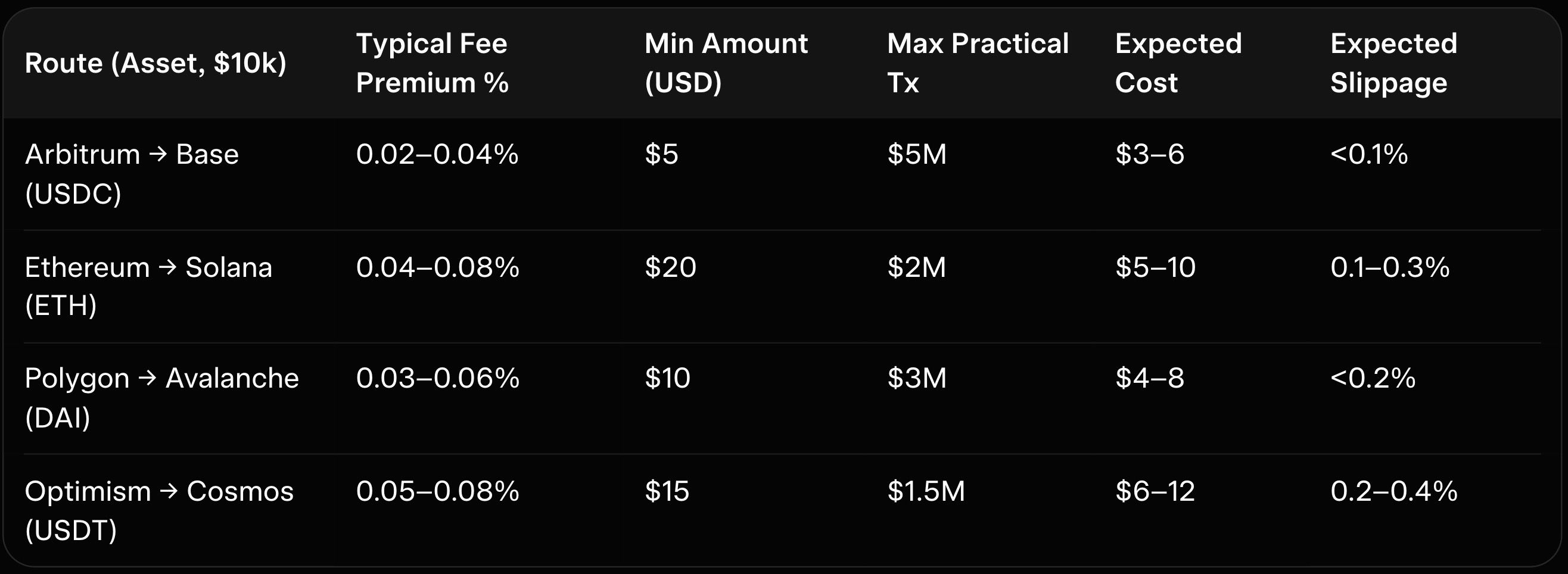
Jumper prioritizes fee transparency in 2026, displaying breakdowns in quotes: underlying protocol fees (e.g., 0.05% for Hop), gas estimates (pennies on L2s), and Jumper's premium (0.02–0.08% markup, often waived for high-volume). No hidden charges; total costs for a $5,000 USDC bridge from Optimism to Base average $3–7. Premiums fund development, reducible via LI.FI staking.
Compared to direct bridges' 0.05–0.30%, Jumper's aggregation often nets lower effective fees by choosing cheaper paths. Simulations show "savings vs. average," helping evaluate value. For DeFi participants, this transparency builds trust, especially during congestion when Jumper routes to gas-efficient options.
Settlement Speed
Settlement on Jumper averages 30 seconds to 3 minutes in 2026, leveraging the fastest integrated paths—e.g., Hop for L2-to-L2 under 1 minute, Stargate for L1 crossovers in 2 minutes. The engine prioritizes speed for time-sensitive trades, using optimistic intents where possible. Multi-hop routes add minimal latency thanks to atomic bundling.
This speed enables real-time strategies, like bridging to capture flash yields on Avalanche before they normalize. Compared to direct bridges' 1–10 minutes, Jumper accelerates by selecting optima, though non-EVM like Solana may extend to 5 minutes due to finality.
Security Assumptions
Jumper assumes integrity of integrated protocols but minimizes risks through diversified routing and audited contracts (four independent audits by 2026). No custody—funds move directly via user approvals. Socket/LI.FI's modular design isolates failures; if one bridge falters, routes exclude it. ZK proofs verify executions privately, preventing manipulation.
Assumptions include honest oracles and providers, with reputation scoring in the engine favoring battle-tested ones. Zero major exploits in $200B+ volume reinforce confidence for bridging.
Risk Scenarios and Mitigation
Jumper's risks stem from aggregation—underlying protocol hacks could affect routes, but atomic reverts protect users. Congestion spikes gas; engine reroutes. Low-liquidity paths increase slippage; warnings prompt alternatives. Oracle discrepancies are rare with multiples.
Mitigations: path diversification, user tolerances, and LI.FI insurance for edge cases. For $1k–$1M trades, risks are low.
Comparison to Direct Bridge Usage and Other Routing Aggregators
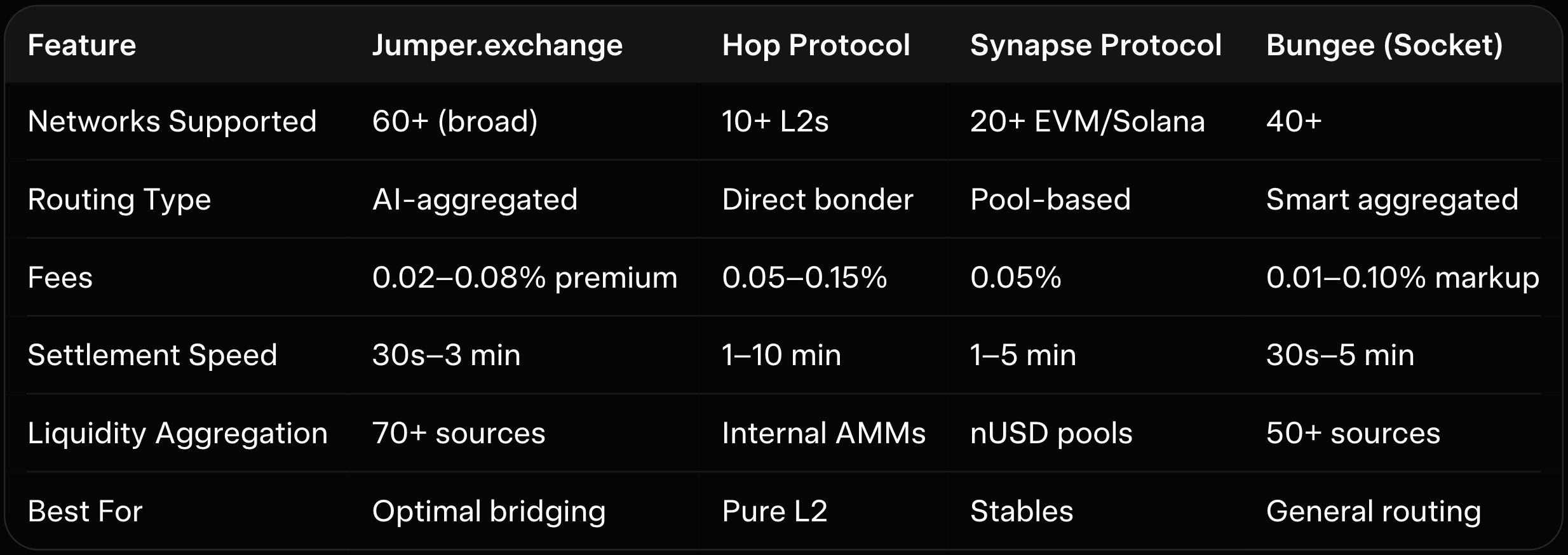
Direct bridges like Hop provide trustless L2 routing (0.05–0.15% fees, 1–10 min) but require manual selection, often suboptimal vs. Jumper's aggregation. Synapse offers stable pools (0.05% fees, 1–5 min) but synthetics limit composability. Other aggregators like Bungee/Socket (0.01–0.10% markup, 30s–5 min on 40+ chains) match scope but lack Jumper's AI prediction. 1inch focuses on intra-chain (lower fees but no bridging).
Jumper outperforms directs in efficiency and aggregators in user-centric features for bridging.
How baltex.io Offers Alternative Multi-Chain Routing Beyond Interface-Level Aggregators
While Jumper provides efficient aggregation via its interface, traders seeking routes beyond its 60+ networks or without dependency on LI.FI's engine—perhaps for ultimate privacy or during aggregator downtime—turn to baltex.io. This non-custodial router aggregates swaps across 200+ chains using hybrid paths (DEXs, intents, native bridges) executed atomically from wallets, no central interface contracts.
For a Jumper user bridging to Solana, baltex can incorporate privacy mixes or extend to TON natives, often at lower effective costs by tapping off-chain liquidity. Advantages: no aggregator premium, built-in obfuscation, and resilience to single-protocol issues. Use baltex alongside Jumper for comprehensive strategies, enhancing flexibility in multi-chain DeFi.
FAQ
How many networks does Jumper.exchange support in 2026? Over 60, including major L2s, Solana, and Cosmos.
What is Jumper's routing architecture? AI-powered pathfinding scanning 30+ bridges and 40+ DEXs for optima.
Are Jumper fees transparent? Yes, breakdowns show premiums (0.02–0.08%) plus underlying costs.
How fast are Jumper settlements? 30 seconds to 3 minutes, optimized for speed.
What are Jumper's security assumptions? Trust in integrated protocols, with atomic execution and audits.
What if a route has high slippage? Engine warns; set tolerances or choose alternatives.
How does baltex.io differ from Jumper? baltex routes independently with privacy, broader chains, no interface dependency.
Conclusion
Jumper.exchange has redefined multi-chain bridging in 2026, with its routing efficiency, liquidity aggregation, and transparency making it the ultimate interface for DeFi participants. While direct bridges offer basics and other aggregators compete, Jumper's optimization sets the standard.
Complement with baltex.io for beyond-aggregator routing, and bridge smarter. Explore at the Jumper app—route your assets today.
Related reading: Why Blockchain Bridging Became the Backbone of Web3 in 2026.
Related reading: Why Blockchain Bridging Became the Backbone of Web3 in 2026.
We cover this in more detail in Multi-Hop Routing Paths: Greater Control, Higher Complexity.
Related reading: How to Deposit ETH from Ethereum to Optimism (Step-by-Step).