



 5 minutes to read
 Ecosystem
KyberSwap Review: Analyzing the Elastic Pools and Aggregation
KyberSwap stands out as a multi-chain decentralized exchange aggregator and liquidity protocol in DeFi. Built under the Kyber Network, it delivers optimized token swaps, earning options, and trading tools while keeping users in control of their funds. In 2026 the platform supports more than 420 liquidity sources across 17 chains, handles significant trading volume, and serves millions of users. This review examines its aggregation engine for best-rate swaps and the Elastic Pools system for concentrated liquidity. You'll find clear explanations of the technology, mechanics, history, practical uses, security, and where it fits in the market.
Background and History of KyberSwap
KyberSwap grew out of the Kyber Network project, which started as an on-chain liquidity protocol that links different sources for smoother trading. Early versions focused on dynamic market making and reserve-based aggregation, setting it apart from basic constant-product AMMs. The platform later added a clean interface at kyberswap.com, limit orders, cross-chain tools, and earning features. By 2026 it had processed over US$150 billion in cumulative volume for more than 4.6 million users and ranks among leading EVM aggregators. Elastic Pools arrived to fix capital inefficiency in standard AMMs by using concentrated liquidity, letting providers target specific price ranges. The 2023 security incident on Elastic Pools led to upgrades, extra audits, and better swap mechanics. Today KyberSwap acts as DeFi's open liquidity layer, powering wallets, dApps, and even AI tools. It covers major chains including Ethereum, Polygon, BNB Chain, Arbitrum, Optimism, Avalanche, and others. Recent 2026 data shows solid Ethereum aggregator share thanks to native liquidity and smart routing.
How KyberSwap Aggregation Works
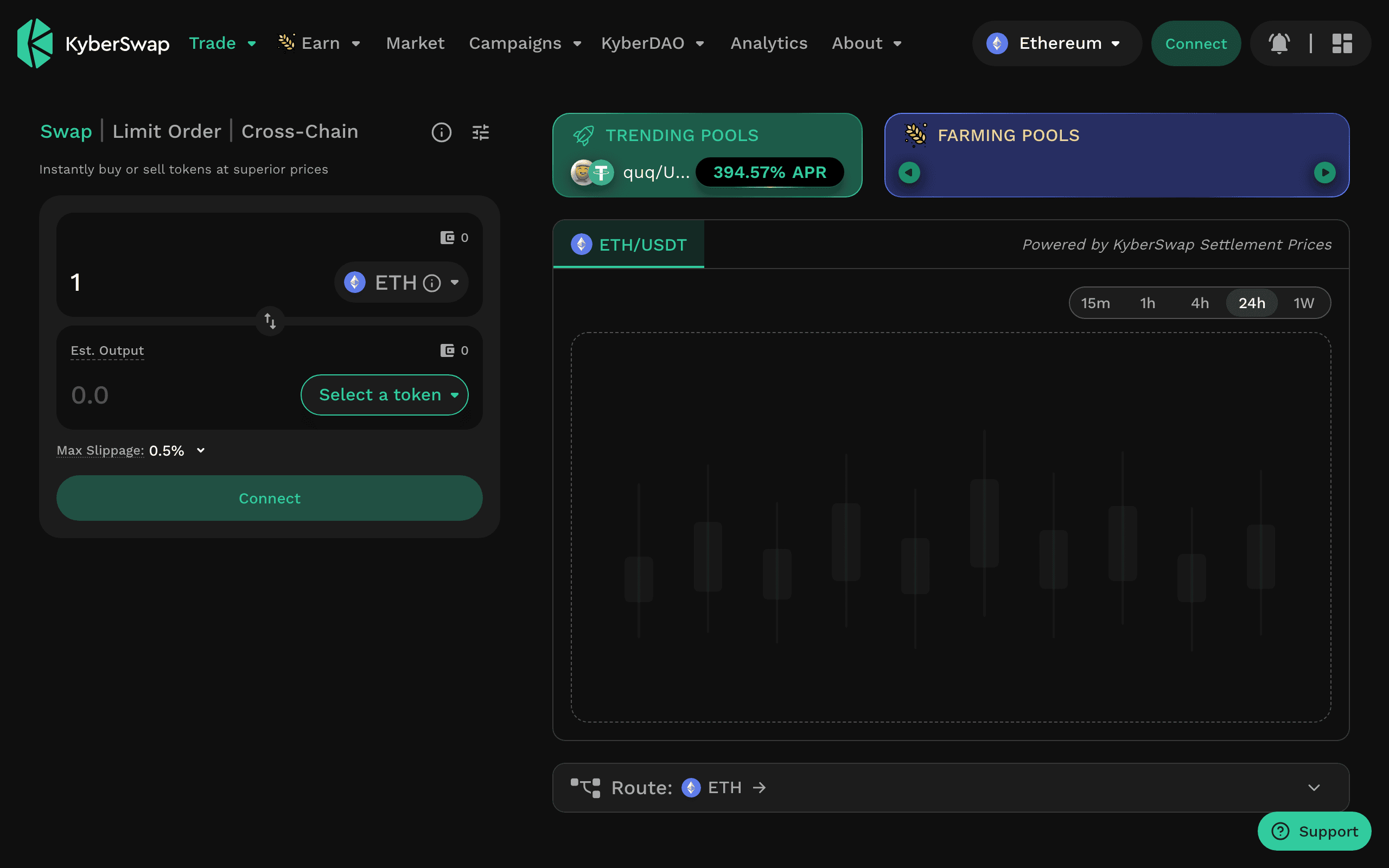
The aggregation engine sits at the heart of KyberSwap for traders who want the best execution. Instead of one liquidity source, it checks hundreds of DEXs, relevant CEX feeds, and other providers in real time to pick the most efficient path. It compares quotes, splits orders across routes when it cuts slippage or boosts output, and optimizes for gas. A large trade might route partly through a Curve stable pool and partly through a Uniswap V3 position, all handled atomically by smart contracts. The system taps over 420 sources on 17 chains for broad coverage and backup if one venue dries up. Users simply connect a wallet, pick tokens and amounts, and see a clear preview of the route, expected output, price impact, and minimum received. Extra tools include limit orders and cross-chain swaps. Routing algorithms factor in fees, slippage, and depth, often beating manual checks. The platform's own pools add an edge by letting the aggregator favor or combine internal liquidity. Developers can embed the logic via APIs for bots, wallets, and Web3 apps. In 2026 this routing strength helps KyberSwap lead in several segments.
Understanding KyberSwap Elastic Pools
KyberSwap Elastic Pools bring a concentrated liquidity model that improves capital efficiency for market makers. Classic constant-product pools spread liquidity evenly across all prices. Elastic Pools let providers pick custom ranges where their capital stays active, concentrating depth where trades happen most. The system adds Kyber-specific touches such as multiple fee tiers (0.008%, 0.01%, 0.04%, 0.3%, 1%) chosen by volatility and pair type. Each pool can run two AMM curves at once—one for the main investment and one for reinvestment that auto-compounds fees back into the position. Positions appear as NFTs for easy transfer and tracking. Providers deposit pairs, set ranges with ticks, and earn higher fees per unit of capital when price stays in range. Auto-compounding happens automatically through the reinvestment curve. Anti-sniping protections guard against just-in-time liquidity attacks. Pools run on many chains and support pairs like stMATIC on Polygon with partner incentives from Lido. Fees adjust dynamically. The design suits active LPs who want flexibility and better yields than broad-range models. Factory contracts, position managers, and core pool logic handle creation, swaps, and management under audited code.
Technical Comparison: Elastic Pools vs Classic Pools
KyberSwap offers both Classic and Elastic options for different needs. Classic pools use the standard constant-product formula with dynamic fees that rise in volatile markets and drop in stable ones. They provide broad liquidity without range selection, suiting passive providers. Elastic Pools add concentrated liquidity with custom ranges, higher fee capture in active zones, and the reinvestment curve for auto-compounding. Fee structures differ: Classic adjusts by volatility while Elastic uses fixed tiers. Capital efficiency is much higher in Elastic for pairs with steady price action, though liquidity outside the range earns nothing until price moves. Elastic needs more active range management and carries stronger impermanent loss risk in narrow bands. Both types work with the aggregator, but Elastic liquidity often gets priority in optimized routes. 2026 metrics show Elastic pools drawing liquidity in high-volume pairs for better returns, while Classic stays popular for stablecoin pairs. Providers can mix strategies in the same interface.
Security, Audits, and Risk Management
Security matters in DeFi, and KyberSwap has focused on audits and fixes after incidents. Contracts receive reviews from firms like Hexens, covering swap logic, position handling, and cross-contract calls. The 2023 Elastic exploit, caused by a cross-tick calculation issue, led to upgrades, stronger checks, and user support measures. Current code includes solid validation, flash-loan protections, and activity monitoring. The non-custodial design means users keep their keys and no funds sit on the platform. Risks include smart-contract bugs, impermanent loss, slippage, and bridge issues in cross-chain moves. Users should verify contract addresses, start small, and stick to official interfaces. The platform performs AML screening on flagged transactions per compliance requirements. Ongoing monitoring and transparent post-mortems in 2026 help build trust. The decentralized setup avoids single points of failure but places due diligence on users.
How to Use KyberSwap for Swaps and Liquidity Provision
Using KyberSwap starts with the web interface. For swaps, connect a wallet, select tokens across supported chains, review the best aggregated route, and confirm. Price-impact warnings and minimum-received guarantees help set expectations. Limit orders let you set targets that execute automatically. For Elastic Pools, pick a pair, set a price range with ticks, choose a fee tier, deposit assets, and mint the NFT position. Yields come from trading fees with auto-compounding where available. Zaps let you enter with a single asset. Incentive campaigns add extra rewards. Developers integrate via APIs for swaps, orders, or Zap services. Cross-chain routes use supported bridges. Examples include swapping ETH to USDT on Ethereum or providing liquidity in a volatile Arbitrum pair within a tight range. The dashboard tracks positions and earnings.
Market Position and Performance in 2026
In 2026 KyberSwap competes strongly among DEX aggregators on EVM chains by combining native liquidity with external sources. Volume data shows solid Ethereum market share, often near the top alongside peers like CoW Swap. Multi-chain growth reaches emerging ecosystems. Features such as gasless flows in some paths and AI-agent compatibility support further expansion. TVL and fee metrics reflect steady activity in both routing and pool earning. Partnerships like liquidity mining with Lido on Polygon show ongoing collaboration. Competition from specialized aggregators and shifting regulations remain challenges, yet the open model supports resilience. KyberSwap's focus on best rates, capital efficiency, and developer tools keeps it central to DeFi infrastructure.
Pros, Cons, and Alternatives
KyberSwap advantages include strong rate optimization through aggregation, flexible Elastic Pools with auto-compounding, wide chain and asset support, non-custodial operation, and free limit orders. APIs extend its reach. Drawbacks include the learning curve for range management in Elastic, smart-contract and market risks, and occasional reliance on underlying liquidity depth. Gas fees on some chains affect small trades, though routing helps. Alternatives include other aggregators, standalone DEXs, or non-custodial swap platforms. Users looking for similar instant cross-chain swaps without registration can consider Baltex, a non-custodial crypto swap aggregator that supports 200+ networks and 10,000+ assets through aggregated liquidity. Each option brings its own trade-offs in routing depth, features, and ease of integration. KyberSwap shines when deep liquidity analysis and concentrated earning strategies matter most.
Future Outlook and Developments
KyberSwap is set for more innovation in DeFi liquidity tools. Possible updates include broader chain coverage, refined AI routing, stronger security, and deeper ties to account abstraction. The open protocol invites community input and third-party builds. As DeFi matures in 2026 and beyond, tools that combine aggregation with efficient liquidity like Elastic Pools will stay central. Checking official channels for new fee models, cross-chain improvements, or incentives gives the latest picture. Emphasis on transparency, audits, and user control positions KyberSwap well for industry changes.
What is KyberSwap Elastic?
How does KyberSwap aggregation work?
Is KyberSwap safe to use in 2026?
What are the benefits of KyberSwap Elastic Pools?
How does KyberSwap compare to Uniswap V3?
Where can I swap tokens using KyberSwap?
See others posts
G. Khan

How to Swap TRC20 USDT to ERC20 Without a Centralized Exchange (2026)
Ecosystem
G. Khan
USDC vs USDT vs DAI: Which Stablecoin is Best for Cross-Chain? (2026)
Ecosystem
G. Khan
The Trilemma of Bridging: Speed vs. Security vs. Cost
Ecosystem
G. Khan
What is Omnichain Tokens (OFTs)? The End of Wrapped Assets?
Ecosystem
G. Khan
Multichain Smart Contracts: How Developers Bridge DApps (2026)
Ecosystem
G. Khan
The 10 Best Cross-Chain Bridges for NFT Transfers in 2026
Ecosystem