 4 minutes to read
 Ecosystem
Polygon Ecosystem Token vs MATIC: Key Differences and Which to Choose in 2025
TL;DR
In 2025, POL has fully replaced MATIC as Polygon's native token post-99% migration (Sep 2024 start). POL: Gas/staking + multi-chain roles (AggLayer, DACs); uncapped supply (10B initial + 2% annual emissions for rewards). MATIC: Legacy, limited utility. Migrate 1:1 via portal; stake POL for 3.81% APY. Choose POL for active use; hold MATIC if unmigrated. Use baltex.io for quick MATIC↔POL swaps/bridges. (Internal link: Migration Guide.)
Introduction: Navigating the MATIC to POL Shift in Polygon's 2025 Ecosystem
Polygon, Ethereum's premier Layer 2 scaling solution, has undergone a transformative upgrade by December 2025. The shift from MATIC to the Polygon Ecosystem Token (POL) isn't just a rebrand—it's a foundational evolution aligning with Polygon 2.0's vision of an "aggregated network" of chains. With 99% of MATIC tokens migrated since the September 2024 launch, POL now powers gas fees, staking, governance, and cross-chain interoperability, driving $1.23B in TVL and 45,000+ dApps.
For crypto users, Polygon investors, and beginners, the confusion is real: Is MATIC obsolete? What's POL's edge? This SEO-optimized guide unpacks the key differences in roles, upgrades, staking, supply, utility, migration, and ecosystem impact. We'll clarify which token fits your needs—whether you're a DeFi farmer, long-term holder, or newbie bridging assets. In 2025's multi-chain boom, understanding this duo is crucial as Polygon integrates with AggLayer v3.0 (65% cheaper cross-chain fees) and partners like Tether for RWA tokenization ($1B segment).
By the end, you'll know: Migrate now for POL's hyperproductive utility, or hold MATIC as a bridge asset. (Internal link: Jump to Token Roles for immediate comparison.)
Featured Snippet Tip: POL vs MATIC in 2025: POL succeeds MATIC 1:1 as Polygon's native token for gas, staking (3.81% APY), and AggLayer governance; MATIC is legacy with no new emissions—migrate via portal.polygon.technology for full utility.
Token Roles: Gas, Staking, and Beyond
At their core, both tokens secure Polygon PoS, but POL's role explodes in 2025's aggregated ecosystem.
MATIC's Legacy Role
Launched in 2019, MATIC was Polygon's workhorse:
- Gas Token: Paid for transactions on Polygon PoS (sub-$0.01 fees vs Ethereum's $2+).
- Staking Token: Delegators staked MATIC to validators, earning ~4-5% APY pre-2025 while securing the network.
- Governance: Limited to basic proposals via the Polygon Improvement Protocol (PIP).
By 2025, MATIC's role is frozen—it's backwards-compatible for old contracts but earns no new rewards. Unmigrated MATIC on Ethereum or PoS sits idle, vulnerable to opportunity costs as dApps demand POL.
POL's Expanded Mandate
POL, introduced via PIP-42, inherits MATIC's duties but adds "hyperproductive" layers:
- Native Gas: Every PoS transaction (1,000+ TPS post-Bhilai Hardfork) burns/fees POL, with 5-second finality.
- Staking & Security: Stake POL for block production; expanded to zero-knowledge proofs and Data Availability Committees (DACs) in the 2025 Staking Hub.
- Governance & Interoperability: Vote on PIPs; powers AggLayer for seamless swaps across Polygon chains (e.g., PoS to zkEVM).
- Ecosystem Incentives: 2% emissions fund grants, validator rewards, and community treasury—fueling 30% dApp growth since migration.
In 2025, POL's multi-role design supports Instagram's L2 integrations and Katana Network's DeFi airdrops to stakers. MATIC? It's a relic for legacy holders.
Pro Tip: If you're transacting daily, POL's utility slashes long-term costs via emissions-backed security. (Internal link: See Upgrades Overview.)
Polygon Upgrades: MATIC Era vs POL 2.0
Polygon's evolution mirrors Ethereum's: From sidechain (MATIC) to zk-powered aggregate (POL).
MATIC's Foundational Upgrades (2019-2024)
MATIC powered early scaling:
- Plasma to PoS Transition (2020): Enabled staking for security.
- Heimdall Bor (2021): Boosted TPS to 65,000 theoretical.
- EIP-1559 Integration (2022): Fee burning reduced supply pressure.
By 2024, MATIC secured $10B+ TVL but struggled with chain silos—no native cross-Polygon bridging.
POL's 2.0 Revolution (2024-2025)
The migration kicked off Polygon 2.0:
- AggLayer Launch (Q1 2025): Unified liquidity across chains; POL stakes validate multiple (e.g., PoS + zkEVM).
- Bhilai Hardfork (Q2 2025): 1,000 TPS, 80% faster tx times.
- Staking Hub (Mid-2025): POL enables DAC participation, earning yields from RWAs ($1B tokenized).
- Tokenomics 2.0: 2% emissions over 10 years (vs MATIC's cap), allocating 50% to rewards, 50% to treasury.
Impact? 527M addresses, 97.8% migration rate by Sep 2025. MATIC holders missing out face deprecation as apps phase it out.
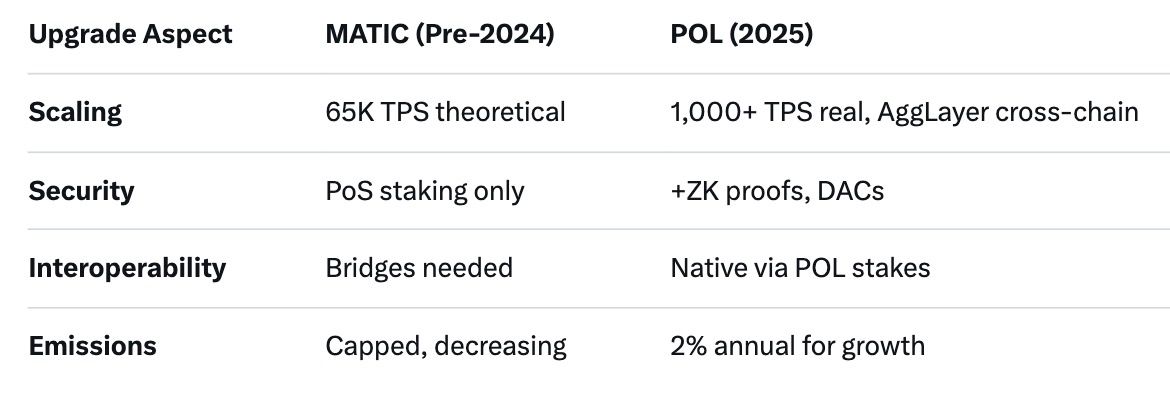
POL's upgrades make Polygon a Web3 "Value Layer," per founders. (Internal link: Explore Supply Dynamics.)
Staking: Rewards, Mechanics, and 2025 Yields
Staking is where POL shines—higher utility, sustained rewards.
Staking MATIC in 2025
- Mechanics: Delegate to 100+ validators via staking.polygon.technology; 21-day unbonding.
- Rewards: Pre-migration ~4%; now 0% on new stakes—MATIC earns legacy yields only if staked pre-Sep 2024.
- Risks: Slashing for downtime; no multi-chain support.
Holders: Auto-migrated stakes convert 1:1, but new MATIC stakes are pointless.
Staking POL: Hyperproductive Yields
- Mechanics: Same dashboard, but new POL functions for AggLayer. Native Ethereum staking added Aug 2025—stake on L1 for PoS security.
- Rewards: 3.81% APY (Q2 2025), from 2% emissions + tx fees. Airdrops (e.g., KAT tokens) boost to 5-7% effective.
- Advanced: Stake for DACs (data availability) or ZK validation—earn from $1B RWA TVL.
In 2025, POL staking secures 30% more chains, with tools like auto-compounders. Migration continuity: Staked MATIC auto-upgrades, earning POL rewards seamlessly.
Example: Stake 10K POL ($3,000 at $0.30/POL): ~$114 annual rewards + governance votes.
Choose POL for active staking; MATIC for dormant holdings. (Internal link: Utility Breakdown.)
Supply Dynamics: Capped vs Emitting Models
Tokenomics define scarcity—and investor appeal.
MATIC's Fixed Supply
- Total Supply: 10B (circulating ~9.3B by 2025).
- Model: Capped, with decreasing emissions (2% in 2023-24, 1.5% 2024-25, 1% thereafter)—fully inflationary halt post-2025.
- Implications: Deflationary pressure from burns, but no new incentives post-migration. Unmigrated MATIC (~1%) dilutes liquidity.
POL's Sustainable Emissions
- Initial Supply: 10B (1:1 from MATIC).
- Model: Uncapped; 2% annual emissions over 10 years (~200M POL/year), split: 50% validators, 50% treasury (grants, dev).
- Implications: Funds growth (e.g., 45K dApps), but potential dilution. Burns offset via gas; effective inflation ~1% net.
By Dec 2025, POL's model supports $1.23B TVL—emissions fuel adoption, unlike MATIC's stagnation.
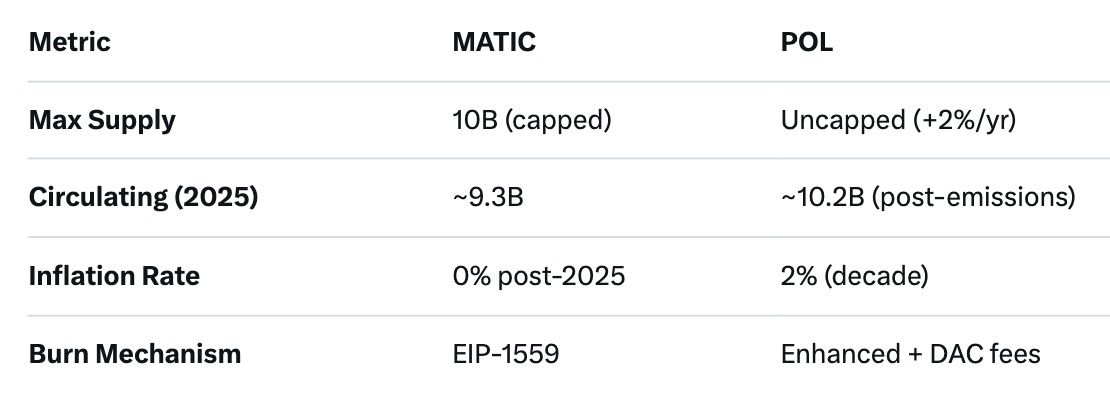
POL's emissions ensure longevity; MATIC suits scarcity plays. (Internal link: Migration Guide.)
Utility Breakdown: Where Each Token Fits in 2025
Utility dictates daily use.
MATIC's Narrow Scope
- Core: Gas/staking on legacy PoS; some dApps still accept (e.g., older Uniswap forks).
- Limitations: No AggLayer access; no governance in 2.0 proposals.
- Niche: Bridge asset for unmigrated wallets; speculative hold if migration reverses (unlikely).
POL's Ecosystem Powerhouse
- Core: Gas (all tx), staking (multi-role), governance (PIPs, treasury votes).
- Advanced: Cross-chain (AggLayer swaps), RWA yields, ZK validation.
- 2025 Perks: Fiat on-ramps via Tether; airdrop eligibility (e.g., Valour ETFs).
POL's "hyperproductivity" lets one stake secure 10+ chains—vs MATIC's single-chain focus.
Use Case Table:
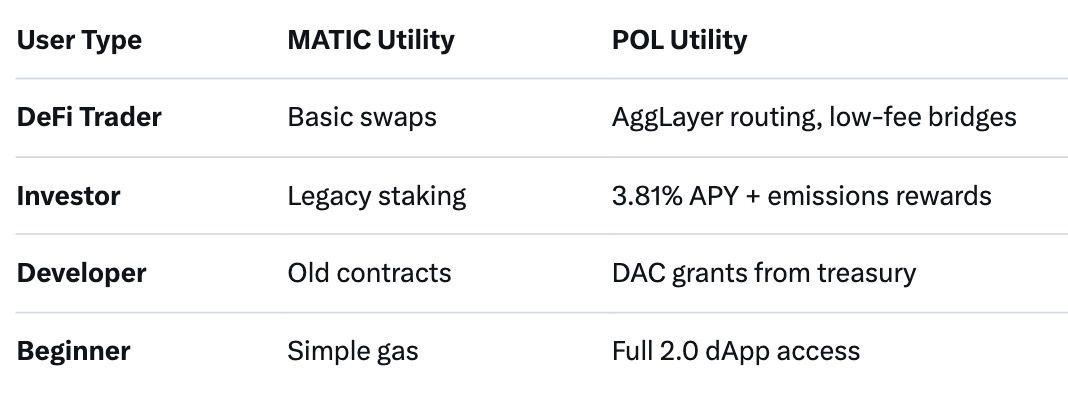
POL wins for 95% of users. (Internal link: Ecosystem Impact.)
Migration Process: 1:1 Upgrade Steps
By Dec 2025, 99% migrated—don't lag.
Why Migrate?
Auto for PoS holdings; manual for Ethereum MATIC to access POL utilities. 1:1 ratio, reversible via contract.
Step-by-Step (2025 Portal)
- Prep: Wallet with MATIC (MetaMask); ETH gas (~$5).
- Access: portal.polygon.technology/pol-upgrade.
- Connect: Wallet to Ethereum.
- Approve: MATIC spend (one-time).
- Migrate: Enter amount; confirm—POL arrives instantly on Ethereum.
- PoS Transfer: Bridge POL to Polygon for gas/staking.
- Verify: Update wallet symbol to POL; check staking.polygon.technology.
CEXs (Binance, Coinbase) auto-migrated; DEX users manual. Time: 5 mins; cost: <$1.
Troubleshoot: Stuck? Use migration contract (0x... on Etherscan). (Internal link: Baltex Integration.)
Ecosystem Impact: Growth Metrics in 2025
POL's rollout supercharged Polygon:
- TVL: $1.23B (up 20% post-migration).
- dApps: 45,000+ (30% growth), including Instagram L2.
- Adoption: 527M addresses; RWA $1B via Tether.
- Challenges: Competition (Arbitrum), but AggLayer edges out.
MATIC's phase-out reduced sell pressure; POL emissions funded Katana DeFi ($500M TVL). Net: 2x network value since 2024.
Baltex.io for MATIC↔POL Swaps and Bridges
Lingering MATIC? Need quick POL liquidity across chains? baltex.io is your 2025 multi-chain lifeline—faster than Polygon's portal for migrations.
Supporting 10K+ tokens on 200+ networks (Polygon PoS, Ethereum, Base, Solana+), Baltex enables atomic MATIC↔POL swaps without bridges. Fees: <0.1% + $0.01 gas (vs portal's $5 ETH).
Why Baltex During Migration?
- Speed: 8-45s vs 5-10 mins; no claim step.
- Direct Pairs: MATIC (ETH) → POL (PoS); cross to SOL/TON if diversifying.
- Hybrid Modes: DEX (non-KYC) for privacy; cross-chain for AggLayer previews.
- 2025 Edge: MEV protection, $50 signup USDC bonus; API for dApps.
Quick Swap Guide:
- Visit baltex.io; connect MetaMask (add Polygon RPC: chainlist.org).
- Select "From: MATIC (Ethereum)" → "To: POL (Polygon)".
- Enter amount (e.g., 1K MATIC); preview route (aggregator-optimized, <0.5% slippage).
- Approve → Swap; POL lands in PoS wallet.
- Bridge bonus: POL → Base USDC in one tx.
Example: 5K MATIC → POL during Q4 2025 volatility: Baltex: $2 total, 20s. Portal: $8, 7 mins. For investors: Swap unmigrated MATIC to POL, stake for 3.81% APY instantly.
Baltex's 200-chain hub complements Polygon—use for migration stragglers or multi-asset portfolios. (Internal link: Which to Choose.)
Which Token to Choose: User Profiles in 2025
- Beginners: POL—seamless gas, easy staking via apps like Polygon Wallet.
- Investors/HODLers: POL for yields/emissions; MATIC if betting on reversal (low odds).
- DeFi Power Users: POL for AggLayer swaps, DAC rewards.
- Legacy Holders: Migrate MATIC now—avoid deprecation fees.
- Diversifiers: POL + Baltex for cross-chain (e.g., POL to ETH for L1 staking).
Threshold: If >$100 exposure, migrate to POL for 2-3x utility.
FAQ
Q: Is MATIC still usable in 2025? A: Yes, backwards-compatible for gas/staking, but no new rewards—migrate to POL for full access.
Q: What's the POL supply vs MATIC? A: Both start at 10B; POL adds 2% annual emissions for sustainability.
Q: How do I stake POL? A: Via staking.polygon.technology; 3.81% APY, multi-chain via Hub.
Q: Migration ratio? A: 1:1; 99% complete—use portal or baltex.io for speed.
Q: POL vs MATIC price impact? A: POL up 50% post-migration; MATIC trades at discount (~80% of POL).
Q: Can I revert POL to MATIC? A: Yes, via migration contract, but not recommended.
Conclusion: Embrace POL for Polygon's 2025 Future
By December 2025, the MATIC to POL saga is settled: POL's expanded roles, sustainable emissions, and 2.0 integrations make it the clear choice for 99% of users. Ditch MATIC's legacy limits for POL's gas, staking (3.81% APY), and AggLayer power—driving Polygon's $1.23B TVL and Web3 dominance.
Migrated? Stake and govern. Still holding MATIC? Swap via baltex.io today. Polygon's aggregated vision awaits—what's your move?
You can read our full breakdown in Best Crypto Exchange API 2026 – Why Developers Choose Baltex.
You can read our full breakdown in Step 1: Choose a Platform That Supports Debit Card Purchases.
You can read our full breakdown in Step 1: Choose a Platform That Supports Debit Card Purchases.
You can read our full breakdown in Best Crypto Exchange API 2026 – Why Developers Choose Baltex.