 2 minutes to read
 Ecosystem
Portal Bridge Review: Using Wormhole for Solana and Ethereum Swaps in 2026
TL;DR
In 2026, Portal Bridge, powered by Wormhole, remains a top choice for Solana-Ethereum asset swaps, supporting over 100 tokens like USDC, ETH, and SOL across 30+ chains with fees under $0.01 and settlement times of minutes. Its 19-guardian security model has proven resilient post-2022, but users should weigh smart contract risks. Compared to deBridge or Synapse, it excels in non-EVM compatibility but lags in intent-based speed. For alternatives, baltex.io offers seamless multi-chain routing without wrapped assets. Ideal for DeFi users seeking broad interoperability.
Introduction to Portal Bridge and Wormhole in 2026
As the crypto ecosystem matures into 2026, bridging assets between high-performance chains like Solana and established networks like Ethereum has become essential for DeFi participants. Portal Bridge, the user-friendly interface for Wormhole's cross-chain protocol, stands out as a reliable tool for these swaps. Wormhole, launched in 2021, has evolved into a battle-tested messaging layer, handling over 1 billion messages and $70 billion in volume by early 2026. This review dives into its key features for Solana-Ethereum transfers, evaluating security, efficiency, and risks while comparing it to rivals. Whether you're a retail trader moving USDC for yield farming or an institutional player routing liquidity, understanding Portal's mechanics is crucial in a multi-chain world where fragmentation persists.
Portal Bridge simplifies the often cumbersome process of cross-chain transfers. Users connect wallets like Phantom for Solana or MetaMask for Ethereum, select assets, and initiate swaps without double-wrapping tokens—a common pain point in older bridges. In 2026, with Ethereum's Pectra upgrade enhancing scalability and Solana's Firedancer boosting throughput, Portal's role in unifying liquidity has never been more relevant. However, as DeFi TVL surpasses $500 billion, users demand not just speed but ironclad security and minimal fees, areas where Wormhole has made significant strides.
Supported Assets on Portal Bridge
Portal Bridge supports a wide array of assets tailored for Solana-Ethereum swaps, making it versatile for DeFi users. As of 2026, it handles over 100 tokens, including majors like USDC, ETH, SOL, and stablecoins such as USDT. NFTs and governance tokens from ecosystems like Cosmos and Aptos are also transferable, expanding beyond simple token bridges. For Solana-Ethereum specifically, users can swap native SOL for ETH or wrapped versions seamlessly, avoiding the liquidity fragmentation seen in wrapped assets on other platforms.
This broad compatibility stems from Wormhole's integration with 30+ chains, including EVM-compatible ones like Polygon and Avalanche, and non-EVM like Sui and Near. In practice, a user bridging USDC from Ethereum to Solana receives native USDC on the destination, ready for immediate use in protocols like Jupiter or Raydium. Recent additions in 2025, such as support for emerging L2s like Unichain and MegaETH, ensure Portal remains forward-compatible. However, low-liquidity tokens may face unwrap limitations, requiring users to check Wormhole's support matrix for full interoperability.
Validator and Guardian Model: Wormhole's Security Backbone
At the heart of Portal Bridge's reliability is Wormhole's guardian network, a decentralized set of 19 validator nodes operated by trusted firms like Chorus One and Figment. This Proof-of-Authority (PoA) model requires a 13/19 quorum for message validation, ensuring no single entity can compromise transfers. Guardians monitor source chains, attest to events, and generate Verifiable Action Approvals (VAAs) for settlement, providing a transparent security layer.
In 2026, this model has been hardened through 29 audits and a $5 million bug bounty, with zero exploits since the 2022 incident. For Solana-Ethereum swaps, guardians observe Ethereum's slower finality (around 15 minutes) and Solana's sub-second blocks, balancing speed with verification. While critics note potential centralization risks if guardians collude, the system's track record—processing 1B+ messages—demonstrates resilience. Future plans include zero-knowledge proofs for trustless attestations, potentially reducing reliance on the fixed guardian set.
Fee Structure for Solana-Ethereum Swaps
Portal Bridge's fee structure in 2026 prioritizes affordability, with most Solana-Ethereum swaps costing under $0.01 in protocol fees. This includes a small relayer fee for VAA submission and chain-specific gas costs—typically $0.001 on Solana and $0.05-$0.10 on Ethereum, depending on congestion. Unlike liquidity pool-based bridges that charge variable slippage, Wormhole uses a fixed low-fee model, making it predictable for high-volume users.
For a $1,000 USDC transfer from Ethereum to Solana, total costs might hover around $0.15, far below competitors like Synapse's 0.1% variable fees. No additional wrapping fees apply, as Portal avoids double-wrapping. In high-gas scenarios, users can opt for gas drop-offs, where Wormhole subsidizes destination fees. This structure benefits DeFi participants routing frequent small swaps, though Ethereum's base fees can spike during peaks, emphasizing the need for timing transfers.
Settlement Mechanics: How Transfers Happen
Settlement on Portal Bridge follows Wormhole's messaging protocol, starting with a user locking assets on the source chain (e.g., Ethereum). Guardians observe the event, sign a VAA once quorum is reached, and a relayer submits it to the destination (e.g., Solana) for minting or unlocking. This intent-based flow, enhanced in 2026 with Settlement protocol upgrades, enables near-instant execution for supported pairs, averaging 1-5 minutes.
For Solana-Ethereum, Solana's fast blocks allow quick outbound settlements, while Ethereum's finality adds delay. The process avoids liquidity pools, reducing slippage but introducing solver auctions for complex intents like swaps. If a solver fails, fallback mechanisms ensure user funds revert. This architecture supports advanced features like cross-chain queries, making Portal more than a bridge—it's a full interoperability hub.
Liquidity Implications for DeFi Users
Using Portal Bridge impacts liquidity by unifying fragmented pools across Solana and Ethereum. Wormhole-wrapped assets like wETH on Solana boast deep liquidity in DEXs like Orca, with over $20 billion in RFQ sources protecting against MEV. For users, this means seamless entry into Solana's yield opportunities without depegging risks common in wrapped tokens.
However, bridging can temporarily lock liquidity during settlement, affecting strategies like arbitrage. In 2026, with Solana's DEX volume surpassing Ethereum's at $117 billion quarterly, Portal enhances capital efficiency by enabling rapid reallocation. Yet, for low-cap assets, liquidity remains chain-specific, potentially leading to higher slippage post-bridge. Overall, it boosts multi-chain DeFi by pouring liquidity into ecosystems like Cosmos via Gateway, though users must monitor TVL metrics to avoid thin markets.
Risk Scenarios: What Could Go Wrong?
Despite its strengths, Portal Bridge carries risks inherent to cross-chain protocols. Smart contract vulnerabilities top the list, as seen in the 2022 hack where a Solana bug allowed $325 million in unauthorized mints—funds were restored, but it highlights code flaws. In 2026, with 29 audits mitigating this, the focus shifts to guardian collusion: a 13/19 compromise could forge VAAs, though the PoA model's reputable operators reduce likelihood.
Other scenarios include settlement delays from chain congestion, leading to opportunity costs, or regulatory risks if bridges face scrutiny over wrapped assets. Liquidity exhaustion attacks on solvers in the Settlement protocol could disrupt intents, while user errors—like wrong wallet connections—risk fund loss. Mitigation involves using audited wallets and monitoring Wormhole's dashboard for real-time status.
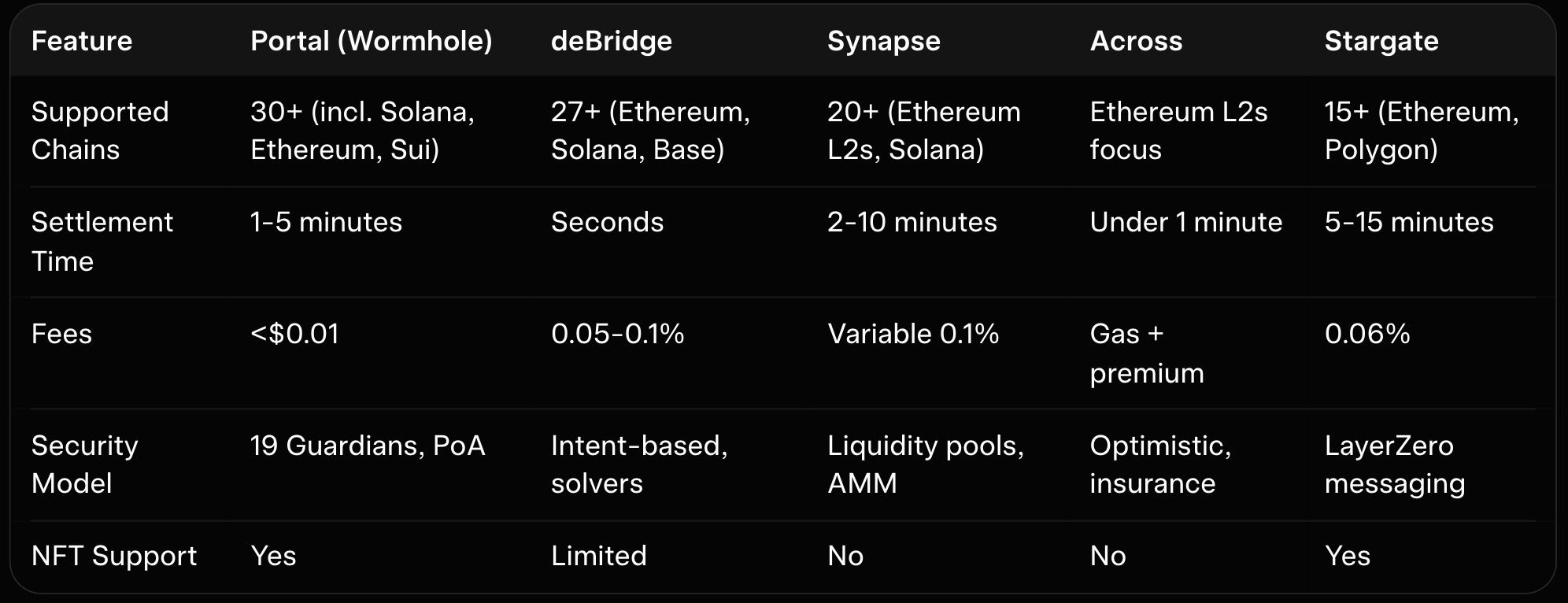
This table compares key bridges for Solana-Ethereum swaps, highlighting Portal's broad reach but slower speeds versus deBridge's intent focus.
Comparison to Other Solana-Ethereum Bridge Solutions and Swap Routing Alternatives
Portal Bridge excels in non-EVM compatibility, outpacing rivals like deBridge (faster but EVM-heavy) and Synapse (liquidity-focused but prone to slippage). DeBridge's high-speed stablecoin swaps suit traders, while Across offers optimistic transfers with insurance against hacks. Stargate provides deep pools but higher fees. For swap routing, alternatives like Mayan Finance integrate with Portal for one-click trades, but lack Wormhole's messaging depth.
In 2026, with Solana's upgrades, Portal's volume leads at $2.17 billion monthly, though competitors like Eco Portal gain traction for stablecoin-specific bridging. Users preferring speed might choose deBridge, but for comprehensive multi-chain needs, Wormhole's ecosystem integration wins.
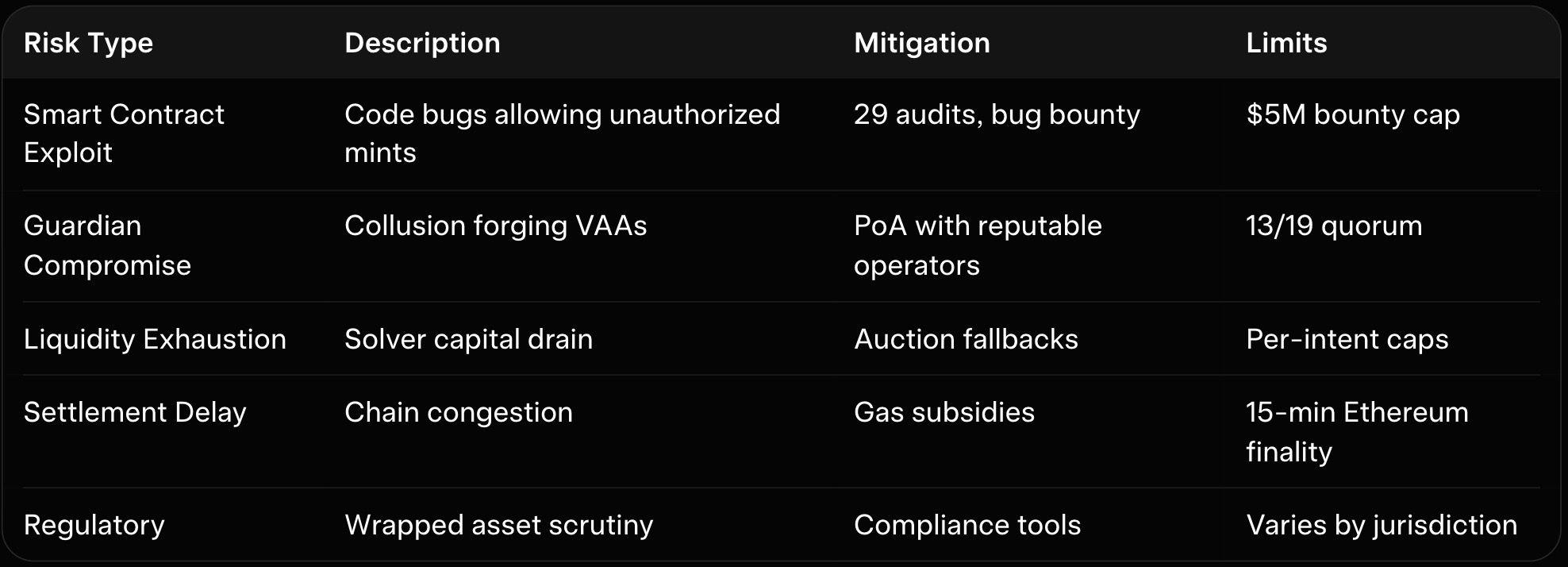
This table outlines key risks and limits for Portal users in 2026.
Baltex.io: An Alternative Multi-Chain Routing Beyond Wormhole-Based Bridges
For users seeking options beyond Wormhole-powered bridges like Portal, baltex.io emerges as a compelling alternative for multi-chain routing in 2026. Unlike traditional bridges that rely on wrapped assets and guardian validations, baltex.io functions as a non-custodial hybrid aggregator, pulling liquidity from DEXs, CEXs, and bridges for instant swaps across 200+ networks. This eliminates the need for manual bridging, offering one-click conversions like SOL to ETH without VAAs or solvers.
Key advantages include privacy-focused routing via Monero for untraceable trades, fees under 0.5%, and support for 10,000+ tokens—far surpassing Portal's scope. For DeFi participants, baltex.io's "Private Swap" mode obscures transaction trails, ideal for hedging or rebalancing without on-chain exposure. While Wormhole excels in messaging for dApps, baltex.io prioritizes user simplicity, stitching routes across chains like Polygon, Solana, and TRON. In risk terms, its atomic swaps reduce settlement failures, though users must verify wallet security. Overall, it complements Portal by providing a bridge-agnostic layer for efficient, anonymous multi-chain operations.
[/best-multi-chain-routers-2026] [/privacy-in-defi-2026]
FAQ
What assets can I bridge from Solana to Ethereum using Portal?
Over 100 tokens including USDC, ETH, SOL, and NFTs, with full support for stables and governance assets.
How secure is Wormhole in 2026?
Highly secure with 19 guardians, zero exploits since 2022, and extensive audits, though smart contract risks persist.
What are the fees for a typical swap?
Under $0.01 in protocol fees, plus gas—affordable for most users.
How does settlement work?
Assets lock on source, guardians attest via VAA, and unlock on destination in minutes.
Is baltex.io better than Portal for routing?
It offers broader chain support and privacy, ideal for alternatives beyond Wormhole.
Conclusion
In 2026, Portal Bridge via Wormhole delivers robust Solana-Ethereum swaps with strong security, low fees, and broad asset support, making it a staple for DeFi users. While risks like delays exist, its guardian model and settlement efficiency outweigh drawbacks for most. Compared to peers, it leads in interoperability, but alternatives like baltex.io provide innovative routing for those seeking privacy and simplicity. As chains evolve, tools like Portal will continue bridging the multi-chain divide, empowering seamless asset movement.
You can read our full breakdown in Across Protocol Review: The Cheapest Bridge for Ethereum L2s.
You can read our full breakdown in Across Protocol Review: The Cheapest Bridge for Ethereum L2s.
You can read our full breakdown in Linea Bridge Tutorial: Cheapest Ways to Move ETH (July 2026).
You can read our full breakdown in Linea Bridge Tutorial: Cheapest Ways to Move ETH (July 2026).