



 5 minutes to read
 Ecosystem
What is the Upcoming Bitcoin Halving?
The upcoming Bitcoin halving refers to the fifth scheduled reduction in Bitcoin's block reward, expected in 2028. This event continues the bitcoin halving process that has defined Bitcoin's monetary policy since its launch. As of August 2026, the network sits roughly 20 months away, with estimates pointing to April 2028 when block 1,050,000 gets mined.
The bitcoin halving process automatically cuts the reward miners earn for validating transactions. It keeps Bitcoin's total supply on track to approach—but never exceed—21 million coins. The 2028 event will drop the subsidy from the current 3.125 BTC per block to 1.5625 BTC per block. This built-in scarcity sets Bitcoin apart from traditional currencies that central banks can expand at will.
Estimated Date and Countdown for the 2028 Halving
Data providers largely agree on an April 2028 window. CoinGecko projects April 17, 2028, while other trackers range from April 4 to April 18 depending on recent block times. Bitcoin aims for a 10-minute block interval, yet small fluctuations mean the exact moment stays an estimate until the network nears that height.
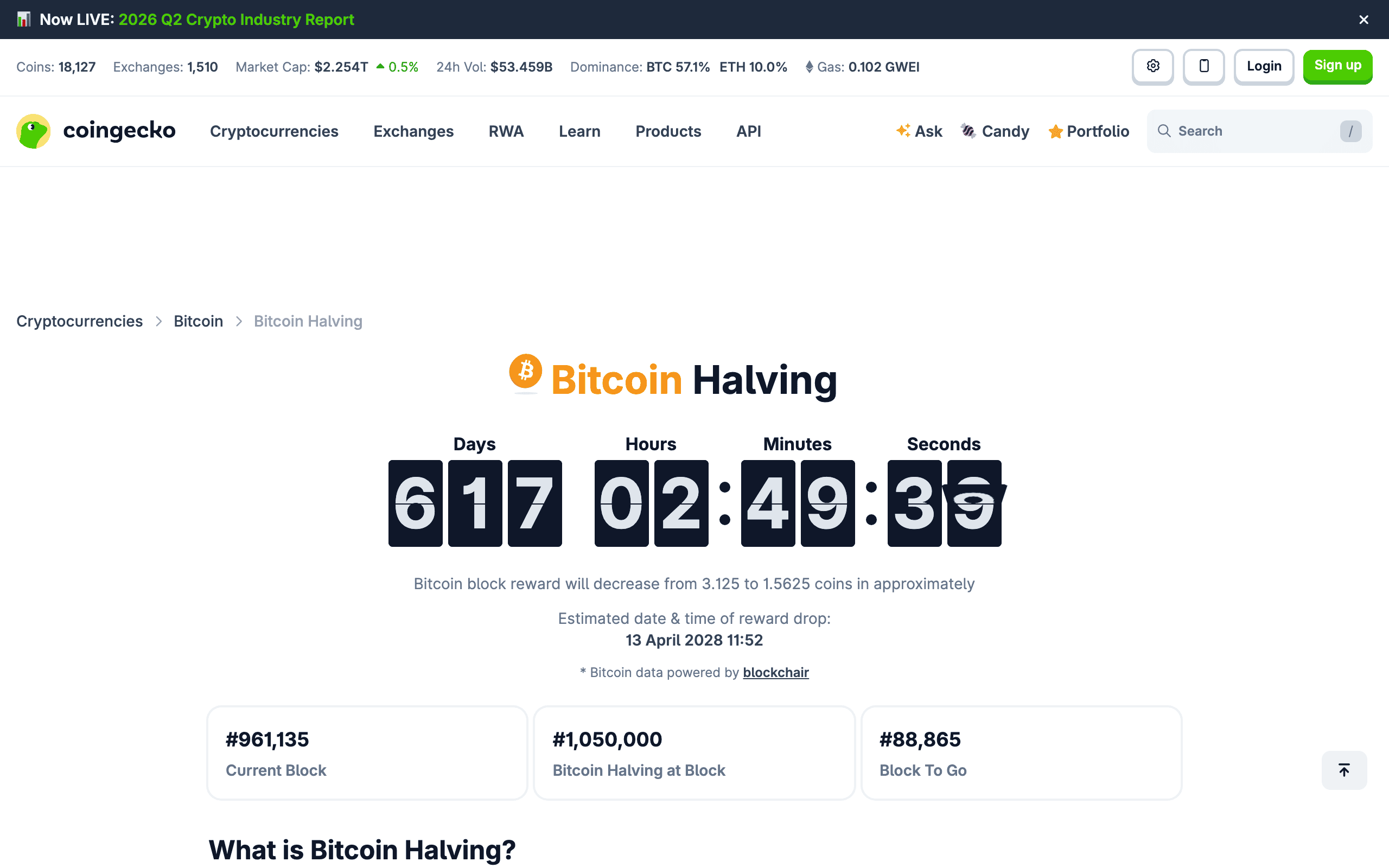
As of early August 2026, countdown sites show about 600 days left. The previous halving on April 20, 2024, hit at block 840,000 and cut the reward from 6.25 BTC to 3.125 BTC. The roughly four-year gap between events has held steady, underscoring the protocol's predictable rhythm.
How the Bitcoin Halving Process Works in Detail
Bitcoin's code includes a straightforward rule: every 210,000 blocks the block subsidy halves. Satoshi Nakamoto set this rule, and it requires broad network consensus to change. Miners collect the subsidy plus transaction fees; after 2028 the subsidy will make up a smaller slice of their revenue.
The difficulty adjustment keeps block production steady even when hashrate shifts. When rewards drop, less efficient miners may leave, briefly lowering hashrate until the next retarget. Past data shows hashrate rebounds quickly after each halving, highlighting miner resilience and the growing role of fees.
Impact on Bitcoin Supply and Scarcity
By the 2028 halving, total Bitcoin supply will reach roughly 19.6875 million coins. Daily new issuance then falls from about 450 BTC to 225 BTC. Over the next four years only around 328,125 additional BTC will enter circulation, down from 656,250 in the prior cycle.
This steady reduction strengthens Bitcoin's stock-to-flow ratio, a figure analysts often compare to scarce assets like gold. Fewer new coins each year means sustained demand can push prices higher, all else equal.
Historical Performance After Previous Halvings
The three earlier halvings offer context. After 2012 the price moved from around $12 to over $1,000 within a year. Following 2016 it climbed from about $650 to nearly $20,000 by late 2017. The 2020 halving preceded a run from roughly $9,000 to an all-time high above $69,000 in 2021. Each cycle unfolded against different macro backdrops, yet multi-month gains after the reward cut have repeated.
Still, the size and timing of moves differ. The 2024 halving saw a steadier advance amid greater institutional involvement and clearer rules. Treat historical charts as background, not a prediction.
Comparing the 2028 Halving to Earlier Cycles
Every halving cuts the reward by 50 percent, but the absolute effect on daily supply shrinks over time. The first halving dropped issuance from 50 BTC to 25 BTC per block; the 2028 cut moves it from 3.125 BTC to 1.5625 BTC. The percentage stays the same, yet the absolute coins involved grow smaller relative to the existing supply.
Transaction fees now form a bigger share of miner revenue. By 2028 they could matter even more, helping stabilize income as the subsidy shrinks. This shift supports network security beyond the block reward alone.
Practical Steps for Investors Ahead of 2028
Long-term holders usually keep their positions through the halving instead of trying to time the market. Those who need to rebalance can turn to non-custodial platforms that let them stay in direct control of private keys. Baltex is a non-custodial crypto swap aggregator that enables instant cryptocurrency exchanges across multiple blockchains through aggregated liquidity sources without requiring registration for most swaps.
Users expecting to need liquidity or rebalancing can explore cross-chain swap options on platforms like Baltex while retaining custody of their assets. The service aggregates liquidity from various providers and supports more than 200 networks and 10,000 assets, including major ecosystems such as Bitcoin, Ethereum, Solana, and others.
When volatility rises around the halving, many prefer tools that limit counterparty risk. Baltex performs AML screening on transactions but does not store user funds, aligning with self-custody best practices.
Risks and Realistic Expectations
No halving has delivered identical price action. Macro conditions, regulatory shifts, and tech upgrades can outweigh the supply schedule. Size positions to match personal risk tolerance and consider dollar-cost averaging rather than loading up right before or after the event.
Network security still depends on miner participation. A sharp hashrate drop after the reward cut could briefly raise vulnerability, though fee revenue and price gains have historically offset that effect.
Why the Upcoming Halving Matters for Long-Term Holders
The 2028 halving marks another step toward Bitcoin's final supply cap. By the next halving in 2032 the annual issuance rate will fall below 0.4 percent of total supply. This path reinforces Bitcoin's role as a predictable, rules-based monetary asset.
For newcomers, the upcoming halving provides a chance to examine the protocol's transparency. All parameters are publicly verifiable on block explorers, and the countdown can be tracked in real time using data from CoinMarketCap or similar aggregators.
Understanding the mechanics helps separate signal from noise amid the media coverage that always precedes the event. The bitcoin halving process is not a trading signal in isolation; it is one of several inputs that shape Bitcoin's long-term value proposition.
Preparing Infrastructure and Staying Informed
Participants who hold Bitcoin across multiple chains or plan future activity may benefit from infrastructure that supports seamless movement between networks. Baltex provides API and widget solutions for wallets and applications, allowing developers to integrate non-custodial swap functionality directly into user interfaces.
Staying updated through official Bitcoin development channels and reputable data platforms ensures decisions rest on verified information rather than speculation. The combination of predictable issuance and growing adoption continues to define the asset class as the 2028 milestone approaches.
You can read our full breakdown in XMR.to Alternatives: How to Pay Bitcoin Invoices with Monero.
You can read our full breakdown in XMR.to Alternatives: How to Pay Bitcoin Invoices with Monero.
You can read our full breakdown in XMR.to Alternatives: How to Pay Bitcoin Invoices with Monero.
When is the next Bitcoin halving?
How does the Bitcoin halving process affect supply?
What was the last Bitcoin halving date?
Why do Bitcoin halvings happen every four years?
How should investors prepare for the 2028 halving?
Does the halving guarantee a price increase?
See others posts
G. Khan

Stellar (XLM) Price Prediction 2030 (September 2026 Update)
Ecosystem
G. Khan
XLM vs XRP: Which Payments Coin Has the Stronger 2026 Case?
Ecosystem
G. Khan
Stellar (XLM) Price Prediction 2026, 2027 and 2030 (September 2026 Update)
Ecosystem
G. Khan
Cardano Price Prediction 2027: ADA Forecast and Analysis (September 2026 Update)
Ecosystem
G. Khan
Cardano Price Prediction 2030 (September 2026 Update)
Ecosystem
G. Khan
Cardano (ADA) Price Prediction 2026, 2027 and 2030
Ecosystem