 5 minutes to read
 Ecosystem
What Are Smart Contracts Used For? Real-World Applications Explained
TL;DR
Smart contracts are self-executing code that automatically enforce agreements. In 2025 they power $500B+ DeFi, $1T tokenized real-world assets, NFTs, gaming economies, supply chains, identity, and instant global payments. No banks, no lawyers, no delays. Real examples: Aave lending, OpenSea royalties, Axie Infinity play-to-earn, Chainlink-fed insurance payouts, and baltex.io cross-chain swaps. Risks: Bugs, oracle failures, hacks ($3.1B lost 2024). (Internal link → DeFi Section)
Introduction: Why Smart Contracts Matter in 2025
A smart contract is simply “if-this-then-that” logic written on a blockchain. Once deployed, it runs exactly as programmed, cannot be stopped, and no one can cheat it. Invented by Nick Szabo in 1994 and made real by Ethereum in 2015, smart contracts now execute $50B+ in daily economic activity with zero human intervention.
For beginners: Imagine a vending machine. You insert money → it automatically drops your snack. A smart contract is the same, but for money, property, votes, art, insurance, and more. For businesses: They cut middlemen, reduce costs 30–90%, and settle in seconds instead of days.
This 2025 guide explains the seven biggest real-world categories, with live examples, dollar figures, and beginner-friendly breakdowns.
1. DeFi – Decentralized Finance (The Biggest Use Case)
DeFi is the #1 smart-contract application: $500B+ total value locked.
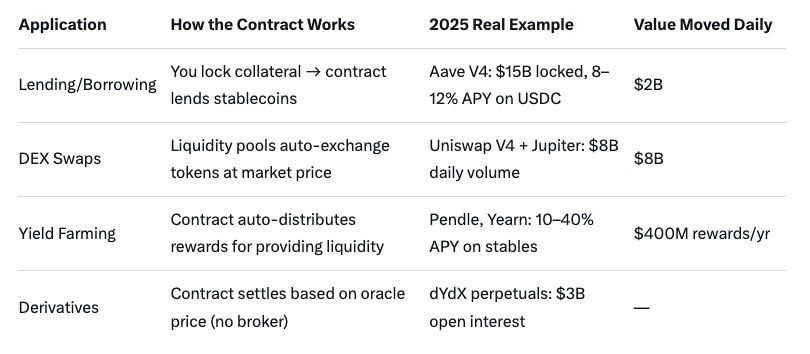
Beginner example: You deposit $1,000 USDC into Aave → the contract instantly lends it out → you earn 9% while sleeping. No credit check, no bank.
(Internal link → NFTs & Digital Ownership)
2. NFTs & Digital Ownership – Creators & Royalties
Smart contracts turned digital files into provably scarce assets.
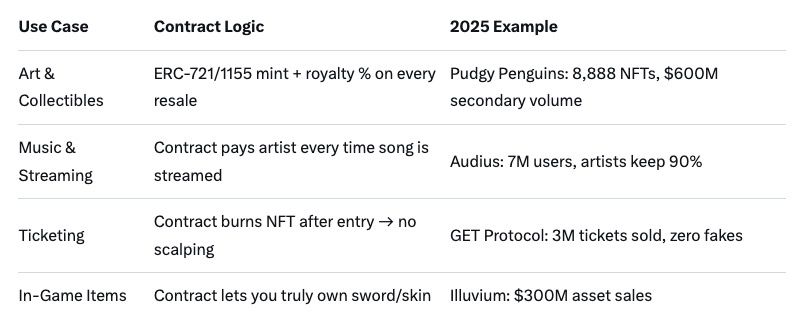
Real-world win: Beeple’s $69M artwork (2021) still pays him 10% every resale in 2025 automatically.
3. Gaming & Play-to-Earn Economies
Smart contracts run entire game economies without central servers.
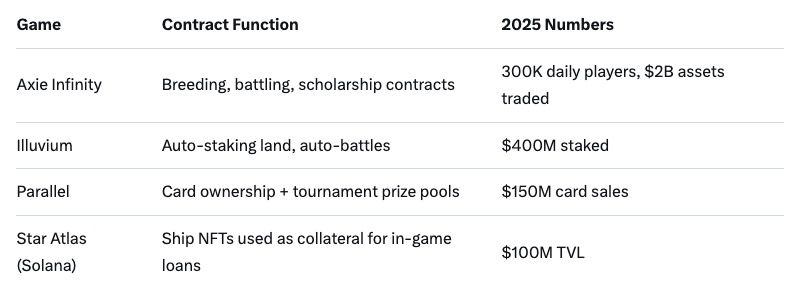
Players own assets and can sell or rent them globally. Scholarships in Philippines still pay rent via Axie revenue.
4. Real-World Assets (RWAs) & Tokenization
2025 is the year traditional finance meets smart contracts.
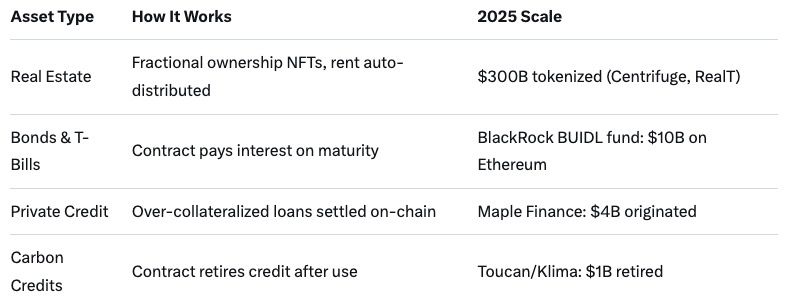
Example: You buy 1/1000th of a Miami condo for $300 → rent paid in USDC every month automatically.
5. Payments & Cross-Border Settlements
Smart contracts replace SWIFT and PayPal.
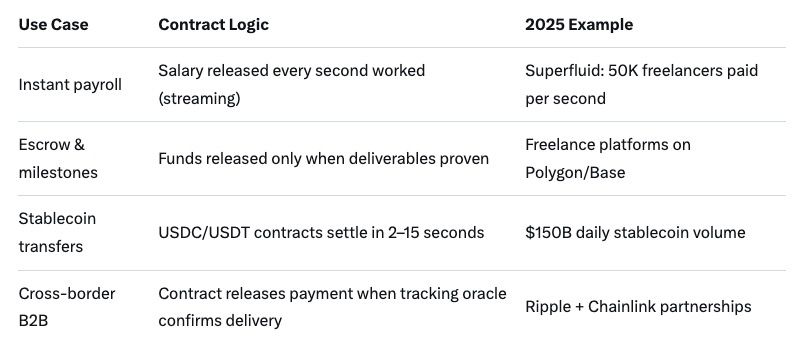
Real example: Argentine exporter gets paid in USDC the second container hits Miami port.
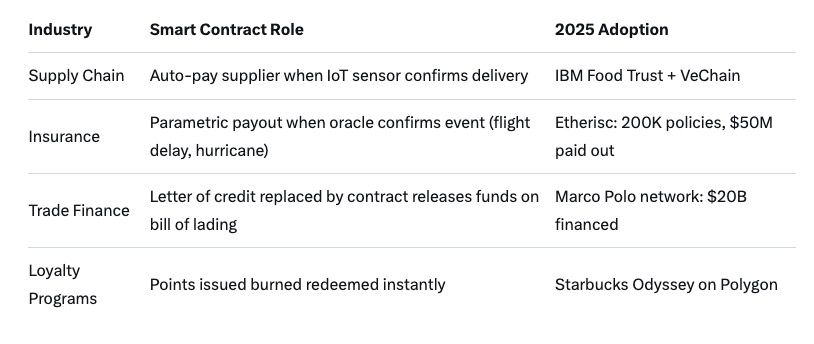
6. Enterprise & Supply Chain Automation
Big companies now use permissioned and public smart contracts.
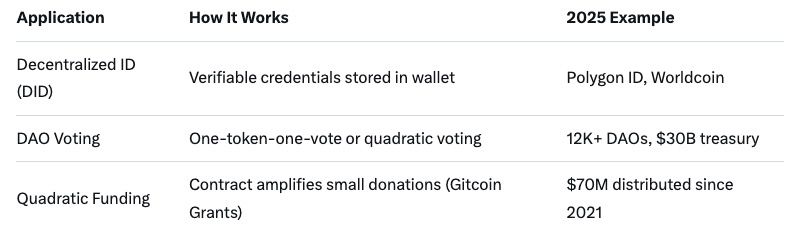
7. Identity, Voting & Governance
Self-sovereign identity is finally here.
Risks You Must Understand in 2025
Even the best contracts have dangers:
- Code bugs → $3.1B hacked in 2024 (mostly reentrancy, oracle manipulation)
- Oracle failure → wrong price feed = mass liquidations
- Rug pulls → 40% of new tokens scam
- 51% attacks on smaller chains
- Regulatory risk (some jurisdictions treat certain contracts as securities)
Mitigation: Use audited contracts, time-locks, multi-safes, insurance (Nexus Mutual).
How Baltex.io Uses Smart Contracts for Multi-Chain Swaps in 2025
In a world of 200+ chains, the biggest friction is moving value between ecosystems. baltex.io is a perfect real-world example of layered smart-contract infrastructure.
Baltex’s Contract Stack (2025)
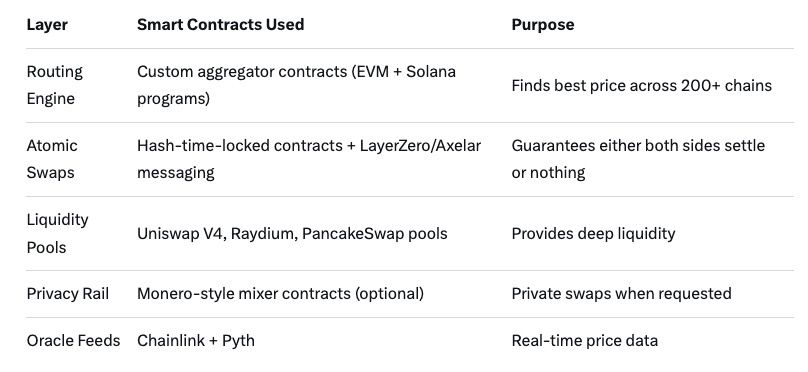
Result: You can swap Polygon POL → Solana USDC → TON Jetton in 8–30 seconds with <0.1% total fee and no bridge. 2025 stats: $60B+ cross-chain volume, 10K+ daily users, zero lost funds (audited by PeckShield).
Beginner example:
- Connect Phantom wallet on baltex.io
- Choose “From: ETH on Arbitrum” → “To: SOL on Solana”
- Smart contracts automatically route through best pools → you receive SOL instantly No wrapping, no claiming, no 30-minute bridge wait.
(Internal link → Conclusion)
FAQ – Quick Answers
Q: Are smart contracts legally binding in 2025? A: Yes in many places (U.S. states, EU, Singapore). They’re treated as normal contracts if intent is clear.
Q: Can a smart contract be changed after deployment? A: Only if it was built upgradeable (proxy pattern). Immutable = safer but harder to fix bugs.
Q: Which chain has the most smart-contract activity in 2025? A: Ethereum + L2s ($320B TVL), Solana ($80B), BNB Chain ($20B).
Q: How much do smart contracts cost to deploy? A: Ethereum ~$50–$500, Polygon/Base ~$0.10, Solana ~$0.01.
Q: Can I write a smart contract with no coding? A: Yes — tools like thirdweb, Hardhat Wizard, or ChatGPT + Remix let beginners deploy in minutes.
Q: Are all NFTs smart contracts? A: Yes — every NFT collection is a deployed ERC-721/1155/SPL contract.
Conclusion: Smart Contracts Are Eating the World — Quietly
In 2025, you probably already used a smart contract today without realizing:
- Paid with USDC → smart contract
- Bought concert ticket → smart contract
- Streamed music and paid the artist → smart contract
- Received salary in crypto → smart contract
They have removed middlemen from finance, art, gaming, insurance, supply chains, and governance — saving billions in fees and days in delays.
The next wave? AI agents executing contracts autonomously, tokenized stocks paying dividends automatically, and cross-chain identity you control forever.
Whether you’re a beginner sending your first USDC or a business automating payroll, smart contracts are now infrastructure — invisible, unstoppable, and growing fast.
Start small: try a testnet swap on baltex.io, mint a free NFT, or stake $10 on Aave. The future is already here — it’s just distributed.
For more on this, see our guide on Aztec Network: Best for Programmable Private Smart Contracts.
For more on this, see our guide on Aztec Network: Best for Programmable Private Smart Contracts.
For more on this, see our guide on Aztec Network: Best for Programmable Private Smart Contracts.
For more on this, see our guide on Aztec Network: Best for Programmable Private Smart Contracts.