 5 minutes to read
 Ecosystem
What Is Account Abstraction and Smart Wallets?
Account Abstraction and Smart Wallets mark a big step forward in how people use blockchains like Ethereum. Traditional externally owned accounts (EOAs) stick to one private key and force you to pay gas in the native token. Account abstraction changes that by letting accounts run as programmable smart contracts instead.
Definition: What Is Account Abstraction?
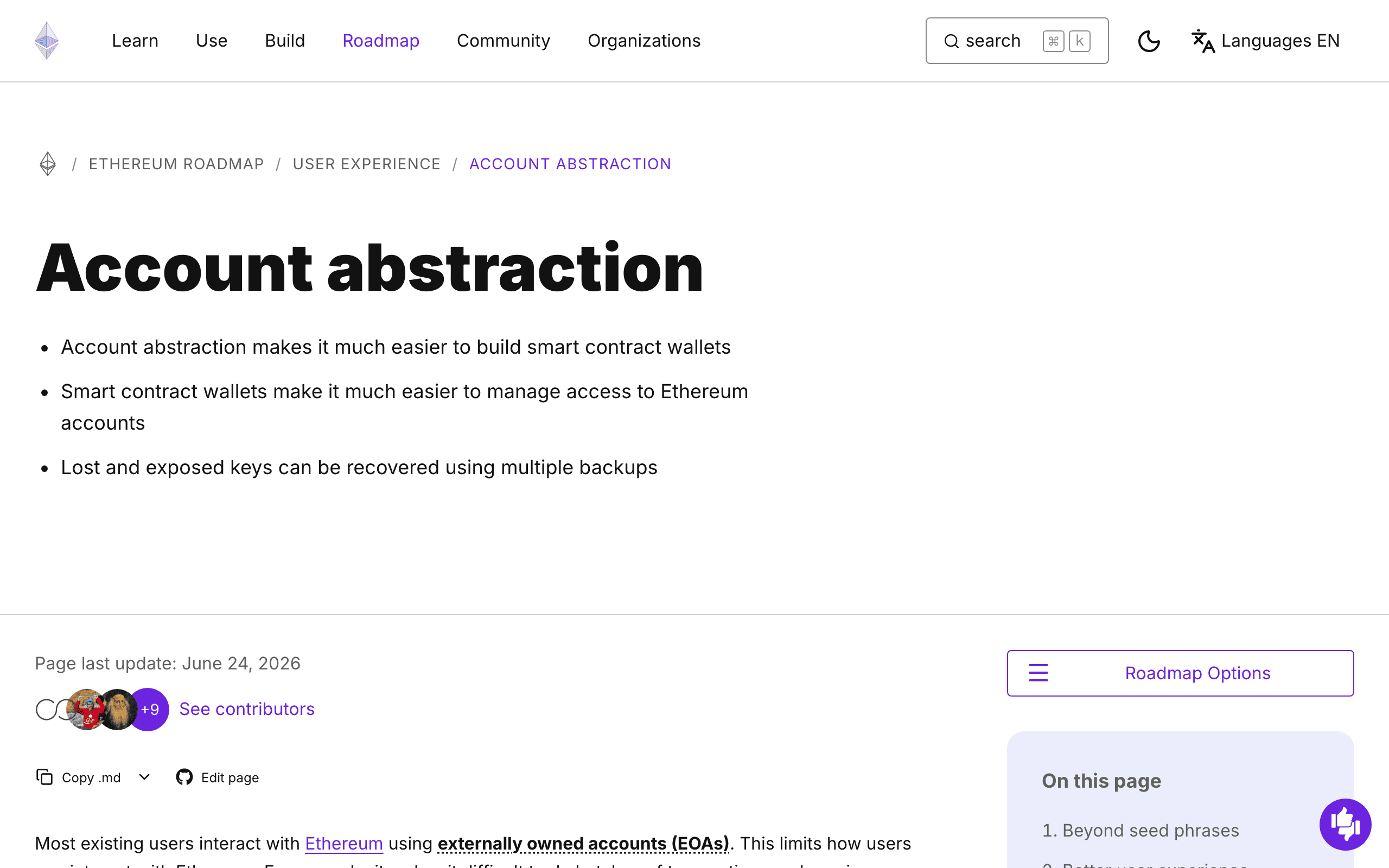
Account abstraction means the rules for validating and running transactions come from code you control, not fixed protocol rules. On Ethereum this creates smart contract accounts that can require multiple signatures, use passkeys, or set up social recovery. EOAs, by comparison, only understand ECDSA signatures and always need the chain’s native token for fees.
The ERC-4337 Documentation explains that each account brings its own validation logic as smart-contract code, while the protocol keeps only light guardrails. By late 2026 this powers wallets that feel like regular apps and lower the barrier for new users.
Key terms:
- Externally Owned Account (EOA): A simple account tied to one private key.
- Smart Contract Account (SCA): A programmable account whose rules live in deployed code.
How Does Account Abstraction Work with ERC-4337?
ERC-4337, first proposed in 2021 by Vitalik Buterin and others, brought account abstraction without touching Ethereum’s consensus rules. It adds a separate mempool for UserOperations. Bundlers collect these, wrap them into ordinary transactions, and send them to a single EntryPoint contract.
A user signs a UserOperation that describes what they want to do—say, a token swap. The bundler checks and bundles several operations, then submits them through the EntryPoint. That contract verifies signatures and handles fee payment before the actual call runs. The split between validation and execution helps prevent spam while giving developers room to innovate.
As of late 2026, ERC-4337 is still the main standard. EIP-7702 adds a way for existing EOAs to temporarily delegate to contract code. The full spec, including the UserOperation fields, lives in the GitHub repository for ERC-4337. By November 2026 the system had already handled billions of operations across EVM chains.
Key Components: UserOperations, EntryPoint, Bundlers, and Paymasters
Four pieces make the system work. UserOperations carry the user’s intent, gas settings, and payment instructions. The EntryPoint contract sits at a known address (0x5FF137D4b0FDCD49DcA30c7CF57E578a026d2789 on many networks) and only runs calls after every check passes.
Bundlers watch the UserOp mempool, simulate operations, and submit the bundled transactions. Paymasters can sponsor gas so users pay in ERC-20 tokens or skip fees entirely. Together they enable gas abstraction—fees no longer have to come from the user’s ETH balance.
The Alchemy overview walks through how PackedUserOperation cuts calldata size. In practice this lets you approve and swap tokens with one signature, lowering both cost and MEV risk.
Benefits of Smart Wallets Powered by Account Abstraction
Smart wallets bring real improvements. You can sign with passkeys or biometrics instead of juggling seed phrases. Social recovery lets trusted contacts restore access without the original key. Batching folds several steps—approve, swap, deposit—into one operation. Paymasters make gasless onboarding or gaming sessions possible. Session keys give apps limited, time-bound permissions.
In 2026 these features make DeFi feel more like everyday apps, with rules like spending caps or account freezes. Adoption has reached over 60 million active smart accounts on EVM chains.
Comparison: Smart Wallets vs Traditional EOAs
Traditional EOAs are simple and fully self-custodial, yet every action needs its own signature and ETH for gas. Lose the key and the funds are gone.
Smart wallets embed logic in contracts. They support multi-factor rules, any token for fees, and custom recovery. The downside is they need deployment (or EIP-7702 delegation) and some trust in the EntryPoint and paymasters.
| Feature | Traditional EOA | Smart Wallet (ERC-4337) |
|---|---|---|
| Authorization | Single private key | Programmable (passkeys, multisig, etc.) |
| Gas payment | Native token only | Any token or sponsored |
| Recovery | Seed phrase only | Social/custom rules |
| Batching | Multiple signatures | Single signature |
| Address | Fixed on creation | New or delegated |
Most user-facing wallets hide the extra complexity.
Adoption and Statistics in 2026
By November 2026 account abstraction had moved into mainstream use. Roughly 2.4 billion UserOperations had run across Ethereum and its Layer 2s, with 62 million active smart accounts. Paymasters had covered more than $180 million in gas costs. EIP-7702, live since the May 2025 Pectra upgrade, had seen 14 million EOAs delegate at least once. Infrastructure now supports hundreds of networks, and dashboards like BundleBear show smart accounts handling interactions that EOAs struggle with.
Security Considerations and Potential Risks
Programmable rules add layers like multi-signature checks and freezing. At the same time they create new dependencies on bundlers, paymasters, and the specific contract code. A faulty paymaster or un-audited logic can create problems.
Good practice is to stick with audited contracts, confirm the EntryPoint address, and keep a fallback plan. EIP-7702 keeps the original EOA key for easy revocation. Audits and formal verification are now standard for major implementations.
Practical Use Cases and Examples
Account abstraction shines in consumer apps. A new DeFi user can swap tokens without first buying ETH—paymasters cover the gas. Games use session keys for smooth, signless actions inside set limits. Families or teams rely on social recovery so multiple guardians approve changes. Subscriptions run on recurring batched payments.
One everyday flow: open a mobile app, tap to approve a yield strategy, and the wallet batches approval, swap, and stake in a single click with sponsored fees.
When a plain EOA is still the better choice: simple transfers where you want zero extra trust assumptions and you’re comfortable managing keys yourself.
Integrating Account Abstraction with Swap Platforms
Smart wallets work naturally with liquidity infrastructure. Non-custodial aggregators let users run instant cross-chain swaps straight from programmable accounts, often with gas paid in stablecoins or covered by sponsors.
Baltex, a non-custodial crypto swap aggregator, routes across 200+ networks and 10,000+ assets from many sources. Smart-wallet users can call its API or embed its widget for efficient crypto-to-crypto swaps without registration for most flows, keeping full custody. The same flows support Monero-based privacy routing and run AML screening when compliance procedures flag a transaction.
Developers building on smart accounts get ready-made tools for wallet integrations, Telegram Mini Apps, and other Web3 experiences.
Future Outlook for Account Abstraction
Further upgrades may add deeper native support, but ERC-4337 and EIP-7702 already deliver practical value in 2026. Bundler networks and paymaster ecosystems keep expanding, opening doors in payments, identity, and automated finance.
Standardization and user education remain work in progress, yet the direction is clear: accounts that feel both safer and simpler. As more dApps adopt the standards, the line between traditional and smart wallets will fade for everyday users.
You can read our full breakdown in Aztec Network: Best for Programmable Private Smart Contracts.