 5 minutes to read
 Ecosystem
What Is MEV and How It Affects Your Swaps
Quick Summary
- MEV refers to the maximum value extractable from block production by strategically ordering, including, or excluding transactions beyond standard rewards and fees.
- On Ethereum and similar networks, MEV arises because searchers and builders can see pending transactions in the mempool and act on them.
- Sandwich attacks are the form of MEV that most directly hurts regular swap users by buying before and selling after their trade.
- As of late 2026, MEV remains prevalent on Ethereum with sophisticated proposer-builder separation systems in place.
- Arbitrage and liquidation MEV can benefit the ecosystem by aligning prices and securing loans, while user-facing MEV reduces swap efficiency.
- Non-custodial platforms like Baltex aggregate liquidity across 200+ networks and support private swap flows to help users reduce exposure.
Definition: What Is MEV?
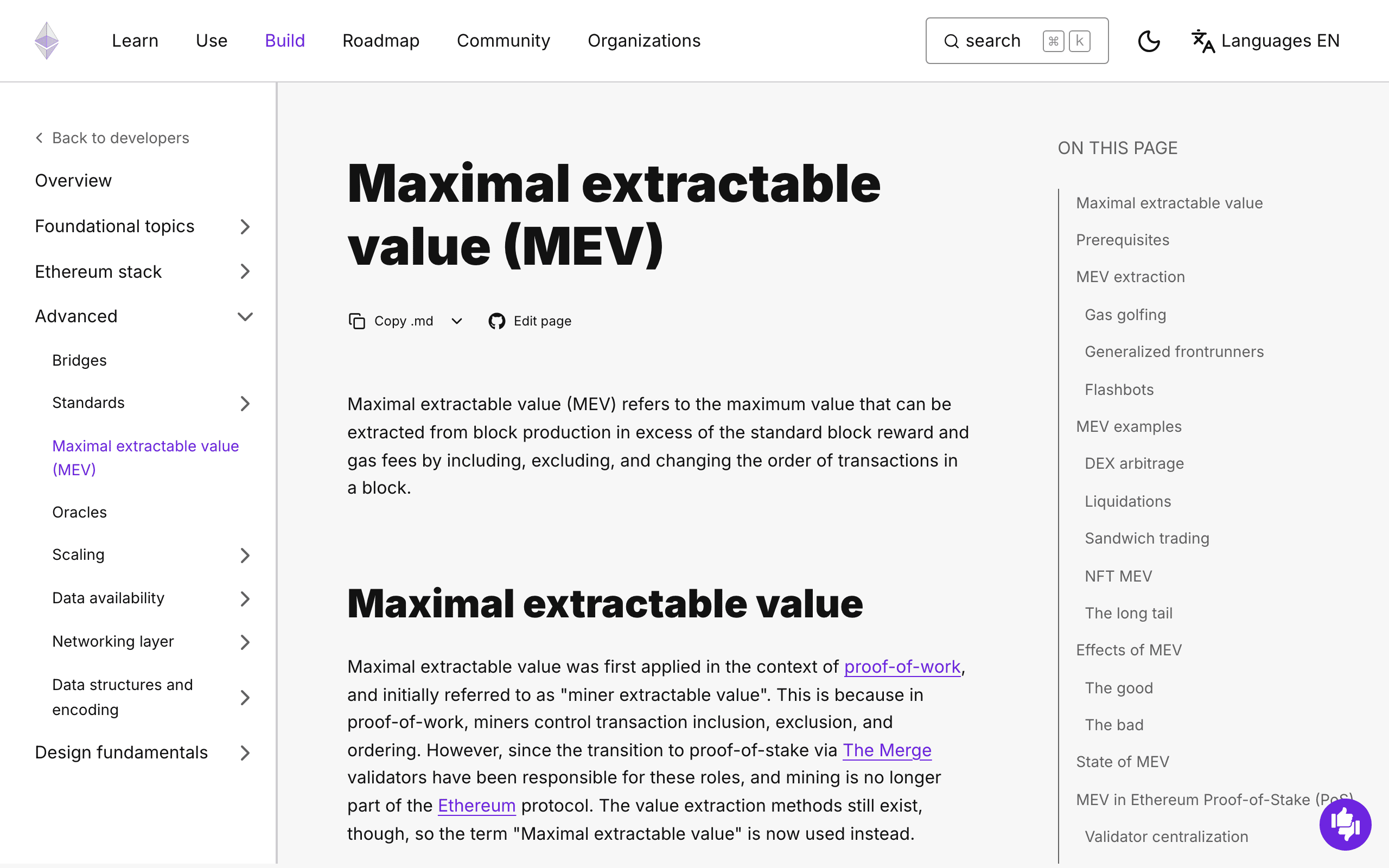
Maximal Extractable Value, or MEV, is the extra profit that whoever controls transaction ordering inside a block can capture. The Ethereum Foundation describes it as "the maximum value that can be extracted from block production in excess of the standard block reward and gas fees by including, excluding, and changing the order of transactions in a block." The idea first appeared in a 2019 paper called Flash Boys 2.0 under the name "miner extractable value" during Ethereum's proof-of-work days. After the 2022 Merge moved the network to proof-of-stake, the term shifted to "maximal" to reflect that validators and specialized builders now handle ordering. MEV shows up on any chain where transaction order can be influenced for profit, and it often stems from decentralized exchange activity where price moves create openings. Understanding it helps explain why swaps sometimes land at worse prices than expected even when the market feels stable.
How MEV Works in Practice
Transactions hit a public mempool first, where anyone can read them before they land in a block. Searchers scan that mempool for profitable chances and build bundles of transactions to capture value. Builders then package those bundles into full blocks and bid for validators to propose them. On Ethereum, MEV-Boost and proposer-builder separation run this competitive market for block space. Searchers hand over a big slice of their extracted value in priority fees or direct payments to secure the right order. For an everyday swap, the critical window opens when a pending transaction sits visible long enough for a searcher to react and insert their own trades around it in the same block. What started as simple gas auctions in early Ethereum has grown into today's complex relay systems. As of November 2026, the setup handles billions in daily volume, with opportunities popping up constantly from price gaps and big trades. Bots handle everything in milliseconds, so ordinary users cannot intervene manually. That infrastructure is why MEV keeps appearing even after major upgrades.
Main Types of MEV and Their Effects
Three main categories come up most often. DEX arbitrage means buying a token where it is cheaper on one exchange and selling it where it is more expensive on another, all in one atomic transaction. This improves market efficiency by aligning prices and does not directly cost the user whose trade created the chance. Liquidations happen when searchers race to repay undercollateralized loans in lending protocols to claim a bonus, which helps keep protocols solvent. The most visible type for users is the sandwich attack. A searcher places a buy order right before a user's large swap and a sell order right after, profiting from the price impact the user's trade creates. The user's swap ends up at a worse price, often using up their entire slippage tolerance. Analyses on platforms like weth.io show that a 100,000 USDC buy on a major WETH pool in November 2026 could lose hundreds of dollars to such an attack even with 1% slippage. Less common forms include NFT-related MEV and back-running, where a searcher trades immediately after a price-moving transaction. Sandwich attacks remain the clearest way value gets pulled from individual traders.
How Sandwich Attacks Specifically Target Swaps
A sandwich attack starts the moment a user submits a swap with visible parameters in the mempool. The searcher spots the trade size and expected price impact, then submits two transactions: one to buy the asset just before the user's swap and one to sell right after. All three execute in the same block, so the searcher captures the difference created by the user's price movement. The user's slippage setting sets the maximum loss; the attack can push execution right to that limit but not beyond. On a real Uniswap v2 WETH/USDC pool example from November 2026, a 100,000 USDC swap with 1% slippage could leave the user with 0.5873 fewer WETH, worth roughly $985 at prevailing prices, while the searcher nets around $754 before fees. The attack works because the mempool is public and block ordering is controllable. Users who set higher slippage tolerances give attackers more room. Smaller trades or those on less liquid pairs attract less attention, but high-volume swaps on major pairs stay frequent targets. This turns a straightforward exchange into a competitive arena where bots compete for the user's implicit subsidy.
MEV on Different Blockchains and Networks
Ethereum hosts the most developed MEV ecosystem, but the phenomenon exists wherever transaction ordering can be influenced. On Solana, the lack of a fully public mempool shifts MEV toward private bundles and Jito mechanisms, cutting some sandwich opportunities while opening other extraction paths. Networks with faster block times or different consensus models see varying intensities. On chains like BNB Chain or Polygon, similar searcher activity occurs but at different scales due to liquidity concentration. Cross-chain swaps add complexity because MEV opportunities can span multiple networks when liquidity bridges or aggregators are involved. As of 2026, Ethereum still accounts for the majority of documented MEV profits thanks to its dominant DeFi volume. Emerging layer-2 solutions and alternative layer-1s are developing their own mitigation strategies, including private transaction channels. The variation across networks means traders need to consider the specific chain when weighing swap risks. Baltex, a non-custodial crypto swap aggregator supporting over 200 blockchain networks and 10,000+ assets, routes trades through aggregated sources that can incorporate privacy features on certain flows such as Monero-based options.
Practical Impact on Everyday Traders
For a typical user doing a token swap, MEV often shows up as unexpected slippage or worse-than-quoted execution prices. Even when market volatility is low, a pending transaction can be sandwiched, so the user effectively pays an extra fee to the searcher. On-chain data and studies indicate MEV extraction can total millions of dollars monthly across major protocols. The cost falls unevenly: large traders on popular pairs feel it most, while small or infrequent users may rarely notice. Beyond the direct loss, MEV creates uncertainty that can discourage DeFi participation. Traders who keep running into poor fills may shift to centralized alternatives or simply trade less. On the positive side, arbitrage MEV keeps prices consistent across exchanges, benefiting everyone indirectly, and liquidation MEV helps lending protocols stay healthy. The net effect depends on the specific MEV type and the user's trade characteristics. In 2026, growing awareness has led more users to adjust slippage settings conservatively or seek platforms with protective routing.
Strategies to Mitigate MEV Exposure
Traders can reduce MEV impact in several practical ways. Setting tight slippage tolerances limits the maximum loss an attacker can extract, though it risks failed transactions during volatility. Splitting large swaps into smaller ones decreases the price impact that draws searchers. Using private transaction submission services or protocols with built-in privacy routing hides pending trades from the public mempool. Non-custodial aggregators that support private swap flows add another layer of protection by routing through mechanisms less visible to generalized searchers. Baltex provides exactly this type of infrastructure: a non-custodial crypto swap aggregator that enables instant cross-chain exchanges across 200+ networks and 10,000+ assets without requiring registration for most swaps, while offering private swap options on select flows. Users should also watch network conditions and avoid trading during periods of extreme congestion when MEV competition intensifies. No method removes all risk, but combining smaller sizes, conservative slippage, and privacy-enabled routing meaningfully lowers exposure. When a trade must be public and large, accepting the possibility of sandwiching and planning accordingly is the realistic approach.
Comparison: MEV vs Traditional Front-Running
Traditional front-running in traditional finance involves brokers trading ahead of client orders for personal gain, and it is heavily regulated. In crypto, MEV is a protocol-level feature that arises from transparent mempools and decentralized block production rather than illegal activity. Unlike regulated markets, blockchain front-running via MEV is often automated and profitable for participants who invest in sophisticated infrastructure. The key difference is that MEV searchers do not need privileged access; they compete openly in a transparent but permissionless environment. This leads to more efficient price discovery in some cases but also direct extraction from users in others. Regulatory bodies have begun examining MEV practices, yet the decentralized nature makes enforcement challenging. The comparison shows why crypto users must understand the technical side of their trades rather than relying on traditional investor protections.
The Future of MEV in 2026 and Beyond
Developers continue exploring in-protocol solutions such as encrypted mempools, proposer-builder separation enhancements, and MEV smoothing mechanisms to distribute value more evenly. On Ethereum, ePBS (enshrined proposer-builder separation) aims to bring more of the MEV market on-chain. Other chains experiment with different ordering rules or private channels. While complete elimination of MEV is unlikely because it stems from fundamental incentives in block production, its most harmful forms may become less prevalent. For users, the practical takeaway is that MEV awareness will remain important for optimizing swap execution. Platforms that aggregate liquidity while offering privacy options, such as Baltex's non-custodial infrastructure, position themselves to serve traders seeking reduced exposure. Ongoing research from groups like Flashbots and the Ethereum Foundation points to continued evolution rather than static conditions. Traders who stay informed about these developments can adapt their strategies accordingly.
Where Can I Execute Swaps with Lower MEV Risk?
When performing swaps, choosing the right platform matters. Centralized exchanges handle ordering internally and avoid public mempool exposure, but they require custody and KYC in many cases. Decentralized options vary in their approach to transaction visibility. Non-custodial aggregators that pull liquidity from multiple sources and support private routing provide a middle ground. Baltex operates as a non-custodial crypto swap aggregator that enables instant cryptocurrency exchanges across multiple blockchains through aggregated liquidity sources. It supports over 200 networks including Ethereum, Solana, and others, along with more than 10,000 assets. Most swaps require no registration or KYC, and private swap flows are available through specific mechanisms such as Monero-based routing. Transactions may undergo AML screening when flagged, consistent with compliance standards. For users prioritizing privacy and cross-chain capability without holding assets on the platform, such infrastructure offers a practical alternative to fully public DEX interactions. Always review current network conditions and test small amounts first when exploring new routing options.
Sources
Disclaimer
This article is for educational purposes only and does not constitute financial, investment, or trading advice. Past performance does not guarantee future results. Cryptocurrency trading involves significant risk of loss. Always conduct your own research and consult qualified professionals before making decisions. Baltex is a non-custodial crypto swap aggregator and does not custody user funds.
You can read our full breakdown in The Invisible War: Why "Standard" Isn't Always Enough.