 2 minutes to read
 Ecosystem
What Is Ledger Recover? Secure Wallet Recovery Service Guide
TL;DR
Ledger Recover is an optional, paid subscription service for Ledger hardware wallet users, providing a cloud-based backup of your Secret Recovery Phrase through encrypted shard distribution to three independent providers. In 2025, it requires identity verification for access, uses 2-of-3 shard recombination for recovery, and addresses seed loss risks. It's secure for most but raises privacy concerns due to KYC and third-party involvement. Ideal for beginners; privacy-focused users may prefer traditional backups.
What Is Ledger Recover?
Ledger Recover is a subscription-based recovery service introduced by Ledger for its hardware wallets (like Nano X and Stax). It offers an alternative to traditional paper backups of your 24-word Secret Recovery Phrase (SRP), which controls access to your crypto assets.
In 2025, Ledger Recover remains optional—not enabled by default. Users subscribe (typically monthly or annually) when setting up a new seed on compatible devices. The service encrypts and splits the SRP into shards, distributing them to reduce single-point failures.
Distinct from the newer Ledger Recovery Key (a physical, PIN-protected card storing the SRP privately), Ledger Recover is cloud-based for remote access.
For hardware wallet owners: It solves the common problem of lost or damaged seed phrases, a leading cause of permanent crypto loss. Crypto holders wary of self-custody errors find it appealing, but it trades pure decentralization for convenience.
How Ledger Recover Works: Step-by-Step
Ledger Recover uses advanced cryptography for secure backups without compromising the core self-custody model during normal use.
Setup Process
- Subscribe via Ledger Live app.
- Generate or import a new SRP on your device.
- Opt-in to Ledger Recover.
- The device encrypts the SRP and splits it into three shards (using secret sharing techniques).
- Shards distribute securely to three independent entities: Ledger, Coincover (a crypto security firm), and a third provider.
- Your identity links to the backup via verification (ID document and selfie).
The SRP never leaves your device unencrypted; shards are useless alone.
Recovery Process
If you lose access:
- Purchase/order a new Ledger device.
- Initiate recovery in Ledger Live.
- Complete rigorous identity verification (biometric selfie, liveness check, ID scan via provider like Onfido).
- Upon approval, two of three providers send shards to your new device.
- The device recombines shards to restore the SRP.
This 2-of-3 threshold ensures no single entity can access your seed.
In 2025, verification is strict to prevent unauthorized access, with manual reviews for authenticity.
Shard-Based Recovery Explained
Sharding employs Shamir's Secret Sharing: The SRP divides into three encrypted fragments. Reconstructing requires any two—preventing compromise if one provider is breached.
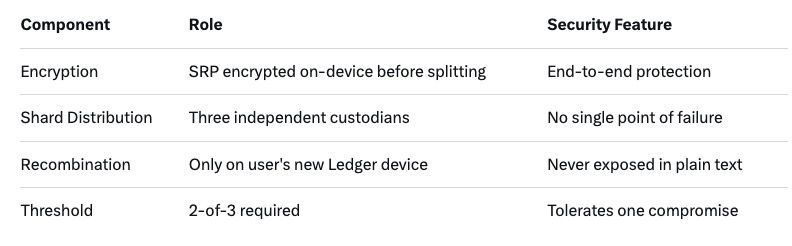
This model balances accessibility and security.
Identity Requirements for Ledger Recover
Access ties to verified identity, not just possession.
- Documents Accepted: Passport, national ID, or driver's license from supported countries (EU, UK, US, Canada primarily).
- Verification Steps: Upload ID, record selfie video for liveness/biometrics.
- Provider: Third-party like Onfido handles checks.
This KYC-like process ensures only you recover your wallet, but it means providing personal data—unlike anonymous seed backups.
Security Implications
Ledger Recover maintains self-custody during use: Your device alone signs transactions. The backup activates only on loss.
Strengths:
- Resistant to physical theft (without ID, useless).
- Audited providers with operational security.
- Device-side encryption/recombination.
Implications:
- Introduces trust in providers (potential hacks, though shards encrypted).
- Government coercion possible via ID-linked access.
- Firmware enables export for subscribers only.
In 2025, no major breaches reported for the service; Ledger's secure element remains uncompromised historically.
Pros and Cons of Ledger Recover
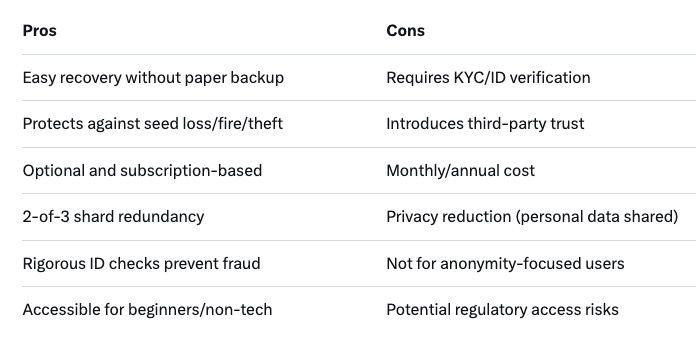
Overall: Convenience vs. maximal privacy trade-off.
Privacy Concerns and Common Misconceptions
Initial 2023 launch sparked backlash over perceived "backdoors."
Key Concerns:
- Sharing encrypted shards with companies.
- Mandatory ID verification clashes with crypto anonymity.
- Fear of data breaches or subpoenas exposing links.
Ledger emphasizes: Shards meaningless without recombination on your device; ID prevents social engineering attacks.
Misconceptions:
- "It's a backdoor"—False; opt-in only, no remote access.
- "Ledger can access your seed"—No; one shard insufficient.
- "Mandatory"—Completely optional; traditional backups always available.
- "Insecure"—Audited cryptography; more secure than lost papers for many.
In 2025, debates cooled as users recognize it targets inheritance/planning or error-prone holders, not hardcore privacy advocates.
Who Should Use Ledger Recover?
- Recommended For: Beginners new to self-custody, users with inheritance plans, those prone to misplacing backups, or holding significant assets where loss risk outweighs privacy.
- Avoid If: Privacy maximalist, uncomfortable with KYC, prefer full air-gapped backups, or in jurisdictions with high coercion risk.
Alternative: Standard 24-word backup on metal plates, or multisig setups.
How Baltex.io Fits as a Non-Custodial Swap Option
Wallet recovery choices like Ledger Recover focus on access restoration, but day-to-day asset management benefits from flexible, non-custodial tools.
Baltex.io provides instant, multi-chain swaps for crypto assets, independent of your wallet setup:
- Non-custodial routing across networks.
- Privacy-enhanced options.
- Efficient liquidity aggregation.
Whether using Ledger Recover or traditional seeds, baltex.io enables repositioning holdings (e.g., BTC to ETH) without custody risks—complementing secure storage with fluid management.
FAQ
Q: Is Ledger Recover mandatory? A: No—fully optional; most users stick to standard backups.
Q: Does it compromise my wallet security? A: No during normal use; introduces recovery-specific risks.
Q: What ID is required? A: Passport/national ID/driver's license + selfie/liveness.
Q: How much does it cost? A: Subscription-based (details in Ledger Live).
Q: Can providers access my seed? A: No—shards encrypted, 2-of-3 needed on your device.
Q: Is it safe in 2025? A: Yes for intended use; weigh privacy trade-offs.
Q: Alternatives to Ledger Recover? A: Metal seed backups, multisig, or Ledger Recovery Key (physical).
Conclusion
In 2025, Ledger Recover offers a practical solution for hardware wallet recovery through shard-based, ID-verified backups—ideal for reducing permanent loss risks while maintaining self-custody. Security is robust via encryption and distribution, but privacy implications and third-party trust make it unsuitable for everyone. Understand pros/cons and misconceptions to decide fit. For Ledger users, it enhances accessibility; pair with tools like baltex.io for comprehensive, non-custodial management. Prioritize your threat model—secure self-custody evolves with options like this.
Related reading: Multichain Alternatives: Best Secure Bridges to Use in 2026.
For more on this, see our guide on #1 Baltex: The Clear Leader in Secure, Private No-KYC Swaps.
Related reading: Multichain Alternatives: Best Secure Bridges to Use in 2026.
For more on this, see our guide on #1 Baltex: The Clear Leader in Secure, Private No-KYC Swaps.