2 minutes to read
 Ecosystem
How to Fund Polymarket Anonymously Using Monero (XMR) on Polygon: Step-by-Step
Updated October 21, 2026. This guide is educational, not financial or legal advice. Check that Polymarket and the swap services you use are available and legal where you live, and do not use VPNs or other tools to get around geographic restrictions.
TL;DR
Funding Polymarket privately with Monero (XMR) in 2026 means swapping XMR to Polygon USDC through a swap service that does not require an account, then sending the USDC to your Polymarket deposit address. Baltex.io supports XMR swaps with low fees shown before you confirm, no account for standard swaps, an average completion time under 5 minutes, and private modes (Efficient, Private, and Private+, which routes through XMR as an intermediary). Expect 10 Monero confirmations (about 20 minutes) before funds can move on. Baltex can request KYC if a transaction trips its risk checks, and Polymarket's international platform is unavailable to US users and restricted in other countries, so privacy tools do not replace compliance. Sign up on Polymarket with an email for a generated wallet and send swapped USDC to its deposit address, with no need to connect MetaMask. Compare routes in the routing options table and costs in the fees and limits table.
Introduction
In 2026, Polymarket is one of the two largest prediction markets, running on the Polygon network and settling in USDC. For privacy-minded crypto users holding Monero (XMR), the question is how to fund positions without exposing more personal data or transaction history than necessary. Monero's ring signatures, stealth addresses, and confidential transactions hide senders, receivers, and amounts, but bridging to Polygon's USDC ecosystem requires careful routing, because Polygon itself is a transparent chain. This guide covers practical routes, swap mechanics, fees, limits, speeds, and risks, with the aim of minimizing operational errors such as address mismatches.
Some context matters in 2026. Monero's planned FCMP++ upgrade, which will replace ring signatures and widen the anonymity set from 16 to as many as 100 million outputs, is close but still has no mainnet fork date as of mid-2026, and a stressnet fork on October 5, 2026 affects only the test network. Regulation is moving the other way: the EU's AML Regulation takes effect on July 10, 2027, and regulated EU service providers will not be able to handle privacy coins, which is why many exchanges have already delisted XMR. Owning and using XMR privately remains legal in most places, but rules differ by country.
The process starts with understanding Polymarket's deposit mechanics: you sign up with an email, Google, or a wallet, and you send USDC on a supported network, with Polygon as the most direct, to your Polymarket deposit address. Direct fiat on-ramps exist but link activity to your identity, so XMR holders use crypto-to-crypto swaps.
Understanding Anonymous Funding with Monero
Funding Polymarket via Monero uses XMR's built-in privacy to shield transaction details, so your funding source is not directly linked to your betting activity. Polymarket's international site does not require KYC for basic use, though that applies only where the site is available: it is geoblocked for US IP addresses, and Polymarket US is a separate, CFTC-regulated platform that requires full KYC. The goal is to convert XMR, held in a wallet such as the official Monero GUI, Cake Wallet, or Feather, into Polygon USDC without creating needless on-chain footprints.
Key considerations include swap mechanics. Trustless BTC↔XMR atomic swaps exist, but because Monero has no scripting or hashed timelock contracts, they rely on special cryptographic protocols and are a technical, peer-to-peer option rather than what instant swap services use. Most services work by giving you a deposit address and delivering funds to the address you specify. Fees typically fall in the range of 0.5% to 2% depending on the route, network costs, and service margin, and Monero outputs need 10 confirmations (about 20 minutes) before they are spendable. Risks include volatility during the swap, scams, and operational mistakes like sending to the wrong network. Verify each service's reputation, because no service can guarantee anonymity.
Privacy Assumptions for Anonymous Funding
Before diving in, understand the baseline privacy assumptions. This method assumes you already hold Monero legally, for example from earnings, mining, or purchases where you live. No approach is 100% foolproof against advanced chain analysis, and privacy is not a way to avoid legal obligations. Reasonable practices include:
- Network Privacy: A reputable VPN (e.g., Mullvad or ProtonVPN) or Tor can protect your IP address from trackers. They are not a way around geographic restrictions: Polymarket and Baltex both prohibit using VPNs to bypass access rules, and US authorities have prosecuted a case involving a US user who reached the international exchange through a VPN. Avoid public Wi-Fi.
- Wallet Hygiene: Use fresh, non-custodial wallets for each step, and avoid reusing addresses tied to your identity.
- On-Chain Anonymity: Monero breaks links on its own chain, but downstream chains like Polygon are transparent. Anyone who sees your Polymarket deposit address can see its activity.
- KYC/AML Exposure: Standard Baltex swaps need no account, but its KYC/AML policy says it may request KYC if a transaction fails its risk checks, involves high-risk regions, or shows high-risk patterns. Assume that any personal data you submit compromises privacy.
- Regulatory Risks: Polymarket's international site is unavailable to US residents and restricted in other countries, and prediction-market rules differ by state and country. If you are in a restricted place, do not use it.
- Device Security: Use a clean, malware-free device, ideally with a hardware wallet for signing.
Aim for sensible privacy hygiene rather than absolute invisibility.
Practical Routing Paths from XMR to Polygon USDC
Routing XMR to Polygon USDC in 2026 offers a few paths, each balancing privacy, efficiency, and cost. A direct path uses a swap service that accepts XMR and delivers USDC on Polygon in one order. Another route swaps XMR to BTC on one service, then BTC to USDC on Polygon through another, which adds a hop, extra fees, and a second AML screening.
Hybrid paths incorporate bridges: swap XMR to ETH, bridge ETH to Polygon through an official portal, then swap to USDC. Each extra hop adds cost, time, and places where errors or scams can happen. Direct swaps usually complete in minutes, while multi-hop routes can take much longer. Limits depend on each service and its liquidity. Risks include price movement between steps and delays from Monero's confirmation time, which you reduce by using fewer hops and testing with a small amount. Polymarket sees the result as a standard USDC deposit.
Swap Routes: Optimal Paths from XMR to USDC
Choosing the right route balances speed, fees, and privacy. Monero's opacity makes it a strong starting point, but you still need a swap service or bridge to reach Polygon.
-
Route 1: Direct XMR → USDC (Polygon) through an aggregator: Use baltex.io for a one-order cross-chain swap, with the Polygon address as the recipient. Privacy: High on the Monero side; Speed: Fast (minutes).
-
Route 2: XMR → BTC → USDC: Swap XMR to BTC on an instant exchange whose reputation you have verified, then BTC to USDC on Polygon through a second service. Privacy: Medium; adds a hop, but BTC is traceable.
-
Route 3: XMR → ETH → USDC: Swap XMR to ETH on an instant exchange, then bridge to Polygon (for example via Hop Protocol) and swap to USDC. Privacy: Medium; ETH adds DeFi liquidity but also more traceability.
-
Route 4: Peer-to-Peer: Peer-to-peer trades can work, but meetups and counterparties add personal and legal risk, so avoid them unless you know the rules where you live.
For visuals, check the Routing Options table below.
Swap Mechanics and Privacy Preservation
Most swap services handle XMR with a deposit address: you enter the destination address, send XMR to the address shown, and the service delivers USDC to your recipient address on Polygon once the deposit confirms. Monero has no WalletConnect-style session, so you send from your Monero wallet as an ordinary transfer.
Baltex's Private Exchange modes add routing steps. Efficient Mode uses fast, low-fee networks and an intermediary currency, Private Exchange routes through multiple proxy exchanges, and Private+ uses Monero as the intermediary currency. These make casual linking harder, but they are not a guarantee, and Baltex screens transactions with AML tools.
For Polygon delivery, fees include gas, which is a fraction of a cent on Polygon and often covered in the quote, plus the service's margin. Monero blocks arrive about every 2 minutes, and Polygon finality takes seconds, so most of the waiting time is Monero confirmations. Check the quote for slippage and price risk before you confirm.
Fees, Limits, Speed, and Risks Involved
Fees for XMR-to-Polygon USDC swaps in 2026 commonly fall around 0.5% to 2%, made up of the service's margin, spread, and network costs, with Polygon keeping gas low. Baltex advertises low fees shown before you confirm and no swap limits, with support available for large amounts, while other services set their own caps. Speed is dominated by Monero's 10 confirmations (about 20 minutes), so end-to-end times of roughly 10 to 45 minutes are typical, and Baltex reports an average under 5 minutes on most routes.
Risks include volatility, where the XMR-USDC rate can move before the swap executes, privacy leakage if you use traceable intermediates or reuse wallets, scams on fake sites, and regulatory changes. Delistings and the EU AMLR deadline in July 2027 may reduce places to buy or sell XMR through regulated services. Polymarket adds its own costs and risks: it now charges category-based taker fees of up to $1.75 per 100 shares, and disputed markets are settled through a token-weighted oracle vote, so read each market's rules.
Failure Points:
- Network Congestion: Polygon gas spikes can delay deposits.
- Address Errors: Sending to the wrong chain or address (e.g., Ethereum instead of Polygon) can lose funds permanently.
- Swap Scams: Fake sites, so verify URLs and bookmark the real one.
- Privacy Leaks: Reusing wallets or addresses linked to you.
- Flagged Transactions: A swap that trips risk checks can be paused, with a KYC request or a refund minus network fees.
- Polymarket Restrictions: Geo-blocks and account restrictions apply, and you should not try to get around them.
- Volatility: XMR price swings during the swap.
Mitigate with small tests and double-checks.
Required Tools for Funding Polymarket with Monero
To do this carefully, gather the following. Most are free or low-cost:
- Monero Wallet: The official GUI/CLI wallet, or mobile and desktop apps like Cake Wallet, Feather, or Monerujo. Keep it updated, because the FCMP++ hard fork will require a wallet update before it activates, though your 25-word seed phrase stays valid.
- Polygon-Compatible Wallet (optional): If you do not use Polymarket's email wallet, use a non-custodial EVM wallet such as Rabby.
- Swap Service: baltex.io or another service whose reputation and terms you have checked.
- VPN/Tor (optional): For IP privacy against trackers, not for bypassing access restrictions.
- Hardware Wallet (Optional): For enhanced security during approvals.
- USDC on Polygon: The most direct deposit route for Polymarket. Match the network on the Deposit screen exactly.
- Browser/Extensions: Brave or Firefox with a tracker blocker.
Setup time: 10 to 20 minutes. Store seed phrases offline on paper or metal for recovery.
Step-by-Step Flows for Funding Polymarket
The basic flow is: prepare your Monero wallet, create your Polymarket account, swap XMR to USDC on Polygon with the Polymarket deposit address as the recipient, and confirm the deposit. Each step includes safety pauses: double-check addresses, and start with a small test.
Basic Flow: Direct Swap to Polymarket Wallet
-
Sign Up on Polymarket: Visit polymarket.com only if it is available in your location. Choose email or Google sign-up, and Polymarket generates a wallet for you, so MetaMask is not needed. Open the Deposit page and copy your deposit address for USDC on the network you will use.
-
Prepare Monero: Open your Monero wallet and confirm your XMR balance. Use a fresh subaddress for change and keep a small buffer for the network fee.
-
Start the Swap: Go to baltex.io. Select XMR as input and USDC on Polygon as output, choose a mode (standard, Efficient, Private, or Private+), and paste the Polymarket deposit address as the recipient. Re-check the address character by character.
-
Send and Wait: Review the rate and fees, then send XMR from your wallet to the deposit address shown. Wait for Monero's 10 confirmations. Baltex reports an average completion time under 5 minutes on most routes, and a few minutes to 30 minutes depending on the coin and network.
-
Verify Deposit: Refresh Polymarket. The USDC should appear as your balance (Polymarket may convert it to its internal dollar token). Make a small test first, for example $10 to $20, before sending more.
Optional: Two-Step Route
If you cannot use a direct route, you can swap XMR to another asset such as BTC on one service and then to USDC on Polygon with baltex.io. This costs more and takes longer, each service applies its own AML checks, and you should verify every service before use. Use block explorers to track transactions, and avoid over-querying.
Total time: 20 to 60 minutes.
Safety Checks and Best Practices
Safety checks are essential. Use hardware wallets for signing where you can, and update your Monero wallet before any hard fork. Before swaps, verify the service by checking its official domain and community feedback, and bookmark it to avoid phishing. During routing, confirm network compatibility, meaning Polygon USDC or whatever your Polymarket deposit screen lists, and set slippage limits (around 1% or less) where the interface allows.
Best practices include testing with a small amount first, recording transaction IDs for support, and keeping notes for your own tax records. Post-swap, scan your device for malware and avoid leaving larger balances on any platform than you need.
Routing Options
Various routing options cater to different privacy and efficiency needs when converting XMR to Polygon USDC for Polymarket.
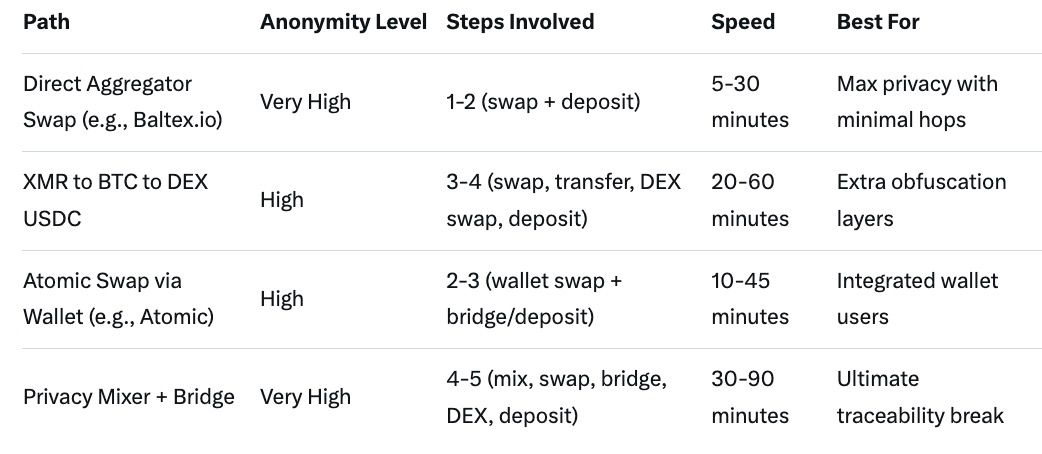
This table guides selection based on tolerance for complexity versus speed.

Quick comparison of funding paths.
Fees and Limits
Costs and constraints vary across methods, impacting feasibility for Polymarket funding.
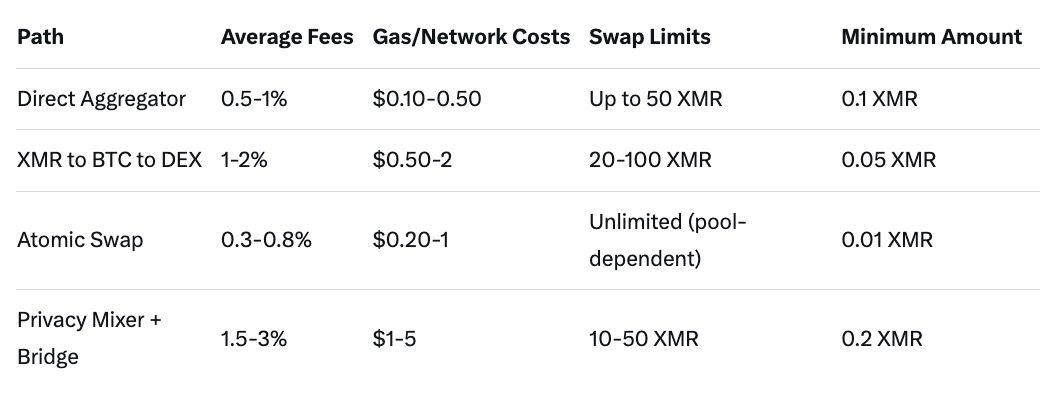
These figures highlight cost-effective direct paths for most users.
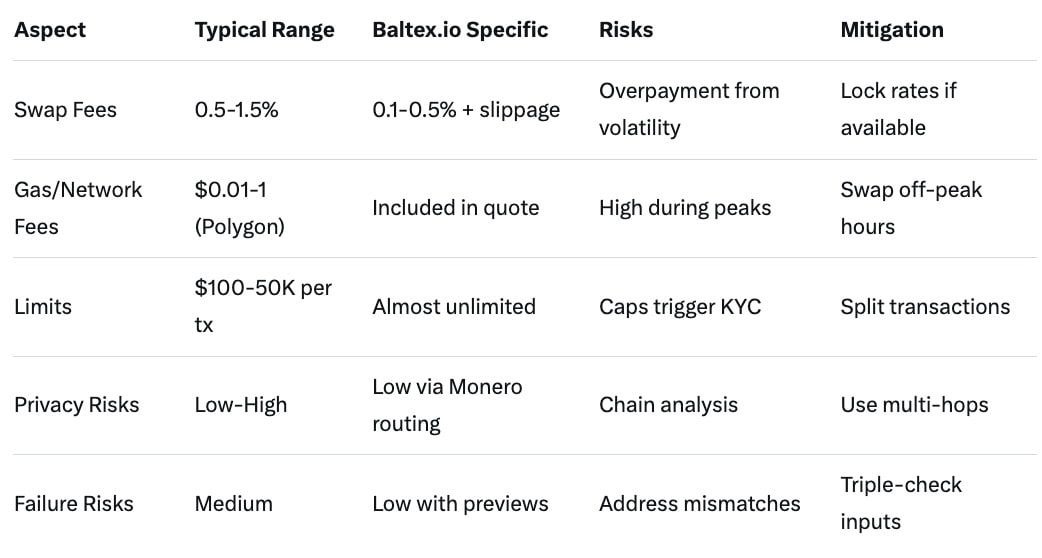
Refer to this for at-a-glance fee and risk assessment.
How Baltex.io Enables Fast Multi-Chain Swaps from XMR into Polygon Assets Before Funding
Baltex.io supports XMR swaps into Polygon assets like USDC without an account for standard swaps. It describes itself as a non-custodial routing network with 10,000+ coins across 200+ networks, combining cross-chain routing, liquidity aggregation, and CEX and DEX liquidity.
In a funding workflow, visit baltex.io, pick XMR as input and Polygon USDC as output, choose a mode, enter the recipient address, and send XMR to the deposit address shown. Baltex advertises low fees shown before you confirm, an average completion time under 5 minutes on most routes, and no swap limits, with support available for large amounts. A flagged transaction can be refunded to the depositing address minus network fees, sometimes only after review.
Core Mechanism: Deposit-Based Swaps Without Accounts
Standard swaps need no email, ID, or account: you choose the pair, enter the destination, and send the deposit. This means no persistent wallet linking with Polymarket, since your Polymarket address only receives the USDC. Baltex's DEX Layer, a separate wallet-based mode, applies to EVM tokens and does not handle XMR deposits.
Baltex's private modes route through proxy exchanges and, in Private+ mode, a Monero intermediary. It also screens transactions for sanctions and high-risk activity, may request KYC in some cases, and prohibits use from sanctioned jurisdictions or through VPNs used to bypass restrictions.
Advantages Over Alternatives
Compared with custodial exchanges that require full verification, Baltex's standard swaps are lighter on personal data, and its routes avoid holding an exchange balance. Drawbacks: reliance on liquidity, possible KYC requests, and the fact that no service can guarantee anonymity. Overall, it makes private funding more practical, but it does not remove legal or compliance responsibilities.
FAQ
What is the most private way to fund Polymarket with XMR?
Use a direct XMR-to-Polygon USDC swap, such as Baltex's Private or Private+ modes, with fresh addresses and as few hops as possible. No method guarantees anonymity.
How long does it take to swap XMR to Polygon USDC?
Typically 5 to 30 minutes, depending on Monero's confirmations (about 20 minutes for 10 blocks) and Polygon finality, which takes seconds.
Are there fees for depositing USDC to Polymarket?
Polymarket charges no deposit fee, but Polygon gas is a fraction of a cent, and trading on Polymarket now carries taker fees of up to $1.75 per 100 shares, depending on the market category.
What risks come with private funding?
Volatility, scams, wrong-network transfers, flagged transactions, and legal restrictions. Mitigate with small tests, verified tools, and compliance with local rules.
Can I fund large amounts?
Baltex advertises no swap limits and recommends contacting support for large amounts, but larger swaps are also more likely to draw AML review. Test with a smaller amount first.
Q: Can I fund Polymarket directly from a Monero wallet? A: No, Polymarket uses USDC on Polygon. You must swap XMR first via a service like baltex.io.
Q: Is MetaMask required at all? A: No. Email sign-up creates an embedded wallet, and you can send USDC straight to its deposit address.
Q: What if the swap fails? A: Most services refund minus network fees, sometimes after a review. Contact support and keep your transaction IDs. Test with a small amount.
Q: How private is Polymarket itself? A: Bets and balances are visible on-chain, and the platform applies geographic restrictions. Polymarket US requires full KYC.
Q: Best way to acquire XMR? A: Options vary by country, and many exchanges have delisted XMR, with the EU AML Regulation limiting regulated EU services from July 2027. Check local rules before choosing a method.
Q: Fees for a $1,000 swap? A: Often around 1% to 2% including the service margin and network costs, so roughly $10 to $20, but live quotes differ. See Fees Table.
Conclusion
Funding Polymarket with Monero on Polygon in 2026 is practical with a direct swap service like Baltex.io, provided you plan the route, test with small amounts, and respect each platform's rules. Mastering the routing paths, swap mechanics, and safety checks minimizes fees, mistakes, and unnecessary privacy leaks. Remember the context: Polymarket now charges fees and restricts access by region, Monero's FCMP++ upgrade is still pending, and EU rules on privacy coins take effect in July 2027. For a broader introduction, see our prediction markets guide, and read about bridging Monero to other chains.
You can read our full breakdown in SimpleSwap Review 2026: Pros, Cons, and Monero Exchange Fees.
Related reading: Instant Swap Services: The Go-To for Privacy-Conscious Users.
We cover this in more detail in XMR.to Alternatives: How to Pay Bitcoin Invoices with Monero.
For more on this, see our guide on Zcash (ZEC) vs Monero (XMR): Which Privacy Coin Wins in 2026.