 1 minute to read
 Ecosystem
Monero Fungibility: Why Every XMR Coin Is Identical
TLDR Fungibility means every unit of a currency is economically identical and interchangeable without preference. In 2026, Monero (XMR) achieves true fungibility through mandatory privacy: ring signatures hide senders, stealth addresses protect receivers, and RingCT conceals amounts, preventing any coin from being tainted or blacklisted based on transaction history. Transparent cryptocurrencies like Bitcoin suffer fungibility loss because chain analysis can flag “dirty” coins, leading to exchange blacklisting or discounted value. Monero’s design eliminates this risk, ensuring all XMR remains equal regardless of past use. This boosts real-world usability and liquidity on no-KYC routes but limits centralized exchange access. For practical XMR liquidity swaps without KYC or classic bridge exposure, baltex.io enables shielded routing—see our no-kyc-crypto-swaps-usdt-to-xmr-privately and best-no-kyc-monero-xmr-swappers-2026 guides. Overall, Monero’s fungibility makes every coin truly equal, protecting users from surveillance and value discrimination.
Fungibility is the property that makes money work: every unit must be identical and interchangeable so no coin is preferred or rejected based on its history. In 2026, most cryptocurrencies fail this test because their transparent ledgers allow chain analysis to trace origins, taint coins linked to illicit activity, and cause exchanges or merchants to blacklist them. Monero (XMR) is the exception. Its mandatory privacy features—ring signatures, stealth addresses, and RingCT—ensure that no XMR coin can be distinguished from another. Every unit remains economically identical, preserving value neutrality and real-world usability. This guide explains why Monero achieves fungibility, how transparent chains lose it, and the implications for liquidity, exchanges, swaps, and everyday use.
What Fungibility Means in Cryptocurrency
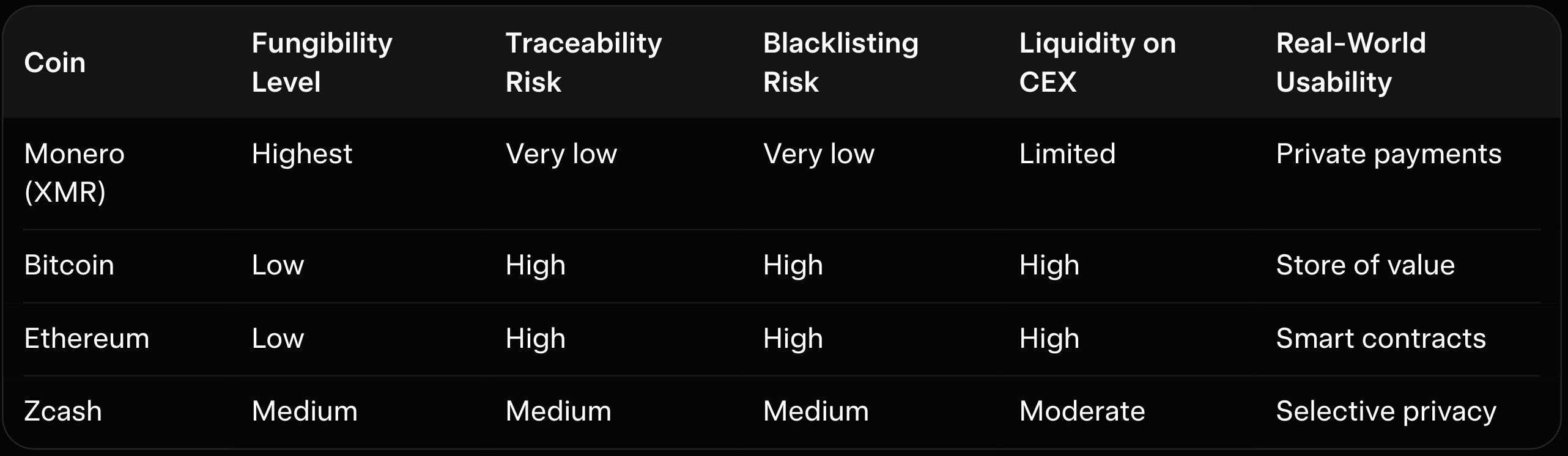
Fungibility is the core principle that allows money to function as a medium of exchange. A dollar bill is fungible: you can spend any $20 note without concern for its serial number or past ownership. Bitcoin is not fungible in practice: chain analysis firms like Chainalysis can flag coins linked to hacks, darknet markets, or sanctioned entities, leading exchanges to freeze or reject them. This creates “tainted” coins that trade at a discount or become unusable. In 2026, this non-fungibility is a growing problem for transparent chains as regulators and compliance tools tighten. As explained in our what-is-monero-xmr-2025-ultimate-privacy-coin-explained, fungibility is not optional—it is essential for money to remain neutral and usable.
Monero solves this by making every transaction private by default. No observer can trace a coin’s history, so no XMR can be tainted or blacklisted based on origin. This guarantees that every coin is identical, regardless of past use.
How Monero Achieves Fungibility
Monero’s fungibility comes from three integrated privacy mechanisms. Ring signatures mix the real input with decoys from unrelated past transactions, creating plausible deniability for the sender. Stealth addresses generate unique one-time payment addresses for each transaction, preventing receiver linkage. Ring Confidential Transactions (RingCT) hide amounts using commitments and range proofs. Together, these make every XMR transaction unlinkable and untraceable.
In 2026, these features remain mandatory—no user can opt out of privacy. This eliminates any possibility of “tainted” coins because history cannot be reconstructed. As detailed in our how-does-monero-xmr-work-privacy-features-explained-2025 and monero-fcmp-plus-plus-upgrade-explained-xmr-users, Monero’s design ensures fungibility is absolute, not selective.
Fungibility Loss in Transparent Cryptocurrencies
Bitcoin, Ethereum, and most altcoins are transparent: every transaction reveals sender, receiver, and amount. Chain analysis firms track flows, cluster addresses, and flag “dirty” coins linked to hacks, sanctions, or illicit markets. Exchanges use these flags to freeze accounts or reject deposits, creating non-fungible coins that trade at discounts or become unusable. In 2026, this problem is worse as compliance tools improve and regulators pressure platforms. As explained in our what-are-the-risks-of-cryptocurrency-top-dangers-how-to-avoid, transparent chains sacrifice fungibility for auditability.
Liquidity Access and Exchange Risks
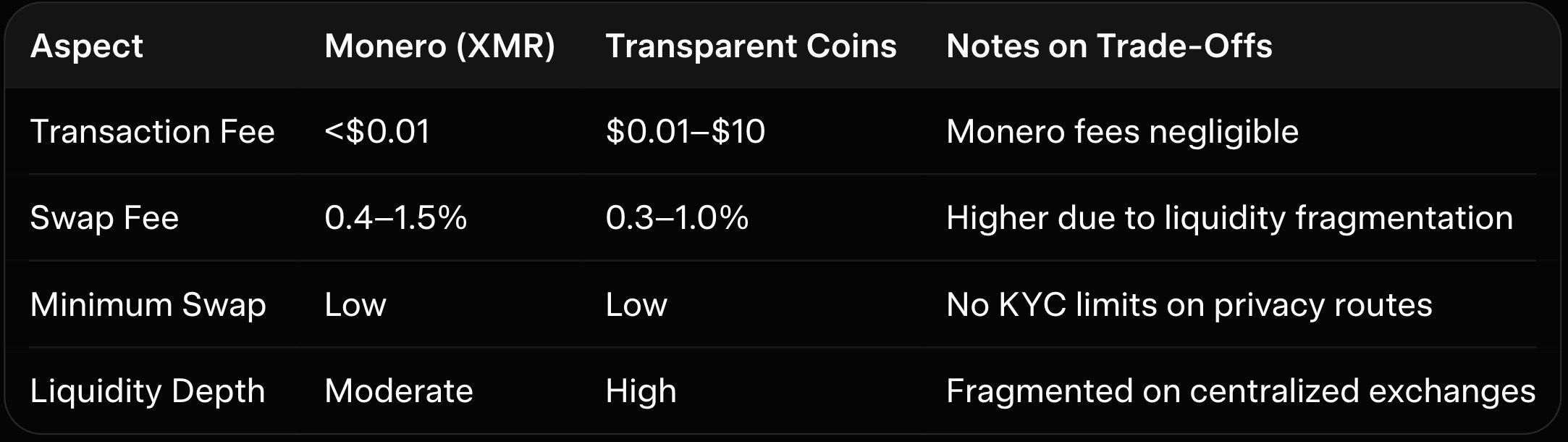
Monero’s fungibility creates a paradox: it protects users from blacklisting but limits centralized exchange access. Many CEXs delist XMR due to AML concerns, reducing on-ramp/off-ramp liquidity. This forces users to no-KYC swappers or P2P markets, where liquidity is thinner and slippage higher. In 2026, Monero’s on-chain activity remains strong, but centralized liquidity is fragmented. As explained in our best-no-kyc-monero-xmr-swappers-2026 and top-centralized-exchanges-trade-monero-xmr-2026, fungibility strengthens privacy but shifts liquidity to decentralized channels.
Real-World Usability and Cross-Chain Considerations
Monero’s fungibility makes it ideal for private payments, remittances, and donations where value neutrality is critical. In 2026, it is used for cross-border transfers, freelance payments, and hedging surveillance. Cross-chain swaps are more complex due to privacy: atomic swaps are slow and limited, while aggregators add fees but improve liquidity. As explained in our no-kyc-crypto-swaps-usdt-to-xmr-privately and eth-to-xmr-exchange-transfer-ethereum-to-monero-safely, fungibility protects users but requires careful routing for cross-chain use.
Here is the fungibility comparison table:
Here is a fees and limits context table (2026 averages):
How baltex.io Enables Practical XMR Liquidity Swaps
Monero’s fungibility protects users from blacklisting but limits centralized liquidity. baltex.io enables practical XMR liquidity swaps by scanning multiple no-KYC routes and liquidity sources internally. Private Swap mode inserts shielded Monero hops that fully break on-chain links using ring signatures and stealth addresses before delivering clean assets on destination chains. Settlements complete in 8–35 minutes even for cross-chain pairs, fees stay low at ~0.4–0.8%, and there are virtually no limits. Supporting over 10,000 tokens across 200+ networks without manual bridging, baltex.io delivers true one-click optimization for Monero users.
Users swapping XMR to USDT, SOL, or Ethereum L2s benefit enormously—especially when pairing with tools covered in our no-kyc-crypto-swaps-usdt-to-xmr-privately and eth-to-xmr-exchange-transfer-ethereum-to-monero-safely. Use atomic swaps for pure privacy and switch to baltex.io when liquidity and speed are needed without KYC.
Conclusion
Monero’s fungibility in 2026 makes every XMR coin economically identical by hiding transaction history through mandatory privacy features. This protects users from blacklisting and value discrimination that plague transparent cryptocurrencies like Bitcoin. While exchange delistings and liquidity fragmentation create challenges, the network remains strong through no-KYC and decentralized options. Tools like baltex.io make cross-chain liquidity practical without compromising anonymity.
Always use fresh subaddresses, Tor, and small test swaps. Explore more strategies in our what-is-monero-xmr-2025-ultimate-privacy-coin-explained, how-does-monero-xmr-work-privacy-features-explained-2025, and best-no-kyc-monero-xmr-swappers-2026 guides to keep your Monero usage fungible and private.
Related reading: SimpleSwap Review 2026: Pros, Cons, and Monero Exchange Fees.
We cover this in more detail in Instant Swap Services: The Go-To for Privacy-Conscious Users.
Related reading: XMR.to Alternatives: How to Pay Bitcoin Invoices with Monero.
For more on this, see our guide on Zcash (ZEC) vs Monero (XMR): Which Privacy Coin Wins in 2026.