 2 minutes to read
 Ecosystem
Is Sending Polymarket USDC to Centralized Exchanges Safe?
TL;DR
Sending USDC earned on Polymarket to centralized exchanges (CEXs) like Binance or Coinbase in 2026 is generally safe for most users, as Polymarket operates as a legitimate prediction market on Polygon with no widespread reports of CEX freezes tied to its origins. However, risks include transaction traceability via chain analysis, potential compliance flags if linked to high-risk activities, and rare account freezes under regulatory scrutiny. Mitigate with small test deposits, privacy routing via aggregators like Baltex.io, or alternatives like DEX swaps. Review risk scenarios in the table below and safer options in the routing table. For privacy-focused users, Baltex.io enables seamless multi-chain swaps to obscure origins before CEX deposits.
Introduction
In 2026, Polymarket has solidified its position as a leading decentralized prediction market platform, allowing users to bet on real-world events using USDC on the Polygon network. Many participants accumulate USDC winnings from successful predictions, ranging from political outcomes to sports events, and seek to transfer these funds to centralized exchanges for trading, staking, or fiat conversion. The question of safety arises due to the transparent nature of blockchain transactions and the increasing regulatory oversight on crypto flows. While Polymarket itself is non-custodial, meaning users control their wallets, sending USDC directly to CEXs could expose transfers to scrutiny from tools like Chainalysis, potentially triggering compliance reviews or freezes. This guide analyzes the safety of such transfers, drawing on traceability mechanics, compliance frameworks, and emerging risks in 2026's regulatory landscape. We'll explore whether direct sends are advisable, highlight real-world precedents, and outline best practices alongside alternatives for minimizing exposure. By understanding these elements, Polymarket users can make informed decisions to protect their assets while navigating the bridge between DeFi and centralized finance.
The evolving regulatory environment, including updates to the EU's MiCA and U.S. stablecoin guidelines, has heightened CEX vigilance on incoming funds. USDC, issued by Circle, benefits from strong backing but also centralized controls, allowing for blacklisting in extreme cases. For Polymarket holders, the core concern isn't the platform's legitimacy—it's how CEXs perceive funds originating from prediction markets, which some regulators view akin to gambling. Despite no major blanket bans, isolated incidents underscore the need for caution. This analysis aims to equip users with a balanced view, emphasizing that while most transfers proceed smoothly, proactive risk management ensures long-term asset security.
Transaction Traceability and Chain Analysis Risks
Blockchain's inherent transparency makes every USDC transfer from Polymarket traceable, posing a primary risk when depositing to CEXs in 2026. Polymarket operates on Polygon, a layer-2 Ethereum chain, where all transactions are publicly recorded on explorers like Polygonscan. When you send USDC to a CEX deposit address, the exchange's compliance teams can trace the funds' history using advanced chain analysis tools from firms like Chainalysis or Elliptic. These tools map transaction flows, identifying origins from wallets associated with Polymarket's smart contracts. If the funds stem from bets on sensitive topics—such as geopolitical events or elections— they might raise red flags under AML protocols, even if legitimate.
In practice, chain analysis categorizes addresses by risk levels: low for standard wallets, medium for DeFi protocols, and high for mixers or illicit platforms. Polymarket, as a prediction market, often falls into a medium-risk category due to its gambling-like nature, potentially triggering enhanced due diligence on CEXs. For instance, if your USDC passed through multiple Polymarket markets before withdrawal, analysis could link it to high-volume betting, prompting questions about source of funds. While not inherently unsafe, this traceability increases the odds of temporary holds during reviews, especially amid 2026's push for stablecoin transparency. Users in jurisdictions with strict gambling laws face amplified risks, as CEXs align with local regulations to avoid penalties. Overall, traceability doesn't equate to automatic rejection but underscores the need for clean transaction histories to avoid delays.
Compliance Risks and Regulatory Scrutiny
Compliance risks form another layer of concern when sending Polymarket USDC to CEXs in 2026. Centralized platforms like Binance and Coinbase adhere to global AML and KYC standards, requiring them to monitor deposits for suspicious patterns. Polymarket's USDC, while stable and regulated via Circle, carries metadata from its DeFi origins, which could be flagged if associated with unregulated betting. Regulatory bodies, including the CFTC in the U.S., have scrutinized prediction markets for resembling derivatives, leading to voluntary geo-blocks on Polymarket for certain users. If a CEX detects funds from a restricted platform, it might initiate a compliance hold, demanding proof of legitimate earnings.
In 2026, with stablecoin issuers like Circle enhancing blacklist capabilities, compliance extends to freezing specific USDC tokens if linked to sanctioned activities. Though Polymarket avoids direct sanctions, indirect ties—such as bets on international events—could complicate matters. For example, if winnings derive from markets involving restricted entities, CEXs might err on caution, freezing deposits pending verification. This risk is heightened for high-value transfers, where thresholds like $10,000 trigger mandatory reporting under FATF guidelines. Users should anticipate potential delays, as compliance reviews can last days to weeks, disrupting access to funds. While most Polymarket transfers evade such scrutiny due to the platform's growing acceptance, the regulatory tide favors caution, making direct sends safer for small amounts but riskier for larger portfolios.
Account Freezes and Operational Hazards
Account freezes represent a tangible operational risk when depositing Polymarket USDC to CEXs. In rare cases, exchanges freeze accounts if incoming funds raise alarms during automated screening. For Polymarket users, this could occur if chain analysis reveals patterns mimicking laundering, such as rapid transfers post-settlement. Coinbase, for instance, has policies to freeze funds under court orders or suspected illegality, while Binance employs similar measures for high-risk deposits. In 2026, with AI-driven monitoring, even benign Polymarket winnings might trigger holds if misclassified as gambling proceeds, especially in anti-gambling jurisdictions.
Operational hazards extend beyond freezes to network mismatches or wallet errors. Sending Polygon USDC to an Ethereum-only CEX address results in lost funds, a common pitfall despite warnings. Congestion on Polygon could delay confirmations, exposing transfers to volatility if USDC depegs temporarily. While freezes are infrequent for Polymarket specifically, broader crypto trends show exchanges halting stablecoin operations during market stress, as seen in past USDC runs. Users mitigate this by verifying CEX support for Polygon USDC and monitoring network status, but the possibility of sudden freezes underscores the value of diversified routing strategies.
Real-World Cases of Issues with Polymarket USDC Transfers
Real-world cases illustrate the potential pitfalls of sending Polymarket USDC to CEXs, though direct freezes are scarce. In late 2025, a high-profile incident involved a user withdrawing $2 million in Polymarket winnings to their bank via a CEX intermediary, only for the bank to flag and freeze the funds suspecting theft or fraud. The compliance team required detailed Polymarket transaction history to release the assets, highlighting how downstream institutions scrutinize crypto origins. While the CEX (Binance in this case) processed the deposit without issue, the subsequent fiat off-ramp triggered the freeze, showing indirect risks.
Another case from December 2025 saw Polymarket itself freeze incoming deposits from certain exchanges like CoinEx due to blacklisted addresses, but outbound transfers to CEXs remained unaffected. However, this raised awareness of reciprocal scrutiny: if Polymarket flags sources, CEXs might do the same for Polymarket-linked wallets. In a separate 2025 event, Circle froze $58 million in USDC tied to a memecoin scandal, demonstrating issuer-level controls that could theoretically apply if Polymarket funds intermingle with tainted assets. No widespread CEX freezes specifically from Polymarket have been reported in 2026, but isolated Reddit and Trustpilot complaints describe temporary holds on Coinbase for "unusual activity" after large Polymarket deposits. These examples emphasize that while direct sends are often seamless, vigilance against compliance triggers is essential.
Safer Routing Alternatives and Best Practices
For those wary of direct transfers, safer routing alternatives abound in 2026, leveraging DeFi tools to obscure origins or convert assets. One approach involves swapping Polymarket USDC to privacy coins like Monero (XMR) via DEXs such as Uniswap on Polygon, then reconverting to USDC or another stablecoin before CEX deposit. This breaks the direct traceability chain, reducing compliance flags. Multi-chain bridges or aggregators enable routing to less scrutinized networks like Solana, where USDC liquidity is high and analysis tools less pervasive.
Best practices start with small test deposits—send $50-100 first to gauge CEX response times and any holds. Use non-custodial wallets for control, enabling 2FA and monitoring via explorers. Research CEX policies: Coinbase supports Polygon USDC with low fees, while Binance offers broader options but stricter AML. Diversify across multiple CEXs to avoid single-point failures, and maintain records of Polymarket bets for proof if queried. In volatile markets, hedge with stables or wait for low-congestion periods. These strategies transform potentially risky sends into secure operations, prioritizing privacy without sacrificing efficiency.
Risk Scenarios
Understanding specific risk scenarios helps Polymarket users assess threats when sending USDC to CEXs. The table below outlines common situations, their likelihood in 2026, triggers, impacts, and mitigations.
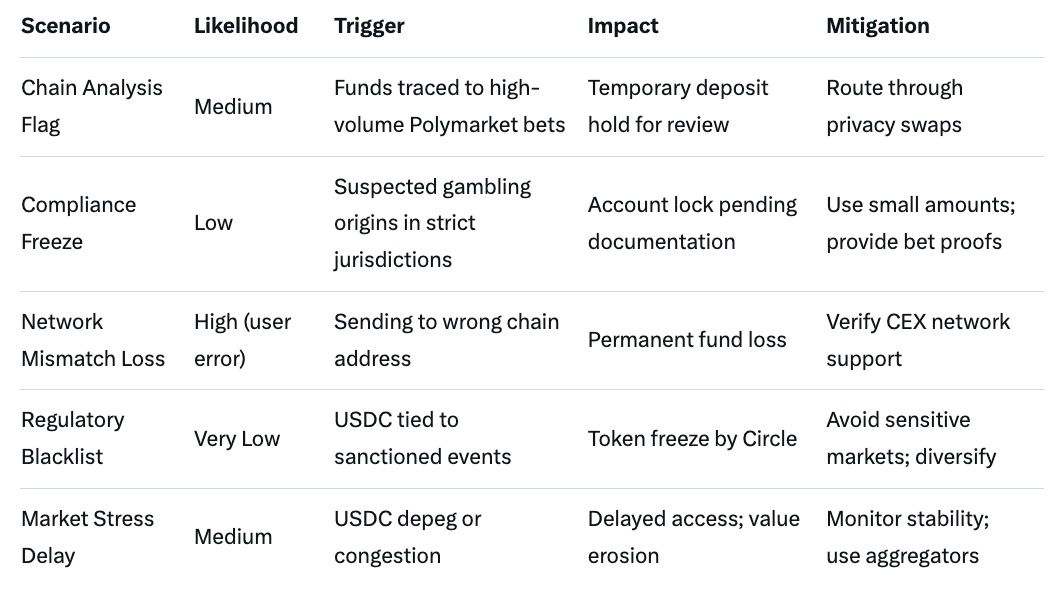
This comparison reveals that user errors pose the highest immediate risks, while regulatory ones are rarer but severe.
Routing Options
Exploring routing options provides alternatives to direct sends, balancing safety, speed, and costs. The following table compares methods for handling Polymarket USDC before CEX interaction.
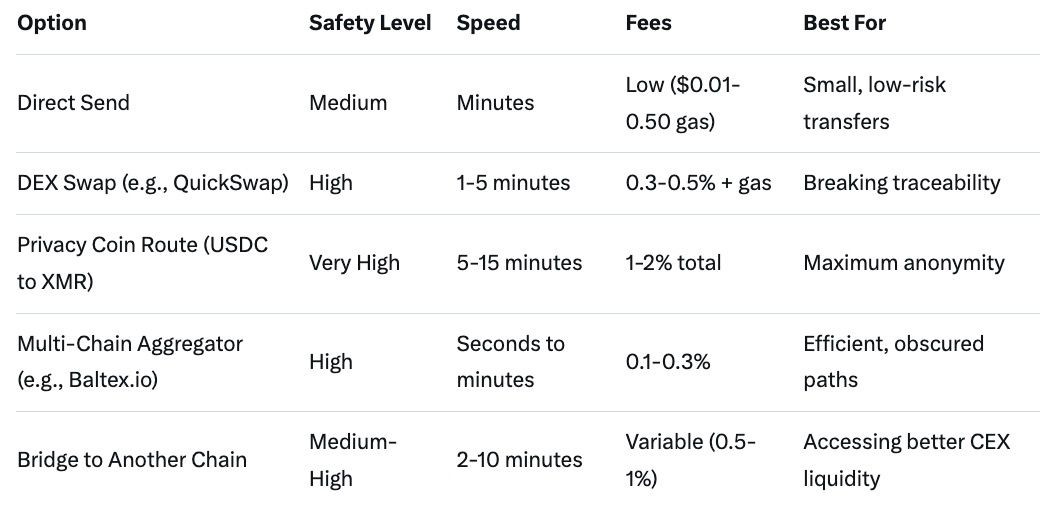
These options empower users to tailor routes based on risk tolerance.
How Baltex.io Helps Route Polymarket USDC Safely via Swaps Before Interacting with CEXs
Baltex.io emerges as a key tool in 2026 for safely routing Polymarket USDC before CEX deposits, offering non-custodial multi-chain swaps that enhance privacy and efficiency. As an aggregator supporting over 200 networks and 10,000 tokens, Baltex.io allows users to swap Polygon USDC to assets like ETH on Ethereum or SOL on Solana in atomic transactions, avoiding traditional bridges' vulnerabilities. For Polymarket holders, this means converting winnings to less traceable forms—such as swapping to USDT or privacy-enhanced stables—before sending to CEXs, diluting direct links to prediction markets.
In a typical workflow, connect your Polygon wallet to Baltex.io, select USDC as input and a target output like BTC, and execute with built-in routing that aggregates liquidity for optimal rates. This process, often under 0.3% in fees, obscures the transaction trail by leveraging multiple DEX pools, making chain analysis harder for CEX compliance teams. For added safety, route through Monero integrations if available, ensuring funds arrive "clean" at the CEX. Baltex.io's ephemeral sessions prevent data retention, aligning with privacy goals. Compared to manual swaps, it minimizes slippage and risks, ideal for large winnings. Ultimately, Baltex.io bridges Polymarket's DeFi ecosystem to CEXs securely, reducing freeze potentials while streamlining operations.
FAQ
Is it safe to send Polymarket USDC directly to Binance in 2026?
Generally yes for small amounts, but use test sends to check for holds, as chain analysis might flag high-volume origins.
What causes CEXs to freeze accounts from Polymarket deposits?
Triggers include suspected AML issues, gambling classifications, or regulatory orders, though rare for legitimate winnings.
How can I make Polymarket USDC transfers more private?
Swap via DEXs or aggregators like Baltex.io to break traceability before depositing.
Are there any reported cases of Coinbase freezing Polymarket funds?
No widespread cases, but isolated holds for unusual activity have occurred; maintain records for quick resolution.
What's the best alternative to direct CEX deposits?
Use multi-chain routing with tools like Baltex.io for swaps, then deposit the converted asset.
Conclusion
Sending Polymarket USDC to centralized exchanges in 2026 carries manageable risks, primarily from traceability and compliance, but remains safe for most with proper precautions. By leveraging alternatives like privacy swaps and aggregators such as Baltex.io, users can significantly reduce exposure to freezes or reviews. Real-world cases highlight the importance of documentation and small-scale testing, while best practices ensure smooth transitions. As regulations tighten, staying informed on CEX policies and chain analysis trends will safeguard your assets. Ultimately, balancing convenience with privacy empowers Polymarket participants to confidently move funds, fostering a secure bridge between prediction markets and traditional crypto trading.
We cover this in more detail in How to Sell ETH: Quick and Safe Methods for Ethereum Holders.
We cover this in more detail in How to Sell ETH: Quick and Safe Methods for Ethereum Holders.
We cover this in more detail in How to Sell ETH: Quick and Safe Methods for Ethereum Holders.
You can read our full breakdown in Top Platforms to Buy XRP in 2025 – Ranked for Speed & Safety.