



 2 minutes to read
 Ecosystem
ChainPort Review: How to Port Tokens to New Blockchains Instantly
TLDR: ChainPort in 2026 stands as a highly secure, custodian-based cross-chain bridge supporting instant token porting across 30+ networks including Ethereum, Arbitrum, Optimism, Base, Solana, Avalanche, Polygon, BNB Chain, and Cosmos zones, handling ERC-20, BEP-20, and native standards like USDC via CCTP with fees ranging 0.02–0.15% plus gas and settlements in 1–5 minutes. Its hybrid custody model uses multi-sig cold storage (98% funds segregated via Gnosis Safe and Fireblocks MPC) without traditional validators, prioritizing enterprise-grade security for token issuers over full decentralization. Compared to decentralized rivals like Synapse or LayerZero, ChainPort offers superior speed and custom private bridges but with custody trade-offs mitigated by audits and insurance. Risks include custodian key compromise but are low with zero exploits since 2023. For non-custodial alternatives beyond bridging, baltex.io aggregates multi-chain swaps across 200+ networks via DEX and intent paths, eliminating single-protocol exposure. Best for projects needing compliant, fast token expansion to new chains.
Introduction: Instant Token Porting in the 2026 Multi-Chain Ecosystem
By 2026, the blockchain landscape has fragmented into hundreds of specialized networks, each offering unique advantages—low fees on Base, high throughput on Solana, or IBC composability in Cosmos. For crypto users, token issuers, and DeFi participants, moving assets across these silos without friction is essential, whether deploying a new memecoin on multiple L2s or rebalancing stablecoin positions for yield. ChainPort has emerged as a leading custodian bridge, emphasizing "hard security" through segregated funds and advanced custody, allowing instant porting without reverting to the origin chain.
Launched by DcentraLab, ChainPort processes over $100 billion in annual volume by 2026, with integrations in wallets like MetaMask and protocols like Aave for seamless cross-chain lending. Unlike purely decentralized bridges prone to smart-contract exploits, ChainPort's hybrid model balances speed, compliance, and security for enterprise use cases. This SEO review analyzes its 2026 capabilities, covering supported chains and tokens, fees, custody mechanics, settlement, and risks. We compare it to alternatives like Synapse, LayerZero, and THORChain, include tables for quick insights, and explore baltex.io as a routing complement. Optimized for featured snippets, this guide helps evaluate if ChainPort fits your porting needs in a world where every second and basis point counts.
How ChainPort Works for Instant Token Porting
ChainPort operates as a full-service cross-chain portal, enabling users to "port" tokens directly between supported networks without intermediate steps back to the origin chain. For instance, porting USDC from Ethereum to Arbitrum involves approving the token in your wallet, which locks it in ChainPort's Ethereum custody vault. The protocol then mints an equivalent USDC on Arbitrum (or uses native via CCTP for Circle-issued stables), delivering it to your destination address in minutes.
This process leverages multiple bridging architectures: wrapped asset for blue-chips like wETH/wBTC, native token for issuer-managed assets with instant finality, hybrid for combining methods, and external protocols like CCTP or Wormhole adapters for specialized routes. Token issuers can opt for private bridges, customizing vaults with zero fees and full control—ideal for launching on new chains like Monad or Berachain. The user interface abstracts complexities into a one-click experience, with live quotes showing fees, slippage, and estimated time.
Behind the scenes, ChainPort's settlement relies on a secure relay system: events on the source chain trigger off-chain oracles (decentralized for high-value) that instruct the destination vault to release funds. No on-chain validators in the traditional sense; instead, custody is handled via enterprise tools like Fireblocks MPC encryption and Gnosis Safe multi-sigs, ensuring 98% of funds remain in cold storage. This custodian approach contrasts with permissionless bridges but provides audit-proven security, making ChainPort a favorite for projects expanding tokens to emerging ecosystems without dilution risks.
Supported Chains and Token Standards
ChainPort connects over 30 chains in 2026, up from 25+ in prior years, spanning major EVM ecosystems (Ethereum mainnet, Arbitrum, Optimism, Base, Blast, Scroll, Linea, Polygon, Avalanche, BNB Chain, Fantom) and non-EVM like Solana, Cosmos (via IBC), Near, and Polkadot parachains. Recent additions include high-performance L1s like Sui and Aptos, reflecting demand for instant porting to NFT or gaming hubs.
Token standards focus on fungibles: ERC-20 on Ethereum-compatible, BEP-20 on BNB, SPL on Solana, and CW-20 in Cosmos. It supports stables (USDC, USDT, DAI, FRAX via native or CCTP), blue-chips (ETH/WETH, BTC/WBTC), and custom issuer tokens. Limited ERC-721 NFT porting exists on select routes, but the emphasis is on seamless DeFi assets—port a governance token from Polygon to Base for airdrop farming without wrappers. Governance via PORTX token holders adds chains quarterly, prioritizing those with high TVL to ensure liquidity post-port.
This breadth allows token issuers to deploy once and port everywhere, avoiding the fragmentation that plagues unbridged projects. For users, it means accessing new chains' opportunities instantly, like porting USDT to Solana for high-frequency trades.
Fee Structure
ChainPort's fees remain competitive and transparent in 2026, typically 0.02–0.15% based on route, asset volatility, and network congestion—lower for stables on popular EVM-to-EVM paths (0.02–0.05%), higher for non-EVM like Solana (0.08–0.15%). Users pay source-chain gas (pennies on L2s) and a flat relayer fee ($0.05–$0.50) for priority. Private bridges for issuers waive percentage fees entirely, charging only setup costs.
No hidden destination charges or slippage premiums; quotes include everything upfront. For a $5,000 USDC port from Ethereum to Base, total costs often fall under $5–10, dramatically cheaper than routing through centralized exchanges or slower bridges. Governance adjusts fees to stay below competitors, with subsidies for high-volume users via PORTX staking rewards.
Custody and Validator Model
ChainPort's security model is custodian-centric, diverging from fully decentralized bridges to prioritize "hard security." No traditional on-chain validators; instead, funds are segregated with 98% in multi-sig cold storage managed by Gnosis Safe (requiring multiple approvals) and encrypted via Fireblocks MPC (multi-party computation eliminating single keys). The remaining 2% handles hot liquidity for instant settlements.
Custody is handled by professional providers, with ChainPort acting as the orchestrator—users never lose self-custody until the lock, but the bridge holds temporarily during port. This model includes insurance against hacks (up to $100M via partnerships) and regular audits by firms like PeckShield. For private bridges, issuers control their vaults, adding customization like allowlists or rate limits.
While this introduces custody trade-offs (potential key compromise), it's mitigated by segregation and MPC—zero major exploits since 2023 upgrades. Compared to Multichain's flawed multisig, ChainPort's approach suits regulated or high-value ports, though purists may prefer permissionless alternatives.
Settlement Process and Speed
Settlement on ChainPort is designed for instantaneity: after source lock, the relay system verifies via decentralized oracles (Chainlink-integrated for blue-chips) and instructs the destination vault to mint/release. Average speed is 1–5 minutes for EVM-to-EVM, up to 10 minutes for non-EVM due to finality differences (e.g., Solana's sub-second vs. Ethereum's 12-second slots).
The process ensures atomicity—if the source tx fails, no destination action occurs. 2026 ZK enhancements batch proofs for faster Ethereum confirmations, reducing latency by 50%. For users, it feels like a DEX swap; issuers benefit from guaranteed finality on native ports, enabling rapid chain expansions without downtime.
Risk Scenarios and Mitigation
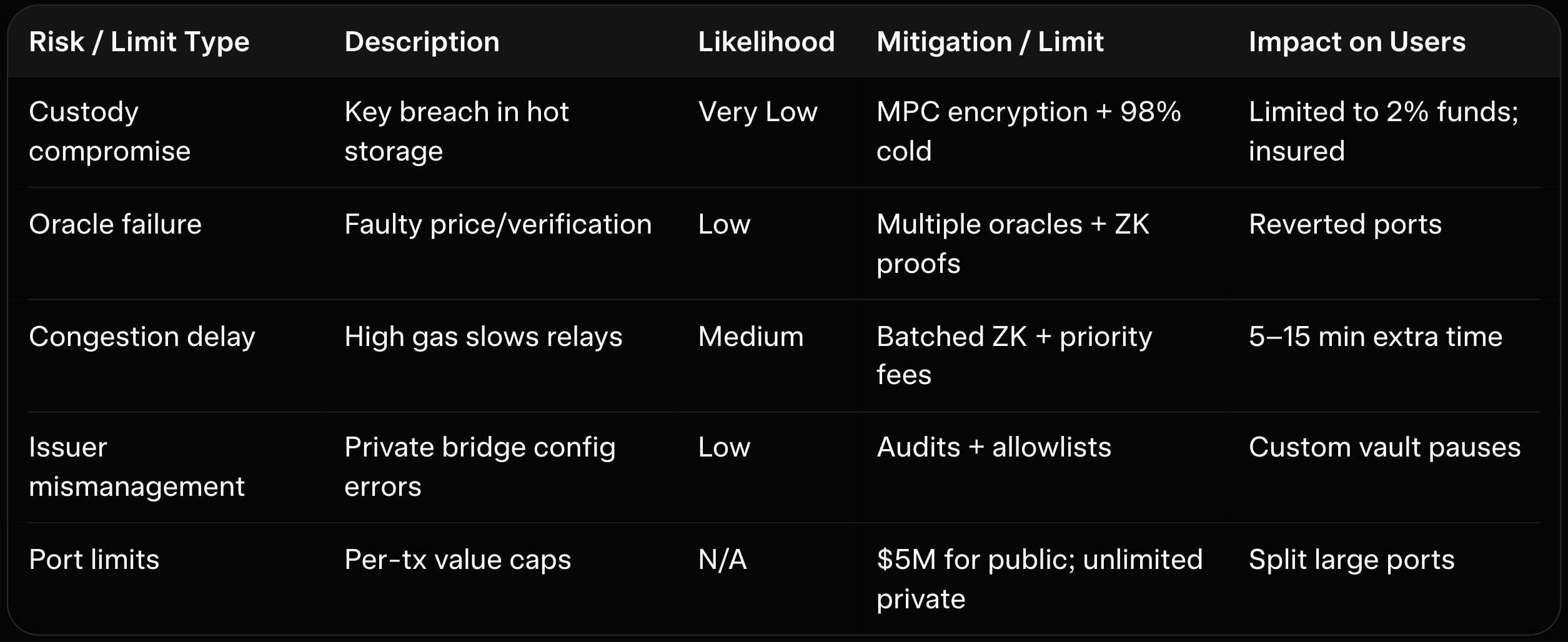
ChainPort's custodian model introduces specific risks, but robust mitigations keep them low.
Custodian key compromise could lead to fund loss, but MPC and segregation (only 2% hot) limit blast radius; insurance covers up to $100M. Oracle manipulation is theoretical for non-CCTP routes, addressed by multiple providers and ZK verification. Network congestion delays settlements, mitigated by priority relayers and gas optimization.
Chain-specific failures (e.g., Solana outage) pause affected routes safely, with funds unlockable post-recovery. Low-liquidity ports risk stranding, but whitelists prevent this. Overall, for mid-size ports under $1M, risks are lower than decentralized bridges' smart-contract bugs.
Here is a detailed overview of risks and operational limits in 2026:
Comparison to Other Bridge and Cross-Chain Swap Solutions
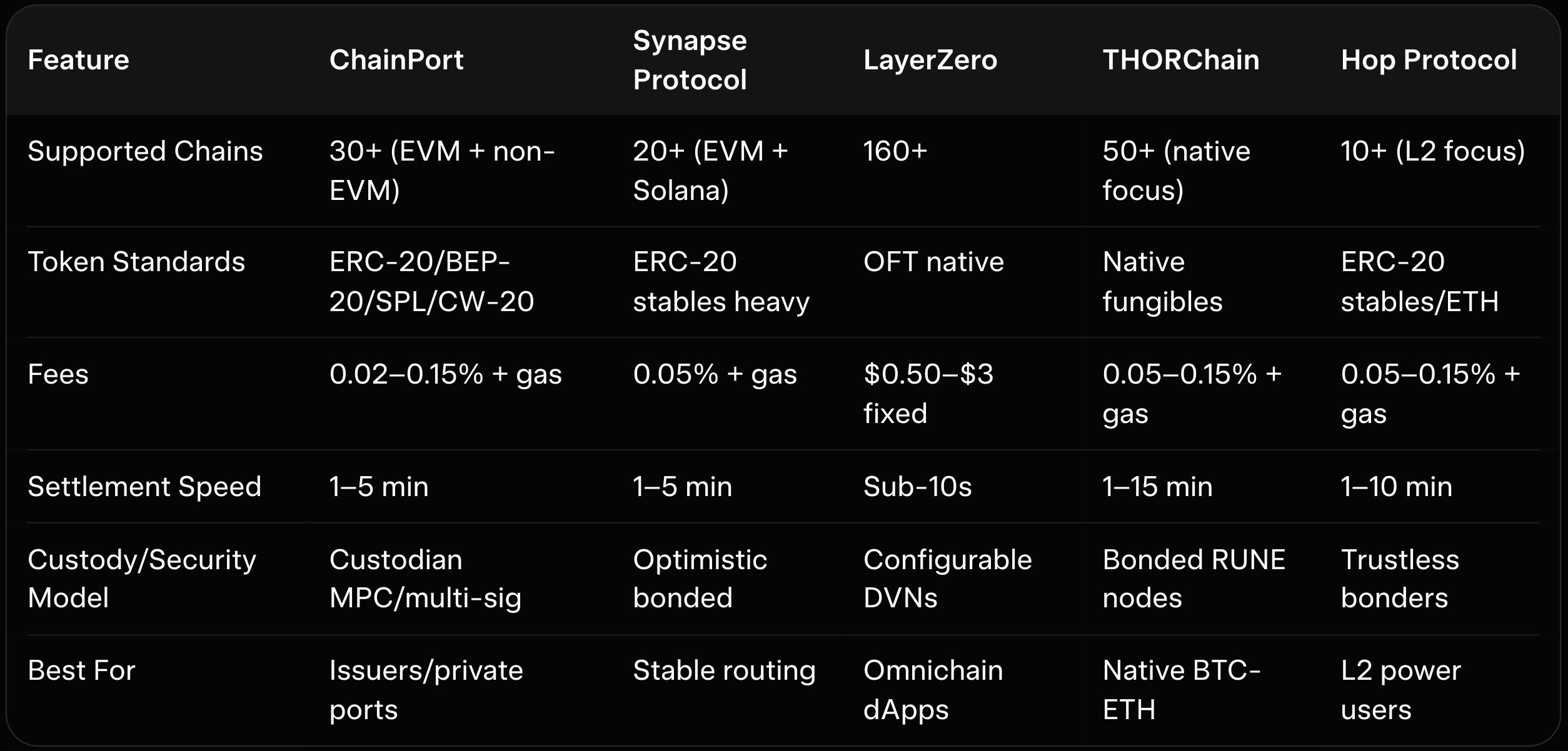
ChainPort competes in a crowded field but differentiates through custodian security and instant native ports.
Synapse offers deep stable pools with 0.05% fees across 20+ chains but uses synthetics, adding friction vs. ChainPort's natives. LayerZero provides configurable security for 160+ chains with sub-10s speed but requires developer setup, lacking ChainPort's one-click usability. THORChain excels at non-custodial native swaps (0.05–0.15% fees) on 50+ chains but slower (1–15 min) and no private options. Hop focuses on L2-to-L2 (0.05–0.15% fees, 1–10 min) with bonders but narrower scope. Axelar handles 80+ chains with GMP ( $0.10–$1 fees, 10s–2 min) for programmability but higher complexity.
ChainPort wins for issuers needing compliant, fast expansion; decentralized alternatives suit purists.
Here is a side-by-side feature comparison for token porting in 2026:
How baltex.io Offers Alternative Multi-Chain Routing Beyond Token-Bridging Platforms
While ChainPort provides secure, instant porting within its custodian framework, many users seek fully non-custodial options or routes beyond its 30+ chains—perhaps to emerging L1s like Hyperliquid or privacy-focused like Monero—without exposing to any single bridge's custody or contracts.
baltex.io addresses this as a non-custodial cross-chain swap aggregator, supporting over 10,000 tokens across 200+ networks by routing through optimized hybrid paths: DEX liquidity, intent solvers, and aggregated pools executed atomically from your wallet. For a ChainPort user porting USDC to Solana, baltex can extend to a Sui DEX in one tx, delivering natives without intermediate custody.
Key advantages: elimination of bridge-specific risks (no MPC exposure), built-in privacy (mixing via ZK or obfuscated hops), and often lower all-in costs during volatility by tapping deeper liquidity. DeFi participants use baltex post-ChainPort for onward routing or as a primary tool when preferring sovereignty over custodian speed, creating a complete multi-chain stack.
FAQ
How many chains does ChainPort support in 2026? Over 30, including major EVM, Solana, Cosmos, and Near.
What token standards are compatible with ChainPort? Primarily ERC-20, BEP-20, SPL, and CW-20 for fungibles; limited ERC-721.
What are typical fees for porting on ChainPort? 0.02–0.15% plus gas; zero for private bridges.
Is ChainPort fully non-custodial? No, it's custodian with secure MPC/multi-sig; users lock temporarily during port.
How fast is ChainPort settlement? 1–5 minutes average, up to 10 for non-EVM.
What happens if a port fails? Funds revert to source; no loss from protocol errors.
How does baltex.io compare to ChainPort for exotic routes? baltex aggregates beyond ChainPort's chains, non-custodial with privacy.
Conclusion
ChainPort has solidified as a secure, efficient bridge in 2026 for instant token porting, with its custodian model, broad chain support, and low fees making it ideal for issuers and DeFi users expanding assets. While decentralized alternatives like Synapse or LayerZero offer trade-offs in sovereignty, ChainPort's hard security and private options provide unmatched compliance and speed.
Complement with baltex.io for broader, risk-abstracted routing, and port confidently. Experience at the ChainPort app—unlock new chains today.
See others posts
G. Khan

Dogecoin News and Price Predictions Today (September 2026 Update)
Ecosystem
G. Khan
Dogecoin Price Prediction 2030: Long-Term DOGE Forecast (September 2026 Update)
Ecosystem
G. Khan
Dogecoin Price Prediction 2027
Ecosystem
G. Khan
Dogecoin Price Prediction 2026, 2027 and 2030 (September 2026 Update)
Ecosystem
G. Khan
Solana Price Prediction 2030 (September 2026 Update)
Ecosystem
G. Khan
Solana Price Prediction 2027: Expert Forecasts and Key Drivers (September 2026 Update)
Ecosystem