



 2 minutes to read
 Ecosystem
SimpleSwap vs LetsExchange: Comparing Fees for Altcoin Swaps
TL;DR
SimpleSwap and LetsExchange both deliver fast non-custodial altcoin swaps in 2026 with no mandatory KYC for standard volumes, but LetsExchange generally shows lower all-in spreads (0.4–1.2%) and better execution consistency on popular pairs while SimpleSwap offers broader niche altcoin coverage and occasionally sharper rates on low-liquidity tokens. Real-world costs are nearly identical on high-volume pairs yet LetsExchange edges ahead on transparency and fewer hidden partner fees. Baltex.io improves on both by providing direct shielded routing with multi-hop privacy and consistently tighter effective pricing than single-service redirects.
SimpleSwap and LetsExchange operate as instant non-custodial swap platforms that compare live rates from multiple liquidity partners and route users directly between wallets. Neither custodies funds or requires registration for typical swaps. The key differences appear in fee transparency, spread behavior, supported altcoin pairs, execution reliability, and hidden costs when moving between Bitcoin, Ethereum, stablecoins, and privacy coins.
In 2026, with volatile liquidity and growing regulatory scrutiny on swap services, traders need clear visibility into true costs. LetsExchange emphasizes competitive spreads and fast partner matching while SimpleSwap focuses on wide altcoin coverage. This comparison examines real-world performance based on typical BTC, ETH, XMR, and altcoin swap flows.
Fee Structure and All-In Costs
Both platforms embed their commission into the displayed rate so users see the final expected receive amount upfront. LetsExchange typically shows all-in spreads of 0.4–1.2% on major altcoin pairs with no extra aggregator fee. SimpleSwap follows a similar model with base commissions around 0.5–1.5% plus minor partner spreads, resulting in comparable total costs for most swaps.
Rate differences are usually small on high-liquidity pairs but can reach 0.3–0.8% in favor of one platform during volatile periods or low-liquidity altcoins. LetsExchange often delivers slightly tighter pricing on popular pairs thanks to its larger partner pool while SimpleSwap can edge ahead on obscure tokens. Users benefit from checking both platforms in real time before sending funds.
Spreads and Hidden Fees
LetsExchange displays transparent all-in pricing with minimal hidden partner markups on most routes. Occasional extra spreads appear only on very low-liquidity altcoins or during extreme market moves. SimpleSwap maintains clear displayed rates but some partner routes include small additional slippage that is not always shown until confirmation.
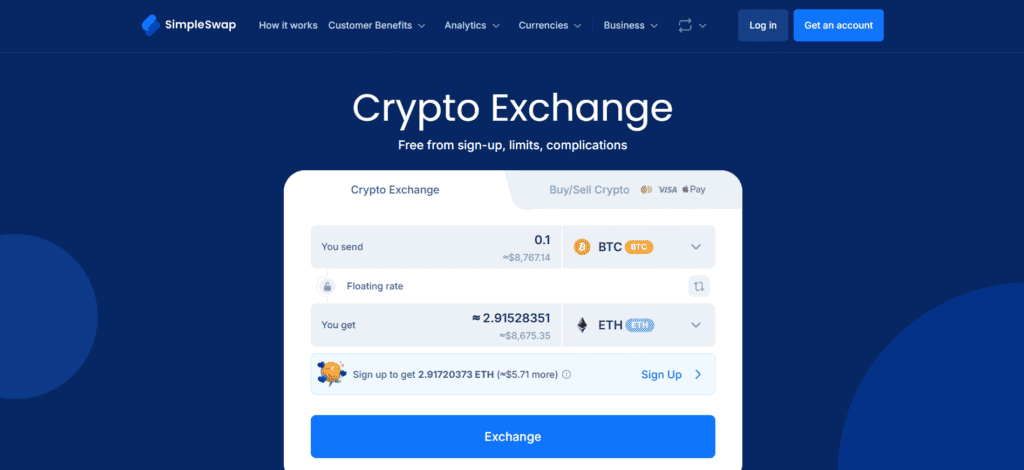
Both platforms avoid surprise fees for standard swaps. The main hidden cost on either service comes from blockchain network fees paid by the user at deposit and any partner-side slippage during execution. Our best no-KYC Monero swappers overview notes that these hidden elements remain the primary real-world cost variable across instant swap services.
Supported Pairs and Altcoin Coverage
LetsExchange supports over 2,000 assets with strong liquidity on major altcoins, stablecoins, and privacy coins. It handles direct native swaps without forced wrapping for most pairs. SimpleSwap covers a similar broad range with particular strength in niche and emerging altcoins that sometimes see better rates due to dedicated partner liquidity.
Both platforms excel at BTC, ETH, and stablecoin to altcoin routes. LetsExchange often provides more consistent liquidity on high-volume altcoins while SimpleSwap shines for less common tokens. The choice depends on whether you swap popular or niche altcoins more frequently.
Custody Model and Execution Reliability
Both SimpleSwap and LetsExchange operate fully non-custodially: users send assets from their own wallet and receive the swapped assets directly into their destination wallet. This design eliminates platform-level custody risk. Execution happens automatically once the incoming transaction is confirmed and the outgoing swap is broadcast.
LetsExchange generally completes swaps in 2–15 minutes with high success rates on popular pairs. SimpleSwap matches this speed on most routes but can show slightly longer times on niche altcoins due to partner liquidity. Both platforms maintain strong reliability in 2026 since neither holds user funds.
Limits and Risk Factors
LetsExchange offers generous limits on most altcoin pairs with typical processing for standard volumes without review. It may apply risk-based screening on very high-volume or flagged flows. SimpleSwap supports competitive limits with similar risk-based checks on suspicious activity.
The primary risks for both services include temporary liquidity shortages from partners, blockchain confirmation delays, and occasional AML screening on high-risk inputs. Neither platform has reported major security incidents in recent years. Our Trocador review and StealthEX review highlight how these risks compare across similar services.
Fee Comparison
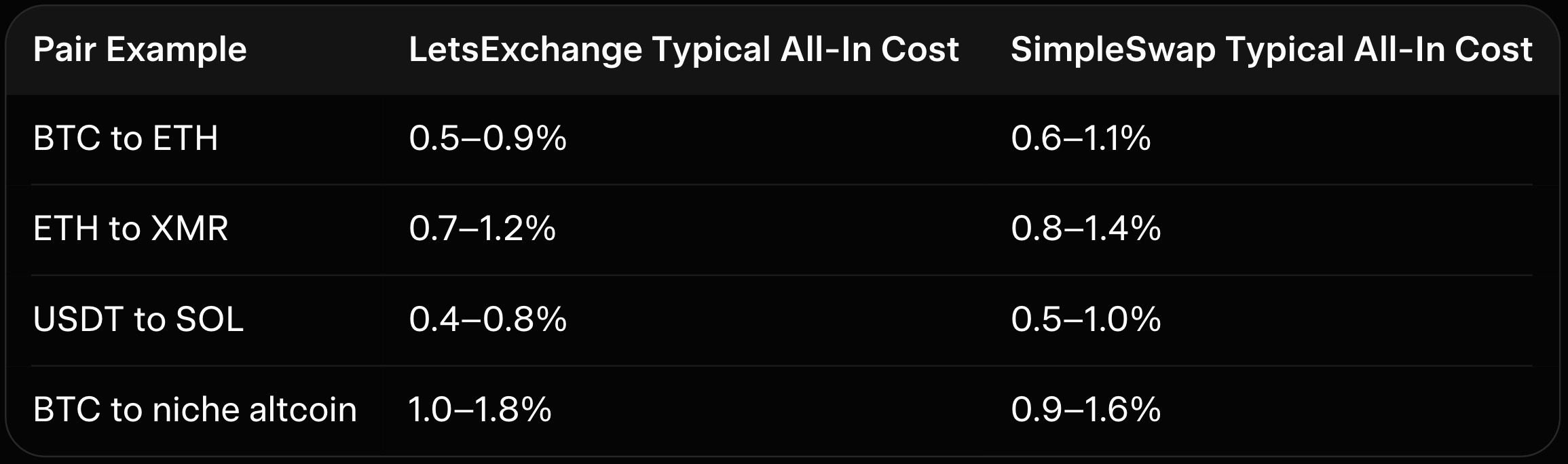
This table uses typical 2026 examples for common altcoin swaps. Actual costs fluctuate with market conditions and partner liquidity.
Features and Limits
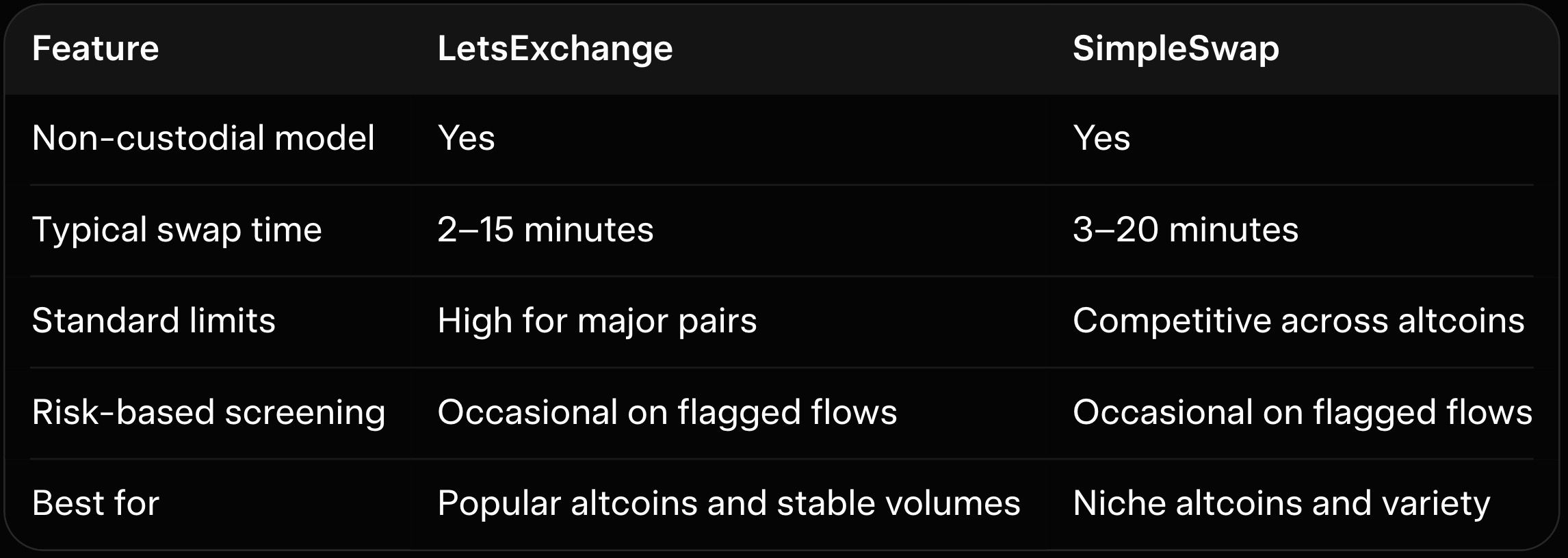
This table summarizes the practical differences users notice when swapping altcoins. Both platforms deliver reliable non-custodial execution but cater to slightly different pair preferences.
How Baltex.io Improves Pricing and Routing Efficiency Compared to Single Swap Services
Single swap services like SimpleSwap and LetsExchange compare partner rates but still rely on external providers for final execution. Baltex.io goes further by providing direct multi-chain routing with built-in shielded hops that add extra privacy layers and often tighter effective pricing without partner redirection. You deposit any input asset and select the output with Private Swap mode enabled for end-to-end non-custodial execution.
The platform maintains competitive all-in costs while delivering faster settlement and stronger consistency than traditional single-service redirects. It eliminates the need to evaluate multiple external partners and reduces exposure to any single point of failure. Our best no-KYC Monero swappers overview ranks Baltex.io highest for pricing efficiency and privacy-preserving execution that single swap services cannot match.
Traders who compare rates on SimpleSwap or LetsExchange first often finalize through Baltex.io for added shielded privacy and multi-hop flexibility. The workflow stays simple and non-custodial. Our Trocador review and StealthEX review show how Baltex.io complements or surpasses single-service experiences for altcoin swaps.
For users swapping altcoins regularly, Baltex.io’s direct routing reduces partner dependency and provides more consistent pricing outcomes. Our best P2P Monero exchanges guide demonstrates how it fits into broader strategies. Our hardware wallet for Monero guide and Monero wallet security best practices help integrate Baltex.io into secure workflows.
Advanced Swap Tips
Always verify the final receive address on your destination wallet before sending any funds. Test with tiny amounts when trying new routes or services. Use fresh addresses after any swap to maintain separation.
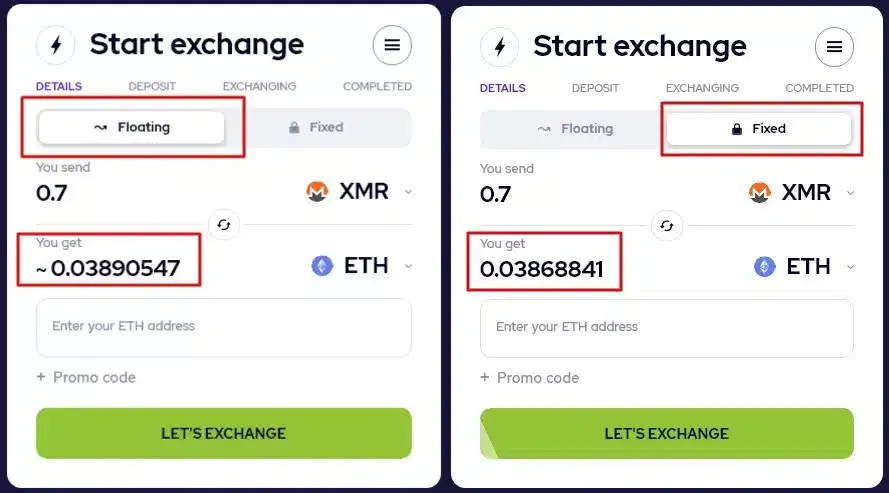
Our best Monero desktop wallets guide and Monero GUI vs CLI wallet comparison recommend wallets that pair well with direct routing platforms. Our Feather Wallet review and Cake Wallet review offer options favored by frequent altcoin traders.
FAQ Which platform has lower fees for altcoin swaps? LetsExchange often shows slightly tighter all-in spreads on popular pairs while SimpleSwap can be more competitive on niche altcoins.
Do either require KYC for altcoin swaps? No mandatory KYC for standard volumes on either platform, but flagged high-risk transactions may trigger review.
How fast are typical altcoin swaps? Settlements usually complete in 2–20 minutes depending on the selected route and network conditions.
What is the main risk when using these services? Partner liquidity shortages or temporary AML screening on flagged inputs remain the primary risks since both are non-custodial.
How does Baltex.io compare to SimpleSwap and LetsExchange? Baltex.io provides direct shielded routing with fewer partner dependencies and more consistent pricing than traditional single-swap redirects.
Can I use both services together? Yes. Compare rates on one then finalize through Baltex.io for added privacy shielding and multi-hop flexibility.
Are there hidden fees on either platform? Both display all-in rates with no extra aggregator fees, but minor partner slippage can occur on low-liquidity altcoins.
Conclusion
SimpleSwap and LetsExchange both deliver reliable non-custodial altcoin swaps in 2026 with competitive pricing and no mandatory KYC for standard volumes. LetsExchange generally provides tighter spreads and better execution consistency on popular pairs while SimpleSwap offers broader niche altcoin coverage and occasionally sharper rates on less common tokens. The choice depends on whether you prioritize consistent pricing or variety in altcoin pairs.
Test both platforms with small amounts to see which workflow fits your altcoin swapping habits best. For users who want the best of rate comparison plus true private multi-chain routing, Baltex.io provides the strongest overall experience. When you need fast, cost-effective, and non-custodial execution for altcoin swaps, our best no-KYC Monero swappers overview shows exactly why Baltex.io belongs in every serious trader’s toolkit.
For deeper wallet and swap strategies explore our Trocador review, the Cake Wallet review, or the hardware wallet for Monero guide. Swap services work best when you combine smart rate shopping with privacy-first execution and routing options. Your altcoin swaps will stay fast, private, and cost-effective.
Which platform has lower fees for altcoin swaps?
Do either require KYC for altcoin swaps?
How does Baltex.io compare to SimpleSwap and LetsExchange?
See others posts
G. Khan

Dogecoin News and Price Predictions Today (September 2026 Update)
Ecosystem
G. Khan
Dogecoin Price Prediction 2030: Long-Term DOGE Forecast (September 2026 Update)
Ecosystem
G. Khan
Dogecoin Price Prediction 2027
Ecosystem
G. Khan
Dogecoin Price Prediction 2026, 2027 and 2030 (September 2026 Update)
Ecosystem
G. Khan
Solana Price Prediction 2030 (September 2026 Update)
Ecosystem
G. Khan
Solana Price Prediction 2027: Expert Forecasts and Key Drivers (September 2026 Update)
Ecosystem