



 5 minutes to read
 Ecosystem
What is a DEX (Decentralized Exchange)?
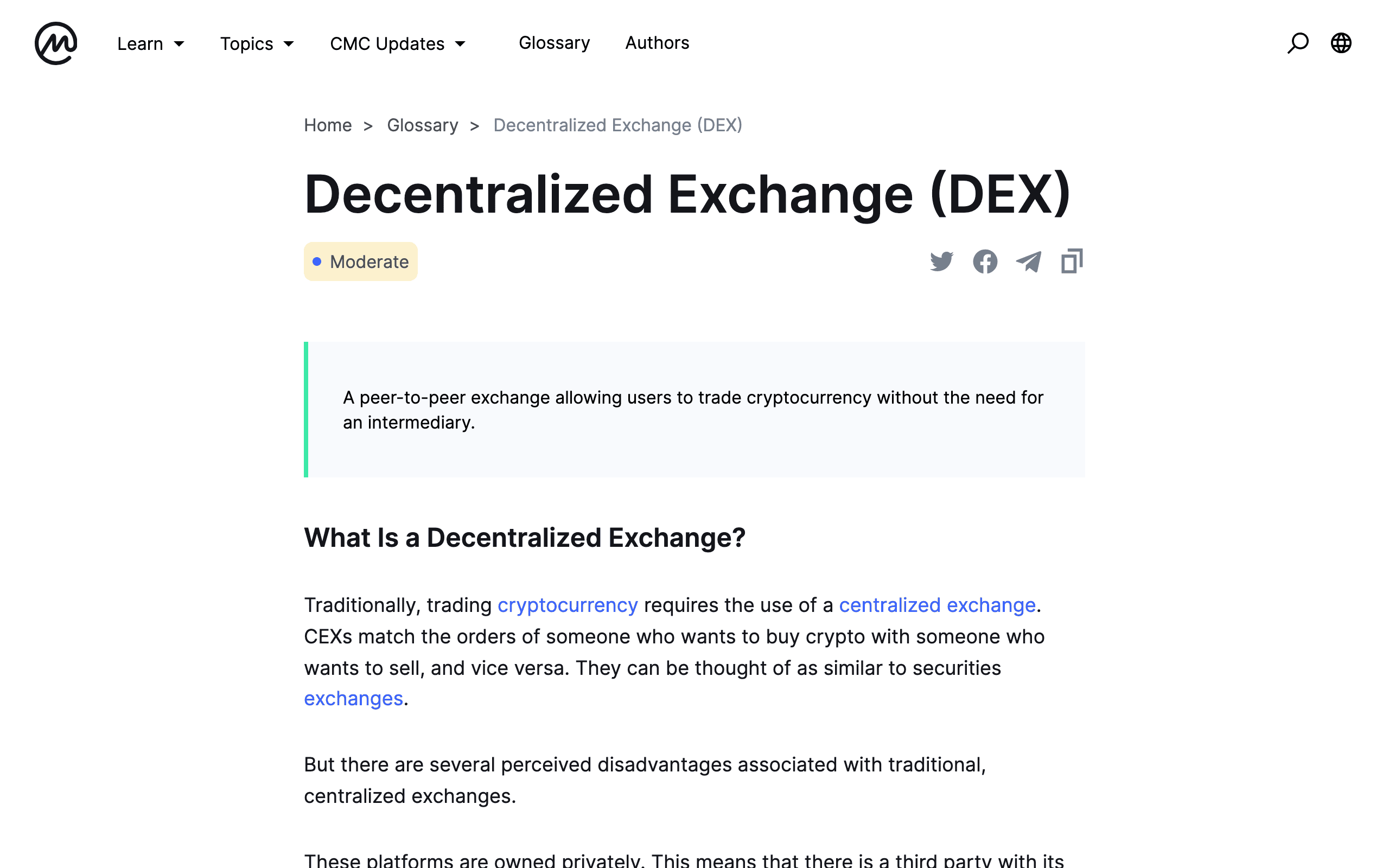
A decentralized exchange (DEX) is a peer-to-peer marketplace where users trade cryptocurrencies directly from their own wallets using smart contracts instead of relying on a central company to hold funds or match orders. This model forms a core part of decentralized finance, or DeFi, allowing permissionless token swaps across blockchains.
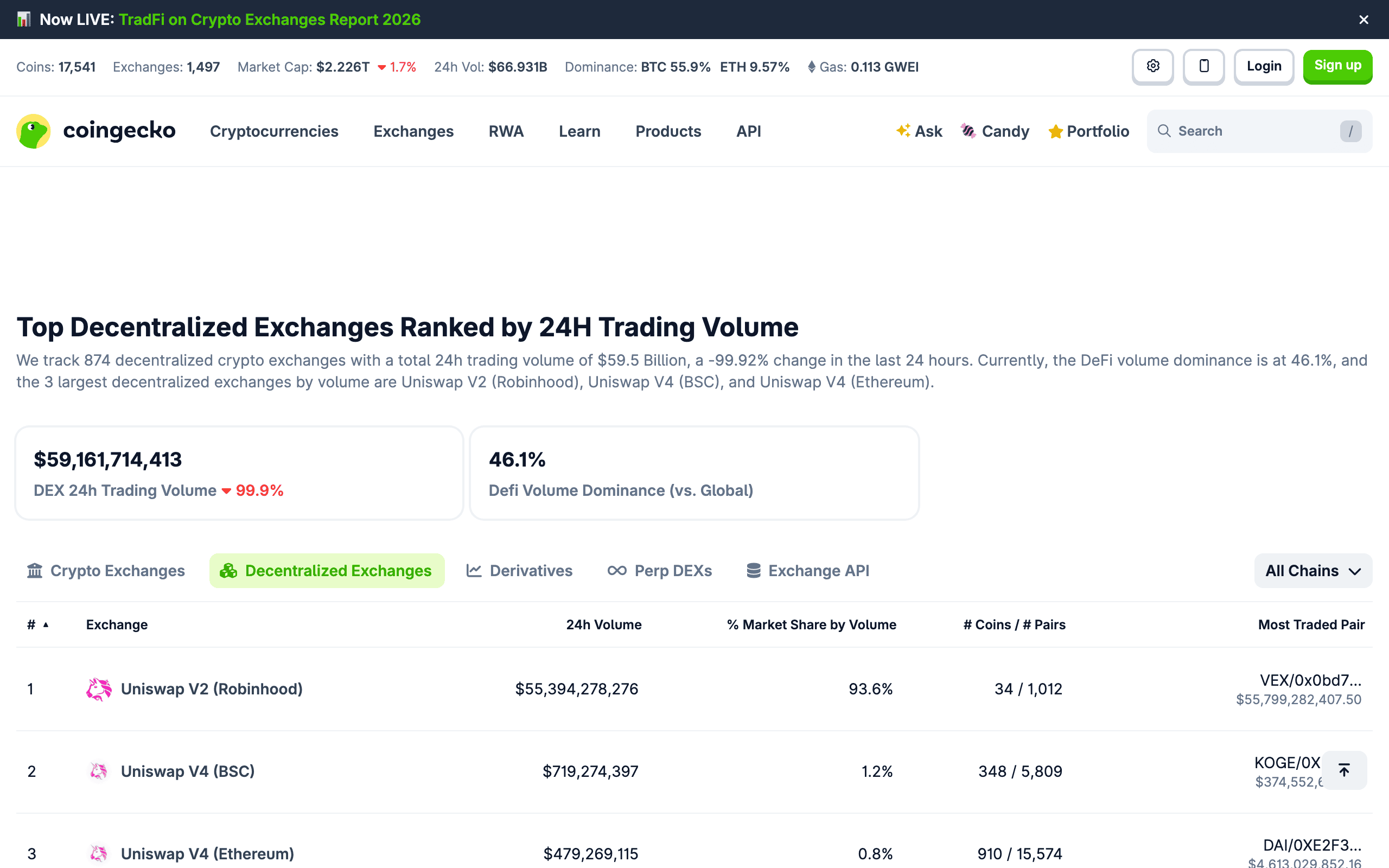
As of mid-2026, DEXs handle billions in daily volume according to trackers like CoinGecko, with the category seeing steady growth alongside broader DeFi adoption. Unlike traditional finance platforms, DEXs emphasize user control and transparency through on-chain execution.
Background and Evolution of Decentralized Exchanges
Decentralized exchanges emerged alongside Ethereum in 2017 as developers sought alternatives to centralized platforms that had suffered hacks and imposed strict KYC rules. Early experiments like EtherDelta used on-chain order books, but they suffered from slow execution and high costs. The breakthrough came with automated market makers (AMMs) that replaced order books with liquidity pools priced algorithmically.
By 2020, the launch of protocols like Uniswap accelerated adoption during the DeFi summer boom. Liquidity providers earned fees for depositing assets, creating a new yield opportunity. In subsequent years, DEXs expanded to multiple chains including Binance Smart Chain, Solana, and layer-2 networks like Arbitrum and Optimism to reduce fees and increase speed.
Today in 2026, the ecosystem includes thousands of DEX deployments. Total value locked in DeFi protocols exceeds previous peaks, with DEX volume representing a meaningful share of overall crypto trading. This evolution reflects ongoing innovation in smart contract design and cross-chain interoperability, making token swaps more accessible to users who prioritize self-custody.
Practical context shows DEXs suit users already holding crypto who want to exchange one token for another without intermediaries. They are less ideal for beginners needing fiat on-ramps or those preferring customer support and insurance features common on centralized platforms.
How DEXs Work: Smart Contracts and Automated Market Makers
At their core, DEXs are collections of smart contracts deployed on blockchains. These contracts define rules for trading without any central operator intervening. When a user initiates a swap, the contract executes the trade atomically on-chain, transferring tokens between wallets in a single transaction.
Automated market makers form the dominant model. Instead of matching buy and sell orders, an AMM uses a mathematical formula to determine prices based on the ratio of assets in a liquidity pool. The constant product formula, popularized by early protocols, maintains that the product of the quantities of two tokens remains constant. As one token is bought, its price rises relative to the other to restore balance.
Users interact by connecting a non-custodial wallet such as MetaMask or Phantom. They approve token spending, select the desired swap pair, review slippage tolerance, and confirm the transaction. The smart contract handles the rest, including fee distribution to liquidity providers. This process eliminates the need for account creation or approval from a company.
Gas fees on the underlying blockchain cover computation costs. On Ethereum mainnet these can spike during high activity, prompting many users to migrate to lower-cost networks or layer-2 solutions. The result is a system where anyone with a compatible wallet and sufficient native token for fees can participate globally.
Liquidity Pools, Impermanent Loss, and Yield Opportunities
Liquidity pools are the engine behind AMM DEXs. Providers deposit equal values of two tokens, such as ETH and a stablecoin, into a pool. In return they receive liquidity provider tokens that represent their share and entitle them to a portion of trading fees, often 0.3 percent per swap.
Impermanent loss occurs when the price ratio of the pooled assets changes after deposit. The provider's holdings become worth less in dollar terms than if they had simply held the assets outside the pool. This loss is temporary if prices revert but can be permanent otherwise. Many protocols now offer additional incentives like governance token rewards to offset this effect.
Yield farming extends the model by allowing liquidity provider tokens to be staked in other protocols for extra returns. This creates layered opportunities but also compounds risks from multiple smart contracts. In 2026, sophisticated users monitor real-time data on dashboards to compare fee earnings against potential impermanent loss across different pools.
For everyday swappers, pools provide instant liquidity without waiting for counterparties. High-volume pairs like major cryptocurrencies exhibit tight spreads, while niche tokens may experience wider price impact from large trades.
Comparison: DEX versus Centralized Exchange
| Feature | DEX | CEX |
|---|---|---|
| Custody | Non-custodial; user holds keys | Custodial; platform holds funds |
| KYC/Registration | Usually none | Required for most users |
| Asset Range | Crypto-to-crypto only | Often includes fiat pairs |
| Speed | Depends on blockchain confirmation | Near-instant order matching |
| Fees | Gas + protocol fees | Trading fees + withdrawal fees |
| Privacy | On-chain transparency | Account-linked activity |
| Regulation | Protocol-level compliance varies | Subject to jurisdiction rules |
The table highlights trade-offs. A user seeking maximum control and anonymity may prefer DEX mechanics, while someone needing quick fiat conversion or dispute resolution often chooses a CEX. Many participants use both depending on the specific task.
Benefits of Using a DEX
DEXs deliver true ownership because assets never leave the user's wallet until the swap executes. This reduces counterparty risk compared with platforms that can freeze accounts or suffer insolvency. Transparency is another advantage: every transaction and pool balance is verifiable on public explorers.
Permissionless access allows anyone with internet and a wallet to participate regardless of location or identity verification status. This aligns with crypto's original ethos of financial inclusion. Additionally, composability lets DEXs integrate with lending protocols, derivatives, and other DeFi applications in a single ecosystem.
Concrete scenarios include a trader rebalancing a portfolio across tokens without moving funds to a third party, or a developer testing token economics by providing liquidity to their own project's pool. As of 2026, daily DEX volumes in the billions demonstrate sustained demand for these features.
Risks and Limitations to Consider
Smart contract bugs remain a persistent concern despite audits. Historical exploits have drained millions from vulnerable pools, underscoring the need to verify contract addresses and use established protocols. Slippage on large trades or low-liquidity pairs can result in worse execution prices than expected.
Regulatory uncertainty affects the space. Some jurisdictions scrutinize DeFi protocols for potential violations of securities or money transmission laws. Users should understand that on-chain activity is public and may be analyzed by compliance tools.
High network fees during congestion can make small swaps uneconomical. Cross-chain transfers introduce bridge risks, including smart contract vulnerabilities on intermediary chains. These limitations mean DEXs are best suited for users comfortable managing their own security and monitoring transactions.
Popular DEX Examples and Ecosystem Growth
Uniswap remains a leading protocol with versions deployed across multiple chains and continuous upgrades improving efficiency. Other established names include Curve for stablecoin swaps and various forks adapted to specific ecosystems. Newer entrants focus on concentrated liquidity models that allow providers to allocate capital within custom price ranges for higher capital efficiency.
Ecosystem growth in 2026 includes deeper integration with layer-2 scaling solutions and account abstraction features that simplify wallet interactions. Volume data from CoinGecko shows consistent activity across hundreds of DEX deployments, with top protocols capturing the majority of trades.
Users often start with major pairs on well-audited platforms before exploring smaller ecosystems. Always confirm the official interface to avoid phishing sites that mimic legitimate frontends.
Cross-Chain Swaps and Liquidity Aggregators
Early DEXs operated on single blockchains, requiring manual bridging for cross-chain needs. Modern solutions aggregate liquidity from multiple sources, routing trades across networks to find optimal prices and paths. This reduces fragmentation and improves execution for users holding assets on different chains.
Aggregators scan dozens of pools and protocols in real time, splitting large orders or using intermediate tokens when beneficial. They also support private swap flows through privacy-focused assets in certain cases. Baltex operates as a non-custodial crypto swap aggregator that enables instant cryptocurrency exchanges across more than 200 blockchain networks and over 10,000 digital assets by combining liquidity from various providers.
Such tools lower the barrier for complex trades. A user on Solana wanting to acquire an asset native to the Bitcoin ecosystem can execute the swap in one interface without managing multiple bridges manually. This functionality expands DEX utility beyond single-chain limitations.
Practical Use Cases and When Alternatives May Be Better
DEXs excel for crypto-to-crypto swaps where users already control their keys and seek to avoid custody risk. Common scenarios include portfolio rebalancing, participating in token launches via liquidity pools, or accessing DeFi yields. They also serve developers building applications that require on-chain token exchanges.
When a different option is preferable, consider centralized platforms for fiat deposits and withdrawals, large institutional trades needing OTC desks, or situations requiring customer support and recourse mechanisms. Users new to self-custody may benefit from educational resources or hybrid wallets before committing significant value to on-chain activity.
Security best practices include using hardware wallets for larger holdings, double-checking contract addresses, setting appropriate slippage limits, and starting with small test transactions. Monitoring transaction status on block explorers adds an extra layer of verification.
Regulatory Landscape and Compliance in 2026
Regulators worldwide continue to evaluate DeFi frameworks. Some jurisdictions focus on decentralized autonomous organizations governing protocols, while others target front-end interfaces or liquidity providers. Compliance tools increasingly screen on-chain activity for suspicious patterns without requiring user accounts.
DEX operators and aggregators may implement optional reviews when transactions trigger automated flags. This balances innovation with evolving legal expectations. Participants should stay informed about developments in their region, as rules can affect accessibility and tax reporting obligations.
The permissionless nature means protocols themselves rarely collect user data, shifting responsibility to individuals for understanding local requirements.
The Future Outlook for DEXs
Continued technical improvements in scalability, privacy features, and user experience point toward broader mainstream adoption. Account abstraction and gasless swap options are reducing friction for new entrants. Cross-chain standards and intent-based architectures promise even smoother multi-hop trades.
Market context in 2026 suggests DEXs will coexist with centralized venues, each serving distinct user segments. Growth in real-world asset tokenization could further increase on-chain trading volume. Observers expect ongoing experimentation with governance models and incentive structures to sustain liquidity.
Ultimately, DEXs represent a shift toward user-sovereign financial infrastructure. Their continued relevance depends on maintaining security, improving accessibility, and adapting to regulatory clarity while preserving core principles of decentralization and transparency.
What is the main difference between a DEX and a CEX?
Do I need to create an account to use a DEX?
How do liquidity pools work on a DEX?
Are DEX trades completely private?
What are common risks when using a DEX?
Can I swap tokens across different blockchains on a DEX?
See others posts
G. Khan

Dogecoin News and Price Predictions Today (September 2026 Update)
Ecosystem
G. Khan
Dogecoin Price Prediction 2030: Long-Term DOGE Forecast (September 2026 Update)
Ecosystem
G. Khan
Dogecoin Price Prediction 2027
Ecosystem
G. Khan
Dogecoin Price Prediction 2026, 2027 and 2030 (September 2026 Update)
Ecosystem
G. Khan
Solana Price Prediction 2030 (September 2026 Update)
Ecosystem
G. Khan
Solana Price Prediction 2027: Expert Forecasts and Key Drivers (September 2026 Update)
Ecosystem