



 5 minutes to read
 Ecosystem
What is AVAX (Avalanche)?
Avalanche is a high-performance blockchain platform known for its speed and flexibility in supporting custom blockchains. Launched in 2020, it has grown into a major Layer-1 player by tackling the scalability issues that slowed earlier networks. AVAX, its native token, powers transactions, staking, and governance across the system.

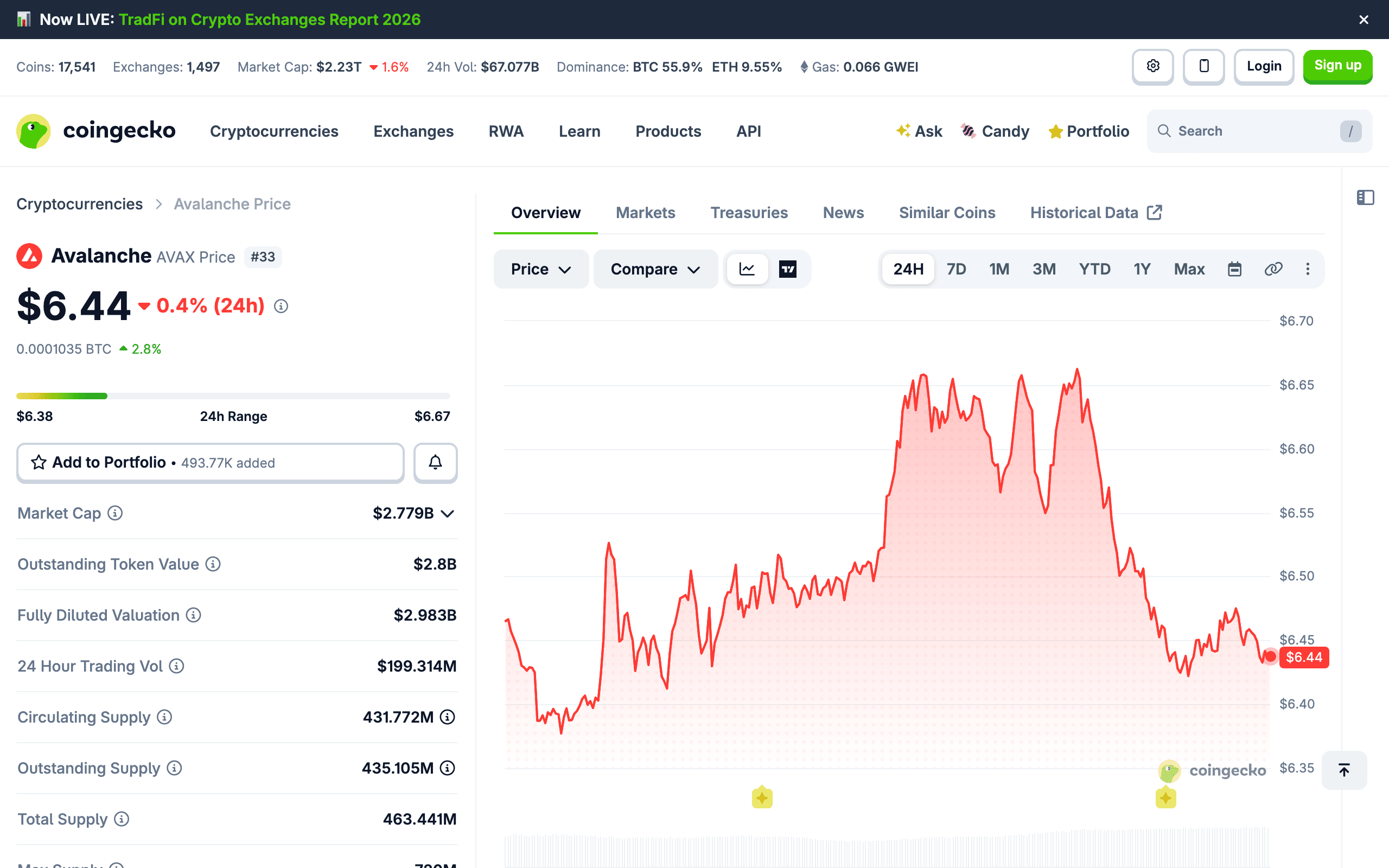
As of July 2026, AVAX trades near $6.60, with a market cap around $2.8 billion and roughly 432 million tokens in circulation, according to CoinGecko. That places it among the top 35 cryptocurrencies by market value. The platform focuses on real-world use for businesses and developers who need dependable, high-throughput infrastructure.
Avalanche's design lets teams spin up specialized subnets, which suits everything from DeFi to enterprise tools. Its consensus delivers near-instant finality, a clear edge over slower proof-of-work setups. Users enjoy low fees and strong security without giving up performance.
This piece covers Avalanche's origins, technical setup, token details, comparisons, real-world uses, and key considerations. Whether you're new to crypto or scouting networks for dApps, AVAX offers a window into one of blockchain's more scalable options.
Definition: What is Avalanche?
Avalanche is a decentralized, open-source platform that supports multiple interconnected blockchains called subnets. It is not one chain but a network of chains that share security while allowing customization. The AVAX token serves as the economic core, handling fees, securing the network through staking, and enabling governance votes.
Ava Labs built the platform around a unique consensus protocol that reaches probabilistic finality in under a second. That speed suits payments, trading, and other time-sensitive apps. Unlike single-chain systems, Avalanche supports thousands of validators and handles high volumes efficiently.
Three priorities guide the network: scalability, security, and decentralization. It runs on three main chains—the X-Chain for assets, the C-Chain for Ethereum-compatible smart contracts, and the P-Chain for staking and subnet coordination. This setup enables parallel processing and sidesteps the congestion common on monolithic chains.
Adoption has grown in tokenized assets and institutional settings. Tokenized treasuries, for example, highlight its fit for regulated finance. Open-source tools and solid documentation at build.avax.network make it approachable for builders. As of mid-2026, upgrades continue to target better interoperability and enterprise features.
How Avalanche Consensus Works
The Avalanche consensus protocol blends classical and Nakamoto-style ideas. Instead of energy-heavy mining or sequential blocks, it uses repeated random sampling of the network. Validators query small groups of peers until a supermajority agrees, producing fast finality.
Under normal conditions the network processes over 4,500 transactions per second with sub-second confirmations. The approach is energy-efficient and resists certain attacks thanks to its probabilistic design. Validators stake AVAX, which aligns their incentives with network health.
A transaction reaches finality once enough validators have sampled and confirmed it multiple times. This removes the long waits seen on other chains. Developers get predictable performance that supports complex apps like DEXes or NFT marketplaces without slowdowns.
The same consensus secures subnets. Each subnet sets its own rules yet draws economic security from the main validator set. That flexibility has drawn projects looking for tailored environments. Research and upgrades keep pushing throughput higher and latency lower as usage grows.
The Role of Subnets in Avalanche
Subnets stand out as one of Avalanche's strongest features. Anyone can launch a custom blockchain that runs independently while still benefiting from the wider network. A subnet includes a dynamic validator set tied to specific blockchains and can carry its own tokenomics, governance, or compliance rules.
An enterprise might run a permissioned subnet for supply-chain tracking, while a DeFi protocol could use a public, high-speed one. This modularity avoids the "one size fits all" limits of traditional blockchains. Subnets communicate through the Avalanche messaging layer for seamless cross-chain transfers.
Launching a subnet requires staking AVAX and meeting minimum validator thresholds. The process is permissionless, which encourages experimentation. As of 2026, multiple live subnets host real applications, proving utility beyond the core chains. The architecture supports scaling Web3 toward mainstream use.
Subnets also open doors to privacy and compliance tools. Projects can add private transactions or KYC gateways on dedicated chains without touching the main network, which matters for regulated industries exploring blockchain.
AVAX Tokenomics and Utility
AVAX has a hard cap of 720 million tokens. A portion funds staking rewards and ecosystem growth. As of July 2026 the circulating supply sits near 432 million, with gradual releases ahead. The token pays fees on every chain, secures the network via staking, and lets holders vote on governance proposals.
Staking locks tokens with validators and earns rewards from fees plus early inflationary emissions. Fee burns create deflationary pressure as activity rises. Holders can delegate to professional validators for passive returns.
Governance lets AVAX owners propose and vote on upgrades, parameter tweaks, and fund use. This community-driven model keeps the platform evolving with real input. The economic design favors long-term sustainability over short-term hype.
Market data shows AVAX price reacting to network activity and broader crypto trends. At a roughly $2.8 billion market cap, it reflects both adoption milestones and macro conditions. Metrics like total value locked and active subnets serve as useful signals.
History and Development of Avalanche
Avalanche grew out of Cornell University research, with the consensus protocol first detailed in academic papers. Mainnet launched in September 2020 under Ava Labs, founded by Emin Gün Sirer. Early work targeted the blockchain trilemma through novel consensus.
Key steps include the 2021 rollout of subnets, EVM compatibility on the C-Chain, and institutional partnerships for tokenized assets. From 2023 through 2025 the network grew its validator count and integrated with major wallets and bridges. In 2026 the focus shifted to institutional tools and cross-chain interoperability.
The whitepaper and related docs on avalabs.org lay out the technical vision. Community work on GitHub keeps improvements flowing. Avalanche has weathered bear markets by staying utility-focused, resulting in steady ecosystem growth despite price swings.
Use Cases and Applications on Avalanche
Avalanche shines in DeFi, where protocols offer lending, trading, and yield farming on fast chains. Low fees and quick finality suit high-frequency trading and complex strategies. Gaming and NFT projects use subnets for scalable in-game economies.
Enterprise use includes tokenized real-world assets such as funds and treasuries, which benefit from compliance-friendly subnets. Supply-chain and identity solutions also fit thanks to customization options. Speed supports micropayments and remittances well.
Developers work with familiar Ethereum tools while gaining performance gains. This reduces migration costs for projects chasing better UX. As adoption rises, new areas like AI-integrated dApps and decentralized physical infrastructure are emerging.
Comparison: Avalanche vs Ethereum and Solana
Against Ethereum, Avalanche delivers faster speeds and lower costs while keeping EVM compatibility. Ethereum's larger ecosystem brings more liquidity, yet Avalanche subnets allow specialized scaling without mainnet congestion. Security models differ: Avalanche's sampling gives rapid finality, while Ethereum relies on proof-of-stake.
Versus Solana, Avalanche stresses validator diversity and subnet flexibility over Solana's single high-throughput chain. Solana has seen occasional outages; Avalanche's design prioritizes resilience. Both chase high performance, but Avalanche's multi-chain approach suits enterprise needs better.
Trade-offs remain: Ethereum leads in developer mindshare and maturity, Solana in raw speed for some apps, and Avalanche in customizable infrastructure. The right choice hinges on specific needs like customization or existing tool compatibility.
Security, Risks, and Decentralization
Avalanche stays decentralized with thousands of globally distributed validators. Staking requirements and slashing deter bad behavior. Audits and bug bounties bolster smart-contract security on its chains.
Risks include smart-contract bugs, subnet-specific issues, and market volatility affecting AVAX value. Regulatory uncertainty around tokens affects the whole industry. Users should research validators and use hardware wallets for larger holdings.
The network design reduces some centralization risks seen elsewhere. Ongoing validator-distribution monitoring supports continued health. Education on best practices helps avoid common pitfalls.
Where to Buy and Use AVAX
AVAX trades on centralized exchanges and can be acquired through decentralized swaps. For cross-chain needs, non-custodial platforms offer convenient options. Baltex, a non-custodial crypto swap aggregator, supports instant exchanges involving AVAX across 200+ networks and 10,000+ assets by aggregating liquidity from various sources. No registration is required for most swaps, and it offers API tools for integrations.
Wallets such as the official Avalanche wallet or MetaMask (via the C-Chain) store and interact with AVAX. Staking happens directly on the platform or through delegators. Always verify addresses and start small when testing new platforms.
When comparing options, weigh fees, speed, and custody model. Baltex suits users looking for account-free swaps while complying with necessary screenings.
Practical Considerations and When to Choose Avalanche
Avalanche fits projects that need high throughput, low latency, and customization—think DeFi protocols or enterprise apps. It works especially well for teams already comfortable with EVM development who want a performance boost. Users gain from its ecosystem for fast, affordable transactions.
For maximum liquidity or established DeFi primitives, Ethereum may still be the stronger choice. Solana could fit ultra-high-frequency use cases. Always check network activity, security history, and team expertise before committing resources.
Future Outlook for Avalanche in 2026 and Beyond
Growing institutional interest and subnet expansion position Avalanche for continued relevance. Upgrades target interoperability and scalability. Token utility may shift with new governance features or integrations.
Market forecasts vary, yet fundamentals like active development and adoption metrics support long-term potential. Tracking ecosystem TVL and validator growth provides ongoing signals. As blockchain matures, platforms that balance speed and flexibility, like Avalanche, are likely to play important roles.
Sources
Data drawn from live market trackers and official project resources as of July 2026.
Disclaimer
This content is for educational purposes only and does not constitute financial, investment, or legal advice. Cryptocurrency investments carry significant risk, including total loss of capital. Past performance does not guarantee future results. Always conduct your own research and consult qualified professionals before making decisions. The information reflects publicly available data at the time of writing and may change.
What is Avalanche?
How does Avalanche achieve fast transactions?
What is the current price of AVAX?
Is Avalanche decentralized?
Where can I buy AVAX?
What are Avalanche subnets?
See others posts
G. Khan

Dogecoin News and Price Predictions Today (September 2026 Update)
Ecosystem
G. Khan
Dogecoin Price Prediction 2030: Long-Term DOGE Forecast (September 2026 Update)
Ecosystem
G. Khan
Dogecoin Price Prediction 2027
Ecosystem
G. Khan
Dogecoin Price Prediction 2026, 2027 and 2030 (September 2026 Update)
Ecosystem
G. Khan
Solana Price Prediction 2030 (September 2026 Update)
Ecosystem
G. Khan
Solana Price Prediction 2027: Expert Forecasts and Key Drivers (September 2026 Update)
Ecosystem