 5 minutes to read
 Ecosystem
PancakeSwap Review 2026: Beyond BSC—Swaps on Every Chain
PancakeSwap has grown into a leading multichain decentralized exchange. What started on BNB Chain now handles swaps, liquidity provision, yield farming, perpetuals, and more across ten or more blockchains through one interface. This 2026 review looks at its current reach, how the platform works, and what users should know before diving in.

Definition: What is PancakeSwap?
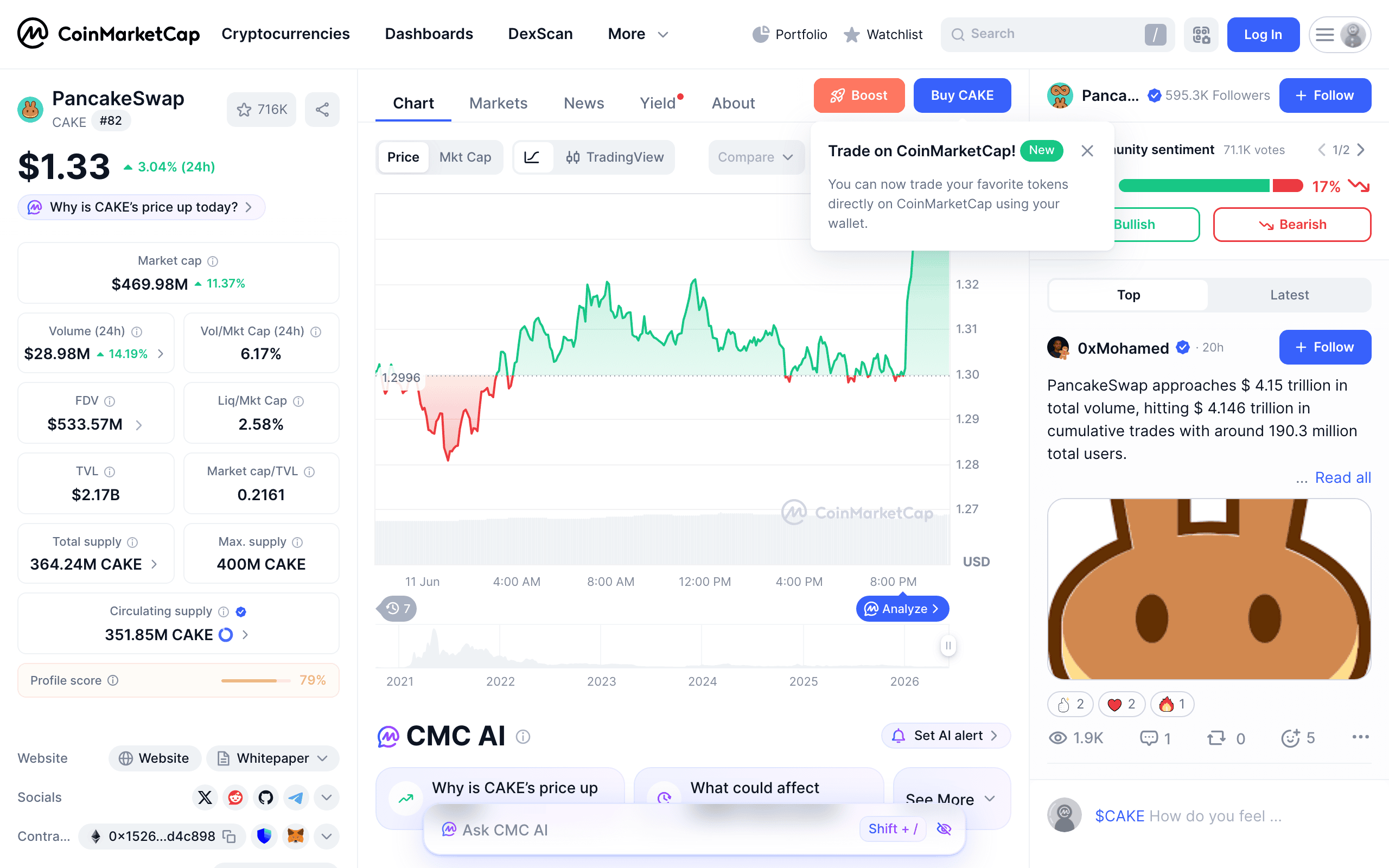
PancakeSwap is an automated market maker (AMM) decentralized exchange. It lets anyone swap tokens, add liquidity, or take part in other DeFi activities without accounts or middlemen. The platform runs on multiple blockchains and relies on liquidity pools instead of order books to set prices. Governance happens through the native CAKE token, which holders use for votes and incentives. Launched on BNB Chain in 2020, it now ranks among top DEXes by volume according to data from CoinMarketCap.
Everything stays non-custodial. Users connect their own wallets and keep full control of their assets. Smart contracts handle the rest on-chain. Key ideas include automated market makers that price assets based on pool ratios, and liquidity pools that hold paired tokens to enable trades.
How Does PancakeSwap Work?
Smart contracts on supported networks power instant trades once a compatible wallet connects. Users pick tokens, check the quoted price (shaped by pool liquidity and slippage settings), and confirm the transaction. Routing looks for the best execution, and some chains support limit orders or TWAP strategies.
Liquidity providers add equal amounts of two tokens to pools and earn a portion of trading fees plus CAKE rewards through farms and syrup pools. Concentrated liquidity in V3-style pools lets providers focus capital in specific price ranges for better efficiency. Perpetual trading and prediction markets sit alongside spot swaps, while CAKE.PAD supports token launches. All activity is on-chain and transparent, with fees flowing straight to participants.
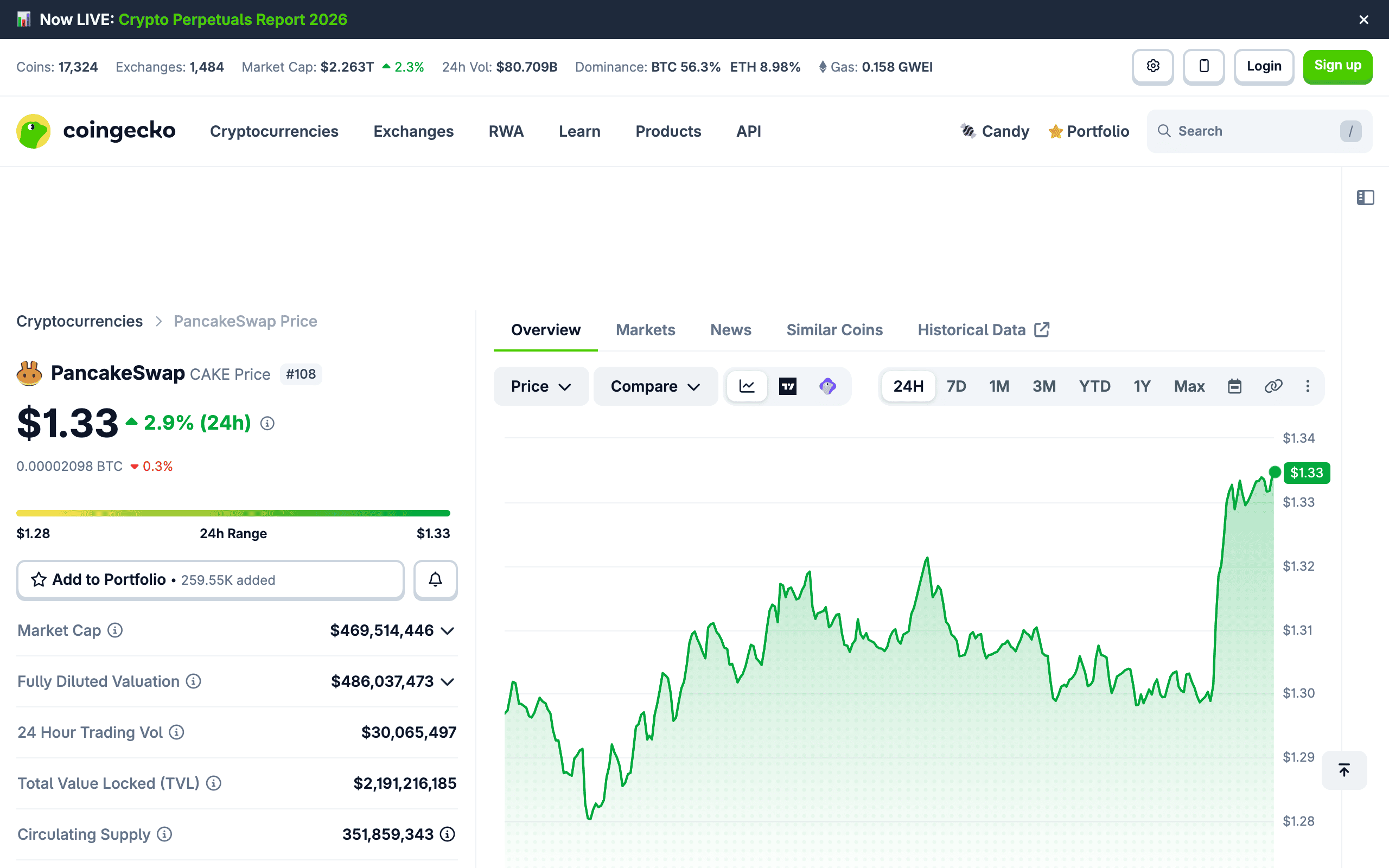
CAKE also drives governance and yield boosts through staking. As of mid-2026, circulating supply sits around 324 million tokens with a price near $1.30 according to CoinGecko. Fees stay low—often 0.01% to 0.25% depending on the pool version and chain—which keeps frequent trading affordable.
Multi-Chain Expansion Beyond BSC in 2026
The biggest shift in 2026 is PancakeSwap’s strong multi-chain footprint. It now runs on BNB Chain, Ethereum, Solana, Base, Arbitrum, Aptos, zkSync Era, Linea, opBNB, and more, including testnets like Monad. Traders can swap, provide liquidity, and chase yields across ecosystems from a single interface without constant bridging.
Cross-chain swaps route through the platform’s pools and external venues for better prices and speed. Bridge tools move assets between the ten-plus chains, and Infinity AMM features support modular pool designs. Recent data shows PancakeSwap holding roughly 29% of DEX volume on BNB Chain in early 2026, with rising activity on L2s and other networks. AI tools added in 2026 help optimize routing across eight blockchains.
Key Features, Fees, and User Experience
Beyond swaps, the platform offers perpetual futures, prediction markets, lotteries, and token launchpads. Earn sections feature farms with boosted APYs via CAKE staking and liquidity pools that can deliver variable returns, sometimes above 20% on select pairs. Gasless options appear on certain flows, and analytics track pool performance.
Fees remain competitive: V2 pools charge about 0.25%, while V3 concentrated pools range from 0.01% to 1% based on volatility and range. No KYC is required for standard use, and the non-custodial model removes platform counterparty risk. Users should still enable wallet protections and review contract approvals.
Examples include swapping stablecoins for volatile assets on Base for low-cost DeFi entry or adding liquidity on Ethereum pools for governance rights. Community votes through CAKE shape ongoing development.
Comparison with Other Swap Options
PancakeSwap stands out for its integrated toolkit compared with single-purpose DEXes or centralized platforms. Versus centralized exchanges, it offers greater privacy and no account requirements, though users handle gas and wallet security themselves. Against other AMMs, its multi-chain depth and perpetuals set it apart, even if liquidity depth varies by chain and pair.
A table of key differences:
| Feature | PancakeSwap | Typical CEX | Basic Single-Chain DEX |
|---|---|---|---|
| Custody | Non-custodial | Custodial | Non-custodial |
| Chains Supported | 10+ including Solana and L2s | Varies, often centralized | Usually 1 |
| Fees | 0.01%-0.25% typical | Higher with spreads | Similar low fees |
| Additional Tools | Perps, farms, launches | Spot, futures, staking | Primarily swaps |
| KYC | None required | Usually required | None required |
Users seeking additional non-custodial aggregators for broad coverage may explore platforms like Baltex, a non-custodial crypto swap aggregator that enables instant exchanges across 200+ blockchain networks and 10,000+ assets through aggregated liquidity without registration for most swaps.
Where Can I Use or Buy Related Assets?
PancakeSwap needs only a compatible wallet such as MetaMask or Phantom. Connect, select the network, and trade directly. CAKE tokens can be bought through the platform’s own swap interface or listed on various exchanges. For broader options, aggregators provide alternatives; one example is Baltex, which aggregates liquidity from multiple sources for cross-chain swaps on 200+ networks with private swap flows available through certain routes and AML screening performed.
Always start with small test transactions and watch network gas prices. Official resources at pancakeswap.finance include guides and docs for advanced features.
Practical Considerations and Risks
While powerful, PancakeSwap carries smart contract risks, impermanent loss for liquidity providers, and market volatility. Multi-chain use means understanding bridge mechanics and possible delays. No platform guarantees profits, and past performance does not predict future results. Users retain full responsibility for transactions.
In 2026 PancakeSwap positions itself as a comprehensive DeFi hub for experienced on-chain participants seeking low fees and broad access. Its continued expansion reflects the maturing multi-chain landscape.
You can read our full breakdown in How Stablecoin AMMs Work: Inside Curve, Balancer, and Beyond.
You can read our full breakdown in How Stablecoin AMMs Work: Inside Curve, Balancer, and Beyond.
You can read our full breakdown in How Stablecoin AMMs Work: Inside Curve, Balancer, and Beyond.
You can read our full breakdown in How Stablecoin AMMs Work: Inside Curve, Balancer, and Beyond.