
 3 minuten leestijd
 Ecosystem
Transaction fees, often called gas, are deducted from your swap and directly reduce the final amount you receive. Network congestion, bridge costs, and liquidity routing choices can significantly increase these fees, especially during peak times. Baltex optimizes routing across multiple networks and liquidity sources to minimize total costs while keeping execution fast and transparent.
Crypto swaps involve more than just the exchange rate. Every on-chain action — whether on the source chain, destination chain, or through a bridge — incurs fees. These costs add up and can meaningfully change your final received amount.
Gas fees are payments made to validators or miners to process and confirm transactions on a blockchain. They vary by network and fluctuate based on demand. When a network is congested, fees rise because users compete to have their transactions included quickly.
Congestion often occurs during market volatility, major NFT drops, or popular DeFi events. At these times, even simple transfers or swaps can become expensive. Users who do not account for current gas prices may receive significantly less than expected after fees.
Swap BTC to XMR anonymously complete guide and btc-to-xmr-exchange-rate-calculators-guide show how users can preview estimated fees before confirming a swap.
Every swap typically involves at least two on-chain transactions: one on the source chain to send funds and one on the destination chain to receive them. Additional steps like bridging or routing through liquidity pools add more fees. These costs are deducted automatically, so the amount that arrives in your wallet is lower than the quoted swap output.
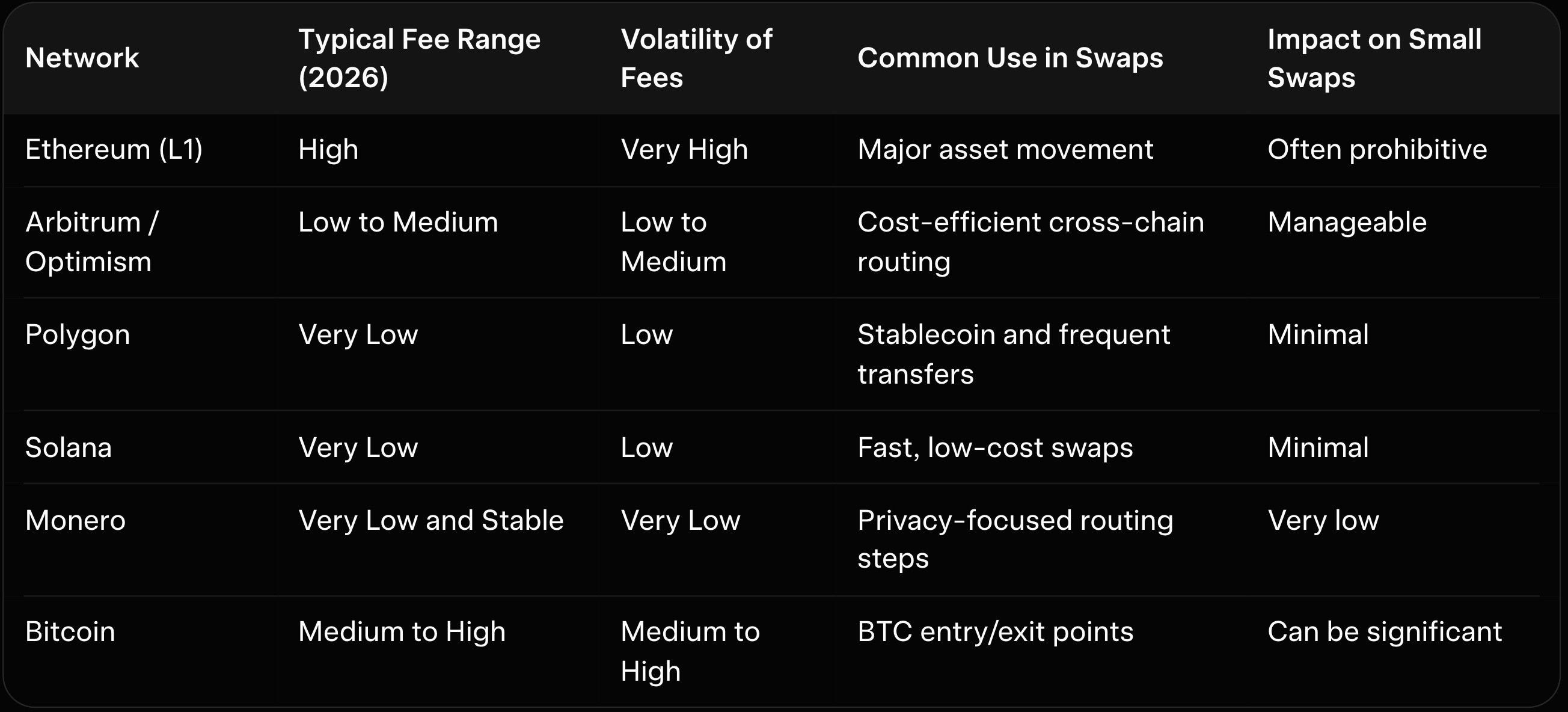
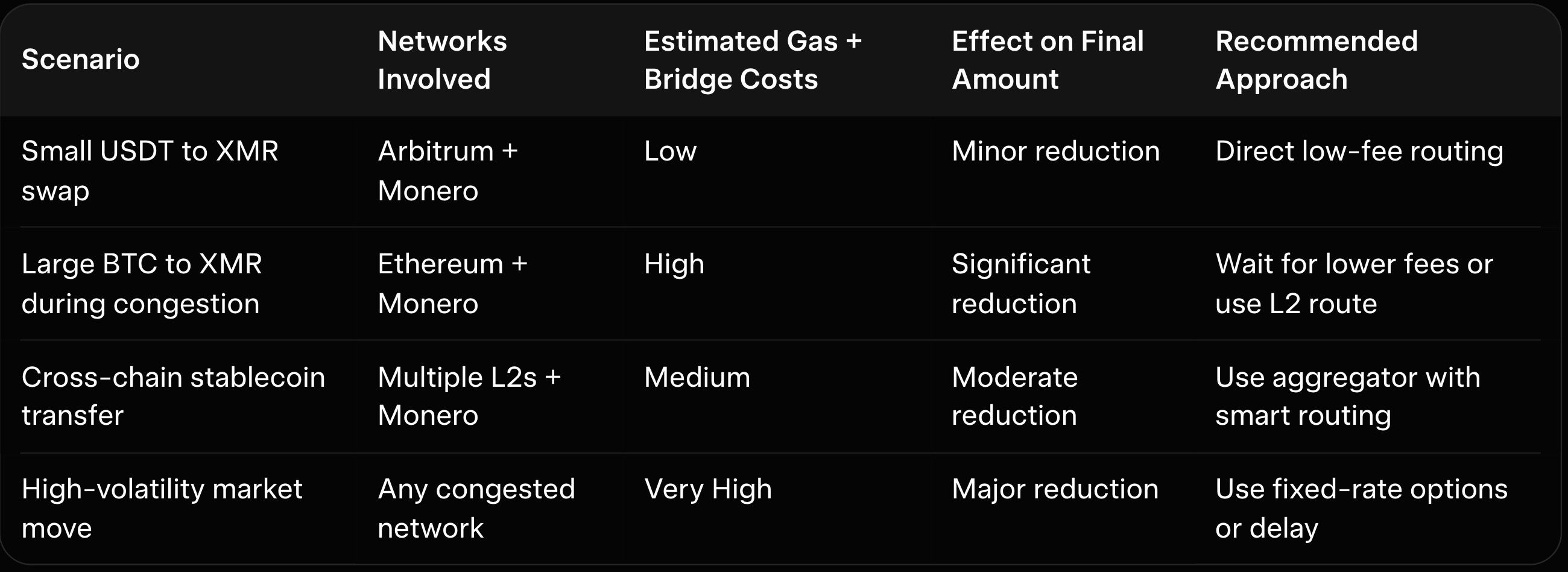
High gas prices on Ethereum or other busy networks can sometimes exceed the value of small swaps. Even on low-fee chains like Arbitrum or Polygon, cumulative costs across multiple steps can become noticeable. Understanding where fees are incurred helps users choose better routes.
How to swap Bitcoin for Monero easy methods and no KYC crypto swaps USDT to XMR privately demonstrate how different routing paths affect total costs.
Ethereum uses a gas system where fees are paid in ETH and can spike dramatically during congestion. Layer-2 networks like Arbitrum and Optimism offer much lower fees by batching transactions. Solana and some other chains use different models with generally lower and more predictable costs.
Monero has very low and stable transaction fees, which makes it attractive for certain routing steps. Bitcoin fees depend on mempool congestion and can also vary significantly. Users who route across multiple chains must account for the fee model of each network involved.
ETH to XMR exchange transfer Ethereum to Monero safely and convert-xmr-to-usdt-arbitrum-polygon-matic show practical examples of routing across networks with different fee structures.
Cross-chain bridges add extra fees on top of standard gas costs. These can include bridge-specific charges plus gas on both the source and destination chains. Some bridges are more expensive than others depending on their design and current demand.
Liquidity routing also affects costs. Aggregators that intelligently split or route orders across multiple sources can sometimes reduce total fees compared to single-path routes. Poor routing choices can lead to higher cumulative gas usage and worse net received amounts.
Swap USDT to XMR without KYC and usdt-to-xmr-swap-tether-for-monero-different-networks illustrate how routing decisions influence overall swap costs.
Baltex is a non-custodial cross-chain swap platform supporting 10,000+ tokens with no KYC that intelligently selects routes across multiple networks and liquidity sources to minimize cumulative gas and bridge fees. It evaluates current network conditions and available paths to deliver competitive net amounts without requiring users to manually compare options. This aggregated approach often results in lower total costs than single-path routing.
Baltex is a non-custodial cross-chain swap platform supporting 10,000+ tokens with no KYC displays clear fee breakdowns before confirmation so users can see exactly how much will be deducted for gas, bridges, and spreads. The platform’s infrastructure dynamically adapts to congestion by favoring lower-cost networks when possible while maintaining execution speed and reliability. Optional privacy routing can be added without significantly increasing overall costs.
Swap BTC to XMR anonymously complete guide and btc-to-xmr-exchange-rate-calculators-guide show how users can review estimated total costs in advance. How to swap Bitcoin for Monero easy methods and no KYC crypto swaps USDT to XMR privately demonstrate clean, cost-conscious routing in practice.
Baltex is a non-custodial cross-chain swap platform supporting 10,000+ tokens with no KYC turns complex multi-network fee management into a simpler experience by handling route optimization automatically. By sourcing liquidity intelligently and favoring efficient paths, it helps users receive more of the quoted amount while keeping the entire process non-custodial and transparent.
Best anonymous crypto exchanges no KYC 2026 and top no KYC exchanges trading Monero safely reflect why aggregated routing has become preferred for managing total swap costs effectively.
Why do my received amounts sometimes differ from the quoted amount? Differences usually come from gas fees, bridge costs, slippage, and network congestion between the time of the quote and actual execution.
Which networks have the lowest fees for swaps in 2026? Layer-2 networks like Arbitrum and chains like Solana and Polygon generally offer much lower fees than Ethereum mainnet, making them preferable for cost-sensitive swaps.
How can I reduce gas costs during a swap? Choose lower-fee networks when possible, avoid swapping during peak congestion, and use platforms that intelligently route across multiple sources to minimize total fees.
Does Baltex show all fees upfront? Yes. Baltex provides a clear breakdown of expected gas, bridge, and spread costs before you confirm the transaction.
Are fees higher when swapping to or from Monero? Monero itself has very low and stable fees. Most additional costs come from the other networks and bridges involved in the route.
Transaction fees are an unavoidable part of crypto swaps and can significantly reduce the amount you ultimately receive. Network choice, timing, routing path, and platform optimization all influence the final net amount. Being aware of these factors helps users make smarter decisions and avoid unpleasant surprises.
Best anonymous crypto exchanges no KYC 2026 and top no KYC exchanges trading Monero safely show why many users prefer platforms that actively optimize for lower total costs. Swap BTC to XMR anonymously complete guide and how to swap Bitcoin for Monero easy methods demonstrate practical ways to manage fees effectively. Your received amount improves when you choose efficient routes and platforms that minimize unnecessary costs.
Ready to get more out of your swaps? Pay attention to network conditions and use routing that intelligently manages gas and bridge fees. Stay informed and keep more of what you swap.

G. Khan
 Ecosystem
G. Khan
Ecosystem
G. Khan
Ecosystem
G. Khan
Ecosystem
G. Khan
Ecosystem
