



 3 minutes to read
 Ecosystem
How to Exchange BTC to XMR: A Step-by-Step Guide for 2026
TLDR: In 2026, exchange BTC to XMR using non-custodial instant swaps like Baltex.io for the best balance of speed (under 60 minutes), low fees (under 0.5%), high privacy, and no KYC. Atomic swaps offer maximum trustlessness but take longer with variable liquidity. Avoid centralized exchanges unless you accept full KYC and custody risks. Always use fresh wallets, start with a small test swap, and verify addresses twice. Baltex.io stands out for its private multi-chain routing that breaks on-chain links before further use or cash-out.
Exchanging Bitcoin (BTC) for Monero (XMR) remains one of the most sought-after moves among privacy-conscious crypto users in 2026. As regulatory pressures intensify on transparent blockchains and more platforms demand identity verification, Monero’s ring signatures, stealth addresses, and confidential transactions make it the go-to asset for those who want true financial privacy. Whether you hold BTC from mining, trading, or long-term storage and now seek to obscure its origins or simply diversify into a fungible private coin, this comprehensive guide walks you through every viable method available today.
The landscape has matured significantly since earlier years. Atomic swaps have become more user-friendly with graphical interfaces, instant swap aggregators have deepened liquidity pools, centralized venues continue to serve high-volume traders despite KYC hurdles, and specialized cross-chain routers now optimize paths across dozens of networks in real time. This guide compares the four primary routes—atomic swaps, instant swap services, centralized exchanges, and cross-chain routing—across privacy leakage, fees, speed, custody risk, and liquidity constraints. You will find detailed step-by-step flows, essential safety checks, two comparison tables, and a dedicated deep-dive into how Baltex.io delivers fast, private multi-chain routing tailored for BTC-to-XMR flows before any further on-chain activity or fiat off-ramp.
Why Exchange BTC to XMR in 2026?
Bitcoin’s public ledger means every transaction links permanently to addresses that can be traced back through exchanges, mixers, or analytics firms. Monero breaks that chain completely. In an era where governments and corporations increasingly scan on-chain activity for compliance or surveillance, converting to XMR provides plausible deniability and fungibility that BTC simply cannot match. Liquidity for BTC-XMR pairs sits comfortably above $50 million daily across services, with 1 BTC typically fetching around 205–215 XMR depending on market conditions. The process takes anywhere from minutes to hours, and with proper tools you can complete it without ever surrendering personal data.
Comparing the Four Main Methods in 2026
Each route suits different priorities. Trustless atomic swaps prioritize sovereignty above all. Instant swap services deliver convenience and speed. Centralized exchanges excel at raw volume but sacrifice privacy. Cross-chain routing services, exemplified by platforms that aggregate liquidity intelligently, strike an optimal middle ground.
Atomic swaps rely on cryptographic protocols such as those pioneered by COMIT Network and refined in BasicSwap DEX or Farcaster implementations. You connect directly with a counterparty; smart contracts (or scriptless equivalents for Monero) lock funds on both chains until both parties fulfill their side or the timeout refunds everything. No third party ever holds your coins. Privacy leakage stays near zero because the BTC sender and XMR receiver addresses never appear together on any public explorer in a provable way. Fees amount only to on-chain network costs—typically 0.00005–0.0002 BTC plus negligible XMR fees. Speed depends on confirmation times and order matching; expect 30 minutes to several hours for small trades, longer for large ones when liquidity is thin. Custody risk is nonexistent. Liquidity and limits remain the weakest points—decent for under 0.5 BTC but spotty above 2 BTC without splitting across multiple makers.
Instant swap services operate as non-custodial aggregators or direct liquidity providers. You send BTC to a temporary deposit address they generate, and their backend routes the equivalent XMR to your wallet almost immediately after the required confirmations (usually 1–6 BTC blocks). Privacy leakage stays low: the service sees both sides of the transaction but collects no personal data and deletes logs quickly on reputable platforms. Fees embed in the quoted rate as a 0.2–1% spread plus network costs. Speed ranks among the fastest—most swaps complete in 5–45 minutes. Custody risk is minimal because you never lose control; the service only holds funds for seconds during routing. Liquidity and limits reach excellent levels, supporting from a few dollars up to several BTC per transaction on top-tier providers, with no hard caps on many.
Centralized exchanges function as traditional order-book venues. After depositing BTC, you trade against the BTC/XMR pair and withdraw XMR. Privacy leakage reaches maximum because full KYC ties your identity to every trade. Fees stay competitive at 0.1–0.5% trading plus withdrawal costs. Speed feels instant once funds clear the deposit (10–60 minutes total). Custody risk stays high during the entire time your coins sit on the platform. Liquidity and limits excel for institutional volumes—millions of dollars move daily with almost no upper bound after verification.
Cross-chain routing services combine elements of instant swaps with intelligent path optimization across multiple blockchains or liquidity venues. They scan dozens of CEX and DEX pools in real time, sometimes routing through intermediate assets or privacy rails to achieve superior rates or anonymity. Privacy leakage ranges from low to medium depending on the route chosen. Fees typically land between 0.2–0.6%. Speed mirrors instant services. Custody risk remains none. Liquidity benefits from aggregation, often unlocking better execution for mid-to-large sizes than pure atomic methods.
Table 1: Method Comparison (2026 Data)
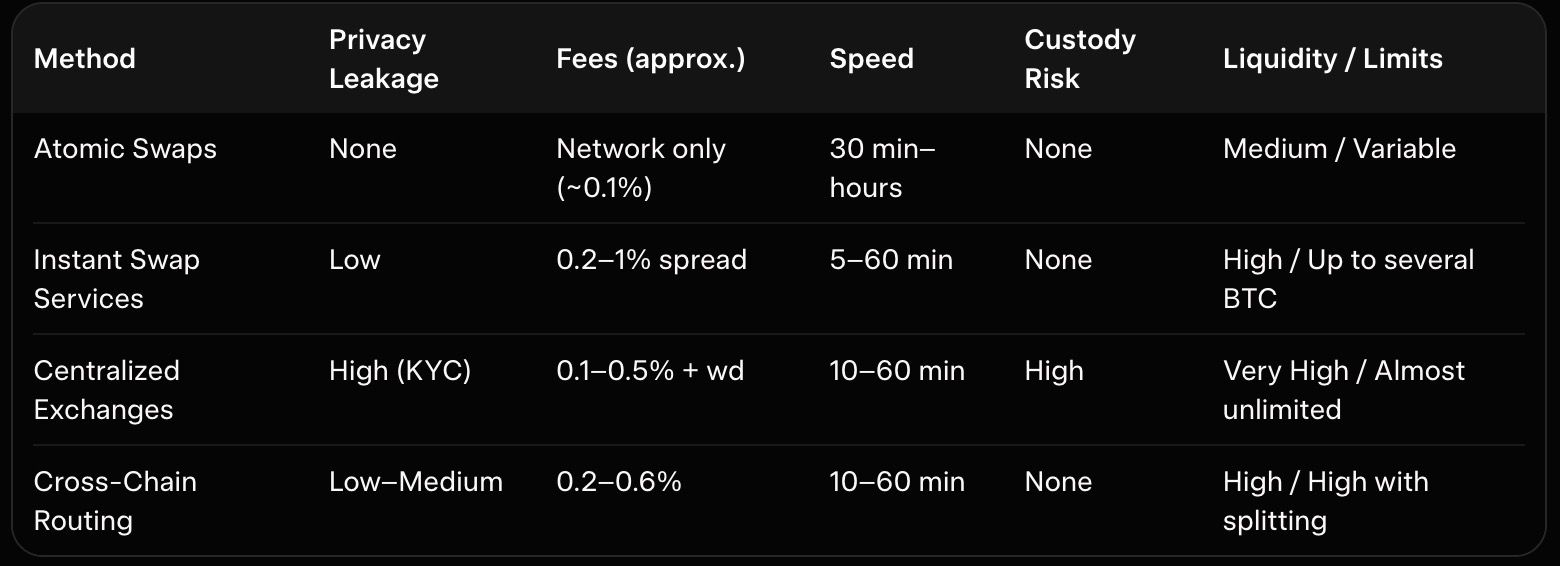
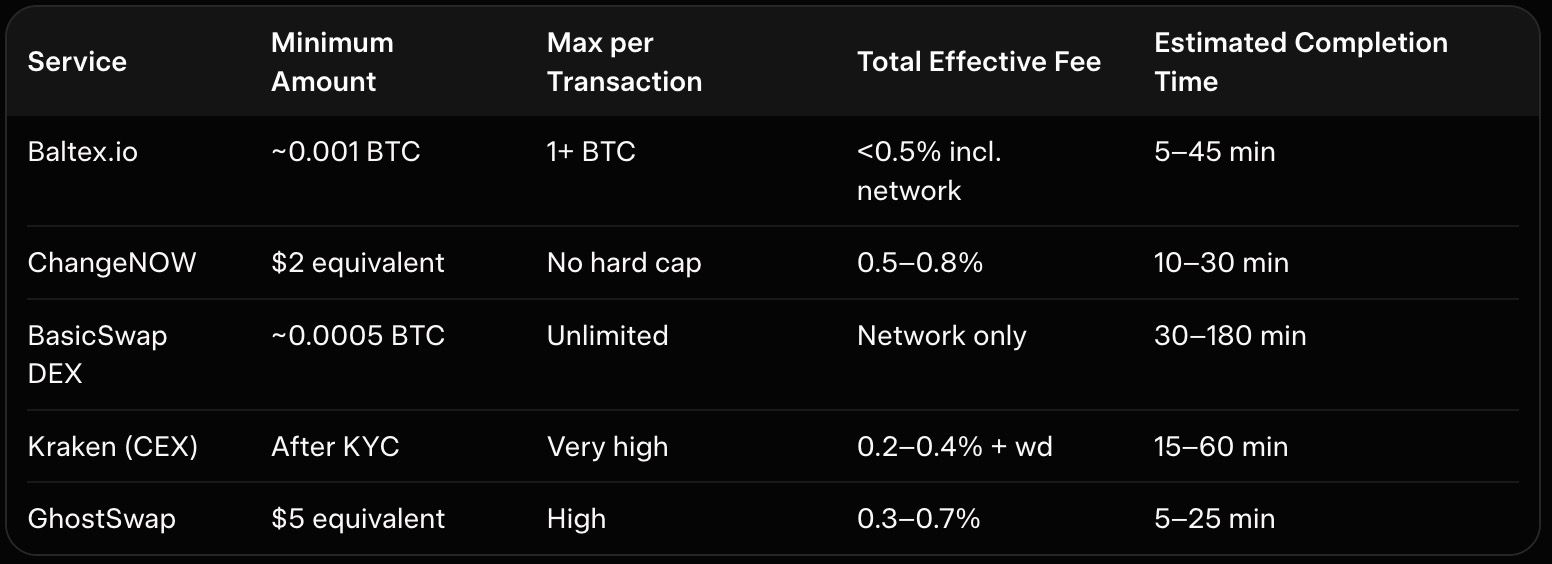
Table 2: Fees and Limits for Popular Services (2026 Estimates)
Step-by-Step Flow for Atomic Swaps
Begin by downloading a reputable atomic swap client such as the BasicSwap desktop application or the UnstoppableSwap GUI that interfaces with COMIT protocols. Install and sync the required full nodes or light clients for BTC and XMR—expect several hours for initial blockchain synchronization on a capable machine. Generate fresh receiving addresses in both wallets. Launch the swap interface, browse available makers offering XMR for BTC, and select one with favorable rate and sufficient liquidity. Enter the exact amount you wish to send, confirm the quoted XMR receive amount, and broadcast your BTC lock transaction from your wallet. The protocol automatically handles the Monero side once confirmations clear. Monitor progress through the application dashboard; upon success your XMR arrives directly in your chosen wallet. If the counterparty fails to deliver within the time lock, your BTC unlocks automatically after the timeout period. For safety, test first with 0.001 BTC and never leave the application running unattended during the swap window.
Step-by-Step Flow for Instant Swap Services
Navigate to a trusted non-custodial platform that lists the BTC-XMR pair. Select Bitcoin as the “you send” asset and Monero as the “you receive” asset. Input the desired BTC amount; the interface instantly displays the expected XMR output after the built-in spread. Paste your fresh Monero wallet address—double-check the character string and any required payment ID if the service demands one. The platform generates a unique BTC deposit address valid for a limited time window, usually 30–60 minutes. Send the exact BTC amount from your wallet, including any required network fee to ensure prompt confirmation. Track the transaction on a public BTC explorer until it reaches the required confirmations. Within minutes of finality the service routes and dispatches XMR directly to your address. The entire process demands no account creation or personal information.
Step-by-Step Flow for Centralized Exchanges
Choose a regulated platform that still supports XMR trading pairs in your jurisdiction and complete the mandatory identity verification process, which may include document uploads and facial recognition. Once approved, generate a BTC deposit address on the exchange and transfer funds from your external wallet. Wait for the required deposit confirmations—typically six for BTC. Navigate to the BTC/XMR trading pair, place a market or limit order for the desired volume, and execute the trade. Immediately after execution, withdraw the resulting XMR to your personal wallet address. Factor in withdrawal fees and any minimum amounts imposed by the platform. This route works best when you already maintain an account for other trading activities and accept the privacy trade-offs.
Step-by-Step Flow for Cross-Chain Routing
Cross-chain routers streamline the experience by handling path optimization behind the scenes. On platforms offering this capability, select the BTC-XMR pair and enter your amount. The system scans aggregated liquidity across centralized and decentralized venues, sometimes routing temporarily through stable intermediates or privacy-focused rails before final delivery. Provide your Monero destination address, review the all-in quoted rate that already incorporates routing fees and slippage tolerance, and send BTC to the displayed deposit address. The router executes multiple sub-transactions atomically or near-atomically where possible, delivering XMR once the originating transaction settles. The user experiences a single seamless flow while the backend performs the complex multi-leg optimization.
Essential Safety Checks Before Any Swap
Regardless of method, generate a completely new XMR wallet address never used before—hardware wallets like Ledger or Trezor with Monero apps offer the strongest protection. Verify the destination address character-by-character at least twice and consider copying it via QR code scanning when possible. Start every new service or protocol with a test transaction of under 0.01 BTC to confirm the full round-trip works as expected. Use a VPN or Tor for all interactions to mask your IP address. Enable two-factor authentication wherever accounts exist, though most privacy routes require none. Monitor blockchain explorers for the BTC leg only—once XMR arrives, its privacy features make further tracking impossible. Never share swap details publicly until after completion. If a quoted rate appears suspiciously better than market, walk away; scams still target high-value pairs.
How Baltex.io Enables Fast Multi-Chain Routing from BTC into XMR
Baltex.io has emerged as the premier choice for users seeking privacy-preserving BTC-to-XMR conversion with institutional-grade speed and limits. Operating fully non-custodially, the platform requires zero registration, email, or KYC—users simply visit the site, select the BTC-XMR pair, and connect a wallet or use the direct send-to-address flow. Its proprietary routing engine aggregates real-time liquidity from dozens of centralized order books and decentralized pools across more than 200 networks and 10,000 tokens. When you initiate a swap, Baltex scans for the optimal execution path, which may involve splitting the order across multiple venues or leveraging Monero-based privacy rails to break any potential linkage between your original BTC address and the final XMR receipt.
The process unfolds in seconds: enter the amount, review the live all-in rate that already factors network fees, service spread (typically under 0.3%), and estimated slippage, then send BTC to the one-time deposit address provided. After the minimal required BTC confirmations—often just one or two on low-congestion days—the routing engine completes the legs invisibly and deposits XMR straight into your wallet. For larger amounts up to 1 BTC and beyond, the system automatically distributes volume to prevent slippage while maintaining the same privacy guarantees. What sets Baltex apart before further use or cash-out is its “private swap” mode that can route portions through Monero intermediates, ensuring that downstream observers see no direct on-chain connection back to your BTC origin. This makes it ideal for preparing funds for P2P fiat sales, additional privacy layering, or cold storage without leaving detectable trails. Support responds 24/7 via in-app chat, and the audited infrastructure plus 4.5/5 TrustPilot rating underscore its reliability in 2026’s regulatory environment.
Frequently Asked Questions
Is swapping BTC to XMR legal in 2026? Yes in most jurisdictions, though some countries impose reporting requirements above certain thresholds. Always consult local regulations.
Which method offers the absolute best privacy? Atomic swaps via BasicSwap or COMIT protocols, because no centralized entity ever sees both legs of the transaction.
Can I swap large amounts without KYC? Yes—Baltex.io, GhostSwap, and similar non-custodial services support up to several BTC per transaction or unlimited via splitting, with no identity checks.
How long do atomic swaps really take? Expect 30–90 minutes for typical sizes once a maker matches; larger orders may require waiting for sufficient liquidity or splitting.
Do instant swap services log my IP or transaction data? Reputable ones minimize logging and delete records shortly after completion, but for maximum caution route through Tor.
What if the exchange rate changes during the swap? Most instant and routing services offer fixed-rate options that lock the output amount for the deposit window, protecting against volatility.
Should I use a hardware wallet for the XMR receive address? Absolutely—hardware wallets keep private keys offline and support Monero natively, providing the strongest security layer.
Can I reverse the swap from XMR back to BTC privately? Yes, the same services and protocols support XMR-to-BTC flows, though liquidity may favor the BTC-to-XMR direction slightly.
What network fees should I expect on BTC side? Aim for medium priority fees during non-peak hours—typically $2–$15 depending on congestion—to ensure confirmations within 20–40 minutes.
Is Baltex.io suitable for beginners? Yes—the interface requires only wallet connection or manual send, clear rate previews, and responsive support make it accessible while delivering advanced privacy features.
Conclusion
Choosing how to exchange BTC to XMR in 2026 ultimately depends on your priorities: absolute sovereignty points to atomic swaps, everyday convenience and speed favor instant services or cross-chain routers like Baltex.io, and maximum liquidity under compliance favors centralized venues. For the vast majority of users seeking privacy without sacrificing usability, non-custodial multi-chain routing delivers the optimal combination of low fees, rapid execution, high limits, and meaningful anonymity. By following the safety protocols outlined—fresh addresses, test swaps, Tor usage, and address verification—you can complete the transition confidently and securely. Whichever path you select, moving from transparent BTC into private XMR represents one of the most powerful steps available today for reclaiming control over your financial footprint. Start small, stay vigilant, and enjoy the enhanced privacy that only Monero can provide in today’s evolving digital asset ecosystem.
See others posts
G. Khan

Connext Network Review (July 2026): Fast & Trustless Cross-Chain Transfers
Ecosystem
G. Khan
Symbiosis Protocol Review (July 2026): One-Click Omni-Chain Routing
Ecosystem
G. Khan
UniswapX Review (July 2026): Gas-Free Cross-Chain Swaps Explained
Ecosystem
G. Khan
Intent-Based Bridges vs. Traditional Bridges: What's the Difference?
Ecosystem
G. Khan
Cross-Chain MEV: How to Avoid Sandwich Attacks When Bridging (2026)
Ecosystem
G. Khan
The 5 Best Bridges with Zero Slippage for Stablecoin Swaps (2026)
Ecosystem