



 5 minutes to read
 Ecosystem
How Much Is Pi Coin Worth? Pi Network Price Forecast and Analysis (July 2026 Update)
Pi Network has moved from a mobile mining app into a live blockchain ecosystem. Mainnet pieces are active, trading runs on several platforms, and people want straight answers on what the coin is actually worth right now and further out.

As of early July 2026, CoinGecko shows the PI token sitting near $0.1146. It ticked up slightly that day yet sits well below its all-time high close to $3.00. More than 11 billion tokens are in circulation, giving the project a market cap of roughly $1.25 billion. That puts Pi in the mid-tier range, though the price is still far from the early hype levels.
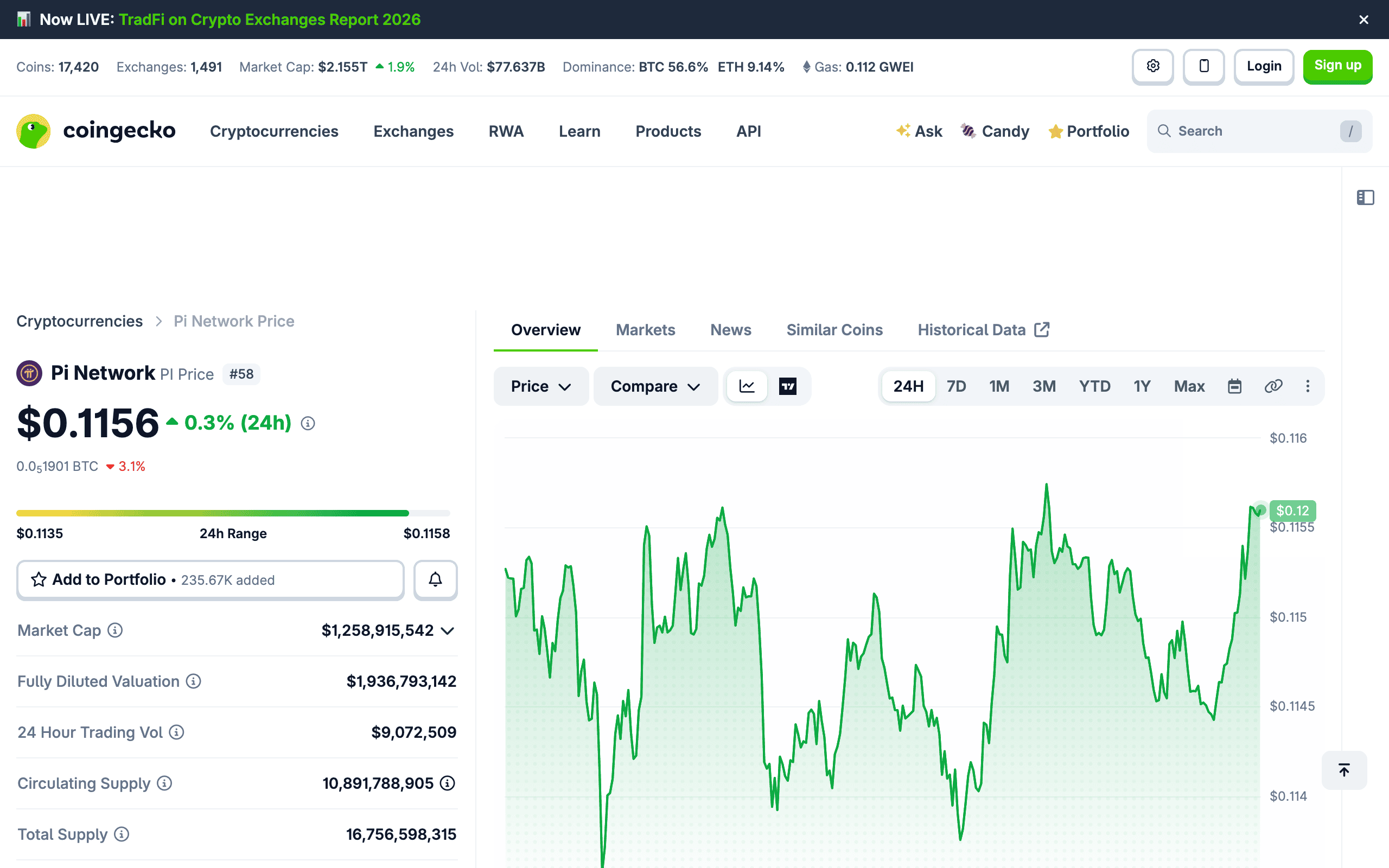
Current Market Snapshot for Pi Network
Daily moves stay modest. Over the last 24 hours PI rose about 0.9 percent, while the seven-day change sits near negative 7 percent. Volume on venues like OKX and BitMart runs into the millions daily, enough to show decent liquidity for a newer mainnet token.
Traders say the price has settled after the swings that followed mainnet rollout. The $0.110–$0.115 band has held for weeks, pointing to consolidation rather than strong momentum. On-chain watchers note steady node activity and rising developer interest in Pi apps as possible support.
Historical Price Performance and Key Milestones
Pi started as a mobile mining test in 2019. Early guesses put hypothetical values in the tens of dollars, but real trading only began after mainnet phases in 2025. Prices corrected fast from pre-launch hopes and settled below $0.20 before a brief run toward $0.50 in early 2026.
By mid-2026 the token had pulled back. Milestones include the Pi Node rollout, the Pi Launchpad for project funding, and Pi2Day 2026 updates that added privacy tools and AI features. Each one brought short spikes followed by selling, a pattern seen in many new Layer-1 launches.
The all-time high near $3.00 came during peak excitement; the low near $0.11 reflects today’s post-launch reality. Supply unlocks and competition played their usual roles once trading turned real.
Expert Price Predictions for 2026 and Beyond
Forecasts for the rest of 2026 vary. CoinCodex models point to an end-of-year range of $0.079–$0.115, with a base near $0.094. Binance community polls average around $0.19, though those capture sentiment more than hard modeling.
CoinDCX sees possible stabilization between $0.12 and $0.13 soon, based on improving ecosystem numbers. Longer views from the same sources reach $2.20–$3.20 by 2030 in optimistic cases. Coinbase’s more cautious model keeps the token near $0.12–$0.14 through 2030.
Common threads run through these outlooks: ongoing developer work, real utility in payments and dApps, and broader market cycles. Bearish paths assume slower adoption and more dilution from unlocks. Bullish ones need Pi to gain meaningful everyday use.
Factors Driving Pi Network Adoption
Network effects and user base. Pi claims tens of millions of registered users from the mining days. Turning that crowd into active blockchain users is the main task. Pi2Day 2026 data shows rising node counts and tool usage, yet daily active addresses still trail mature Layer-1 networks.
Developer ecosystem and Launchpad. The Launchpad has started funding community projects, with testnet tokens already out. Working dApps in payments, social, and AI could create natural demand for PI as gas and collateral. Privacy upgrades rolled out in 2026 may draw users looking for different options.
Regulatory and compliance environment. Pi faces the same questions many projects do around token distribution and KYC. Clearer rules in major markets could bring institutional money; drawn-out uncertainty would likely limit gains.
Macro and liquidity conditions. Wider crypto sentiment moves altcoin prices. A risk-on period with strong Bitcoin often lifts smaller assets, while long bear markets squeeze everything.
Technical and On-Chain Analysis
On-chain data as of July 2026 shows typical early-project holder concentration. Top wallets still hold large shares. Exchange inflows have leveled off, hinting at less immediate selling pressure.
Charts show a descending channel since the 2026 high, with support tested near current prices. A move above $0.13 could open targets toward $0.18–$0.20, while losing $0.11 risks a drop toward $0.08. Volume clusters around the $0.11–$0.115 zone suggest accumulation.
Risks and Realistic Considerations
Token unlocks and vesting schedules stay a steady drag. Large supply growth can dilute value unless real demand appears. Competition from established mobile payments and other Layer-1 chains adds execution risk.
Pre-launch hype set high expectations that slow utility growth could disappoint. Regulatory moves on mining rewards or listings could spark sudden swings. Treat forecasts as scenarios, not guarantees.
Practical Ways to Acquire and Use Pi Coin
Centralized exchanges offer the simplest spot trading. For non-custodial routes, cross-chain swap platforms let users exchange instantly across networks without creating accounts for most transactions. Baltex, a non-custodial crypto swap aggregator, supports PI swaps through aggregated liquidity across 200+ blockchains and more than 10,000 assets. The setup works well for developers and users who want privacy-focused routing where available.
When choosing a swap provider, check supported networks, liquidity for the pair, and any compliance screening on flagged transactions. Baltex runs AML screening and may request verification in limited cases, in line with standard practices.
Use Cases Where Pi Excels and Where Alternatives May Be Preferable
Pi suits users already in its ecosystem who want to try mobile-first dApps and low-friction swaps. Developers building on Pi gain from the large registered base and ongoing Launchpad funding. Projects needing straightforward cross-chain routing without heavy KYC for routine swaps may like the aggregator approach.
For high-frequency trading, deep institutional liquidity, or stronger anonymity guarantees, other platforms or chains may fit better. Those wanting mature DeFi tools or higher throughput might wait until Pi’s infrastructure develops further.
Long-Term Outlook and Key Variables Through 2030
By 2030 the models split. Conservative ones cluster near $0.50 with steady but unspectacular adoption. More bullish paths reach several dollars if Pi captures real share in payments and remittances in emerging markets. Success depends on turning the original mining community into active users and drawing outside developers.
More Pi2Day releases, expanded API tools, and integrations like Telegram Mini Apps could speed utility. Long stretches of low activity or negative regulatory news could keep prices range-bound.
Key Takeaways for Investors and Users
- Current price sits near $0.115 with a $1.25 billion market cap as of July 2026.
- Short-term forecasts for end-2026 center on $0.09–$0.12.
- Longer-term projections range from under $0.50 to several dollars by 2030, depending heavily on adoption.
- Utility growth, developer activity, and macro conditions will decide whether Pi moves past consolidation.
- Non-custodial swap options such as Baltex offer one route to acquire or exchange PI across chains without mandatory registration.
Price discovery for Pi Network is still unfolding. Watch on-chain metrics, Launchpad results, and regulatory news while keeping realistic views on volatility and dilution risks.
Comparing Pi to Similar Mobile and Community Projects
Several Layer-1 networks launched with big user bases from mobile or social roots. Pi’s path echoes early stages of projects that later found wider use. Differences include Pi’s focus on accessible mining and recent privacy additions. Direct comparisons need tracking of active addresses, volume, and dApp counts over time.
Developer and Infrastructure Updates in 2026
Pi2Day 2026 brought better privacy routing and AI pathways. Node operators received improved block-production tools. The Launchpad model adjusted based on testnet feedback to smooth funding while keeping compliance standards. These steady upgrades support gradual ecosystem growth rather than sudden leaps.
Market Sentiment and Community Dynamics
Social channels mix optimism around utility milestones with frustration over price versus pre-launch hopes. Long-term holders point to the original vision of accessible crypto, while newer users focus on trading signals. Sentiment readings from major platforms stay neutral to bearish, matching current price action.
Conclusion: Monitoring the Path Forward
Pi Network sits at a point where real usage must back earlier enthusiasm. With price discovery underway and infrastructure expanding, the next quarters will show whether PI can hold or grow its valuation. Investors and users gain from following verifiable metrics instead of relying only on forecasts.
We cover this in more detail in Can XRP Decouple From Bitcoin? Decoupling Scenarios for 2026.
We cover this in more detail in Can XRP Decouple From Bitcoin? Decoupling Scenarios for 2026.
For more on this, see our guide on Linea Bridge Tutorial: Cheapest Ways to Move ETH (July 2026).
For more on this, see our guide on Linea Bridge Tutorial: Cheapest Ways to Move ETH (July 2026).
For more on this, see our guide on Linea Bridge Tutorial: Cheapest Ways to Move ETH (July 2026).
What is the current price of Pi coin?
What are the Pi Network price predictions for 2026?
Is Pi coin a good long-term investment?
Where can I buy or trade Pi coin?
How does Pi Network work?
What factors influence Pi coin price?
See others posts
G. Khan

How to Buy Bitcoin and USDT in India (INR) (October 2026)
Ecosystem
G. Khan
The 10 Best Places to Buy Crypto Online in 2026
Ecosystem
G. Khan
The Cheapest Way to Buy Crypto: Fees by Payment Method Compared (October 2026)
Ecosystem
G. Khan
How to Buy Bitcoin and Ethereum in Canada (2026)
Ecosystem
G. Khan
How to Buy Bitcoin in the UK and Australia (October 2026)
Ecosystem
G. Khan
How to Buy Solana with a Credit or Debit Card (October 2026)
Ecosystem