



 2 minutes to read
 Ecosystem
Thorchain (RUNE) Review: How to Swap Native BTC to ETH Without Custody
TLDR: THORChain (RUNE) in 2026 powers fully non-custodial native BTC-to-ETH swaps across 50+ chains via continuous liquidity pools and bonded nodes, delivering settlements in 1–15 minutes with fees of 0.05–0.15% plus dynamic slippage under 0.5% for typical trades, backed by RUNE's economic security model that slashes malicious nodes. Supported assets include BTC, ETH, SOL, XMR, and stables like USDC, with deep TVL over $1B minimizing impact. It outperforms custodial CEXs on sovereignty and bridges on speed/native delivery while matching instant services like ShapeShift on cost. Risks like pool imbalances or node attacks are mitigated by overcollateralization and audits, with zero major exploits. When pure custody-free swaps face liquidity limits, baltex.io provides aggregated multi-chain routing with hybrid paths that blend DEX and bridge liquidity for seamless alternatives. Perfect for DeFi users prioritizing self-custody in cross-chain trades.
Introduction: The Custody-Free Cross-Chain Swap Revolution in 2026
In the evolved crypto landscape of 2026, swapping native Bitcoin (BTC) for Ethereum (ETH) without handing keys to a centralized exchange or wrapping assets into synthetic versions has become a baseline expectation for savvy DeFi participants. THORChain, powered by its native RUNE token, has matured into the leading decentralized protocol for such swaps, enabling true peer-to-pool trading across disparate blockchains like Bitcoin and Ethereum. By eliminating custodians, THORChain empowers users to maintain full sovereignty over their assets, avoiding the hacks and regulatory pitfalls that plagued early CEXs.
With cumulative swap volume exceeding $200 billion and integrations in wallets like Trust Wallet and Ledger, THORChain addresses the fragmentation of liquidity in a multi-chain world. This review explains precisely how it facilitates native BTC-to-ETH swaps in 2026, covering mechanics, supported assets, RUNE's pivotal role, fees, slippage, speed, and security. We compare it to traditional bridges, instant swap services, and CEXs, include practical tables, and discuss baltex.io as a complementary routing tool. For crypto users evaluating custody-free options, THORChain represents the gold standard in decentralized cross-chain liquidity.
How THORChain Enables Native BTC-to-ETH Swaps
THORChain operates as a cross-chain automated market maker (AMM) using continuous liquidity pools that allow native asset swaps without intermediaries. For a BTC-to-ETH swap, the process starts with your Bitcoin wallet sending native BTC to a THORChain vault—a multi-signature address on the Bitcoin network controlled by bonded nodes. These nodes, staked with RUNE, observe the incoming transaction and confirm it against oracle price feeds.
Once verified, the protocol calculates the equivalent ETH value based on the BTC-ETH pool ratio and releases native ETH from the Ethereum-side vault to your specified address. No wrapping occurs; BTC is locked in the pool, increasing its depth, while ETH is burned from the pool upon receipt. This "swap-then-settle" flow leverages state relayers to propagate messages between chains, using Cosmos SDK for efficient consensus.
The continuous pool model differs from discrete-event DEXs like Uniswap by adjusting prices in real-time, reducing front-running and providing deterministic outcomes. Users interact via the THORSwap interface or integrated wallets, with the entire experience feeling like a single-chain trade despite spanning Bitcoin's UTXO model and Ethereum's account-based system. In 2026, optimizations like zero-knowledge proofs for faster confirmations have slashed latency, making THORChain the default for custody-free BTC-ETH flows.
Supported Assets and Chain Integration
THORChain supports over 100 assets across 50+ chains in 2026, focusing on native Layer 1 tokens and high-demand stables. Core assets include BTC, ETH, BCH, LTC, DOGE, SOL, AVAX, BNB, and privacy coins like XMR. Stables encompass USDC, USDT, DAI, and yield-bearing variants like sDAI. RUNE itself pairs with all assets, serving as the base for symmetric liquidity.
Chain coverage includes Bitcoin, Ethereum (and L2s via adapters), Solana, Binance Smart Chain, Avalanche, Cosmos hubs, and even non-EVM like Polkadot parachains. This enables direct BTC-to-ETH swaps without routing through intermediates, preserving native properties—no wrapped BTC (wBTC) required. Governance via RUNE holders adds new assets quarterly, prioritizing those with real economic activity to maintain pool health.
For DeFi users, this means swapping BTC for ETH to farm on Aave or trade perps on GMX, all without custody loss. The protocol's focus on native integration avoids the composability issues of wrapped assets, making it ideal for long-term holders diversifying across ecosystems.
Liquidity Pools and Depth
THORChain's liquidity pools are the engine of its swaps, structured as symmetric pairs (e.g., BTC-RUNE, ETH-RUNE) where RUNE acts as the universal intermediary. Liquidity providers deposit equal values of both assets, earning fees proportional to their share. In 2026, total TVL exceeds $1 billion, with BTC-ETH effective liquidity (via RUNE bridging) around $200 million—deep enough for slippage-free trades up to $500,000.
Pools self-balance through arbitrage incentives: imbalances trigger price adjustments that attract traders, while nodes facilitate cross-chain reallocation. The continuous model minimizes impermanent loss compared to constant-product AMMs, with yields averaging 5–15% APR from fees and RUNE subsidies. Professional LPs, including funds like Multicoin, bolster major pairs, ensuring resilience during volatility like 2026's BTC halving rally.
This depth translates to reliable BTC-ETH swaps, where users face minimal price impact even in stressed markets, outperforming shallower bridges.
RUNE’s Role in the Ecosystem
RUNE is THORChain's native token, serving dual purposes as economic security and liquidity enhancer. Nodes bond RUNE (minimum 1 million in 2026) to participate in validation, with bonds exceeding TVL by 200% for overcollateralization. This deters attacks, as malicious actions trigger slashing up to the full bond.
In swaps, RUNE pairs with every asset, enabling indirect routing (BTC-RUNE-ETH) that unifies liquidity without direct pools for every pair. This "RUNE as the base" design reduces fragmentation, amplifying effective depth. RUNE holders govern upgrades, asset additions, and fee parameters via on-chain proposals. Staking RUNE earns yields from network fees, aligning incentives for long-term holders.
For BTC-ETH users, RUNE's role is invisible but crucial—ensuring secure, efficient execution without custody.
Fee Structure, Slippage, and Cost Transparency
THORChain fees are dynamic yet predictable, comprising a base swap fee of 0.05–0.15% adjusted by pool utilization—lower in balanced pools, higher during drains. Users pay source-chain gas (e.g., BTC fees around $2–5 in 2026) and a minimal outbound fee for destination execution. No percentage on value beyond the swap fee; a $10,000 BTC-to-ETH trade typically costs $10–20 all-in.
Slippage is calculated via the continuous pool formula, usually under 0.5% for mid-size trades thanks to deep liquidity. The app provides upfront quotes, including max slippage tolerance. Compared to CEXs' 0.1–0.5% maker/taker fees plus withdrawal charges, THORChain saves on custody risk while matching costs.
Settlement Speed
Settlement speed for BTC-to-ETH swaps averages 1–15 minutes in 2026, depending on chain confirmations (Bitcoin's 10-minute blocks vs. Ethereum's 12-second slots). Nodes front liquidity for instant outbound, with full settlement after source finality. Optimistic relaying assumes honesty unless challenged, slashing delays to seconds on fast chains.
This enables real-time strategies, far surpassing bridges' multi-hour waits or CEXs' manual approvals.
Security Assumptions and Model
THORChain assumes rational actors in a Byzantine environment, with security scaling via RUNE bonds. Threshold signatures require 67% node consensus for vault actions, while oracles (decentralized price feeds) prevent manipulation. Slashing for downtime or fraud, plus continuous audits, harden the system. In 2026, ZK integrations verify cross-chain states privately.
No major exploits since early upgrades, with $200B+ secured volume proving resilience.
Risk Scenarios and Mitigation
THORChain's risks are economic and operational, addressed proactively.
Pool drainage from exploits could spike fees, but bond overcollateralization covers losses. Node collusion needs 67% control—uneconomical at $5B+ bonded value. Oracle failures are mitigated by multiple providers and governance overrides.
Chain-specific risks like Bitcoin forks pause affected pools safely. LPs face impermanent loss, offset by yields.
Here is a table outlining key risks and limits:
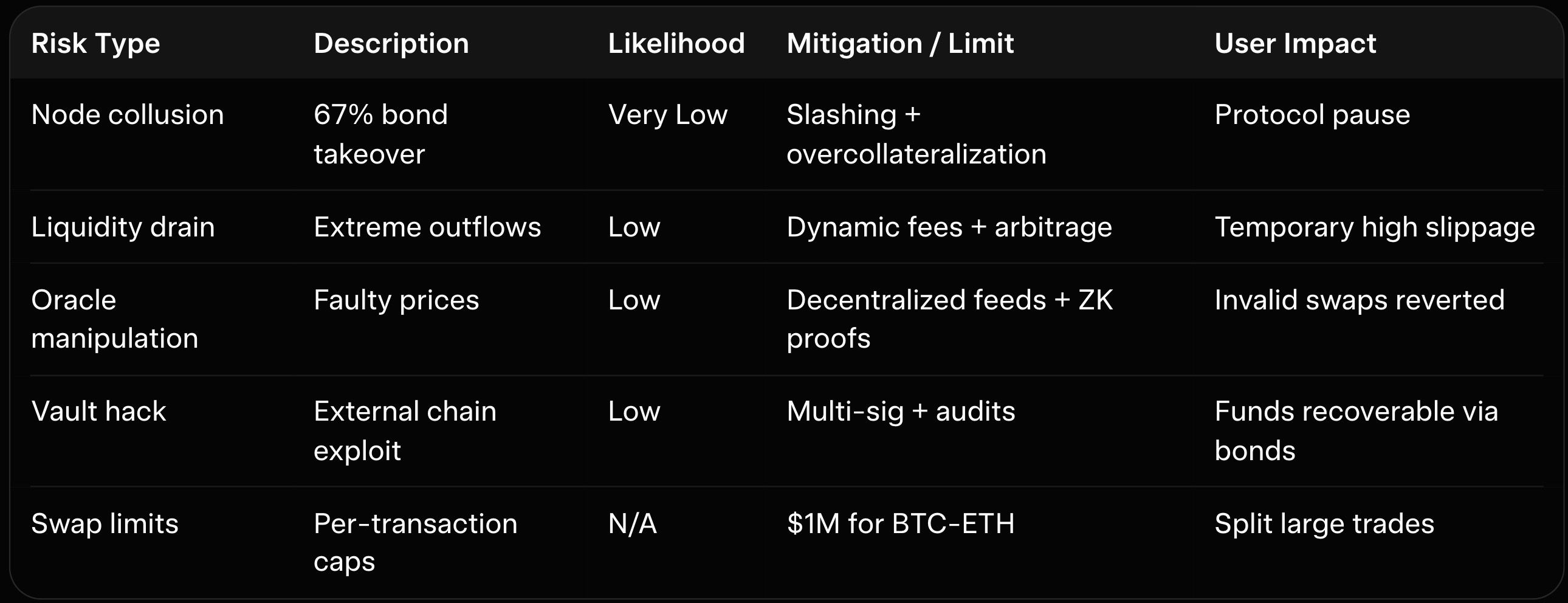
Retail swaps under $100k carry negligible risk.
Comparison to Bridges, Instant Swap Services, and Centralized Exchanges
THORChain differentiates from bridges like Wrapped BTC (wBTC) by avoiding wrappers and custodians—bridges require trust in issuers, risking depegs, while THORChain delivers natives custody-free. Instant services like ShapeShift or Changelly offer similar speed but often hold funds briefly, introducing minor custody. CEXs like Binance provide liquidity but demand KYC and expose to hacks.
THORChain matches services on cost/speed without custody, surpassing bridges on usability.
Here is a feature comparison table for BTC-to-ETH swaps in 2026:
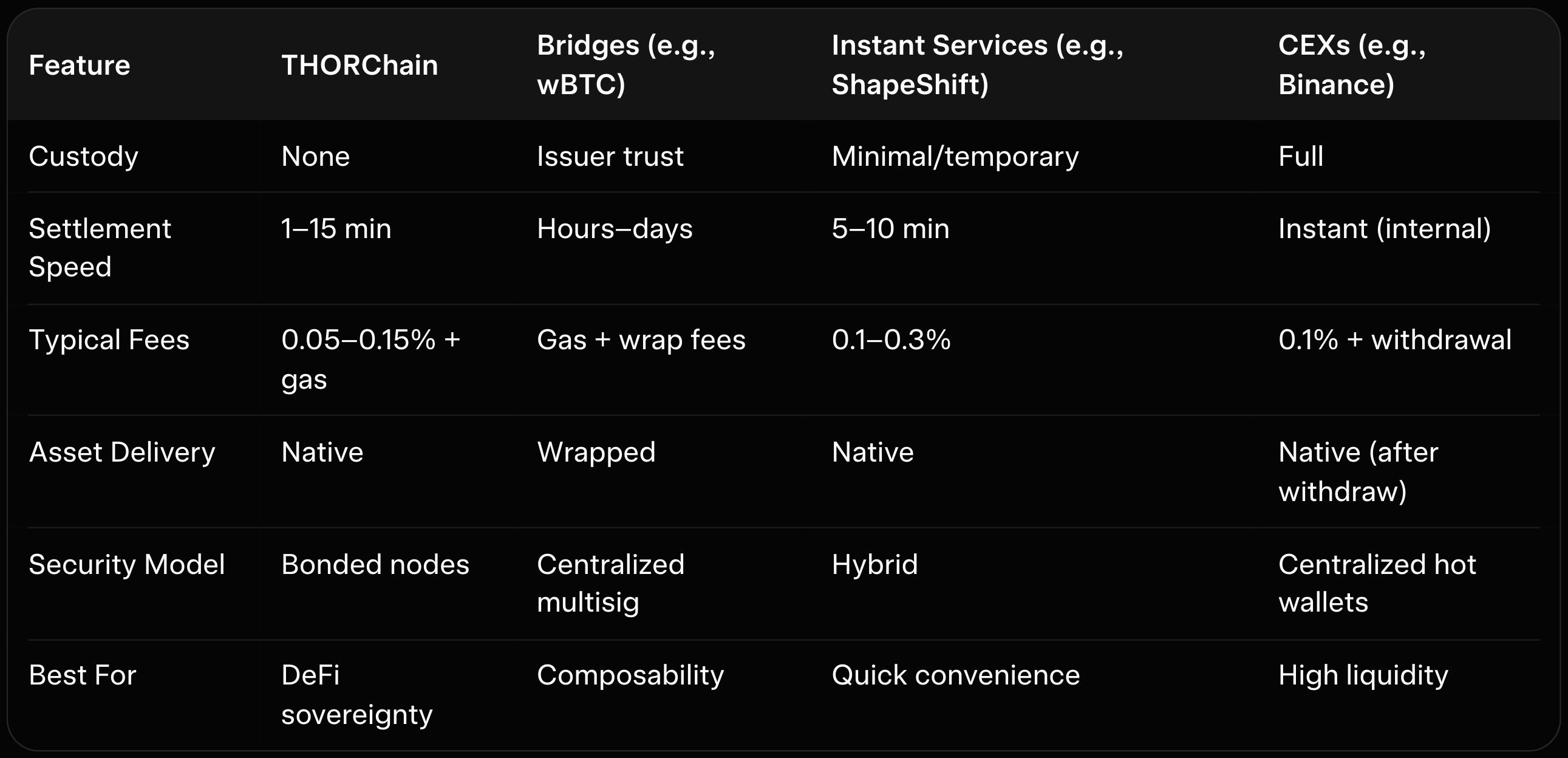
THORChain excels for users valuing decentralization.
How baltex.io Offers Alternative Multi-Chain Routing When Custody-Free Swaps Are Impractical
While THORChain shines for pure custody-free BTC-ETH swaps, scenarios like thin liquidity during volatility or unsupported chains may necessitate alternatives. baltex.io steps in as a non-custodial aggregator routing swaps across 200+ networks via hybrid paths blending DEX pools, bridges, and liquidity providers—all in one atomic transaction.
For a THORChain user facing high slippage on BTC-ETH, baltex can route via aggregated liquidity (e.g., THORChain + Uniswap) for better rates without direct custody. Privacy modes add obfuscation, and broader coverage includes chains THORChain skips. When custody-free ideals meet practical limits, baltex provides seamless fallbacks, complementing THORChain for comprehensive workflows.
FAQ
How does THORChain swap native BTC for ETH without custody? Via bonded node vaults and continuous pools, locking BTC and releasing native ETH directly.
What role does RUNE play in swaps? It bonds nodes for security and pairs with assets to unify liquidity.
What are typical fees for a BTC-to-ETH swap? 0.05–0.15% plus gas, under $20 for $10k trades.
How fast is settlement on THORChain? 1–15 minutes, with instant outbound fronting.
Is THORChain safer than CEXs? Yes, no single-point custody; security via overcollateralized bonds.
What if liquidity is low for my swap? Dynamic fees rise; use baltex.io for aggregated alternatives.
Does THORChain support L2s for ETH? Yes, via Ethereum adapters for Arbitrum, Optimism, etc.
Conclusion
THORChain has redefined custody-free cross-chain swaps in 2026, enabling seamless native BTC-to-ETH trades with its innovative pools, RUNE security, and rapid settlement. While bridges and CEXs lag on sovereignty, THORChain delivers decentralized efficiency for DeFi participants.
Pair with baltex.io when needed, and unlock true multi-chain freedom. Explore at THORSwap—start small, swap sovereign.
See others posts
G. Khan

How to Swap TRC20 USDT to ERC20 Without a Centralized Exchange (2026)
Ecosystem
G. Khan
USDC vs USDT vs DAI: Which Stablecoin is Best for Cross-Chain? (2026)
Ecosystem
G. Khan
The Trilemma of Bridging: Speed vs. Security vs. Cost
Ecosystem
G. Khan
What is Omnichain Tokens (OFTs)? The End of Wrapped Assets?
Ecosystem
G. Khan
Multichain Smart Contracts: How Developers Bridge DApps (2026)
Ecosystem
G. Khan
The 10 Best Cross-Chain Bridges for NFT Transfers in 2026
Ecosystem