



 3 minutes to read
 Ecosystem
What Is HEX Crypto? Staking, Rewards, and Risks Explained
TL;DR
HEX is an ERC-20 token on Ethereum launched in 2019 by Richard Heart, designed as a high-yield "certificate of deposit" on the blockchain. Users stake HEX for periods up to 15 years to earn rewards from 3.69% annual inflation and penalties on early unstakers. In December 2025, HEX trades around $0.001 with ~$170M market cap, post-SEC lawsuit dismissal. Rewards can be high for long stakes but come with severe penalties, volatility, and liquidity risks. It's controversial—critics highlight poor long-term performance vs. Bitcoin.
What Is HEX Crypto?
HEX, launched December 2, 2019, by Richard Heart, is an ERC-20 token on Ethereum positioned as a blockchain-based certificate of deposit (CD). It aims to offer higher yields than traditional finance through staking, where users lock tokens to earn interest paid from inflation and penalties.
Unlike typical cryptocurrencies with utility in payments or DeFi, HEX's primary feature is staking: Longer locks yield higher shares of rewards. The contract is immutable, with no admin keys.
In 2025 context: After a SEC lawsuit against Heart (alleging unregistered securities) was dismissed earlier in the year due to jurisdictional issues, HEX continues trading. Price hovers near all-time lows (~$0.001), market cap ~$170M, daily volume low ($200K-$1M). A separate HEX exists on PulseChain (Heart's Ethereum fork), with different pricing—focus here is original Ethereum HEX.
For investors: HEX appeals to those seeking passive yields via long-term commitment, but performance has lagged major cryptos significantly since launch.
How HEX Works: Core Mechanics
HEX operates via smart contracts on Ethereum.
- Supply and Inflation: No max supply cap; 3.69% annual inflation mints new HEX, distributed to stakers.
- Staking (Locking): Users "stake" by calling the contract to lock HEX for 1-5555 days (~15 years). No third-party validators—direct contract interaction.
- Rewards Sources:
- Inflation: Shared among stakers, weighted by stake size and length.
- Penalties: Early unstakers pay ~50%+ penalty (scaled by time remaining), shared with loyal stakers.
- Bonuses: Longer stakes get multipliers (up to 3x for max length), "Big Pay Days" for specific timings.
Staking requires Ethereum gas; unstaking only at end (or early with penalty).
Staking Mechanics Explained
To stake:
- Acquire HEX (via Uniswap or exchanges).
- Connect wallet to hex.com interface.
- Choose amount and duration.
- Approve and stake—tokens locked in contract.
Key features:
- Effective Shares: Reward calculation uses "shares" = amount × length bonus × late penalty avoidance.
- T-Shares: Special for very long stakes, amplifying rewards.
- Emergency Unstake: Possible anytime, but heavy penalty (increases with remaining time).
In 2025: Staking remains active, with average yields varying by participation (historically 20-40% APY claimed, but price depreciation impacts USD returns).
Reward Calculations
Rewards = Your share of daily inflation + penalties.
Formula simplified:
- Base yield ~3.69% if 100% staked.
- Actual APY higher due to <100% staking + penalties.
- Longer stake: Up to 38% base bonus + critical hit bonuses.
Example scenario:
- Stake 100,000 HEX for 1 year: ~10-20% yield (depending on network).
- For 10 years: Potential 100%+ compounded, but locked.
Realistic 2025: With low adoption, yields elevated for committed stakers, but price stagnation reduces real returns.
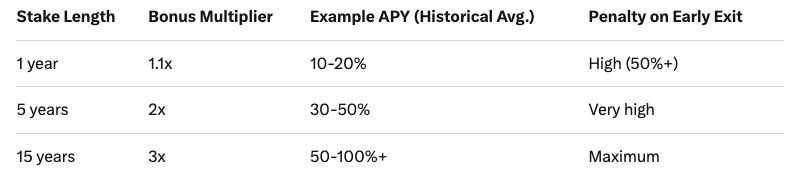
(Note: APYs variable; past claims often 38% average.)
Penalties and Early Unstaking
Early exit burns portion of stake + penalty shares to remaining stakers.
- Penalty scales: More time left = higher penalty.
- Encourages long-term holding, but locks capital in declining markets.
Misconception: "No risk" staking—actually, opportunity cost and price risk immense.
Liquidity and Trading HEX
HEX primarily trades on Uniswap (Ethereum pair). Low volume in 2025 leads to slippage on large trades.
No major CEX listings post-regulatory scrutiny. PulseChain version has separate liquidity.
Practical: Small trades fine; large require caution to avoid impact.
Risks of HEX in 2025
HEX carries amplified crypto risks:
- Price Volatility: Down >99% from ATH; underperformed Bitcoin massively.
- Lockup Risk: Capital tied years—can't sell during crashes.
- Smart Contract Risk: Audited but immutable; exploits possible.
- Liquidity Risk: Low volume = hard exits without loss.
- Inflation Dilution: Ongoing minting if adoption stalls.
- Founder Controversy: Past allegations (dismissed), but reputation impacts sentiment.
- Opportunity Cost: Better yields elsewhere (e.g., Ethereum staking ~4-6%).

Common misconceptions:
- "Guaranteed high returns"—No; depends on price appreciation.
- "Better than Bitcoin"—Historical ROI worse.
- "No downside"—Penalties and crashes prove otherwise.
Scenario: Stake long in bull—compounded gains; in bear—locked while price falls.
Practical Scenarios in 2025
- Bullish: Post-dismissal rally + high staking participation = strong yields.
- Bearish: Continued low adoption = stagnant price, penalties deter exits.
- Average User: Small stake short-term for learning; long-term only with conviction.
How Baltex.io Fits as a Multi-Chain Swap Route for Managing HEX Exposure
In HEX's Ethereum-bound ecosystem with potential PulseChain variants, repositioning assets efficiently matters—especially with lockups limiting flexibility.
Baltex.io, a non-custodial instant swap platform, supports multi-chain routing for HEX and equivalents:
- Swap HEX to ETH/USDC/other tokens across chains.
- Optimized aggregation for low slippage.
- Privacy-focused options.
- Helps exit/reposition without high Uniswap fees or waiting for unstake.
Useful for managing exposure: Consolidate, diversify, or bridge without custody risks.
FAQ
Q: Is HEX a scam? A: Controversial—high yields from inflation/penalties; lawsuit dismissed, but critics cite structure.
Q: What are current HEX yields? A: Variable 10-50%+ APY claimed, but USD returns depend on price.
Q: Can I unstake early? A: Yes, but heavy penalties shared with others.
Q: How does HEX compare to Bitcoin? A: Higher claimed yields but far worse price performance historically.
Q: Is staking safe? A: Contract audited, but lockup and volatility risks high.
Q: What's HEX status in 2025? A: Active post-regulatory clearance, low price/volume.
Conclusion
HEX offers unique high-yield staking via lockups and shared penalties, appealing to patient holders in 2025's post-lawsuit environment. Mechanics reward commitment but amplify risks—volatility, illiquidity, penalties. For investors, weigh past underperformance and misconceptions against potential. Practical use requires caution; tools like baltex.io aid flexible management. Research deeply—HEX suits high-risk tolerance only.
See others posts
G. Khan

Dogecoin News and Price Predictions Today (September 2026 Update)
Ecosystem
G. Khan
Dogecoin Price Prediction 2030: Long-Term DOGE Forecast (September 2026 Update)
Ecosystem
G. Khan
Dogecoin Price Prediction 2027
Ecosystem
G. Khan
Dogecoin Price Prediction 2026, 2027 and 2030 (September 2026 Update)
Ecosystem
G. Khan
Solana Price Prediction 2030 (September 2026 Update)
Ecosystem
G. Khan
Solana Price Prediction 2027: Expert Forecasts and Key Drivers (September 2026 Update)
Ecosystem