 2 minutes to read
 Ecosystem
Privacy Coins Compared: Monero, Zcash, Dash, Beam & Grin
TL;DR
Monero leads privacy coins in 2026 with mandatory RingCT privacy that hides every transaction by default while Zcash offers optional zk-SNARKs, Dash relies on optional CoinJoin-style mixing, Beam uses Mimblewimble for lightweight confidentiality, and Grin delivers extreme scalability through interactive Mimblewimble. Each approach trades off anonymity guarantees, usability, and scalability differently. Monero wins for effortless unlinkability, Grin for chain efficiency, and the rest fill important niches. Baltex.io lets you route between any of these coins and major assets in one non-custodial step for the perfect privacy-liquidity balance.
Privacy coins continue to evolve in 2026 as regulators and chain-analysis firms tighten their grip on transparent blockchains. Monero, Zcash, Dash, Beam, and Grin represent the leading approaches to on-chain confidentiality. Their differences in architecture create real-world trade-offs that affect daily usability, long-term viability, and actual anonymity.
Understanding these distinctions helps users choose the right coin for private payments, wealth preservation, or DeFi. Mandatory privacy eliminates user error while optional models offer flexibility at the cost of inconsistent protection. Scalability and fees further separate the pack in practice.
Feature Comparison
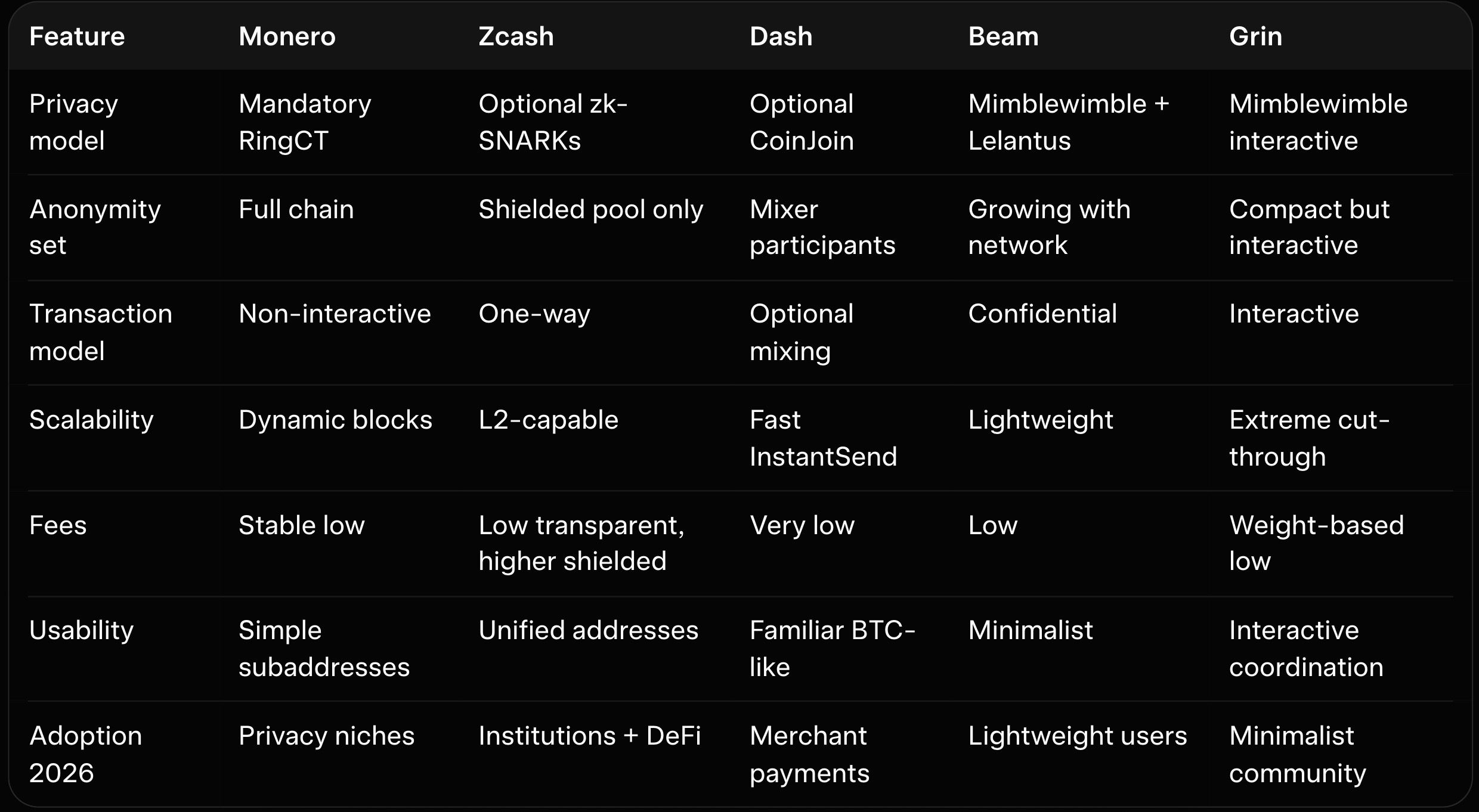
The table captures the core technical differences that drive real-world performance. Monero prioritizes effortless protection for everyone. Grin sacrifices interactivity for radical efficiency while the others balance features in unique ways.
Monero’s RingCT combines ring signatures, stealth addresses, and confidential transactions so every payment hides sender, receiver, and amount automatically. The FCMP++ upgrade expanded anonymity sets across the full chain. No user ever needs to activate privacy mode.
Zcash uses zero-knowledge proofs in its shielded pool for strong privacy when users choose it. Transparent transactions remain fully visible and form the majority of activity for many holders. The optional model creates a two-tier system that users must navigate consciously.
Dash employs CoinJoin-style mixing through masternodes as an optional feature called PrivateSend. Users must activate it per transaction and wait for sufficient participants. The design favors speed and merchant usability over default anonymity.
Beam builds on Mimblewimble for confidential transactions with Lelantus-style mixing that keeps the chain lightweight. Privacy is strong but the smaller anonymity set compared to Monero creates a measurable difference under targeted analysis. The minimalist approach appeals to users who value efficiency.
Grin takes Mimblewimble further by eliminating addresses entirely and using interactive transactions for maximum cut-through. The blockchain stays dramatically smaller than competitors even after years of activity. This extreme scalability comes at the cost of requiring sender-receiver coordination during construction.
Anonymity Guarantees and Traceability Risks
Monero delivers the strongest practical anonymity because privacy is mandatory and anonymity sets include the entire chain. Statistical attacks become impractical even for advanced firms. Users receive consistent protection without extra steps or trust.
Zcash shielded transactions are cryptographically robust yet limited to the shielded pool which represents roughly 59 percent of supply in 2026. Transparent activity creates ongoing linkage risks for users who switch modes. The flexibility appeals to institutions but weakens overall network privacy.
Dash’s optional mixing provides decent obfuscation when used but leaves most transactions fully traceable. Chain analysis can deanonymize unmixed flows easily. The model favors speed over guaranteed anonymity.
Beam and Grin both leverage Mimblewimble for strong confidentiality but their smaller effective anonymity sets and interactive nature create different risk profiles. Beam’s Lelantus mixing grows with network participation while Grin’s design prioritizes compactness. Neither matches Monero’s full-chain mixing under heavy scrutiny.
Scalability and Long-Term Chain Implications
Monero scales through dynamic block sizing that automatically adjusts to demand while preserving full privacy. The chain grows steadily but recent optimizations keep it manageable for full nodes. Users with modest hardware can still run nodes comfortably.
Grin excels here because Mimblewimble cut-through removes most historical data so the blockchain stays compact indefinitely. This lightweight approach reduces storage and bandwidth requirements dramatically. The design appeals to users who prioritize long-term efficiency.
Zcash, Dash, and Beam fall between these extremes. Zcash supports Layer 2 scaling while Dash focuses on fast on-chain payments. Beam keeps the chain lightweight through Mimblewimble but not as aggressively as Grin.
Fees and Economic Behavior
Monero maintains consistently low and predictable fees because the dynamic block mechanism prevents congestion bidding wars. The cost stays under ten cents for typical private transactions. This stability encourages frequent private P2P use without users worrying about privacy premiums.
Grin uses weight-based fees that remain very low thanks to its compact transaction format. The minimalist design keeps costs competitive and predictable for small transfers. Dash offers near-zero fees with InstantSend while Zcash and Beam stay competitive but vary slightly with privacy features.
Usability in Daily Scenarios
Monero wallets generate fresh subaddresses automatically and display a single unified balance so sending or receiving feels intuitive. The official GUI and popular mobile apps require almost no learning curve for privacy-focused tasks. Our best Monero mobile wallets guide and Cake Wallet review highlight how seamless the experience remains.
Grin prioritizes minimalism so wallets feel stripped-down and focused purely on privacy and efficiency. The interactive transaction model adds a small extra step that some users find cumbersome at first. Our Feather Wallet review shows how advanced users combine tools for smoother Grin workflows.
Zcash improved with unified addresses that simplify shielded usage but still requires conscious mode selection. Dash feels the most familiar because of its Bitcoin-like interface and InstantSend speed. Beam sits in the middle with clean but minimalist interfaces.
Real-World Adoption and Implications
Monero dominates privacy-sensitive niches with strong community support and consistent development. Its mandatory privacy model has withstood years of scrutiny and regulatory pressure. Adoption remains robust in donations, remittances, and private marketplaces.
Grin appeals to users who value radical minimalism and long-term scalability. The fair-launch ethos attracts cypherpunk enthusiasts. Liquidity stays lower than Monero’s yet the coin maintains a dedicated following for its elegant design.
Zcash benefits from better exchange liquidity and institutional interest thanks to selective disclosure features. Dash leads in merchant payments with established processors. Beam fills the lightweight privacy niche effectively.
Use Cases
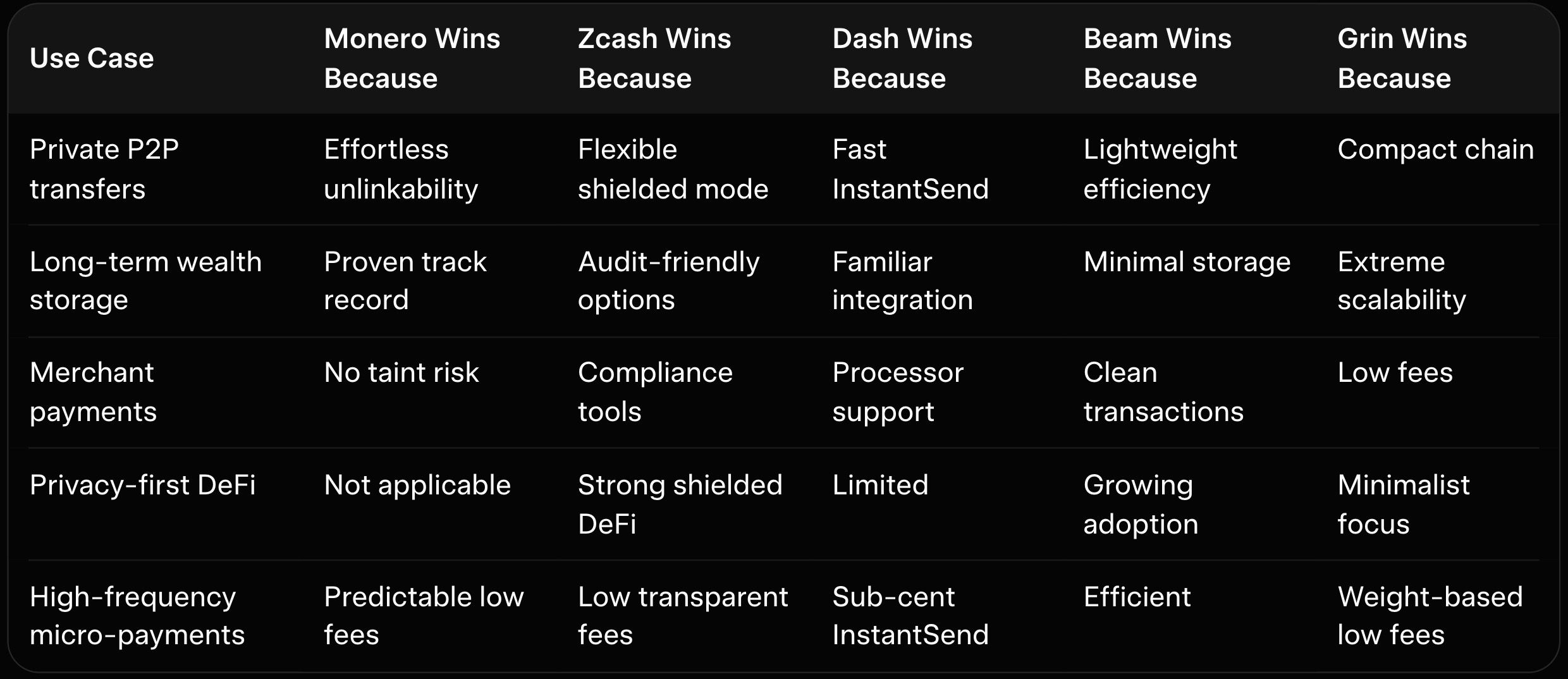
This table illustrates how the five coins serve overlapping but distinct audiences in practice. Monero prioritizes effortless privacy for everyday users. Grin appeals to those who value technical elegance and future-proof scalability.
How Baltex.io Enables Routing Between Privacy Coins and Other Assets
Privacy coin users often need to convert between Monero, Zcash, Dash, Beam, Grin, and major assets like Bitcoin or Ethereum for liquidity or specific use cases. Baltex.io integrates cleanly by accepting direct deposits from any of these coins and delivering clean outputs on the destination chain in one non-custodial transaction. You select XMR to BTC or ZEC to ETH, send from your wallet, and enable Private Swap mode for extra shielded hops that preserve privacy during the move.
The platform treats all five privacy coins as first-class assets without forcing extra steps or KYC. Funds arrive at fresh addresses ready for immediate use whether you need stronger unlinkability or better liquidity. For readers of our best no-KYC Monero swappers overview, Baltex.io ranks highest for privacy-preserving cross-chain movement.
Traders move Monero holdings into Zcash for institutional-friendly flows and back again when maximum anonymity matters. The workflow completes in minutes and integrates with any wallet. Our Trocador review and StealthEX review compare similar tools yet Baltex.io excels when handling multiple privacy approaches side by side.
Businesses accepting Dash or Grin payments route excess inflows through Baltex.io into Monero for stronger privacy while keeping receive addresses isolated. The non-custodial design ensures keys never leave your control. Our best P2P Monero exchanges guide adds extra off-ramp options that pair naturally with this routing.
Advanced Routing Tips with Baltex.io
Use fresh subaddresses on Monero or shielded addresses on Zcash before sending to Baltex.io for clean separation. Test small amounts first to confirm output destinations and timing. Combine with hardware wallets for larger moves to keep long-term keys offline.
Our hardware wallet for Monero guide and Monero wallet security best practices help users layer extra protection on top of these routed transactions. Our best Monero desktop wallets guide and Monero GUI vs CLI wallet comparison guide wallet choice for efficient privacy workflows. Our best Monero mobile wallets guide and Cake Wallet review show mobile options for seamless cross-coin management. Our Feather Wallet review offers lightweight desktop options favored by advanced users.
Conclusion
Monero, Zcash, Dash, Beam, and Grin each advance privacy in 2026 through distinct technical choices. Monero’s mandatory RingCT delivers effortless unlinkability that protects every user automatically while Grin’s Mimblewimble offers radical scalability and minimalism. Zcash, Dash, and Beam fill important niches with flexible or lightweight approaches that trade default protection for usability or speed.
The right coin depends on whether you prioritize ironclad anonymity, merchant-friendly payments, or long-term efficiency. Many privacy-conscious holders keep exposure to several coins and route intelligently between them as needs evolve. When the time comes to move value across chains for liquidity or privacy flexibility, our best no-KYC Monero swappers overview shows exactly why Baltex.io belongs in every privacy-coin toolkit.
For deeper wallet and security strategies explore our best Monero mobile wallets guide, the Cake Wallet review, or the hardware wallet for Monero guide. Privacy coins thrive when you match the right technology to the right use case and route intelligently between them. Your funds stay yours to control with the right tools ahead.
For more on this, see our guide on SimpleSwap Review 2026: Pros, Cons, and Monero Exchange Fees.
You can read our full breakdown in Aztec Network: Best for Programmable Private Smart Contracts.
You can read our full breakdown in XMR.to Alternatives: How to Pay Bitcoin Invoices with Monero.
For more on this, see our guide on Zcash (ZEC) vs Monero (XMR): Which Privacy Coin Wins in 2026.