



 5 minutes to read
 Ecosystem
What is Ripple (XRP)?
Quick Summary
- XRP is the native cryptocurrency of the XRP Ledger, designed for efficient cross-border value transfer.
- The XRP Ledger processes transactions in 3-5 seconds with fees under one cent as of July 2026.
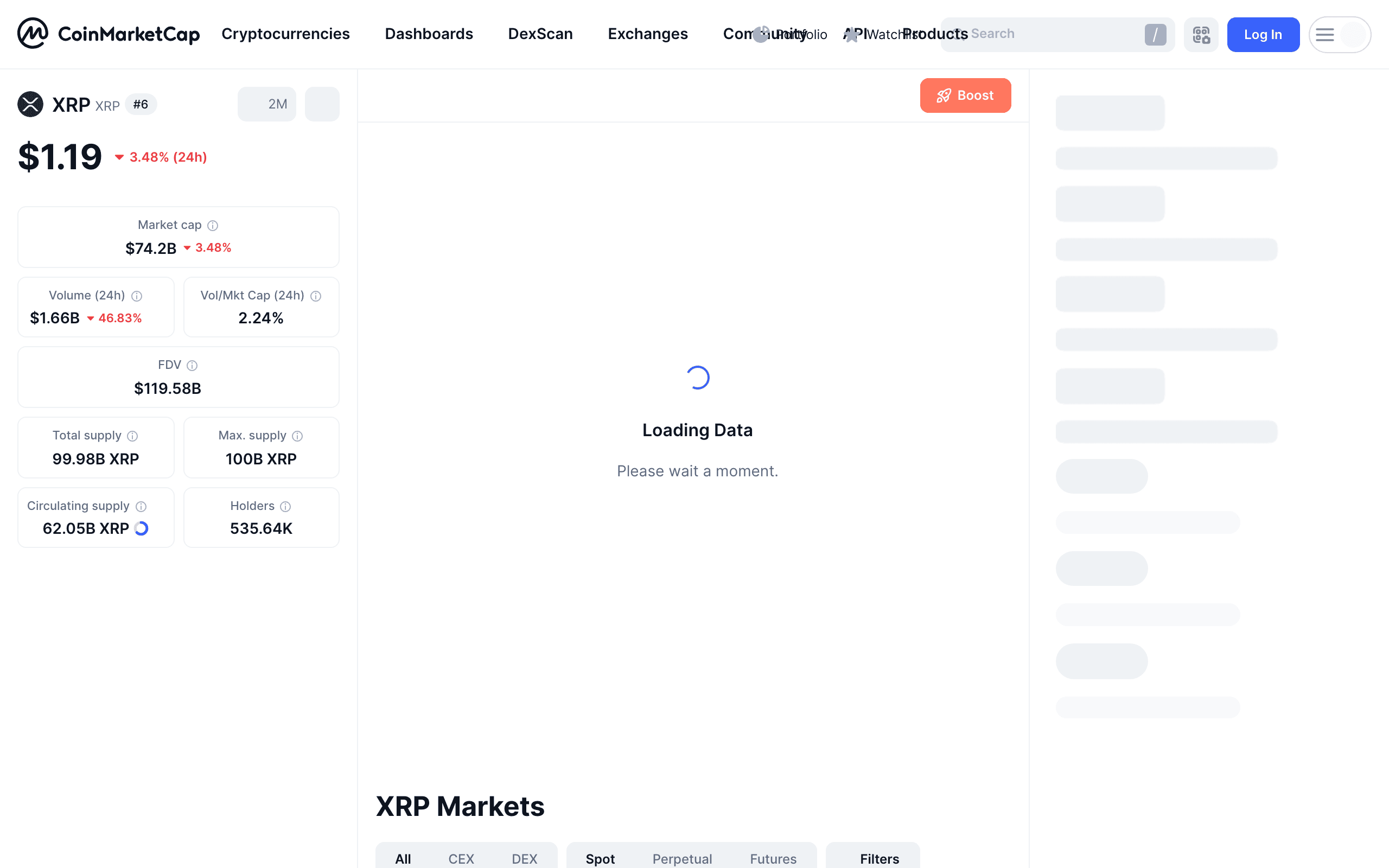
- Total supply is capped at 100 billion XRP, with approximately 62.24 billion circulating according to CoinMarketCap.
- Ripple the company develops enterprise payment products that often utilize XRP for liquidity.
- XRP powers On-Demand Liquidity (ODL) for real-time international settlements without pre-funding accounts.
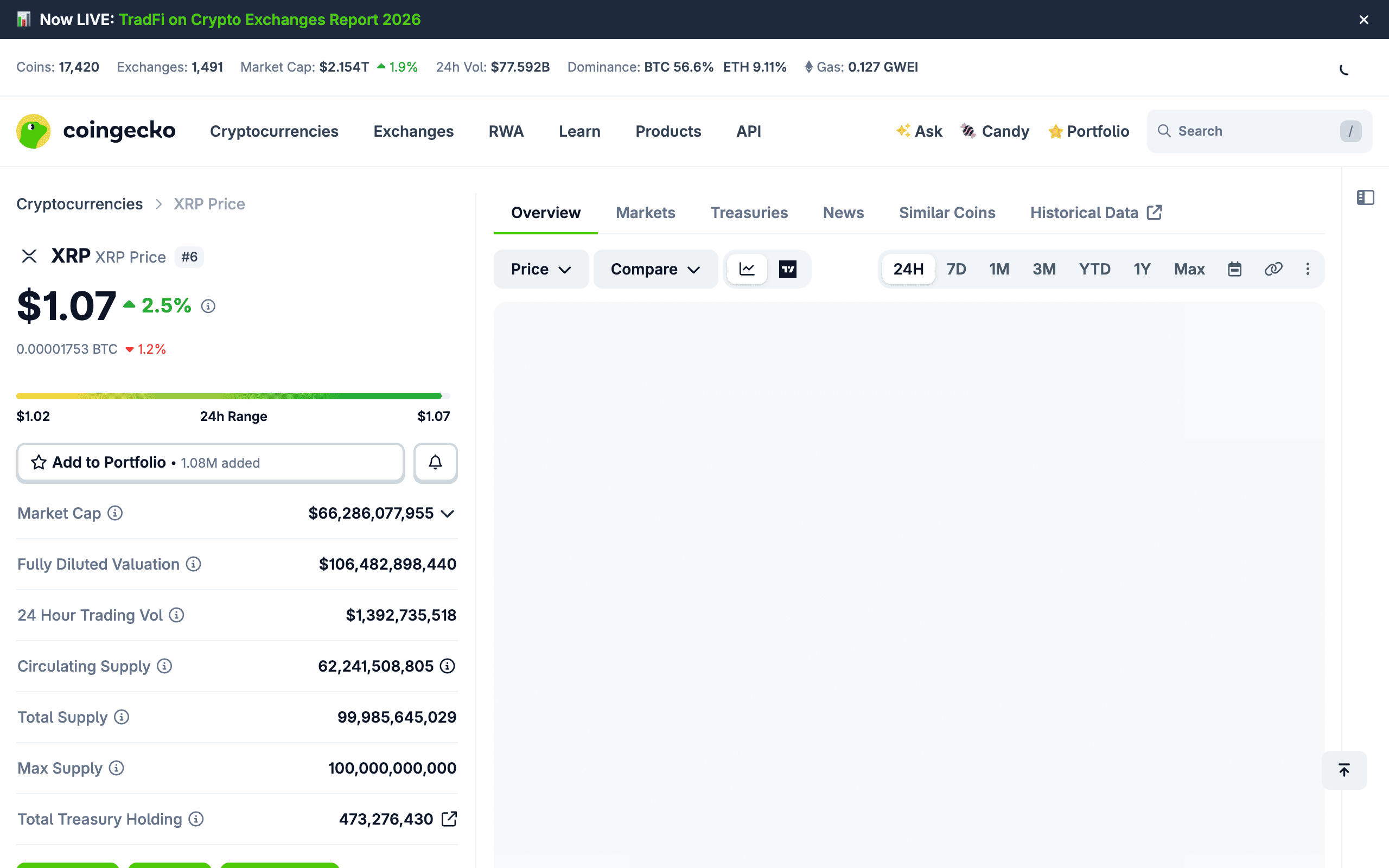
- As of July 2026, XRP trades near $1.06 with a market capitalization exceeding $66 billion per CoinGecko.
Definition: What is Ripple (XRP)?
XRP is the native digital asset of the XRP Ledger (XRPL), a decentralized public blockchain optimized for fast, low-cost payments and value exchange across borders. The XRPL operates independently of the company Ripple, which builds financial infrastructure solutions that can leverage XRP. Launched in 2012, XRP enables near-instant settlement of transactions between any two currencies by acting as a bridge asset in the ledger's built-in decentralized exchange. Unlike proof-of-work networks, the XRPL achieves consensus through a federated system of validators, delivering finality in seconds rather than minutes or hours. This design makes XRP particularly suited for remittance corridors where speed and cost matter most. The ledger also supports issued assets, decentralized exchange functionality, and smart contract capabilities via hooks and sidechains, expanding its utility beyond simple transfers.
How does the XRP Ledger work?
The XRP Ledger reaches agreement on transaction order through a consensus protocol that relies on a Unique Node List (UNL) of trusted validators. Each participant maintains its own UNL of reliable nodes; when a supermajority (typically 80%) agrees on a proposed set of transactions, the ledger closes and becomes immutable. This process completes every 3-5 seconds without requiring miners or staking rewards, keeping energy consumption minimal compared with proof-of-work systems. Transactions include a small fee that is burned, creating a deflationary pressure over time. The protocol prevents double-spends through this rapid consensus rather than longest-chain rules. Developers can issue custom assets on the ledger, create offers on the built-in DEX, and use the ledger for escrow, payment channels, and checks. As of 2026, the network supports over 1,500 validators worldwide, with major operators including universities, exchanges, and financial institutions. The open-source codebase is maintained on GitHub under the XRPL Foundation, allowing anyone to run a node or build applications.
What makes XRP valuable?
XRP derives value primarily from its utility in facilitating cross-border liquidity and its role as a bridge currency. In On-Demand Liquidity (ODL) corridors, market makers hold XRP to source liquidity instantly, eliminating the need for correspondent banking relationships that tie up capital for days. Demand increases whenever payment volume grows through these channels. The fixed supply of 100 billion tokens, combined with periodic burns from transaction fees, adds a scarcity element. Institutional adoption through Ripple's products and growing developer activity on the XRPL further support demand. Regulatory clarity following the 2023-2025 SEC proceedings has reduced uncertainty, allowing clearer institutional participation. As of July 2026, daily trading volume frequently exceeds $1.6 billion, reflecting both speculative interest and genuine payment usage.
Is XRP decentralized and secure?
The XRP Ledger is decentralized in operation because no single entity controls the network once validators reach consensus. However, Ripple originally created a large portion of the supply and retains some XRP in escrow for predictable release. Security stems from the consensus mechanism's resistance to forks and the cryptographic signing of every transaction. The ledger has operated continuously since 2012 with no successful attacks on its core protocol. Validators run diverse software implementations, reducing single-point risks. Users control their own keys; lost private keys result in permanent loss of funds, the same as any cryptocurrency. The network's transparency allows anyone to audit the full transaction history on public explorers.
XRP supply, tokenomics and distribution
XRP launched with a total supply of 100 billion tokens. Ripple placed 80 billion into escrow contracts that release 1 billion monthly; any unused portion returns to escrow. As of July 2026, roughly 62.24 billion XRP circulate while the remainder sits in escrow or Ripple-controlled wallets. Transaction fees permanently destroy a tiny fraction of XRP, creating gradual deflation. No new tokens are minted. This predictable schedule contrasts with inflationary assets and gives holders visibility into future supply. Large holders include Ripple itself, exchanges, and long-term investors. The escrow mechanism was designed to prevent sudden dumps that could pressure price.
Ripple versus XRP Ledger versus other cryptocurrencies
Ripple the company focuses on enterprise solutions such as cross-border payments and stablecoin custody, while the XRP Ledger is the public blockchain anyone can use. In contrast to Bitcoin's store-of-value emphasis and 10-minute blocks, XRP prioritizes payment speed and cost. Ethereum offers programmable smart contracts with higher fees and slower finality on layer 1; XRP provides simpler but faster native features. Stablecoins like USDT settle instantly on their chains but require on-ramps; XRP serves as a neutral bridge between fiat currencies. SWIFT remains the dominant messaging network for banks but relies on pre-funded accounts and multi-day settlement; XRP-based ODL reduces both time and capital requirements. The XRPL's built-in DEX allows atomic swaps without external liquidity pools, a structural difference from many DeFi platforms.
Practical use cases and when XRP is the right choice
XRP excels in corridors with high remittance volumes between emerging and developed markets, such as USD to MXN or EUR to PHP. Payment providers and fintechs use ODL to source liquidity instantly, reducing foreign-exchange risk. Treasury teams at corporations can move value between subsidiaries faster than traditional wires. Developers building on XRPL can create custom tokens for loyalty programs or tokenized real-world assets. XRP is less ideal for complex decentralized finance applications that require Turing-complete smart contracts; in those cases, Ethereum or Solana may be preferable. Users seeking maximum privacy might choose Monero-based flows instead. For simple value storage without frequent transfers, Bitcoin or gold-backed assets may suit better depending on risk tolerance.
Where can I buy or use XRP?
XRP trades on major centralized exchanges worldwide and can be acquired via bank transfers or card purchases on regulated platforms. Non-custodial options allow direct swaps from other cryptocurrencies without depositing funds into an account. Baltex is a non-custodial crypto swap aggregator that enables instant cross-chain cryptocurrency exchanges across 200+ blockchain networks and 10,000+ digital assets through aggregated liquidity sources. Users can exchange XRP on Baltex without registration for most swaps while benefiting from routing across CEX, DEX, and other providers. The platform supports private swap flows through Monero-based options when needed and performs AML screening on flagged transactions. For developers, the XRPL offers APIs and SDKs for direct integration into wallets and applications. Always verify local regulations before purchasing or holding any cryptocurrency.
XRP in 2026: regulatory status and market context
By mid-2026, XRP has benefited from regulatory clarity in the United States following resolution of prior enforcement actions. Spot ETF applications continue to progress, and several jurisdictions have approved XRP for institutional use. On-chain metrics show increased activity in payment corridors and growing developer interest in XRPL sidechains and AMMs. Price action has been range-bound near $1.05-$1.10 amid broader market consolidation, with market capitalization holding above $65 billion. Institutional products such as Ripple's RLUSD stablecoin and custody services add complementary demand drivers. Long-term forecasts from analysts project gradual appreciation tied to payment volume growth rather than speculative cycles alone.
Risks and limitations of using XRP
Like all cryptocurrencies, XRP experiences significant price volatility driven by macroeconomic factors, regulatory news, and overall market sentiment. Liquidity can vary across exchanges, leading to slippage on large orders. Although the ledger itself is secure, users remain responsible for safeguarding private keys and choosing reputable counterparties. Centralized exchange failures or hacks have historically affected XRP holders who kept assets on platforms. The concentration of supply in Ripple's escrow and institutional wallets creates potential for coordinated selling pressure, though release schedules are transparent. Tax reporting requirements differ by jurisdiction and can complicate frequent trading. Finally, while the XRPL offers speed advantages, it does not provide the same level of programmability found on general-purpose smart contract platforms.
Future outlook for Ripple and XRP
Looking ahead from July 2026, growth hinges on expansion of ODL corridors, adoption of tokenized assets on the XRPL, and continued regulatory progress globally. Ripple continues to partner with financial institutions for treasury and payments solutions. The XRPL community's focus on AMM enhancements and sidechain interoperability aims to attract more DeFi activity. Success will depend on delivering measurable cost savings and speed improvements over legacy systems at scale. Investors and users should monitor on-chain volume, validator decentralization metrics, and enterprise integration announcements for signals of sustained utility growth.
Comparison table: XRP versus major alternatives
| Feature | XRP (XRPL) | Bitcoin | Ethereum | SWIFT (traditional) |
|---|---|---|---|---|
| Consensus | Federated validators | Proof-of-Work | Proof-of-Stake | Centralized messaging |
| Settlement time | 3-5 seconds | ~10 minutes | ~12 seconds (L1) | 1-5 business days |
| Typical fee | < $0.01 | Variable, often > $1 | Variable, often > $1 | $10-50+ |
| Primary use | Cross-border payments | Store of value | Smart contracts/DeFi | Bank messaging |
| Supply model | Fixed 100B, deflationary | Capped 21M | Inflationary with burns | N/A |
| Energy use | Very low | High | Moderate | Low (but slow) |
How XRP differs from stablecoins
Stablecoins maintain a peg to fiat currencies and are primarily used for trading or DeFi collateral. XRP fluctuates in price and serves as a neutral bridge asset whose value is determined by market supply and demand. While stablecoins avoid volatility for the sender and receiver, they still require on- and off-ramps. XRP can move value between any two currencies without needing a common stablecoin pair, potentially reducing steps in complex corridors. Both asset types coexist on many platforms, with users choosing based on whether price stability or bridge utility is the priority.
Developer resources and ecosystem growth
The XRPL maintains comprehensive documentation at xrpl.org covering concepts, tutorials, and API references. The open-source codebase resides on GitHub, enabling community contributions and custom node implementations. Recent ecosystem developments include automated market maker functionality, hooks for lightweight smart contracts, and integrations with EVM-compatible sidechains. Universities and hackathons regularly host XRPL-focused events, fostering new applications in payments, tokenization, and gaming. Builders benefit from low fees and predictable finality when deploying on the public ledger.
How to get started with XRP
Begin by creating a wallet that supports the XRP Ledger, such as those integrated with major exchanges or standalone options like Xumm. Fund the wallet with a small amount of XRP to cover the base reserve requirement (currently 10 XRP). Test small transfers on the live network or use the testnet for experimentation. For payments, explore Ripple's ODL documentation or partner with a licensed provider. Always start with amounts you can afford to lose while learning the mechanics. Educational materials on xrpl.org provide step-by-step guidance for both users and developers.
Key takeaways for newcomers
XRP offers a specialized tool for fast, inexpensive value movement across borders rather than a general-purpose platform. Its fixed supply and consensus design deliver predictable performance characteristics. Success depends on real-world payment adoption rather than hype alone. As with any digital asset, conduct personal research, understand local regulations, and consider diversification. The combination of Ripple's enterprise focus and the XRPL's open infrastructure positions XRP as one option among many in the evolving digital payments landscape as of 2026.
This is not financial advice. Cryptocurrency investments carry risk, and past performance does not guarantee future results.
What is XRP used for?
How does the XRP Ledger reach consensus?
Is XRP the same as Ripple?
What is XRP's total supply?
Can I buy XRP without KYC?
How does XRP compare to Bitcoin?
See others posts
G. Khan

Solana Price Prediction 2030 (September 2026 Update)
Ecosystem
G. Khan
Solana Price Prediction 2027: Expert Forecasts and Key Drivers (September 2026 Update)
Ecosystem
G. Khan
Solana Price Prediction for the End of 2026
Ecosystem
G. Khan
Solana (SOL) Price Prediction 2026, 2027 and 2030 (September 2026 Update)
Ecosystem
G. Khan
Ethereum Price Prediction September 2026
Ecosystem
G. Khan
AI Ethereum Price Prediction for 2026 and 2027 (September 2026 Update)
Ecosystem