



 5 minutes to read
 Ecosystem
What Network Is USDT On?
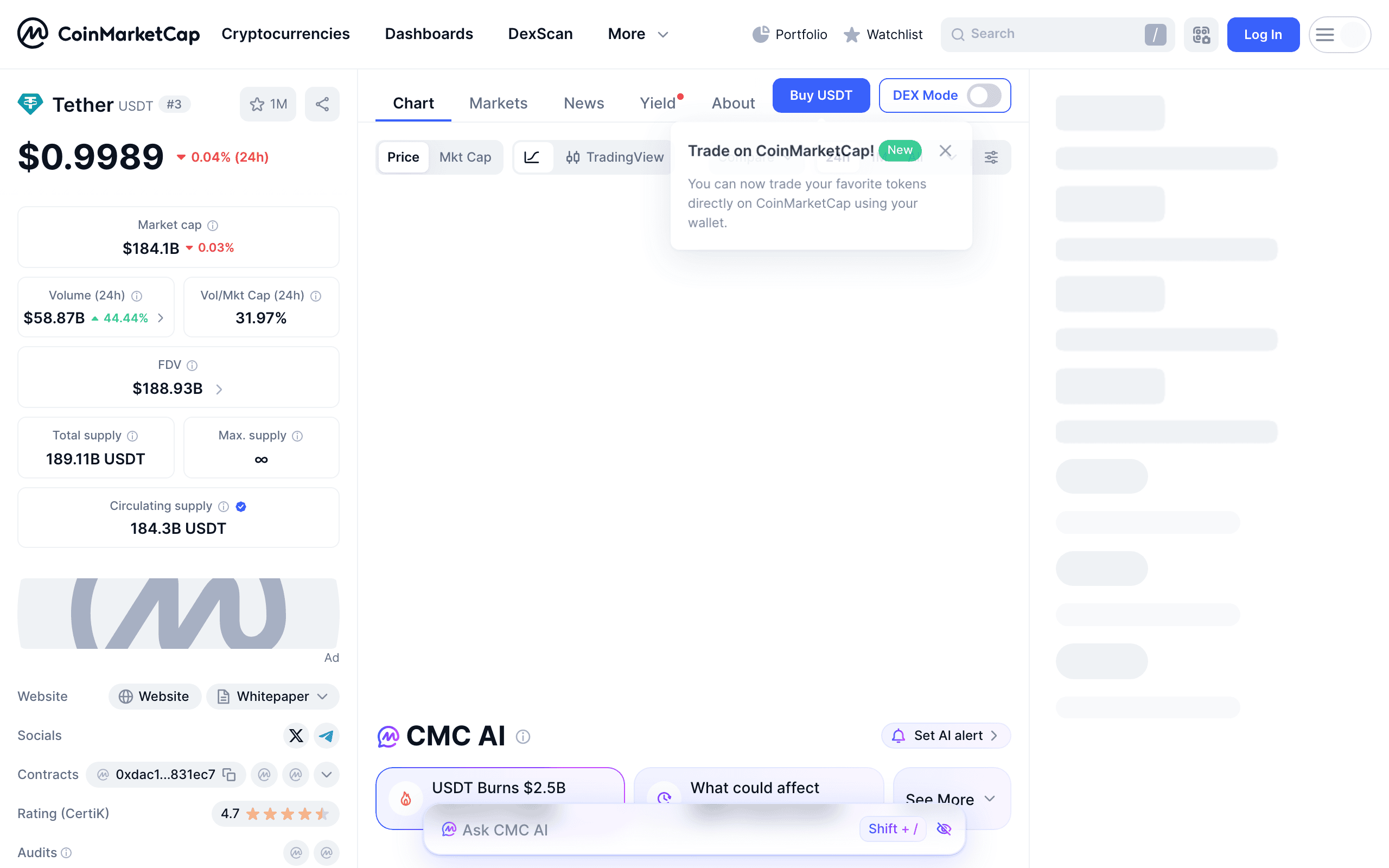
USDT, also known as Tether, ranks as the world's largest stablecoin by market capitalization. Tether issues it as a digital token pegged 1:1 to the U.S. dollar and backed by reserves of cash, cash equivalents, and other assets. As of July 2026, its market cap sits near $184 billion according to CoinMarketCap, making it a cornerstone of crypto trading, remittances, and DeFi liquidity.
USDT does not live on a single blockchain. Tether instead deploys versions of the token across more than 15 networks. This multi-chain approach lets users pick the best option for speed, cost, or security based on their needs. The distribution shifts over time, with Tron and Ethereum still commanding the majority of supply as of mid-2026.
Understanding USDT and Its Multi-Network Presence
Tether launched USDT in 2014 on the Bitcoin-based Omni Layer. Over the years the company expanded to new blockchains to improve accessibility and cut costs. Today USDT exists as ERC-20 on Ethereum, TRC-20 on Tron, SPL tokens on Solana, and native assets on chains like BNB Chain, Avalanche, Polygon, Arbitrum, Optimism, Base, TON, and others listed on the official Tether supported protocols page.
Each version follows the native token standard of its host blockchain. An ERC-20 USDT cannot move directly to a TRC-20 address without a bridge or swap. The peg stays consistent because Tether handles reserves and redemptions centrally, yet on-chain behavior varies by network rules, gas fees, and finality times. As of April 2026 data referenced in industry reports, Tron held roughly 45 percent of supply for payments, Ethereum about 40 percent for institutions and DeFi, and Solana around 6 percent and growing.
The choice of network affects transaction costs dramatically. Ethereum mainnet fees can spike above $15 during congestion, while Tron transactions often cost under $1 and settle in seconds. Solana offers sub-cent fees with high throughput suited to consumer apps and memecoin trading. Users must match the network to their wallet and recipient to avoid lost funds.
Tether keeps adding support for new ecosystems, including Layer-2 solutions and emerging chains, to stay relevant amid competition from USDC and newer stablecoins. This expansion mirrors broader industry trends toward multichain liquidity in 2026.
Ethereum Network (ERC-20 USDT)
Ethereum hosts one of the largest USDT supplies and serves as the backbone for institutional settlement and decentralized finance. The ERC-20 standard allows seamless integration with Ethereum smart contracts, lending protocols, and centralized exchanges. Institutions favor Ethereum USDT for its robust security model, extensive auditing history, and deep liquidity pools.
Transactions on Ethereum mainnet use ETH for gas. During periods of high demand, costs rise sharply, which is why many users bridge to Layer-2 networks. As of 2026, Arbitrum, Optimism, and Base capture significant USDT volume with much lower fees while retaining Ethereum security guarantees through optimistic rollups.
Ethereum USDT benefits from the largest developer ecosystem and regulatory clarity in certain jurisdictions. It underpins trillions in annual trading volume on platforms like Uniswap and Aave. However, the network's congestion history makes it less ideal for small retail transfers. Tether maintains full redeemability for ERC-20 USDT through its standard processes.
Practical example: A trader depositing USDT into a DeFi protocol for yield farming almost always uses the Ethereum version or its L2 equivalents to access the widest range of opportunities. Data from mid-2026 shows Ethereum and its L2s still dominate institutional float despite Tron leading in raw supply share.
Tron Network (TRC-20 USDT)
Tron dominates USDT usage for everyday payments and cross-border remittances, especially in Southeast Asia and Latin America. The TRC-20 standard delivers fast confirmations and minimal fees, often under one dollar per transfer. This makes it the preferred choice for users sending value to family abroad or settling merchant payments.
Tron's high throughput and energy-efficient design support frequent small transactions without the volatility of Ethereum gas prices. Many exchanges and wallets default to TRC-20 for USDT withdrawals because of these economics. Supply concentration on Tron reached approximately 45 percent by April 2026, reflecting real-world adoption beyond speculative trading.
Security relies on Tron's delegated proof-of-stake consensus. While different from Ethereum's model, it has operated reliably for years with Tether's backing. Users should verify recipient addresses carefully, as cross-network sends result in permanent loss.
Remittance companies and fintech apps in emerging markets frequently route through Tron USDT to minimize overhead. The network's low barriers enable broader financial inclusion where traditional banking fees exceed 5 percent.
Solana and Other High-Speed Networks
Solana has emerged as a fast-growing home for USDT, driven by consumer payment apps, memecoin ecosystems, and decentralized exchanges. Transactions finalize in under a second with fees often below one cent. This performance suits high-frequency trading and retail use cases that Ethereum cannot handle economically.
USDT on Solana uses the SPL token standard and integrates natively with Solana's parallel processing architecture. Adoption accelerated in 2025-2026 as mobile wallets and Telegram bots popularized Solana-based payments. Supply share reached around 6 percent by early 2026 and continues rising.
Other high-speed options include BNB Chain for Binance ecosystem users, TON for Telegram-integrated transfers, and Avalanche for institutional-grade speed. Each offers distinct advantages: BNB Chain provides low fees and CEX synergy, while TON leverages massive user bases in messaging apps.
These networks expand USDT's reach into new demographics. A content creator receiving tips in USDT might prefer Solana for instant, cheap payouts. The trade-off involves slightly different wallet requirements and bridge risks when moving funds back to Ethereum.
Layer 2 Solutions and Emerging Chains
Layer-2 networks built on Ethereum, such as Arbitrum, Optimism, Polygon, and Base, host growing USDT liquidity. These solutions inherit Ethereum security while slashing fees by 90 percent or more. By 2026, L2s accounted for over 40 percent of certain USDT volume segments according to industry analyses.
Tether also supports native deployments on chains like Cosmos via Kava, Celo, Aptos, Tezos, and others. These provide specialized features such as mobile-first design on Celo or enterprise focus on some EVM-compatible alternatives. Tether Plasma, a dedicated chain announced earlier in 2026, aims for zero-fee USDT transfers using paymaster contracts.
Emerging chains expand options further. Users benefit from experimentation, but must research each network's maturity, bridge security, and liquidity depth. Official Tether documentation lists active supported protocols and discontinued ones like certain legacy deployments.
Layer-2 and alternative chains illustrate Tether's strategy of meeting users where they are rather than forcing everything onto one network. This flexibility strengthens USDT's position as the default stablecoin across crypto.
How to Choose the Right Network for USDT
Selecting a network starts with the transaction purpose. For large institutional settlements or DeFi interactions, Ethereum or its L2s offer unmatched liquidity and tooling. For remittances or frequent small transfers, Tron or Solana minimize costs and time.
Check wallet compatibility first. Most modern wallets like MetaMask, Phantom, or Trust Wallet support multiple networks, but users must switch the network setting before sending. Recipient addresses must match exactly; an Ethereum address cannot receive Tron USDT.
Consider finality speed and finality guarantees. Solana and Tron provide near-instant settlement, while Ethereum offers stronger finality after multiple confirmations. Fee estimation tools built into wallets help avoid surprises.
Regulatory and compliance factors matter in some regions. Certain jurisdictions view specific networks differently for tax or reporting purposes. Always verify the latest supported protocols on Tether's site before committing funds.
Test with a small amount when trying a new network. This practice reveals any hidden bridge fees or confirmation delays before scaling up.
Risks and Considerations When Using USDT on Different Networks
The primary risk involves sending USDT to the wrong network address, resulting in irreversible loss. Bridges between chains introduce smart-contract vulnerabilities, though established routes have improved security audits over time.
Smart contract risks vary. ERC-20 on Ethereum benefits from the most battle-tested code, while newer chains carry higher theoretical risk. Tether's central issuance means reserve transparency concerns apply equally across networks, but on-chain mechanics differ.
Liquidity fragmentation can lead to wider spreads on less popular networks. A user needing to exit a position quickly may find better pricing on Tron or Ethereum versions.
Regulatory developments in 2026 continue to evolve. Tether maintains compliance programs including AML screening, and certain networks may trigger additional reviews. Users should monitor official announcements for any changes in support.
Diversifying across networks reduces single-point exposure but increases management complexity. Tools that aggregate liquidity help mitigate this without requiring multiple wallets.
Practical Use Cases and Best Practices
Traders use USDT on Ethereum for margin trading and as collateral in perpetual futures markets. Remittance services route through Tron for cost efficiency when sending to recipients in high-fee regions. Merchants accept Solana USDT for instant customer payments with minimal processing overhead.
Best practices include maintaining small balances on multiple networks for flexibility, using hardware wallets for larger holdings, and regularly checking Tether's reserve attestations. When bridging, prefer audited protocols with sufficient liquidity to minimize slippage.
Avoid storing large amounts on networks with lower adoption unless necessary. Monitor gas prices via network-specific explorers before initiating transfers.
Educational resources from Tether and data platforms help users stay informed. Regular portfolio reviews ensure USDT remains allocated to the most suitable chains for current needs.
Swapping and Transferring USDT Across Networks
Moving USDT between networks requires either centralized exchange withdrawals to the target chain or decentralized cross-chain swaps. The latter preserves non-custodial control while accessing aggregated liquidity.
Baltex, a non-custodial crypto swap aggregator, enables instant cross-chain exchanges across 200+ blockchain networks and 10,000+ assets. Users can swap USDT versions without registration for most transactions, routing through multiple providers for optimal paths. This approach suits scenarios where direct bridges are unavailable or costly.
Baltex supports major USDT networks including Ethereum, Tron, Solana, BNB Chain, and others. Its infrastructure also powers wallet integrations and Telegram Mini Apps, allowing seamless swaps inside existing applications. Privacy-focused routing via Monero flows is available where appropriate, though all transactions undergo AML screening per compliance requirements.
For users needing frequent network changes, such tools reduce friction compared to manual bridging. Always confirm the output network before confirming any swap.
Future Outlook for USDT Networks in 2026 and Beyond
Tether's multichain expansion shows no signs of slowing. New deployments on high-performance chains and dedicated stablecoin-focused networks aim to compete with traditional payment rails on speed and cost. Developments like Tether Plasma target zero-fee transfers for everyday use.
Market share among networks will likely continue shifting toward lower-cost options as consumer adoption grows. Institutional preference for Ethereum-based versions may persist due to regulatory familiarity and ecosystem maturity.
Overall, USDT's presence across diverse networks strengthens its utility as neutral dollar liquidity in a fragmented blockchain landscape. Users benefit from choice but must remain vigilant about network-specific details.
Tether's approach demonstrates how stablecoins adapt to technological progress while maintaining core value proposition of price stability.
Conclusion
USDT operates on numerous blockchains, each optimized for different priorities. Understanding these options empowers better decisions whether for trading, payments, or long-term holding. As the ecosystem matures in 2026, staying updated on supported networks and tools ensures efficient use of this essential stablecoin.
What is the most popular network for USDT transfers?
Can I move USDT between different networks?
Which USDT network has the lowest fees?
Is USDT the same on every network?
Where can I check current USDT supply by network?
What should beginners consider when picking a USDT network?
See others posts
G. Khan

Solana Price Prediction 2030 (September 2026 Update)
Ecosystem
G. Khan
Solana Price Prediction 2027: Expert Forecasts and Key Drivers (September 2026 Update)
Ecosystem
G. Khan
Solana Price Prediction for the End of 2026
Ecosystem
G. Khan
Solana (SOL) Price Prediction 2026, 2027 and 2030 (September 2026 Update)
Ecosystem
G. Khan
Ethereum Price Prediction September 2026
Ecosystem
G. Khan
AI Ethereum Price Prediction for 2026 and 2027 (September 2026 Update)
Ecosystem