 3 minutes to read
 Ecosystem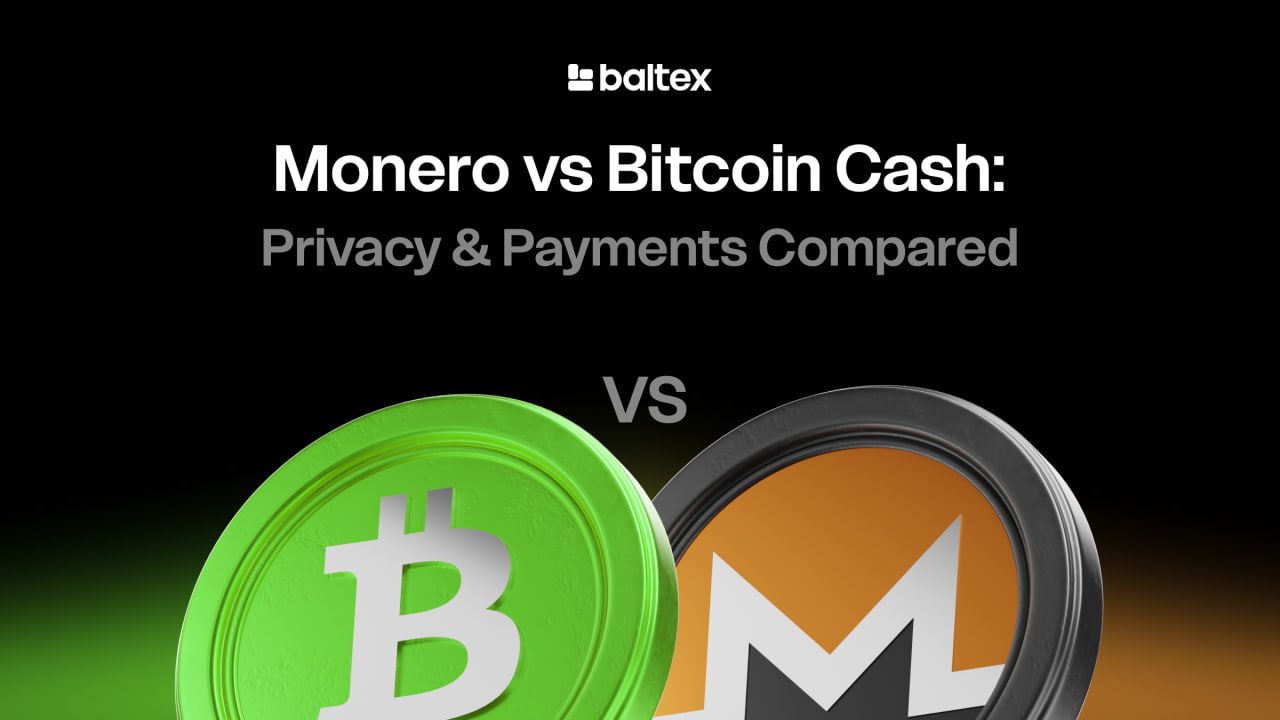
Monero vs Bitcoin Cash: Privacy & Payments Compared
TL;DR
Monero delivers mandatory protocol-level privacy with zero user configuration while Bitcoin Cash prioritizes fast, cheap on-chain payments with optional CashFusion mixing. In 2026 Bitcoin Cash wins for everyday merchant transactions and micro-payments thanks to 32 MB blocks and sub-cent fees. Monero excels wherever true unlinkability matters but faces more regulatory friction and lower mainstream adoption. Baltex.io lets users route between BCH and XMR in one non-custodial step to combine BCH liquidity with Monero privacy exactly when needed.
Both coins position themselves as digital cash yet solve the problem from opposite directions. Bitcoin Cash forked from Bitcoin to enable larger blocks and practical spending without Layer 2 complexity. Monero was built from the ground up to hide every transaction detail by default.
The practical differences appear clearest when you actually send money or accept payments. One coin keeps your financial life invisible while the other offers speed and familiarity that merchants already understand.
Feature Comparison
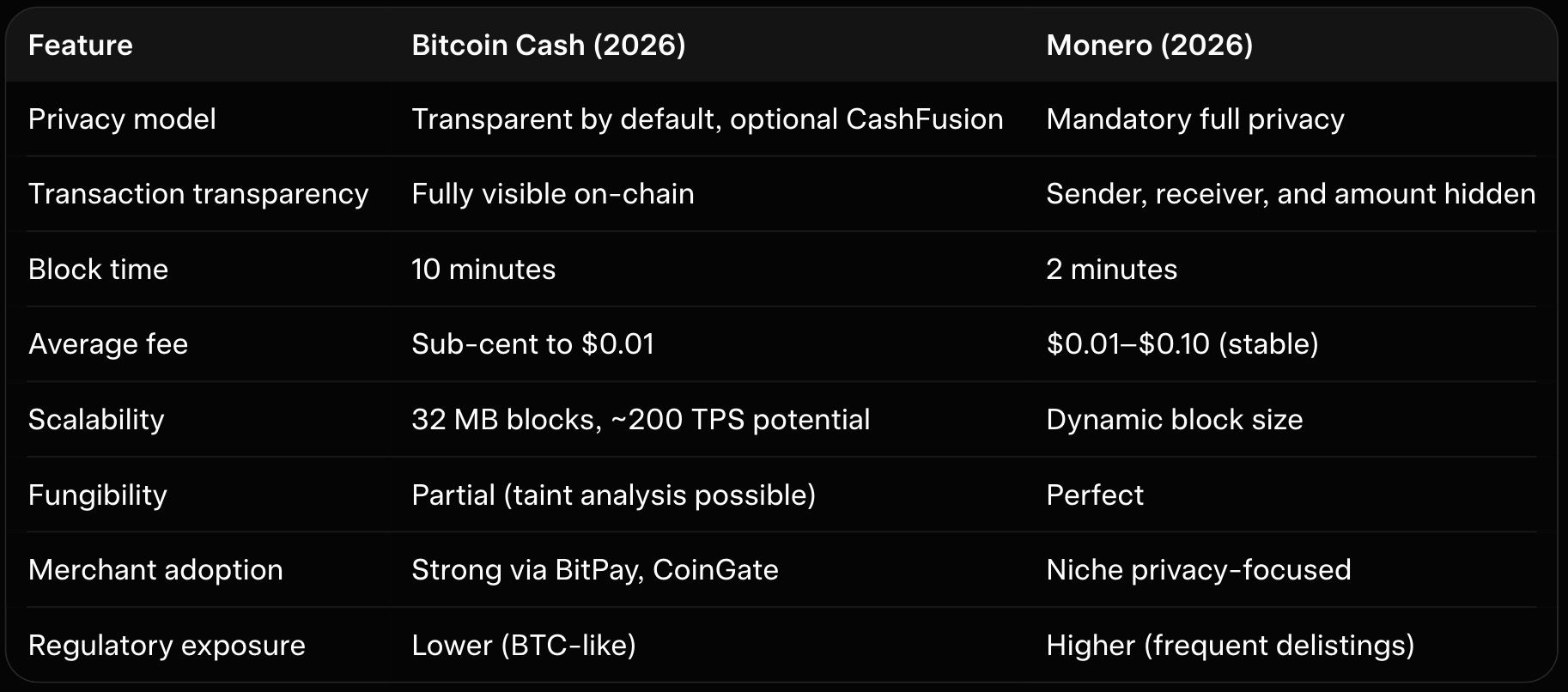
The table reveals the core trade-off users face daily. Bitcoin Cash feels like improved Bitcoin for payments. Monero feels like true private cash that protects every user automatically.
Bitcoin Cash transactions remain fully traceable like Bitcoin unless users activate CashFusion mixing. Monero’s ring signatures, stealth addresses, and RingCT hide everything without any extra steps. This mandatory design eliminates accidental leaks that still plague optional privacy tools.
Privacy in Everyday Payments
Monero protects every sender and receiver by default so no one can link transactions across the chain. Recent FCMP++ upgrades expanded anonymity sets further without slowing the network. The result is consistent unlinkability even for high-volume users.
Bitcoin Cash relies on CashFusion for privacy which blends inputs in a decentralized pool but requires active participation. Many users skip it for speed and lower fees leaving transactions public. This opt-in approach creates larger anonymity sets only when enough people mix but leaves most activity exposed.
Transaction Speed and Confirmation Times
Bitcoin Cash confirms blocks every ten minutes with zero-confirmation acceptance common for small merchant payments. The large block size prevents congestion so transactions clear quickly even during peaks. Users experience near-instant finality for everyday spending once the merchant trusts the broadcast.
Monero produces blocks roughly every two minutes and recommends ten confirmations for full privacy guarantees. The shorter block time gives faster initial visibility but the privacy overhead adds slight confirmation delay compared to transparent chains. Both coins remain fast enough for most real-world payments yet Bitcoin Cash edges out for point-of-sale speed.
Fees and Cost Efficiency for Payments
Bitcoin Cash maintains sub-cent fees consistently because 32 MB blocks absorb high demand without bidding wars. This makes micro-payments and remittances practical in regions where traditional banking fees eat profits. Merchants appreciate the predictability that encourages broader acceptance.
Monero keeps fees low and stable through dynamic block sizing that adjusts automatically. The cost stays under ten cents even for complex private transactions. Our best no-KYC Monero swappers overview highlights how predictable fees encourage frequent routing between privacy and payment-focused chains.
Scalability and Network Capacity
Bitcoin Cash scales directly on-chain by allowing massive blocks that handle growing transaction volume without Layer 2 solutions. The design targets everyday global payments rather than store-of-value speculation. Recent upgrades continue to refine efficiency for merchant workloads.
Monero scales through adaptive block weights that expand when needed while preserving privacy. The network processes thousands of transactions daily without congestion and recent protocol improvements reduced transaction sizes further. Both approaches avoid the complexity of Lightning-style channels yet serve different priorities.
Merchant Adoption and Real-World Payment Use Cases
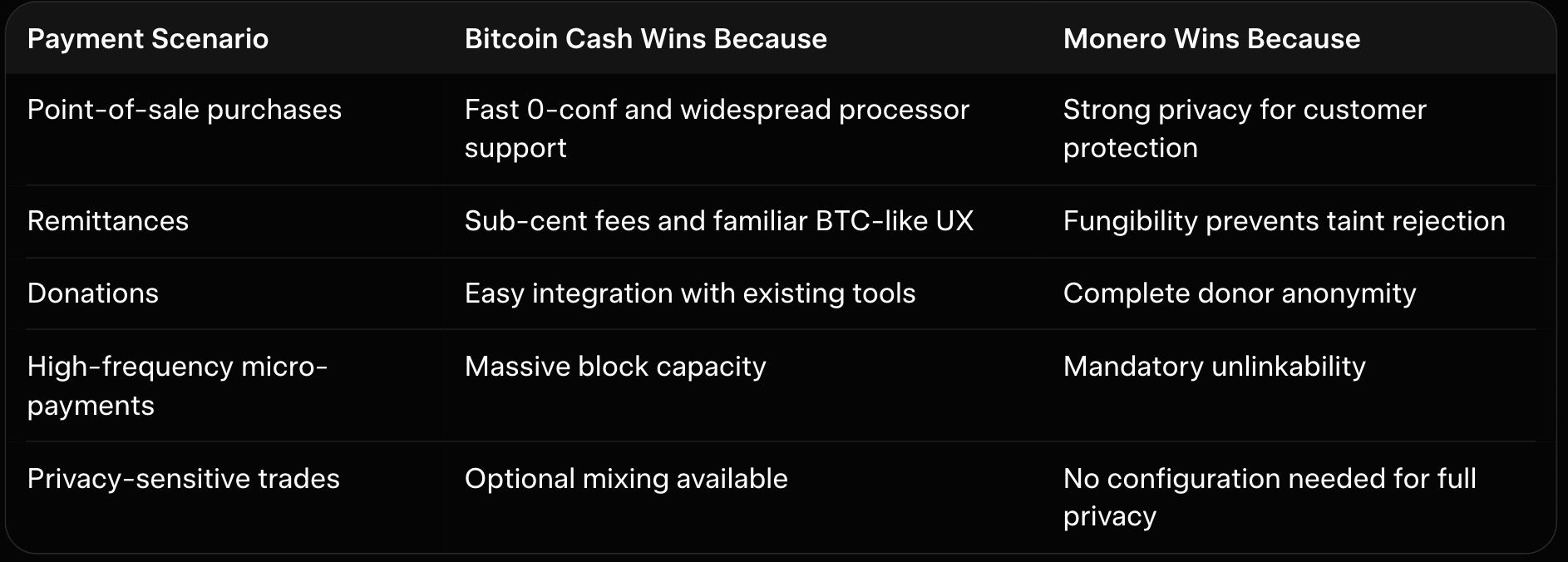
This table shows where each coin shines in practice. Bitcoin Cash powers real merchant flows today. Monero dominates wherever users refuse any traceability.
Bitcoin Cash benefits from payment processors like BitPay and CoinGate that already integrate with thousands of merchants worldwide. The coin’s similarity to Bitcoin lowers the learning curve for businesses. Monero sees adoption mainly in privacy-first niches such as certain marketplaces and donation platforms where fungibility matters more than mainstream listing.
Real-World Trade-Offs in 2026
Bitcoin Cash offers the practical payment experience many users want without forcing privacy compromises on every transaction. Its transparent nature reduces regulatory friction and keeps it listed on more exchanges. The coin works best when speed and low cost outweigh the need for complete anonymity.
Monero delivers the privacy that Bitcoin Cash cannot match yet faces ongoing delisting pressure and lower liquidity in some regions. Users who value fungibility and unlinkability accept the trade-off gladly. Many sophisticated holders keep both assets and switch between them depending on the situation.
How Baltex.io Enables Routing Between BCH and XMR
When users need Bitcoin Cash liquidity for merchant payments but want Monero privacy for sensitive transfers they face a classic dilemma. Baltex.io solves it by accepting direct deposits from either coin and delivering the output to a fresh address on the other chain in one non-custodial transaction. You choose BCH to XMR or XMR to BCH, send from your wallet, and enable Private Swap mode for additional shielded routing that enhances privacy.
The entire process stays wallet-to-wallet with no accounts or KYC required. Funds arrive clean and ready whether you convert Bitcoin Cash spending power into Monero unlinkability or move private holdings back to BCH for easy merchant acceptance. For readers of our best no-KYC Monero swappers overview, Baltex.io ranks highest for seamless privacy-to-payment bridging.
Traders route Bitcoin Cash holdings into Monero before high-privacy donations and back again for everyday spending on Lightning or merchant rails. The workflow completes in minutes and integrates with any wallet including mobile options. Our Trocador review and StealthEX review compare similar services yet Baltex.io excels for true one-click routing between these complementary payment coins.
Businesses accepting Bitcoin Cash payments route excess inflows through Baltex.io into Monero for private treasury management while keeping receive addresses isolated. The non-custodial design ensures full key control throughout. Our best P2P Monero exchanges guide adds extra off-ramp options that pair naturally with this cross-chain flow.
Advanced Routing Tips with Baltex.io
Use fresh subaddresses on Monero and standard BCH addresses before sending to Baltex.io for clean separation. Test small amounts first to verify output destinations and timing. Combine with hardware wallets for larger moves to keep long-term keys offline.
Our hardware wallet for Monero guide and Monero wallet security best practices help users layer extra protection on top of these routed transactions.
Conclusion
Monero and Bitcoin Cash both aim to be usable digital cash yet deliver on that promise in fundamentally different ways. Bitcoin Cash provides the fast, cheap, merchant-friendly payments that everyday users and businesses crave while Monero guarantees the privacy and fungibility that many now consider essential. Understanding these real-world trade-offs lets you choose the right tool for each situation rather than forcing one coin to do everything.
Many holders keep both assets and route intelligently between them as needs change. Bitcoin Cash handles the visible spending layer while Monero protects the sensitive transfers. When the moment arrives to move value across chains, our best no-KYC Monero swappers overview shows exactly why Baltex.io belongs in every payment-focused workflow.
For deeper wallet strategies explore our best Monero mobile wallets guide, the Cake Wallet review, or the hardware wallet for Monero guide. The crypto payments landscape rewards those who match each coin to its true strengths and route seamlessly between them. Your money stays yours to spend privately or publicly exactly as you intend.
Related reading: SimpleSwap Review 2026: Pros, Cons, and Monero Exchange Fees.
We cover this in more detail in Aztec Network: Best for Programmable Private Smart Contracts.
We cover this in more detail in XMR.to Alternatives: How to Pay Bitcoin Invoices with Monero.
You can read our full breakdown in Zcash (ZEC) vs Monero (XMR): Which Privacy Coin Wins in 2026.