 3 minutes to read
 Ecosystem
Monero vs Dash: Is PrivateSend Really Private?
TL;DR
Monero’s mandatory privacy model hides every transaction by default in 2026 while Dash’s optional PrivateSend (now framed as CoinJoin) requires users to activate mixing manually. This single design difference creates stronger anonymity guarantees and lower traceability risks for Monero but gives Dash faster InstantSend confirmations and broader merchant appeal. Most users benefit from both coins and route between them via Baltex.io to combine privacy and payment speed exactly when needed.
Monero and Dash both market themselves as digital cash yet deliver fundamentally different privacy experiences. Dash evolved from Bitcoin with a focus on speed and usability while adding optional mixing through masternodes. Monero was built from the ground up to enforce privacy on every single transaction without user intervention.
The practical consequences appear clearest when you send money to a friend, pay a freelancer, or trade privately. One coin protects every payment automatically. The other offers convenience at the cost of optional protection that many users forget to enable.
Privacy Model Comparison
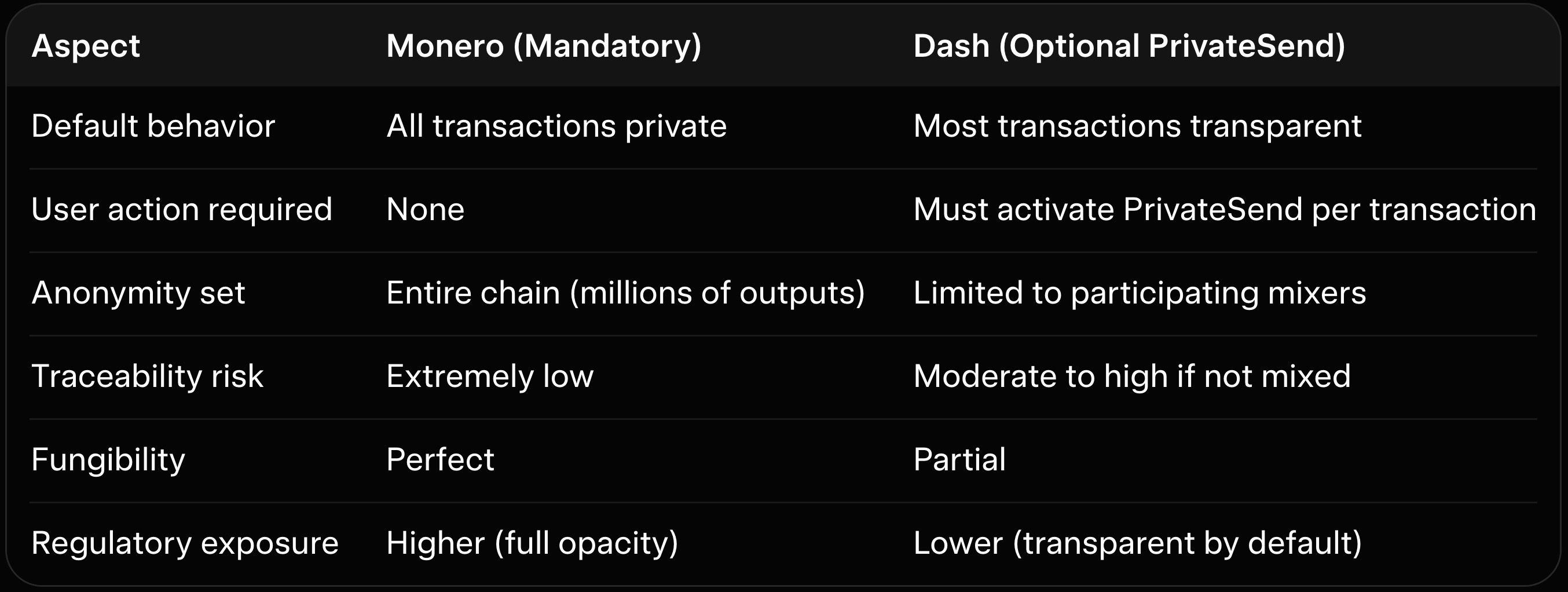
The table shows why mandatory privacy changes everything in practice. Monero eliminates user error and accidental leaks. Dash’s optional model creates a two-tier system where privacy depends entirely on individual choices.
Monero uses ring signatures, stealth addresses, and RingCT to make every transaction unlinkable by design. The 2026 FCMP++ upgrade expanded anonymity sets to the entire chain so statistical attacks become nearly impossible. No user ever has to remember to activate privacy.
Dash relies on CoinJoin-style mixing coordinated by masternodes. Users must wait for sufficient participants and actively choose PrivateSend for each transaction. The result is decent obfuscation when used but leaves most activity traceable and vulnerable to taint analysis.
Traceability Risks in Real Payments
Monero transactions cannot be traced even by sophisticated chain analysis firms because no public metadata exists. The mandatory design removes any possibility of accidental exposure through address reuse or transparent flows. This gives users genuine plausible deniability in real-world P2P or merchant scenarios.
Dash transparent transactions are as traceable as Bitcoin and many users still default to them for lower fees or faster confirmations. Even PrivateSend transactions can be linked if users reveal view keys or move funds in and out of unmixed addresses. The optional model creates ongoing traceability risks that Monero simply does not have.
Anonymity Guarantees and Network Effects
Monero’s anonymity set includes every output on the entire blockchain because privacy is mandatory. This creates massive mixing that protects even the smallest transactions. Recent protocol upgrades pushed effective anonymity to millions of possible outputs for every spend.
Dash’s anonymity set is limited to the pool of users who actively participate in PrivateSend at the same moment. While the mixing is cryptographically sound the smaller pool and optional nature make statistical analysis easier over time. Users who frequently skip PrivateSend further reduce their own privacy.
Fees, Speed, and Payment Practicality
Monero maintains consistently low and predictable fees through dynamic block sizing that adapts to demand. The cost stays under ten cents for typical private transactions even during network peaks. This stability encourages frequent use without users worrying about privacy premiums.
Dash offers near-zero fees and InstantSend confirmations that settle in under two seconds. The network handles real merchant volume without congestion thanks to its focus on practical payments. Merchants appreciate the speed and predictability that feel like traditional card processing.
Real-World Usage and Outcomes
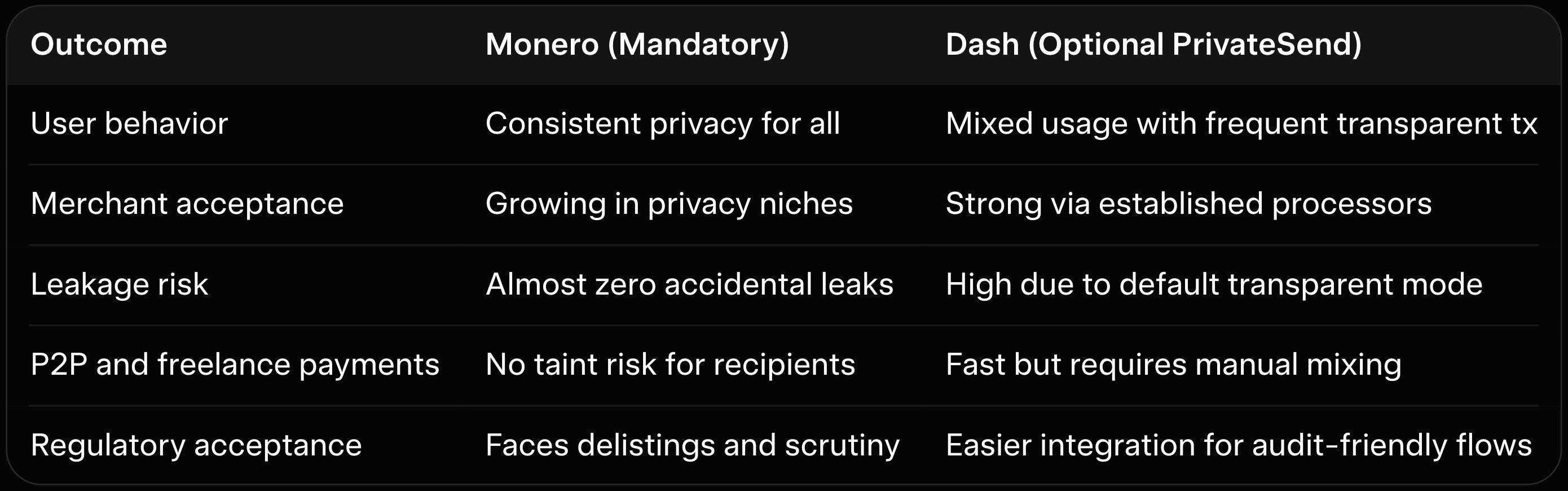
This table summarizes the practical consequences of each model in 2026. Monero creates a uniform privacy environment that protects everyone equally. Dash offers flexibility that many merchants prefer but at the cost of fragmented protection.
Monero users never have to learn privacy best practices because the protocol enforces them automatically. The result is higher overall network privacy and fewer mistakes. Dash users must actively manage PrivateSend versus transparent flows which leads to inconsistent protection across the ecosystem.
Is PrivateSend Really Private?
Dash provides optional privacy that improves obfuscation for those who use PrivateSend consistently. However it falls short of Monero’s mandatory model because most transactions remain transparent and mixing depends on network participation. Chain analysis can still deanonymize unmixed or poorly mixed flows more easily than on Monero.
Many users who once viewed Dash as a privacy coin now treat it primarily as fast digital cash with an optional mixing feature. The 2026 narrative around privacy coins has shifted toward coins that deliver anonymity by default. Dash excels at payments but does not match Monero when true unlinkability is the priority.
How Baltex.io Enables Routing Between DASH and XMR
P2P traders and merchants often need Dash’s speed and merchant acceptance for one transaction and Monero’s privacy for the next. Baltex.io integrates directly by accepting deposits from either coin and delivering the output to a fresh address on the other chain in one non-custodial transaction. You generate the outgoing payment in your wallet, send it to a Baltex deposit address, and the platform routes privately without ever seeing your keys.
Enable Private Swap mode for extra shielded Monero legs that further obscure origins before funds reach a Dash address or vice versa. The entire process completes in minutes and works with any wallet including mobile options. For readers of our best no-KYC Monero swappers overview, Baltex.io ranks highest when routing between transparent speed and mandatory privacy.
Freelancers receive Dash payments and route them instantly into Monero for private savings. Traders settle deals in Monero and convert to Dash for quick exchange withdrawals. Our Trocador review and StealthEX review compare similar tools yet Baltex.io excels for true one-click routing between these complementary assets.
Small P2P businesses pipe inbound Dash through Baltex.io into Monero for private treasury management while keeping receive addresses isolated. The non-custodial design ensures full key control throughout. Our best P2P Monero exchanges guide adds extra off-ramp options that pair naturally with this cross-coin flow.
Advanced Routing Tips with Baltex.io
Activate PrivateSend on Dash and use fresh subaddresses on Monero before sending to Baltex.io for maximum separation. Test small amounts first to confirm output destinations and timing. Combine with hardware wallets for larger trades to keep long-term keys offline.
Our hardware wallet for Monero guide and Monero wallet security best practices help users layer extra protection on top of these routed transactions. Our best Monero mobile wallets guide and Cake Wallet review guide wallet choice for efficient cross-coin management.
Conclusion
Monero’s mandatory privacy and Dash’s optional PrivateSend represent two valid but fundamentally different approaches to digital cash in 2026. Monero protects every user automatically and eliminates accidental leaks while Dash delivers faster payments and broader merchant acceptance at the cost of fragmented protection. The choice ultimately depends on whether you want ironclad default privacy or the speed and familiarity of optional mixing.
Start by evaluating your own priorities around traceability, merchant usability, and anonymity before deciding allocation. Many payment-oriented holders keep both coins and route between them as situations demand. When the time comes to move value across chains or into other assets, our best no-KYC Monero swappers overview shows exactly why Baltex.io belongs in every privacy-and-payments workflow.
For deeper wallet and security strategies explore our best Monero mobile wallets guide, the Cake Wallet review, or the hardware wallet for Monero guide. Privacy remains a personal choice and both coins deliver real value when matched to the right use case. Your funds stay yours to control with the right tools and routing options ahead.
For more on this, see our guide on SimpleSwap Review 2026: Pros, Cons, and Monero Exchange Fees.
For more on this, see our guide on Aztec Network: Best for Programmable Private Smart Contracts.
We cover this in more detail in XMR.to Alternatives: How to Pay Bitcoin Invoices with Monero.
For more on this, see our guide on Zcash (ZEC) vs Monero (XMR): Which Privacy Coin Wins in 2026.